Zellige: The Thousand-Year History and Hidden Math Behind Morocco's Mosaic Tiles
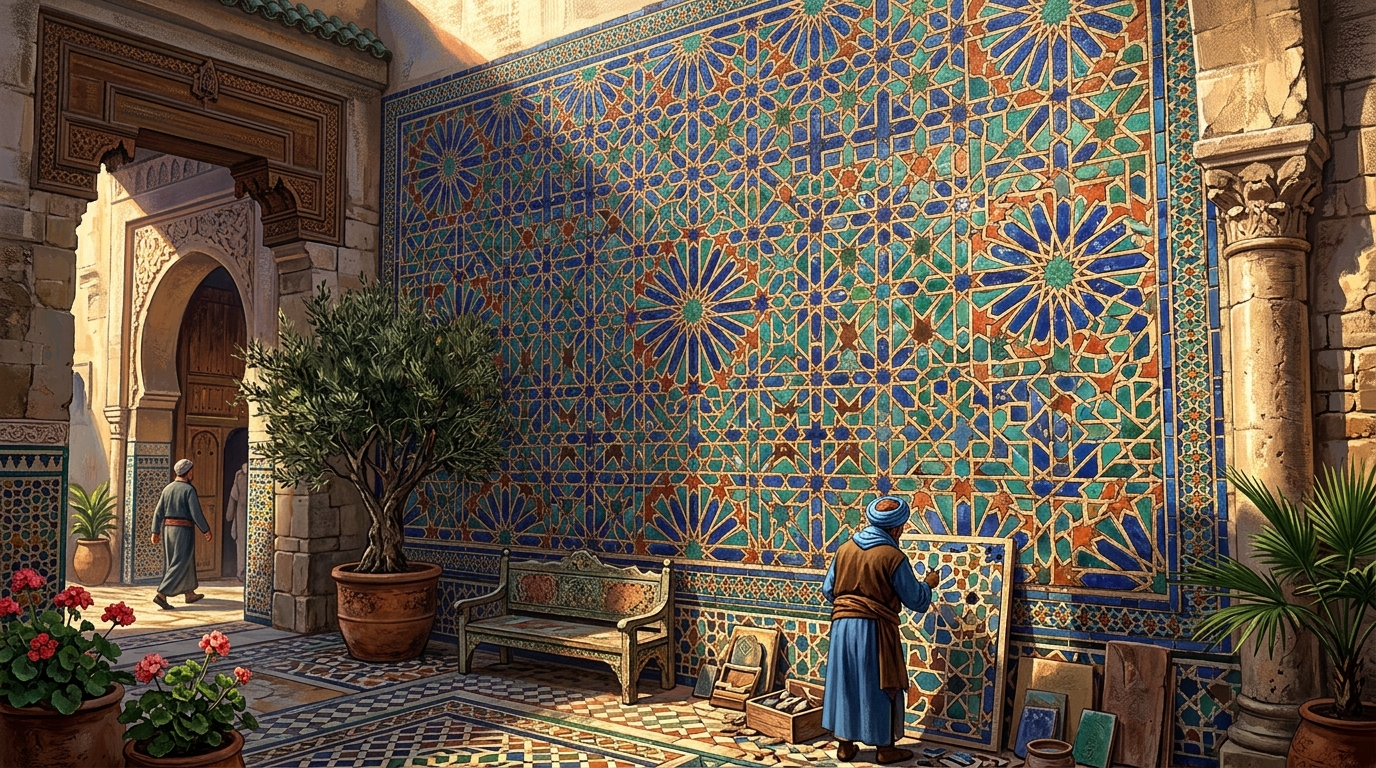
From 'to slide' to a national art form
The word zellige (also transliterated zellij) comes from the Arabic verb zalaja, meaning 'to slide' or 'to slip,' a reference to the smooth, glazed surface of the finished tile. The same Arabic root produced the Spanish and Portuguese word azulejo, the term still used across the Iberian Peninsula and Latin America for glazed decorative tile — a linguistic trail that maps almost exactly onto the historical spread of the craft itself, from North Africa into Al-Andalus and beyond.
The earliest confirmed roots of this kind of glazed geometric tilework reach back to the 10th and 11th centuries in the wider Maghreb: fragments from al-Mansuriyya in present-day Tunisia are dated to the mid-10th-century Fatimid or mid-11th-century Zirid period, and by the 11th century, sophisticated cross-shaped and eight-pointed star tiles appear at Qal'at Bani Hammad in Algeria. The earliest reliably dated Moroccan examples are found on the minarets of the Kutubiyya Mosque in Marrakesh, built in the mid-12th century — meaning zellige, as recognizably Moroccan architectural decoration, is now well over eight hundred years old.
Fez's dominance as the craft's production center is not an accident of prestige; it is geological. The city sits on deposits of a specific Miocene-era grey clay containing a precise mix of kaolinite and illite that makes it unusually well suited to producing dense, durable ceramic tile, which is a large part of why Fez became, and remains, zellige's undisputed capital rather than any of Morocco's other historic imperial cities.

The Marinid golden age
While the underlying mosaic techniques existed earlier, zellige's true golden age is generally dated to the Marinid dynasty, which ruled from Fez between the 13th and 15th centuries. The Marinids were prolific architectural patrons, and they used zellige extensively to decorate the theological colleges (madrasas), mosques and civic buildings that still define Fez's old medina today. The Bou Inania Madrasa, the Al-Attarine Madrasa and the Medersa Seffarine remain the clearest surviving showcases of Marinid-era zellige, with some wall panels featuring over 1,500 individual hand-cut pieces per square meter, worked in up to ten distinct colors.
This period coincided with a broader flourishing of complex geometric tilework across the western Islamic world, under the Marinids in Morocco, the Zayyanids in Tlemcen, Algeria, and the Nasrids in Granada, whose Alhambra palace remains one of the most famous examples of the same underlying artistic tradition outside Morocco itself, complete with mosaic fragments cut as narrow as two millimeters in the Mirador de Lindaraja. The craft continued to develop under later dynasties: the Saadians expanded its use significantly in the 16th century, and Sultan Moulay Ismail applied zellige extensively to the facades of his citadel complex in Meknes in the late 17th and early 18th centuries.
By the modern era, zellige had become one of the clearest visual markers of Moroccan national identity in architecture — visible as recently as the 1913 construction of Fez's Bab Bou Jeloud gate, and carried forward into contemporary landmark buildings including the Hassan II Mosque in Casablanca, which uses traditional zellige techniques set to an expanded modern color palette.

The geometry: why the patterns never really end
Zellige's geometric patterns are not simply decorative flourish; they are built on strict mathematical principles of symmetry, tessellation and the division of the circle into equal parts, the same underlying geometry that produces Islamic star patterns across the wider Muslim world from Spain to Central Asia. Every star, cross and polygon shape in a zellige panel is derived from a small set of base grids, repeated and interlocked so that the pattern could, in principle, extend infinitely in every direction without ever needing to repeat identically.
That mathematical structure carries deliberate religious and philosophical weight. In Islamic artistic tradition, the endlessly repeating, non-figurative geometric pattern is widely understood as a visual expression of tawhid — the oneness and infinite nature of God — precisely because figurative representation of living beings is traditionally avoided in religious architectural decoration. A zellige wall is not just beautiful; it is meant to gesture toward a concept of divine order and infinity that a finite, bounded image could never fully represent.
This is also why zellige craftsmen do not work from photographs or printed blueprints in the way a modern tiler might. A maalem carries hundreds of named pattern forms in memory, understands the underlying grid geometry well enough to adapt a pattern to an irregular wall, arch or dome, and applies that knowledge by hand, piece by piece — a combination of mason, geometric mathematician and cultural custodian that Morocco has actively worked to formally recognize and protect as intangible heritage.
How a single tile is actually made
The physical production process starts far from anything resembling a finished mosaic. Clay is molded into plain glazed squares, roughly 10 centimeters per side, then calibrated, dried and fired once before being glazed and fired again — the same basic ceramic tile production used for plain flooring anywhere in the world. The transformation into zellige happens only after that: a chain of specialist maalems, often three working in sequence, take the plain glazed squares and turn them into individual geometric pieces. The first selects the tile and marks the desired shape; the second roughly chisels the form using a small, medieval-style adze-hammer called a menqach; the third finalizes each piece with precise hand-cutting, leaving a thin band of exposed terracotta visible around the glazed edge of every finished piece.
Assembly is, in a real sense, the reverse of how you might expect a mosaic to be built: pieces are laid face-down in the intended pattern, checked and adjusted, then coated on the back with layers of plaster or whitewash before the whole assembled panel is lifted and set into a wall with mortar or grout. One regional variation is worth noting: in Tétouan, tiles are traditionally cut before firing rather than after, producing a harder, longer-lasting enamel at the cost of slightly duller color saturation compared to the Fez method.
Traditional zellige color palettes have expanded over the centuries but retain a recognizable core: cobalt blue, emerald green, white, black and mustard yellow dominate the medieval and early-modern palette, historically achieved using mineral pigments including iron oxides and chrome-based yellows, with brighter reds and additional blue tones entering the palette in later periods. Becoming a maalem capable of working confidently across this entire process — geometry, cutting, color, assembly — is not a short course: apprenticeships traditionally begin in childhood, around age six to fourteen, and last roughly a decade before a craftsman is considered a master.

A craft under real pressure
For all its cultural prestige, zellige craftsmanship in Morocco faces a genuine generational bottleneck. Reporting on Fez's craft schools found that, as of 2018, only seven out of four hundred students enrolled in a local training program had chosen to specialize in zellige, a stark number for a craft that requires roughly a decade of apprenticeship before a student can call themselves a maalem, and that offers, in an era of cheaper machine-made tile alternatives, an uncertain economic path compared to other trades.
That tension — a defining national art form up against a shrinking pipeline of new hand-craftsmen — is a central reason Morocco's Ministry of Youth, Culture and Communication formally launched a project in late 2025 to inscribe the zellige art of Fez and Tétouan on UNESCO's Representative List of the Intangible Cultural Heritage of Humanity, following the same protective path already used for the Moroccan caftan. The tiles on the wall of a centuries-old madrasa are not at risk; the specific, embodied human knowledge required to cut a new one exactly the same way is the part genuinely under pressure, and a formal heritage listing is aimed squarely at safeguarding that knowledge rather than the objects it has already produced.
None of that has dimmed zellige's international profile. Contemporary architects and interior designers worldwide now specify 'zellige-style' tile for kitchens, bathrooms and feature walls far outside Morocco, and authentic hand-cut Moroccan zellige has become a premium global export in its own right. The gap between that global demand and the shrinking domestic base of trained maalems is, if anything, the central story of zellige's next chapter — a thousand-year-old geometric tradition trying to make sure its very specific, very human production process survives contact with a world that increasingly wants the look without necessarily preserving the decade of training behind it.
The UNESCO nomination effort has also become entangled with a cultural ownership dispute between Morocco and Algeria, after Algeria separately sought international recognition for zellige as part of its own heritage. Morocco's government response — filing an official complaint and accelerating its own nomination through direct engagement with UNESCO's culture division — treats the question of who gets credited for originating and sustaining the craft as inseparable from the question of who is actually still training the next generation of maalems to practice it.
Frequently asked
What does the word 'zellige' mean?
It comes from the Arabic verb zalaja, meaning 'to slide' or 'to slip,' referring to the smooth, glazed surface of the tile. The same Arabic root produced the Spanish and Portuguese word azulejo.
Where did zellige originate?
The earliest related glazed geometric tilework is dated to the 10th-11th centuries in Tunisia and Algeria. The earliest reliably dated Moroccan examples are on the Kutubiyya Mosque minarets in Marrakesh, built in the mid-12th century.
When was zellige's golden age in Morocco?
Under the Marinid dynasty, which ruled from Fez between the 13th and 15th centuries and used zellige extensively to decorate madrasas like Bou Inania and Al-Attarine, with panels reaching over 1,500 hand-cut pieces per square meter.
Why is Fez the center of zellige production?
Fez sits on deposits of a specific grey clay rich in kaolinite and illite that is especially well suited to producing dense, durable ceramic tile, giving the city a geological as well as historical advantage as the craft's production center.
Who makes zellige tiles?
Master craftsmen called maalems, who traditionally begin training as children (around age 6 to 14) and complete roughly a decade of apprenticeship before being considered masters of the craft.
How is a zellige mosaic actually made?
Plain glazed clay squares are fired, then hand-chiseled into geometric shapes using a small adze-like tool called a menqach, often by a sequence of specialist craftsmen. The finished pieces are assembled face-down in the intended pattern, coated on the back with plaster, then set into a wall with mortar.
What do the geometric patterns in zellige symbolize?
The repeating, non-figurative geometric patterns are widely understood in Islamic artistic tradition as a symbolic expression of tawhid, the infinite and unified nature of God, reflecting divine order through mathematics rather than pictorial imagery.
What colors are traditionally used in zellige?
The core traditional palette includes cobalt blue, emerald green, white, black and mustard yellow, historically produced using mineral pigments such as iron oxides, with reds and additional blues added in later periods.
Is zellige craftsmanship at risk today?
Yes, to a degree. As of 2018, reporting found only seven of four hundred students in a Fez craft school had chosen to specialize in zellige, reflecting concern about generational continuity for a craft requiring roughly a decade of training.
Where can you see historic zellige today?
Major examples include the Bou Inania and Al-Attarine madrasas in Fez, the Kutubiyya Mosque in Marrakesh, the Saadian Tombs, Meknes's imperial architecture, and modern applications like the Hassan II Mosque in Casablanca.
- Wikipedia — Zellij ↗
- Zellijtiles.com — The History & Craft of Zellige ↗
- Omari Zellige — How Zellige Tiles Are Made ↗
- TAP.ma — Moroccan Mosaic Art: The Complete Guide to Zellige ↗
- Morocco World News — Morocco Launches Project to Inscribe Fez, Tetouan Zellige Art on UNESCO Heritage List ↗
Video via official YouTube embeds; photos via Wikimedia Commons under their stated licenses. All rights belong to the respective owners; 212 Daily claims no ownership.