Yennayer: Inside the Amazigh New Year Morocco Now Celebrates as a Holiday
What Yennayer is, and when it falls
Yennayer is the name given to the first day, and by extension the whole New Year celebration, of the Amazigh calendar — the traditional agricultural calendar used historically by Amazigh (Berber) communities across Morocco, Algeria, Tunisia and Libya. Its date lines up with the old Julian calendar's New Year, which in the modern Gregorian calendar now falls around January 12 to 14, depending on the community and, since 2024, the officially designated date in Morocco.
The word's origin is genuinely debated among linguists rather than settled. One explanation traces Yennayer to the Amazigh roots yan ("one" or "first") and ayyur ("moon," and by extension "month"), reading it as "the first month." A rival and, according to some specialists, better-supported explanation traces it instead to the Latin Ianuarius — the Roman month of January, named for the god Janus — on the grounds that Latin month names were absorbed into North African speech in both Tamazight and Arabic during and after the Roman presence in the region, with the festival's roots tied to the Roman new year kalends. Both theories circulate, and neither is fully settled.
Because it tracks the Julian rather than Gregorian calendar, Yennayer traditionally fell on January 12 or 13 depending on the community and year. Morocco has since fixed it administratively at January 14, a choice explained below, though many families and rural communities continue to mark the day according to older local reckonings as well.
The Amazigh calendar's count: history, myth and a 1980 reconstruction
Yennayer celebrations are typically framed as marking a specific year number in the Amazigh calendar — for the January 2026 Yennayer, the year 2976. That count is genuinely tied to an ancient reference point: it dates from 950 BCE, the approximate year in which Shoshenq I, a ruler of Libyan Amazigh (Meshwesh) origin, is said to have ascended to the throne of pharaonic Egypt, founding Egypt's Twenty-second Dynasty — a real and historically documented monarch, making him one of the most significant Amazigh figures in ancient North African history.
It is important to be precise about what is and is not established here. The specific epoch year of 950 BCE was not handed down as a continuously used ancient count; it was formally proposed and popularized in 1980 by Ammar Negadi, an Algerian Amazigh scholar and activist, as part of a broader 20th-century movement to give Amazigh identity its own formal calendar to set alongside the Islamic and Gregorian calendars. Some of the folk retellings built around that date — including claims linking Shoshenq I's rise directly to a victory over Pharaoh Ramesses II — do not hold up historically, since Ramesses II's reign predates Shoshenq I's by roughly two centuries. The count is best understood, honestly, as a modern act of cultural commemoration anchored to a real ancient figure, rather than an unbroken calendar Amazigh communities have counted continuously for three thousand years.
None of that undercuts the underlying tradition, however: the seasonal celebration itself — tied to the agricultural calendar, the turn from one farming year to the next — is old and genuinely rooted in rural North African life, distinct from the specific numbering system now attached to it.
From folk festival to official holiday: Morocco's 2023-2024 decision
For most of Morocco's modern history, Yennayer was observed as a family and community tradition without any official status. That changed on May 3, 2023, when King Mohammed VI decided that the Amazigh New Year would become a national paid public holiday, putting it on par with the Islamic New Year (1st of Muharram) and January 1 on the Gregorian calendar. The decision was formalized through decrees (published in Morocco's Bulletin Officiel in December 2023) amending the kingdom's official list of paid holidays, and the first nationally recognized observance took place on January 14, 2024.
The choice of January 14 specifically, rather than the more traditional January 12 or 13, has been explained through a mix of practical and symbolic reasoning. Commentators have pointed to the scheduling convenience of spacing the new holiday a few days after Morocco's Independence Day on January 11, making longer bridged weekends possible in some years; to a deliberate choice not to align with January 13, the date more commonly used in neighboring Algeria, at a time of strained relations between the two countries; and to the fact that January 14 is where the old Julian calendar's New Year currently falls when measured against the modern Gregorian calendar, a gap that continues to widen slightly over time.
Whatever the precise mix of reasons, the substance of the decision was significant on its own terms: it marked the first time Yennayer carried the same paid, nationally mandated status in Morocco as the country's Islamic and international New Year holidays, following years of advocacy — including from members of parliament — for fuller state recognition of Amazigh culture and language, which was itself recognized as an official language of Morocco in the 2011 constitution.

Traditional foods: porridge, hidden pits and seven vegetables
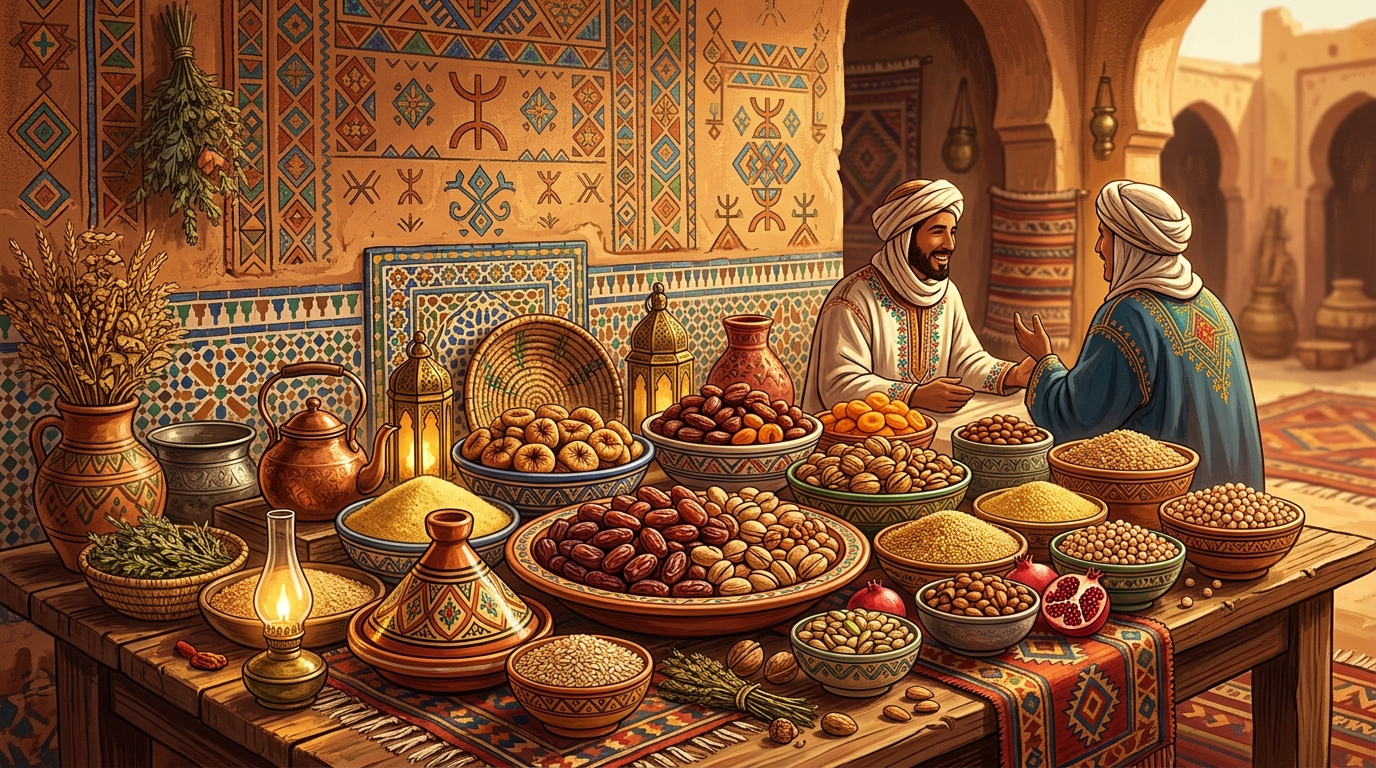
Food sits at the center of how Yennayer is actually celebrated in Moroccan households, and the dishes vary meaningfully by region. In much of the Middle and High Atlas, families prepare couscous with seven vegetables — commonly some combination of pumpkin, cabbage, courgette, carrot, onion, turnip and tomato — a dish so associated with the holiday in the southeastern oases of the Draa-Tafilalet region that Yennayer is sometimes referred to locally as sebaa khodra, literally "seven vegetables," with each vegetable said to represent a wish for the year ahead: prosperity, health, peace and so on.
In the Souss region of southern Morocco, a different dish carries the holiday's central ritual: tagoula (also called tarwayt), a thick, slow-cooked porridge of coarsely ground barley or corn semolina. A single date pit, called amnnaz, is hidden inside the pot before serving. Tradition holds that whoever finds the pit in their portion will be blessed with good fortune for the coming year — a small, playful piece of domestic fortune-telling built directly into the meal.
In High Atlas villages, a related dish called ourkimen (from the Amazigh irkm, referring to soaking) takes the place of tagoula: a hearty mix of seven kinds of soaked legumes and cereals — commonly lentils, broad beans, chickpeas, split peas and white beans among others — slow-cooked together and believed to help ensure abundance in the year ahead. Some families instead hide the lucky token in a mound of couscous layered with hard-boiled eggs and cinnamon rather than in a porridge, a variation on the same fortune-telling idea.

Regional variations across Morocco and the wider Amazigh world
Beyond food, Yennayer customs vary from valley to valley. Common threads include a first haircut for young boys, seen as marking growth into the new year; blessings and small rituals around marriage prospects; and agricultural rites in which children are sent to gather produce from the fields or family stores, a small enactment of the harvest the new farming year is meant to bring. The holiday is also known by different local names depending on the region — id Yennayer and id Suggas (roughly "the night of the year") both appear in Moroccan usage, alongside terms like haguza used in some communities.
The tradition extends well beyond Morocco's borders. Algeria recognized Yennayer as an official paid holiday earlier than Morocco did, generally observed there on January 12, which is part of why Morocco's choice of a separate January 14 date has been read as a small marker of national distinction between the two countries' otherwise very similar Amazigh new year traditions. Tunisia and Libya's Amazigh communities, considerably smaller as a share of the national population than in Morocco or Algeria, mark the occasion as well, generally with less state-level fanfare.
Across all these countries, the core shape of the celebration is consistent even as the specific dishes and rituals differ: a family gathering built around a special seasonal meal, an emphasis on agricultural renewal and good fortune for the year ahead, and — increasingly, in Morocco especially — a public dimension of concerts, school programs and municipal events layered on top of the older private, household-level customs.
Why the holiday status matters
The 2024 recognition of Yennayer as a paid public holiday landed as more than a scheduling change. For Amazigh activists and communities, who make up a substantial share of Morocco's population and who campaigned for decades for greater state recognition of Amazigh language and culture, it represented a concrete, materially meaningful acknowledgment — a day off work and school, treated by the state exactly as Islamic and Gregorian New Year holidays are treated, rather than a folkloric curiosity tolerated on the margins.
In practice, the first officially recognized Yennayer in January 2024 saw Moroccan schools run special lessons on Amazigh culture, municipalities organize concerts and exhibitions, and national television carry programming on the new year's traditions — a level of institutional attention that reflects Morocco's broader, gradual process of formally incorporating Amazigh identity into national life, a process that also includes Tamazight's recognition as an official language of the Moroccan constitution since 2011.
None of that erases the more grassroots, older layer of the celebration: the porridge with the hidden date pit, the couscous with seven vegetables, the first haircut, the small rituals repeated in homes across the Atlas and the Souss long before any decree gave the day a name on a government calendar. Yennayer's recent official status sits on top of that older tradition rather than replacing it — a modern political recognition of a genuinely old agricultural and cultural practice.
Frequently asked
What is Yennayer?
Yennayer is the Amazigh (Berber) New Year, marking the start of the traditional Amazigh agricultural calendar. It is celebrated across Morocco, Algeria, Tunisia and Libya, generally in mid-January, with family meals, folk rituals and, in Morocco since 2024, official public holiday status.
What date is Yennayer celebrated in Morocco?
Morocco officially fixed the paid public holiday at January 14 starting in 2024, though the traditional date, tied to the old Julian calendar, falls around January 12-13 and is still used by some communities.
Why is Yennayer called that?
The etymology is debated. One theory derives it from the Amazigh words yan ("first") and ayyur ("month"). Another, considered by some linguists better supported, traces it to the Latin Ianuarius (January), reflecting Roman calendar terms absorbed into North African speech.
What year is it in the Amazigh calendar?
The Amazigh calendar dates from 950 BCE, linked to the rise of the Amazigh-origin Egyptian pharaoh Shoshenq I, making the January 2026 Yennayer the start of year 2976. This specific dating system was formalized in 1980 by Algerian scholar Ammar Negadi rather than continuously counted since antiquity.
Is the Shoshenq I origin story historically accurate?
Partly. Shoshenq I was a real Amazigh-origin pharaoh who founded Egypt's Twenty-second Dynasty around 950 BCE. However, some popular versions of the legend, including claims he defeated Ramesses II, are not historically accurate, since Ramesses II's reign ended roughly two centuries before Shoshenq I's rise.
When did Morocco make Yennayer an official holiday?
King Mohammed VI decided on May 3, 2023, to make Yennayer a national paid public holiday, formalized by decree in Morocco's Bulletin Officiel in December 2023, with the first official observance on January 14, 2024.
Why did Morocco choose January 14 instead of January 12 or 13?
Explanations offered include convenient spacing after Morocco's January 11 Independence Day, a deliberate difference from Algeria's more common January 13 observance, and alignment with the Julian calendar's current gap from the Gregorian calendar.
What foods are traditionally eaten at Yennayer?
Common dishes include couscous with seven vegetables (sometimes called sebaa khodra), tagoula or tarwayt porridge from the Souss region with a hidden date pit (amnnaz) believed to bring luck to whoever finds it, and ourkimen, a High Atlas dish of seven soaked legumes and cereals.
What is the significance of the hidden date pit in tagoula?
A single date pit is hidden inside the cooked porridge before serving. Whoever finds it in their portion is traditionally considered blessed with good fortune for the coming year, a form of playful household fortune-telling built into the meal.
Is Yennayer celebrated outside Morocco?
Yes. It is observed across the wider Amazigh world, including Algeria (which recognized it as an official holiday earlier than Morocco, generally on January 12), Tunisia and Libya, with regional variations in customs, dishes and the level of official state recognition.
- Wikipedia — Yennayer ↗
- Life in Morocco — The choice of 14 January as the Yennayer public holiday ↗
- Morocco World News — Celebrating Yennayer: The Flavors of the Amazigh New Year in Morocco ↗
- Morocco World News — Aseggas Amaynou 2976: Yennayer, the Ancient Calendar That Counts Time the Amazigh Way ↗
- Morocco World News — MPs Urge Moroccan Government for Exceptional Extension of Amazigh New Year Holiday in 2024 ↗
- Nationalia — Amazigh New Year becomes Morocco's new bank holiday ↗
Video via official YouTube embeds; photos via Wikimedia Commons under their stated licenses. All rights belong to the respective owners; 212 Daily claims no ownership.