What Is a Guembri? Inside the Three-String Bass Lute That Drives Gnaoua Trance
What the guembri actually is
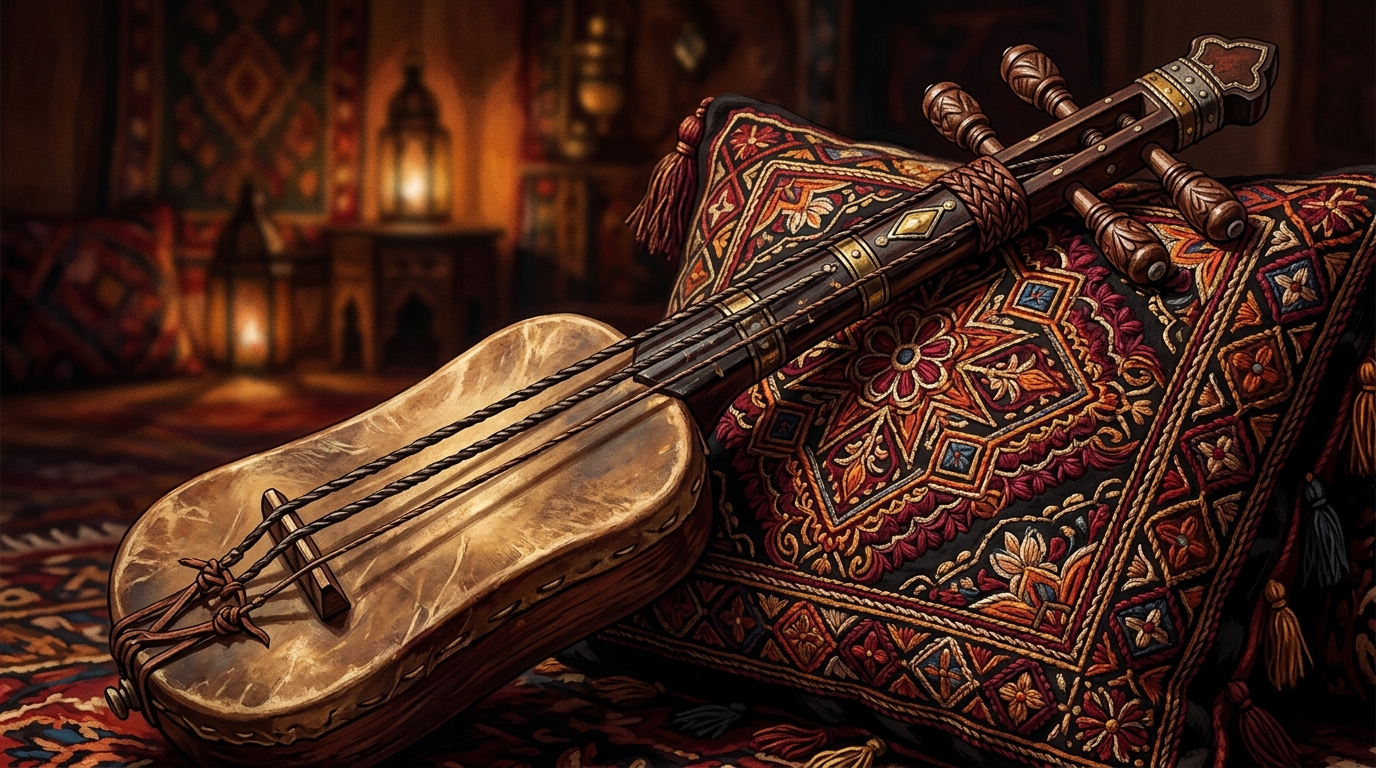
The guembri is a three-string, plucked lute with a long neck and a large, rounded, box-like body carved from a single log. Unlike an oud or a guitar, it has no frets and no soundhole in the conventional sense; instead the entire top of the body is covered with a taut skin membrane, traditionally camel or goat hide, stretched over the wood the way a drumhead is stretched over a shell. That skin is what gives the instrument its deep, slightly buzzing, unmistakably bass-forward tone.
Names vary by region and community: guembri and gimbri are the most common spellings, sintir is widely used as well, and hajhouj (also written hajhuj) appears in some Gnaoua lineages, particularly in the south. All refer to the same family of instrument, built and played the same essential way, though details of size, tuning and ornamentation can shift from one maâlem's workshop to the next.
Ethnomusicologists trace the guembri's lineage to West African plucked lutes carried north by enslaved sub-Saharan communities from at least the 15th and 16th centuries onward, part of the same trans-Saharan movement of people that shaped Gnaoua identity overall. That West African ancestry is also why some organologists consider the guembri family a distant relative of the banjo, which developed from related skin-topped lutes carried across the Atlantic by enslaved Africans in the Americas.
Outside formal Gnaoua ceremonies, itinerant guembri players have long been a familiar sight in Morocco's public squares, from Marrakech's Jemaa el-Fna to smaller town markets, performing shorter, informal sets for passersby rather than full overnight rituals. This street-performance tradition runs parallel to, and sometimes overlaps with, ceremonial Gnaoua practice, and it is often where visitors to Morocco first encounter the instrument's sound.


Construction: wood, skin and three strings
A guembri is built from a single hollowed block of wood, most often a soft, resonant wood chosen for its acoustic properties, carved into a long rectangular or slightly rounded body with a narrow neck rising from one end. The three strings, traditionally made of twisted gut or nylon fiber rather than metal, run from tuning pegs at the top of the neck, across a small bridge sitting directly on the skin membrane, down to an anchor point near the base of the body.
That bridge-on-skin arrangement is the key to the guembri's sound: because the strings' vibrations pass directly through the drum-like skin top rather than a rigid wooden soundboard, the instrument produces a thick, percussive, almost muted bass tone quite different from a conventional stringed instrument. Some players attach small metal plates or rings near the bridge, which rattle sympathetically against the skin to add a buzzing shimmer to certain notes, echoing the metallic clatter of the qraqeb castanets that perform alongside it.
The guembri is played resting across the player's lap or propped against the body, plucked directly with the fingers and thumb rather than with a pick, while the player often also strikes the skin body itself with the fingers of the same hand to add a percussive backbeat between plucked notes — effectively turning the instrument into a combined bass and drum in one.
Sizes vary by region and by the maker's own workshop practice, and a maâlem will often own more than one guembri, choosing a particular instrument for a particular ceremony or mood. Because the skin head is a natural material, it is sensitive to humidity and temperature, and many players warm the instrument gently near a fire or heater before a performance to tighten the skin and sharpen its tone — a small ritual of preparation that mirrors the broader ceremonial care given to the instrument.
The guembri inside the lila and derdeba ceremony
The guembri's primary traditional context is the lila, also known as derdeba: an all-night Gnaoua ceremony intended to invoke a set of spiritual entities (mluk), each tied to specific colors, incense and rhythmic patterns, and to guide participants into a healing trance state called jedba. In this setting the maâlem leads on guembri while singing call-and-response verses, working alongside a moqadma (or shuwafa), the ritual guide responsible for incense, colors and the ceremonial objects the ritual requires.
Alongside the guembri, the second essential sound of the ceremony is the qraqeb: a pair of heavy iron castanets, one held in each hand, that snap out fast, driving cross-rhythms over the guembri's steady bass pulse. Where the guembri anchors the harmonic and rhythmic foundation, the qraqeb supply the sharp, metallic energy that pushes a room from music into trance. Larger tbel drums are sometimes added as well, particularly in outdoor or festival settings.
UNESCO recognized this entire complex of practice, instruments and ritual — Gnaoua music broadly, not the guembri in isolation — by inscribing it on the Representative List of the Intangible Cultural Heritage of Humanity in December 2019, citing its role as a spiritual and communal practice as much as a musical genre.
Within the lila, the guembri's repertoire is organized around specific mluk, spirits each associated with their own songs, colors and incense, performed in a set order as the night progresses. A maâlem must know dozens of these pieces by heart, along with the order in which they are traditionally performed, since the ceremony's structure — not just its individual songs — is considered essential to its spiritual effectiveness.
Playing technique and the role of the maâlem
Becoming a guembri maâlem is not a matter of a few lessons. In many Gnaoua lineages the role is passed down within families or brotherhoods, with apprentices absorbing repertoire, ceremonial knowledge and technique over years of watching and gradually taking on small roles at real lilas before ever leading one themselves. The guembri itself is often treated with a degree of reverence beyond an ordinary instrument, blessed or ritually prepared before being put into ceremonial use.
Technically, the maâlem alternates between a small number of core basslines — recognizable, cyclical patterns tied to specific mluk (spirits) and their associated songs — and rapid ornamented runs that signal transitions within the ceremony. Because the guembri has only three strings and no frets, its pitch vocabulary is deliberately restricted compared to instruments like the oud; the power of the playing comes from rhythmic drive, tone and repetition rather than harmonic complexity, which is precisely what makes it so effective at inducing trance over long stretches of time.
Contemporary maâlems such as Hamid El Kasri have carried this technique onto international stages, performing at the Gnaoua World Music Festival in Essaouira — held annually since 1998 — alongside musicians from jazz, rock and blues backgrounds, while others, like the late Mahmoud Guinia (1951-2015), collaborated directly with visiting Western artists and helped introduce the guembri's sound to global audiences.

From ritual instrument to global sound
The guembri's move beyond ceremonial settings accelerated from the late 20th century onward, as Gnaoua troupes began performing publicly at festivals and collaborating with touring international musicians. Visiting artists across jazz, rock and blues have long been drawn to the guembri's hypnotic bass patterns, and its low-end, cyclical style has been cited as an influence on some Western musicians exploring African-rooted grooves, cementing the instrument's reputation as a genuine bridge between Moroccan ritual music and global popular music.
That crossover appeal has only grown with contemporary fusion acts. Groups such as Bab L'Bluz build their entire sound around an amplified, guitar-like adaptation of the guembri, pairing it with blues and rock songwriting, while Marrakech-born hip-hop group Fnaire layer rap verses over Gnaoua-rooted guembri basslines and local percussion. None of this has displaced the instrument's ceremonial role — lilas continue much as before — but it means the guembri now has two lives: one inside the overnight ritual it was built for, and one on festival stages from Essaouira to Europe and beyond.
For newcomers to the sound, the easiest way in is simply to listen for the instrument's role: rather than picking out a melody the way a guitar or violin might, listen for the guembri as the steady, breathing foundation everything else in a Gnaoua performance — voice, qraqeb, dance — is built on top of. Once that low pulse becomes recognizable, it is easy to hear echoes of it well beyond Morocco, in any music built around a repeating, hypnotic bass figure meant to carry a room somewhere it could not get to on its own, whether that room is a candlelit courtyard in Essaouira or a festival stage thousands of miles away.
Frequently asked
What is a guembri?
A guembri is a three-string bass lute at the center of Moroccan Gnaoua music, with a wooden body covered in camel or goat skin, plucked to produce a deep, buzzing bass tone that anchors the rhythm and harmony of a performance.
What is the difference between a guembri, a sintir and a hajhouj?
These are regional names for essentially the same instrument family. Guembri and gimbri are the most widely used spellings, sintir is common as well, and hajhouj (or hajhuj) appears in some Gnaoua lineages. Construction and playing style are the same across the names.
What is the guembri made of?
The body is carved from a single hollowed block of wood and topped with a stretched animal skin, traditionally camel or goat hide, which the bridge rests directly on. The three strings are traditionally gut or nylon fiber rather than metal.
How is the guembri played?
It is plucked directly with the fingers and thumb while resting on the player's lap or against the body, often combined with percussive taps on the skin body itself, letting one musician provide both bass line and drumbeat simultaneously.
What is the guembri's role in a lila or derdeba ceremony?
In a lila (also called derdeba), an all-night Gnaoua healing ceremony, the maâlem (master musician) leads on guembri, providing the harmonic and rhythmic foundation while singing call-and-response verses that help guide participants into a trance state known as jedba.
What is the qraqeb and how does it relate to the guembri?
The qraqeb are heavy iron castanets played in pairs, one per hand, that snap out fast cross-rhythms over the guembri's steady bass pulse. Together the two instruments form the essential sound of a Gnaoua ceremony, bass and metal percussion combined.
Where does the guembri come from historically?
The instrument's lineage traces to West African plucked lutes, carried to Morocco by sub-Saharan communities brought north through the trans-Saharan trade, particularly from the 15th and 16th centuries onward. It shares ancestry with other skin-topped African lutes, including instruments considered ancestral to the banjo.
Who becomes a guembri maâlem?
The role is typically passed down within Gnaoua families or brotherhoods, with apprentices learning repertoire, ceremonial knowledge and technique over years before leading ceremonies themselves. The instrument itself is often treated with ritual respect beyond its function as a piece of equipment.
Is Gnaoua music, and the guembri, internationally recognized?
Yes. UNESCO inscribed Gnaoua as a whole on its Representative List of the Intangible Cultural Heritage of Humanity in December 2019, and the guembri is regularly showcased at the Gnaoua World Music Festival in Essaouira, held annually since 1998.
How has the guembri influenced modern music?
Contemporary fusion acts have adapted the guembri for new contexts: Bab L'Bluz build songs around an amplified version of the instrument fused with blues and rock, while groups like Fnaire layer rap over traditional guembri basslines, extending the instrument's reach well beyond ceremonial Gnaoua settings.
- Wikipedia — Sintir ↗
- Wikipedia — Gnawa music ↗
- UNESCO — Gnawa, Intangible Cultural Heritage of Humanity ↗
- Afropop Worldwide — Field Report: The Gnawa World Music Festival in Essaouira ↗
- Festival Gnaoua — Maâlem Hamid El Kasri, artist profile ↗
Video via official YouTube embeds; photos via Wikimedia Commons under their stated licenses. All rights belong to the respective owners; 212 Daily claims no ownership.