Tifinagh: Inside the Ancient Amazigh Script Now on Morocco's Road Signs
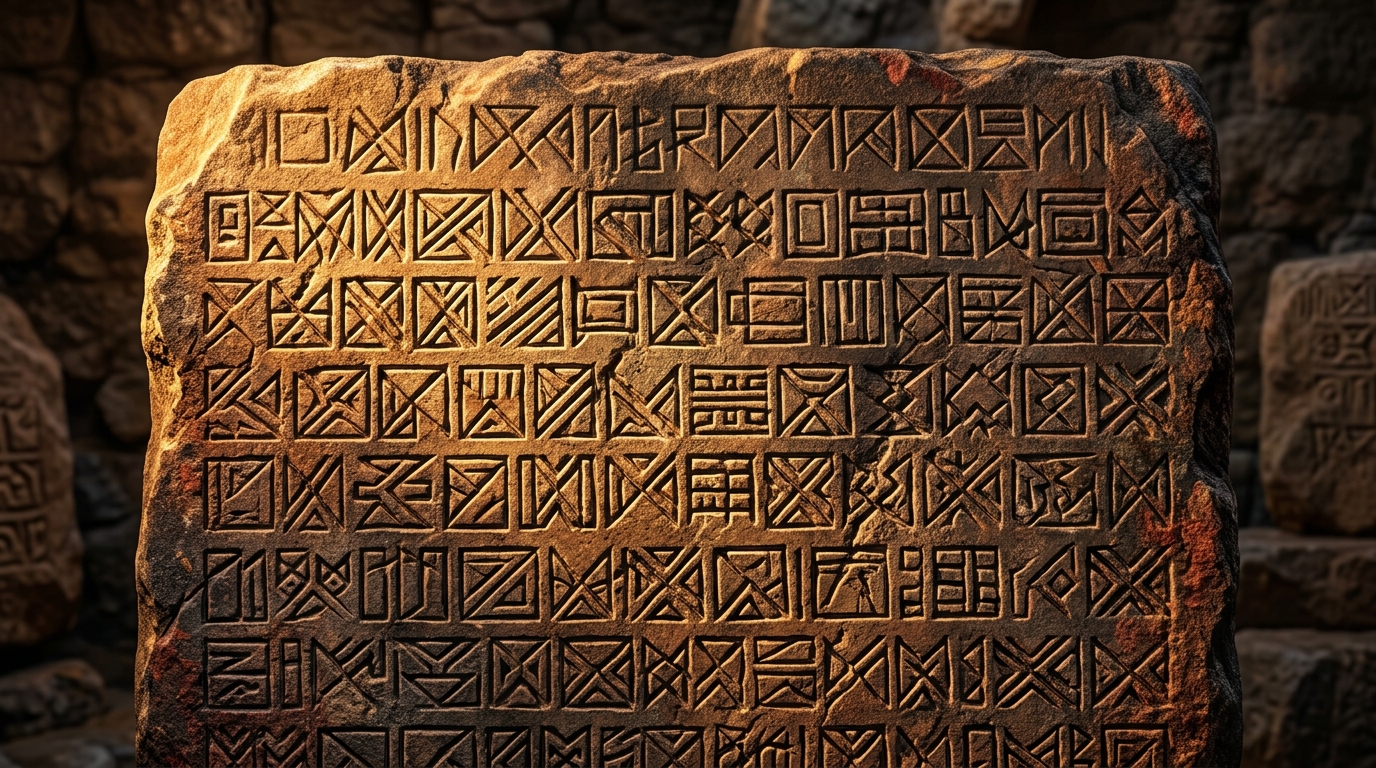
An alphabet older than Rome's presence in North Africa
Tifinagh descends from the ancient Libyco-Berber script, which was in active use across North Africa roughly from the third century BCE, with some of the oldest surviving examples believed to date back as far as the sixth century BCE. Scholars still debate exactly how it developed — whether it emerged independently or was shaped by contact with Phoenician writing — but there is no dispute that it predates the Roman and later Arab presence in the region by a wide margin. The original script was an abjad, meaning it recorded consonants without vowels, and it was traditionally written from bottom to top, though other directions were also used in different inscriptions.
After the Arab conquest of the Maghreb, roughly from the eighth century onward, Arabic script gradually displaced Libyco-Berber and Latin writing across most of North Africa. But the script did not disappear entirely — it survived among the Tuareg communities of the Sahara, across what is now southern Algeria, Mali, Niger, and Burkina Faso, who kept variants of the script alive for everyday but limited uses: short messages, graffiti, and games, within societies that otherwise transmitted most knowledge orally rather than through writing.
Because Tuareg groups were spread across such a vast desert region with limited contact between some communities, regional variants of the script developed with small differences in individual letter shapes — variations significant enough for specialists to trace, but generally not large enough to prevent Tifinagh users from understanding each other's writing.
From near-extinction to a political symbol
By the twentieth century, Tifinagh's everyday use outside Tuareg communities had all but vanished, and most Amazigh speakers elsewhere in North Africa, including Morocco, wrote their languages, when they wrote them at all, in Arabic or Latin script instead. The script's revival began not in Morocco but in Paris, where in the 1970s a group connected to the Berber Academy developed what is now called Neo-Tifinagh — a modernized, fully alphabetic version designed to make the script usable for standard printing and modern communication rather than only ceremonial or improvised writing.
The push to revive Tifinagh was politically charged from the start. Some prominent academics at the time dismissed the script as archaic and impractical, while activists insisted it was central to reclaiming a distinct Amazigh identity rather than folding Amazigh languages permanently into Arabic or French writing systems. Through the 1980s, activist Ammar Negadi and organizations such as the UPA published material in both Tifinagh and Latin script, and by 1993 the Afus Deg Fus association had produced the first standardized Neo-Tifinagh fonts, cutting the character set down from around fifty symbols to twenty-six for practical use.
That revival collided directly with state power in this period. Morocco, like other North African governments at the time, treated the promotion of Neo-Tifinagh with suspicion as part of a wider Amazigh political and cultural movement, and there were cases of individuals being arrested for using or promoting the script during the 1980s and 1990s. Across the border in Libya, the government under Muammar Gaddafi went further, explicitly banning Tifinagh from public display altogether. Tensions over Amazigh language rights across the region, including this specific script conflict, fed into broader unrest, notably Algeria's 2001 Kabyle uprising known as the Black Spring.

How the letters actually look and what the yaz symbol means
Visually, Tifinagh stands apart from both Arabic and Latin script. Its letters are built almost entirely from geometric elements — circles, squares, dots, straight lines, and crosses — giving it a look that reads as more architectural or ornamental than cursive, and making it well suited both to ancient rock carvings and to modern printed or digital use. There is no cursive joining of letters the way Arabic script requires; each character stands independently, which is part of why the script has proven relatively adaptable to signage, logos, and digital fonts during its modern revival.
One character in particular carries outsized symbolic weight: the yaz (ⵣ), a vertical line with two smaller diagonal or horizontal strokes, sometimes described as representing a standing human figure. When the Berber Academy activists in Paris designed the modern Amazigh flag in the 1970s, they placed the yaz, rendered in red, at its center, over horizontal bands of blue, green, and yellow. Within Amazigh cultural and political symbolism, the yaz is often described as representing the concept of the "free man" or "free person," a reference tied closely to a common self-designation of Amazigh peoples themselves. That single letter, more than any other part of the alphabet, has become a shorthand for Amazigh identity and pride, appearing on flags, jewelry, tattoos, and protest banners across North Africa and the diaspora.
Morocco's official adoption
The turning point for Tifinagh's legal status in Morocco came in stages. In 2001, King Mohammed VI established the Royal Institute of Amazigh Culture (IRCAM), tasked in part with standardizing the Amazigh language for education and public life. In 2003, IRCAM formally selected Neo-Tifinagh as the official script for Standard Moroccan Amazigh, a decision explicitly framed as a compromise between rival camps that had separately pushed for Arabic or Latin script instead — choosing Tifinagh let the government avoid appearing to favor either the Arabic-script or Latin-script factions while giving Amazigh its own clearly distinct written identity.
The deeper constitutional shift came in 2011, when a new Moroccan constitution, adopted amid the wider wave of regional political reform that year, formally recognized Tamazight (the Amazigh language) as an official language of Morocco alongside Arabic — a historic change after decades in which Amazigh languages had no official status at all. Parliament further confirmed in 2019 that Tifinagh specifically would remain the script used for writing Tamazight in official contexts, settling a debate that had continued even after the 2003 and 2011 milestones.
In practical terms, this has translated into Tifinagh appearing on Moroccan currency, government buildings, some public institutions, and, increasingly, road signage — cities including Agadir have moved to add Tifinagh alongside Arabic and French on street signs and local landmarks, and other regions have followed with trilingual signs for towns across the country in more recent years. Standard Moroccan highway and city-name signs today typically carry three scripts stacked or arranged together: Arabic, Tifinagh, and Latin, reflecting the country's officially trilingual approach to public signage rather than a single dominant writing system.


How much Tifinagh is actually used day to day
Official recognition has not translated into widespread daily literacy in the script. Tifinagh was introduced into some Moroccan elementary schools starting in 2003 as part of Amazigh-language instruction, but implementation has been uneven and limited in scope relative to Arabic and French, which remain overwhelmingly dominant in Moroccan education, media, and publishing. Researchers and activists have noted that written materials produced specifically in Tifinagh sometimes reach only a very small readership, since most Amazigh speakers who do write their language informally, in text messages or on social media, still tend to default to Latin script for practical, everyday communication.
That gap between symbolic and practical use is itself telling. Tifinagh functions today as much as a marker of identity and official recognition as it does a script most Amazigh speakers actually read fluently — its presence on a currency note, a government building, or a road sign carries real political and cultural weight even for people who could not easily read a full paragraph written in it. For younger generations exposed to it through school, media, and public signage, however, that gap may narrow over time, particularly as Amazigh-language broadcasting and digital content slowly expand.
Whatever the pace of everyday adoption, the symbolic distance Tifinagh has traveled is hard to overstate: from a script once suppressed and its users arrested, to letters now printed on the money in Moroccans' pockets and the highway signs they drive past — a reversal that took less than half a century. Amazigh cultural advocates continue to push for deeper integration, including expanded Tifinagh instruction in secondary and higher education and greater use in broadcast media, arguing that official recognition should ultimately translate into a script Moroccans can read as fluently as they read Arabic or French, not just recognize on a banknote.
Frequently asked
What is Tifinagh?
Tifinagh is the writing system used for the Amazigh (Berber) languages of North Africa. It descends from the ancient Libyco-Berber script, used in the region since at least the third century BCE, and survives today in a modernized form called Neo-Tifinagh, officially adopted by Morocco in 2003.
How old is the Tifinagh script?
Its ancestor, the Libyco-Berber script, was in active use across North Africa from at least the third century BCE, with some inscriptions possibly dating back to the sixth century BCE, making it far older than the Arabic script that later became dominant in the region.
Who kept Tifinagh alive before its modern revival?
Tuareg communities in the Sahara, across what is now southern Algeria, Mali, Niger, and Burkina Faso, preserved variants of the script for centuries after it had largely disappeared elsewhere in North Africa, primarily for short messages, graffiti, and games.
What is Neo-Tifinagh?
Neo-Tifinagh is a modernized, fully alphabetic version of the historic script, developed starting in the 1970s by activists connected to the Berber Academy in Paris and later standardized further, reducing the character set to about twenty-six letters for practical printing and modern use.
When did Morocco officially adopt Tifinagh?
Morocco's Royal Institute of Amazigh Culture (IRCAM) selected Neo-Tifinagh as the official script for Standard Moroccan Amazigh in 2003. Tamazight itself was then recognized as an official language of Morocco in the 2011 constitution, and parliament reaffirmed Tifinagh as its official script in 2019.
What does the yaz symbol mean?
The yaz (ⵣ) is a Tifinagh letter placed at the center of the modern Amazigh flag, commonly interpreted as representing a standing human figure and associated with the concept of the "free man" or "free person" central to Amazigh identity.
Is Tifinagh used on Moroccan currency and road signs?
Yes. Following its official adoption, Tifinagh has appeared on Moroccan banknotes, government buildings, and an increasing number of road signs, with cities such as Agadir formally adding it alongside Arabic and French on street signage.
Was Tifinagh ever banned or suppressed?
Yes. During the 1980s and 1990s, Morocco treated the promotion of Neo-Tifinagh with suspicion as part of wider Amazigh political movements, and individuals were arrested for using it in some cases. Libya's government under Muammar Gaddafi explicitly banned public display of the script.
Is Tifinagh widely used in everyday writing in Morocco today?
Not as much as its official status might suggest. Arabic and French remain dominant in education, media, and daily written communication, and even Amazigh speakers who write informally, such as in texting, often default to Latin script rather than Tifinagh, despite the script's growing presence in official and symbolic contexts.
What does Tifinagh script look like?
It is built from geometric shapes — circles, squares, dots, straight lines, and crosses — with each letter standing independently rather than joined in a cursive style, giving it a distinct visual appearance from both Arabic and Latin script.
- Wikipedia — Tifinagh ↗
- Morocco World News — Tifinagh: The Amazigh Alphabet ↗
- Morocco World News — Parliament Confirms Tamazight to Be Written With the Tifinagh Alphabet ↗
- Amazigh World News — Agadir Officially Adds Tifinagh to Street Signs and Billboards ↗
- Atlas of Endangered Alphabets — Tifinagh ↗
- Canarias Historia — Tifinagh Alphabet: A Symbol of Amazigh Cultural Revival ↗
Video via official YouTube embeds; photos via Wikimedia Commons under their stated licenses. All rights belong to the respective owners; 212 Daily claims no ownership.