The Moroccan Bride's Wardrobe: A Guide to the Takchita and the Seven-Outfit Wedding
Before the dresses: the hammam and the henna night
The wedding wardrobe does not begin at the reception; it begins days earlier, with rituals designed to prepare the bride physically and spiritually before she ever puts on a takchita. Central to this is a visit to the hammam, Morocco's traditional communal bathhouse, where the bride is washed, scrubbed and massaged by female relatives, often using ghassoul clay and rose water, in a ritual understood as purifying rather than purely cosmetic — a literal and symbolic cleansing before the transition into married life.
That is followed, typically a day or two before the main ceremony, by the henna night, one of the most photographed rituals in Moroccan wedding culture. The bride's hands and feet are decorated in intricate henna patterns by a specialist, surrounded by female family and friends in an atmosphere of singing and celebratory ritual rather than quiet preparation. For this event the bride commonly wears a distinct outfit from her main wedding takchitas — often a green-and-gold caftan — chosen specifically for the henna ceremony rather than reused later in the reception sequence.
Only after these rituals does the bride move into the reception itself, where the outfit changes most people associate with Moroccan weddings actually take place, orchestrated from start to finish by the negafa and her team of assistants, who function as a combination of stylist, dresser and wedding director for the entire event.
A full Moroccan wedding, in its most traditional form, is not a single evening but a sequence of events stretched across several days: the hammam, the henna night, an engagement or contract-signing gathering, and then the main reception itself, which in many families is the only stage guests outside close family actually attend. Understanding that the takchita sequence belongs to just the final, most public stage helps explain why so much choreography — timed costume changes, a professional styling team, a physically carried entrance — gets packed into that one night: it is the culmination of a preparation process that has already been building for days.

The takchita itself: two layers, one silhouette
Whatever regional style is layered on top, the underlying construction of a Moroccan bridal takchita stays consistent. It is a two-piece garment: an inner dress called the tahtiya, made from a comparatively simple, fine fabric, worn under an outer overdress called the dfina, which carries the bulk of the embroidery, beadwork and sequin detail, left open down the front. The two pieces are cinched together at the waist by a wide, decorative belt known as the mdamma, usually coordinated in color and ornamentation with the dfina, which shapes the silhouette and marks the visual transition between the plain inner layer and elaborate outer layer.
That structure is why a single takchita can look dramatically different from one wedding to the next while remaining recognizably the same type of garment: change the color and density of the dfina's embroidery, change the belt, and the same basic two-piece formula produces a white bridal takchita, a gold ceremonial one, or a deep-colored regional variant, without altering the underlying construction at all.
Because the outer dfina concentrates so much hand embroidery — often metallic thread worked over days or weeks by skilled artisans — a top-tier wedding takchita is a genuinely significant financial and craft investment for a Moroccan family, on par with a Western couture wedding gown, and is frequently rented, custom-commissioned, or in some families passed down and re-embroidered across generations rather than bought new and discarded after a single use.
Jewelry is treated as an inseparable part of the outfit rather than an accessory layered on afterward. Ornate belts, layered necklaces, tiaras and, for certain regional looks, elaborate head ornaments are chosen to match each specific takchita in the sequence, meaning the negafa and her team are effectively managing several complete, coordinated looks — dress, belt, jewelry and sometimes headpiece — rather than a single dress with interchangeable accessories.
The outfit sequence: from white purity to the golden finale
While exact sequences vary by family, region and budget, a well-documented traditional pattern runs through most Moroccan weddings, with brides changing through as many as six or seven distinct looks across a single evening, each representing a different color, region or symbolic moment rather than simply a fashion change. The reception typically opens with a white takchita, chosen specifically to symbolize purity, marking the bride's formal entrance into the ceremony itself.
From there the sequence moves through regionally named looks that function almost like a tour of Morocco's different textile traditions in miniature. The Fassiya, associated with Fez, is a particularly elaborate look, often paired with tall, ornate head ornaments and worn during the bride's turn on the amariya. A Rbatia, associated with Rabat and often rendered in blue tones, represents the capital's regional style. A Sahraouia, wrapped rather than tailored in the conventional sense, pays tribute to Morocco's Saharan south. A Soussia brings in vivid color and Amazigh-influenced patterning associated with the Souss region. The evening commonly closes with a Mejdoub — a heavily gold-embroidered caftan reserved specifically for the finale, the richest and most visually dominant look of the night.
This is not simply theater for its own sake. Moving a bride through looks associated with Fez, Rabat, the Sahara and the Souss over a single evening is, in effect, a compressed performance of national unity through costume — Morocco's major regional textile traditions represented, in sequence, on one person, in one night, regardless of where the wedding itself is actually taking place or where the couple is originally from.
Color choice within that sequence is rarely arbitrary. White opens the night as a purity marker; deep golds and heavy metallic embroidery close it as a marker of abundance and celebration; the specific hues attached to each regional look (blue for Rabat, vivid multicolor for the Souss) echo the historical textile identity of that region's own traditional dress, so that even a guest unfamiliar with the wedding's specific choreography can generally read where in the sequence the bride currently is just from the color and weight of what she is wearing.
The amariya: the throne that stops the party
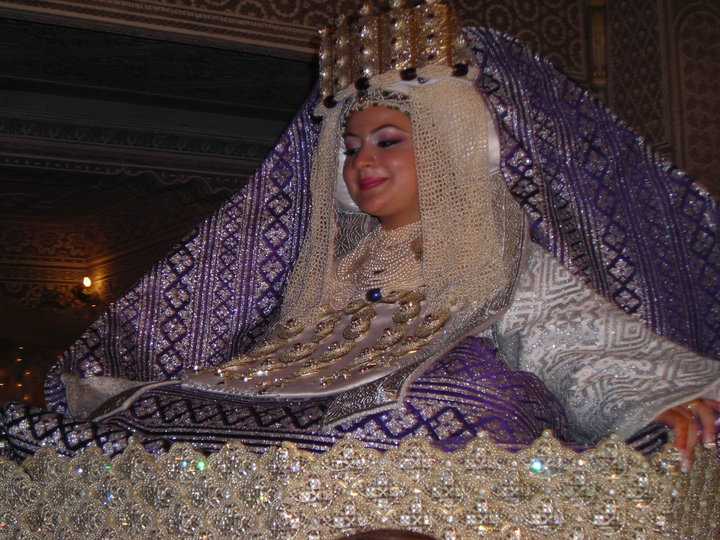
No moment in the sequence draws more attention than the amariya, the grand entrance in which the bride — and often the groom alongside her — is seated on an ornate, throne-like litter and physically lifted into the air by male attendants, carried through the reception hall while guests cheer, sing and record the moment on their phones. It is, functionally, the visual centerpiece of the entire wedding, the moment every other costume change is building toward or stepping away from.
The amariya tradition has deep roots: 16th-century chronicles describe related ceremonial processions using amaria-style carriers during religious festivals in Marrakech, a lineage that the wedding version of the ritual still echoes centuries later, even though its context has shifted from religious procession to matrimonial celebration. The specific outfit worn during the amariya turn — most often the elaborate Fassiya, with its tall headpiece — is chosen deliberately to read clearly and dramatically from a distance and from above, since the whole point of the moment is visibility over the crowd.
Regional variation matters here too. In cities like Tetouan and other parts of northern Morocco, historical bridal costume displayed in Moroccan ethnographic museums shows how distinct a 'Bride from Fez' outfit can look compared to bridal dress from other regions, in headpiece, jewelry and embroidery style, even though the underlying two-piece takchita logic — inner dress, ornate overdress, coordinating belt — holds across almost all of them.
Museums such as the Musée de la Parure in Rabat preserve exactly these historical regional bridal costumes, giving a fixed reference point for how a specific city's wedding dress looked generations ago, before contemporary designers began reinterpreting the same silhouettes with modern fabrics and lighter embroidery techniques for today's brides. Comparing a museum-preserved 'Bride from Fez' costume to a modern Fassiya worn at a wedding today shows both how much has stayed constant — the tall headpiece, the layered jewelry, the basic two-piece cut — and how much has evolved in terms of fabric weight and embellishment technique.

Frequently asked
How many outfits does a Moroccan bride wear at her wedding?
Traditionally up to seven, though six is also common depending on family budget and preference. Each outfit typically represents a different Moroccan region or symbolic moment in the ceremony, rather than being purely decorative variation.
What is the first outfit a Moroccan bride wears at the reception?
A white takchita is the traditional opening look, chosen specifically to symbolize purity as the bride formally enters the wedding ceremony.
What is the Fassiya?
The Fassiya is an elaborate bridal look associated with the city of Fez, often paired with a tall, ornate headpiece, and is commonly the outfit worn during the bride's turn on the amariya throne.
What is the amariya at a Moroccan wedding?
The amariya is an ornate, throne-like litter on which the bride (often with the groom) is seated and physically carried above the crowd by attendants, one of the most visually dramatic moments of the celebration, with roots traced to 16th-century Moroccan ceremonial processions.
What happens at a Moroccan henna night?
Held a day or two before the wedding, the henna night involves intricate henna designs applied to the bride's hands and feet by a specialist, surrounded by female family and friends, in a celebratory ritual of singing and blessings. The bride typically wears a distinct outfit, often green and gold, for this event.
What is the tahtiya and the dfina in a takchita?
The tahtiya is the takchita's plain inner dress. The dfina is the heavily embroidered outer overdress worn open over it. The two are cinched together with a decorative belt called the mdamma.
Why does the hammam matter before a Moroccan wedding?
The pre-wedding hammam visit is a ritual bathing and purification ceremony, understood as symbolically preparing the bride for marriage, not simply a spa treatment. It typically takes place before the henna night and the main ceremony.
What is a Mejdoub in a Moroccan wedding wardrobe?
The Mejdoub is typically the final and most elaborate outfit of the night, a gold and heavily embroidered caftan worn to close out the wedding celebration.
Who organizes the bride's outfit changes at a Moroccan wedding?
A professional stylist called the negafa, assisted by her team (negafates), manages the bride's costume changes, hair, jewelry and overall styling throughout the event, functioning as both dresser and wedding director.
Are all the wedding outfits takchitas?
Not exactly. The sequence typically mixes true two-piece takchitas with related one-piece caftans and regional dress forms like the wrapped Sahraouia, but the takchita's inner-dress-plus-overdress-plus-belt structure is the dominant, defining silhouette of the wardrobe as a whole, which is why the entire bridal wardrobe is often referred to informally as 'the takchitas' even when a few individual pieces are technically one-piece caftans.
- D&D Clothing — Moroccan Traditional Wedding Styles ↗
- Souksnet — Inside a Moroccan Wedding: Traditions, Henna & Days of Celebration ↗
- Slow Morocco — The Moroccan Wedding ↗
- Prime Morocco Tours — Moroccan Wedding Ceremony: Traditions and Rituals ↗
- Wikipedia — Takchita ↗
Video via official YouTube embeds; photos via Wikimedia Commons under their stated licenses. All rights belong to the respective owners; 212 Daily claims no ownership.