Sahrawi Culture: The Desert Traditions of the Western Sahara Region

Who the Sahrawi are
Sahrawis are the traditional inhabitants of the western Sahara desert region, an ethnic group formed through centuries of mixing between Sanhaja Berber tribes, Arab tribes — most significantly the Beni Hassan, who arrived in the region roughly between the thirteenth and fourteenth centuries — and West African populations including Wolof and Soninke communities connected through trans-Saharan trade. Most Sahrawis today identify primarily with Arab culture and language, though Berber vocabulary and cultural traits remain woven into everyday Sahrawi life.
This mixed ancestry produced a population historically organized around nomadic tribal confederations rather than fixed settlements, with an economy built on camel and goat herding, trans-Saharan caravan trade, and seasonal movement in search of pasture and water across a famously harsh, resource-scarce landscape. Sahrawi communities today live across a wide geography: in Morocco's southern provinces and the broader Western Sahara territory, in northern Mauritania, in parts of southwestern Algeria, and in Sahrawi refugee camps near Tindouf, Algeria.
Religiously, Sahrawis are Sunni Muslim and follow the Maliki school of Islamic jurisprudence, the same school followed across much of Morocco and northwest Africa, with a historically flexible, nomad-adapted style of religious practice that traditionally functioned without the fixed mosque infrastructure common in settled communities, reflecting the practical realities of a mobile desert lifestyle.

Hassaniya: the language of the Sahrawi
Sahrawis speak Hassaniya Arabic, a distinct variety of Arabic that developed among the Beni Hassan tribes in the western Sahara and is also spoken across much of Mauritania. Hassaniya has absorbed substantial influence from the Amazigh languages historically spoken across the same region, along with vocabulary drawn from West African languages such as Wolof and, more recently, from Spanish, a legacy of the Spanish colonial administration of what was then Spanish Sahara until 1975.
Unlike some other regional Arabic dialects that developed alongside a continuously present substrate language, Hassaniya has almost entirely displaced the Berber languages that were once spoken across much of the same territory, making it the near-universal everyday language of Sahrawi communities today, alongside French or Spanish as secondary languages depending on location and generation.
Hassaniya also functions as the vehicle for an extensive oral literary tradition. Poetry composed and performed in Hassaniya — often centered on themes of love, honor, the desert landscape, and clan and family history — has historically been central to Sahrawi social life, transmitted and performed alongside music rather than treated as a separate, purely written art form.
The melhfa and traditional dress
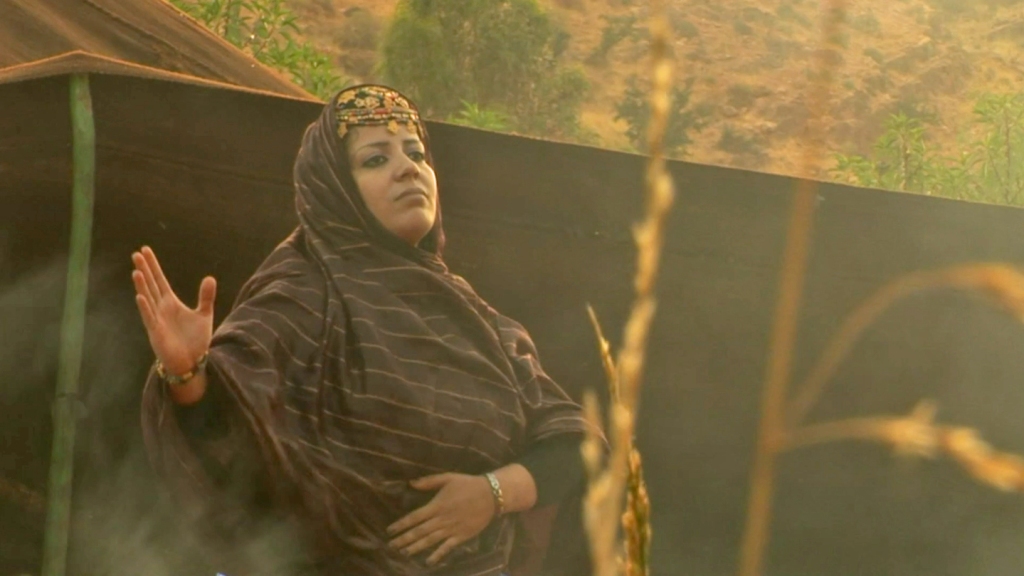
The most visually distinctive element of Sahrawi dress is the melhfa, a long rectangular cloth — typically around 4.5 meters by 1.6 meters — that Sahrawi women wrap skillfully around the head and body, traditionally made from lightweight natural fabric such as cotton and available in a wide range of colors and patterns, from vivid prints to solid black. Beyond its practical function protecting wearers from sun, heat, and blowing sand, the melhfa carries strong identity significance for Sahrawi women, though, like many traditional modest garments, it is also a subject of ongoing internal debate regarding its relationship to ideas about gender, modesty, and social expectation.
Men traditionally wear the daraa, a loose, flowing robe suited to desert heat, often in blue or white, broadly similar in silhouette to garments worn by other nomadic and Bedouin populations across the wider Sahara and Sahel. Both garments reflect the same underlying design logic: loose, breathable, and protective clothing adapted over generations to one of the most physically demanding climates inhabited by any traditional culture in the world.

Tea, tents, and the culture of hospitality
As in Morocco more broadly, tea occupies a central place in Sahrawi social life, but the Sahrawi version has its own distinct character: traditionally brewed strong and sweet, sometimes prepared over charcoal for a subtle smoky flavor, and served across three successive rounds, each carrying its own meaning within the ritual. Preparing and serving tea is treated as a genuine social event in itself among Sahrawi nomadic communities, an occasion for storytelling, poetry recitation, and extended conversation rather than a quick refreshment.
That hospitality tradition extends to the physical setting it happens in: the traditional Sahrawi tent, woven from goat wool and camel hair, portable and adapted for a mobile herding lifestyle that follows pasture and water availability across the seasons. Communities organized around these tents historically emphasized strong values of solidarity, extended family ties, and mutual obligation toward guests and fellow tribal members — practical necessities in an environment where isolated travelers and small groups depended heavily on the hospitality of others they encountered.
Music and poetry are inseparable from this social fabric. Sahrawi musical tradition, sometimes referred to through the term azawan, blends Hassaniya sung poetry with instruments including the tidinit, a long-necked lute traditionally played by men; the ardin, a lap harp with roughly nine to fourteen strings traditionally played by women; and the tbal, a hand drum providing rhythmic accompaniment. Composing and performing a song traditionally involved close collaboration between poets and musicians, with the poetic themes of love, honor, and desert life continuing to shape performances even as some contemporary Sahrawi musicians have incorporated electric guitar and other modern instrumentation.
Cuisine built around scarcity and the camel
Sahrawi cuisine reflects the same desert logic that shaped the rest of the culture: a diet historically built around what a nomadic, herding lifestyle could reliably provide. Camel and goat meat, along with lamb, form the traditional protein base, while camel milk — notably high in water content and nutritionally dense — has long served as both a staple drink and a practical way to stay hydrated in an extremely arid climate. From that milk, Sahrawi households traditionally produce zriga, a fermented, churned dairy product with a thick, yogurt-like consistency distinct from dairy preparations found elsewhere in Morocco.
Couscous holds the same central, weekly ritual role among Sahrawi communities that it does across much of Morocco, though the Sahrawi variation is notably distinct: prepared from twisted dried barley flour steamed over water vapor and then mixed simply with camel milk and sugar, rather than the vegetable-and-meat-topped versions more familiar in northern Moroccan cities. Other dishes include a camel-meat tajine and thareed, a comfort dish of bread soaked in a rich broth with meat, chickpeas, and vegetables, similar in concept to bread-based stews found in other Bedouin and Gulf culinary traditions.
As with tea, meals function as much as social occasions as nutritional ones — communal, unhurried, and built around the same underlying hospitality values that shape the rest of Sahrawi social life, from the tent to the tea tray to the shared dish at the center of the table.
A culture shaped by a disputed and unresolved political situation
Any accurate picture of Sahrawi culture today has to acknowledge that it exists within a genuinely disputed political context. Western Sahara's sovereignty status remains unresolved: Morocco administers the majority of the territory and considers it part of Morocco, while the Polisario Front, representing the Sahrawi Arab Democratic Republic, seeks full independence for the territory. A ceasefire between Morocco and the Polisario Front has held since 1991, though the underlying political dispute has not been settled through the referendum originally envisioned at that time.
The practical result is that Sahrawi people today live under quite different circumstances depending on location: an estimated roughly 160,000 or more Sahrawis live in Moroccan-administered Western Sahara and Morocco's southern provinces, integrated into Moroccan civic and economic life, while a separate population, estimated at around 170,000-plus, lives in UN-recognized Sahrawi refugee camps near Tindouf, in Algeria, administered by the Polisario Front and supported by international humanitarian assistance. Sahrawi communities also live in Mauritania and other neighboring countries.
Given the sensitivity and the genuinely contested nature of the underlying political question, readers seeking the current diplomatic and legal status of Western Sahara are better served consulting dedicated, up-to-date reporting and international organizations directly rather than a single cultural overview — this piece focuses specifically on the shared cultural traditions, language, and daily life practices that connect Sahrawi communities across these differing political circumstances, rather than adjudicating the dispute itself.
Frequently asked
Who are the Sahrawi people?
Sahrawis are an ethnic group native to the western Sahara desert region, formed through historical mixing between Sanhaja Berber tribes, Arab tribes (notably the Beni Hassan), and West African populations. They speak Hassaniya Arabic and traditionally followed a nomadic, camel- and goat-herding way of life.
What language do Sahrawis speak?
Sahrawis primarily speak Hassaniya, a distinct Arabic dialect also spoken in Mauritania, which incorporates significant Amazigh (Berber), West African, and Spanish loanword influence and has largely displaced the Berber languages once spoken across the same region.
What is a melhfa?
The melhfa is a long rectangular cloth, roughly 4.5 by 1.6 meters, that Sahrawi women wrap around their head and body. It traditionally protects wearers from sun, heat, and sand, comes in many colors and patterns, and carries strong identity significance, though its social meaning is also debated within Sahrawi communities.
Where do Sahrawi people live today?
Sahrawi communities live across Morocco's southern provinces and Moroccan-administered Western Sahara, in Mauritania, in southwestern Algeria, and in UN-recognized Sahrawi refugee camps near Tindouf, Algeria, reflecting the region's unresolved and disputed political history.
What is the Sahrawi tea ceremony?
It is a traditional, socially central ritual in which strong, sweet tea is brewed and served across three successive rounds, each carrying its own meaning, typically accompanied by storytelling, poetry, and extended conversation among family and guests.
What instruments are used in traditional Sahrawi music?
Key traditional instruments include the tidinit, a long-necked lute traditionally played by men; the ardin, a multi-stringed lap harp traditionally played by women; and the tbal, a hand drum, often accompanying sung Hassaniya poetry in a tradition sometimes referred to as azawan.
What religion do Sahrawis practice?
Sahrawis are predominantly Sunni Muslim and follow the Maliki school of Islamic jurisprudence, the same school common across Morocco and much of northwest Africa, historically practiced in a flexible style adapted to a mobile, nomadic lifestyle.
What is the political status of Western Sahara?
It remains genuinely disputed. Morocco administers most of the territory and considers it part of Morocco, while the Polisario Front seeks independence as the Sahrawi Arab Democratic Republic. A ceasefire has held since 1991, but the underlying sovereignty question remains unresolved, and readers should consult dedicated, current international reporting for the latest diplomatic status.
What is the traditional Sahrawi tent made of?
Traditional Sahrawi tents are woven from goat wool and camel hair, designed to be portable for a nomadic lifestyle that historically followed seasonal pasture and water availability across the desert.
What do Sahrawi people traditionally eat?
Traditional Sahrawi cuisine centers on camel and goat meat, camel milk, and dairy products like zriga (a fermented, churned milk product). Couscous is a weekly staple, often prepared in a distinct Sahrawi style with barley flour, camel milk, and sugar rather than the vegetable-topped versions common elsewhere in Morocco.
- Wikipedia — Sahrawis ↗
- Wikipedia — Culture of Western Sahara ↗
- Wikipedia — Music of Western Sahara ↗
- Wikipedia — Melhfa ↗
- Wikipedia — Western Saharan Cuisine ↗
- History Rise — The Sahrawi People: History, Culture, and National Identity Explained ↗
Video via official YouTube embeds; photos via Wikimedia Commons under their stated licenses. All rights belong to the respective owners; 212 Daily claims no ownership.