Morocco's Rose Festival: Inside the Moussem des Roses of Kelaat M'Gouna
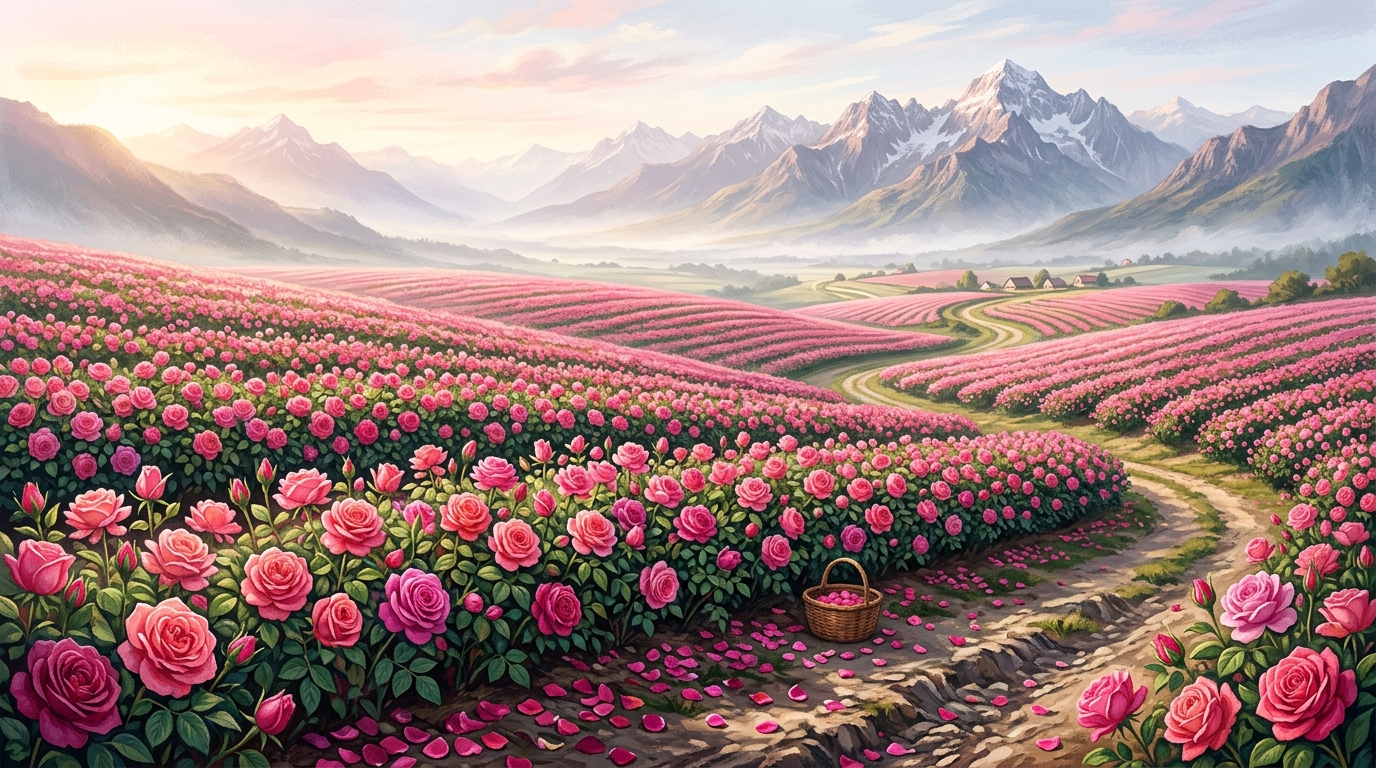
Where the Valley of Roses gets its name
Kelaat M'Gouna (also written Kalaat M'Gouna or El Kelaa des Mgouna) is a town of roughly 38,000 people in Tinghir Province, in Morocco's Drâa-Tafilalet region, about 330 kilometers east of Marrakech and not far from Ouarzazate. It sits at around 1,450 meters of elevation along the Dades River, in a stretch of valley long known locally as the Valley of Roses for the Damask roses (Rosa damascena) grown in hedgerows and terraced fields across the surrounding countryside.
Accounts of how the rose first arrived here differ. One tradition holds that Damask roses reached the valley with pilgrims returning from a Hajj pilgrimage as early as the 10th century, carrying cuttings back along overland trade routes and planting them in the Dades. Other regional accounts tie the valley's modern rose industry more specifically to the French colonial period, when a rosewater distillery is said to have opened in the town in the late 1930s, formalizing what had likely been a smaller-scale local practice into a proper regional industry. Whichever version is more precise, the valley has been closely associated with rose cultivation for generations, and the flower has become the region's defining crop and identity.
Today the Valley of Roses stretches along a chain of villages and kasbahs between Boumalne Dades and Kelaat M'Gouna, with an estimated few thousand kilometers of rose hedges planted as living fences around fields and orchards rather than in dedicated plantations, a traditional style of cultivation that doubles as erosion control and boundary-marking for local farmers. The route between the two towns is often called the Road of a Thousand Kasbahs, a reminder that the rose hedges share this landscape with older fortified earthen architecture, palm groves and almond orchards, all irrigated by the same Dades River that gives the valley its name.

The harvest: a race against a few short weeks
The Damask rose harvest around Kelaat M'Gouna is a narrow, intense window rather than a long season. Roses bloom from roughly late April through May, and workers, most of them local women, pick the flowers by hand at dawn, before the day's heat causes the petals to release their fragrant oils and wilt. The entire harvest, from first blooms to last, typically runs about six weeks across May and June, and timing shifts slightly from year to year depending on rainfall and temperature.
The scale of the harvest is considerable for a rural valley economy: cooperatives and distilleries in the region process thousands of tonnes of rose petals every year, drawn from thousands of kilometers of rose hedges planted across the valley. The petals are steam-distilled, traditionally in copper alembics, to produce rose water used in cooking and cosmetics, and a far more concentrated rose oil, or attar, prized by the international perfume industry. Producing that oil is remarkably petal-intensive: it takes roughly four tons of fresh rose petals to yield a single liter of rose essential oil, which explains why the oil commands a premium price relative to the more everyday rosewater.
Much of this processing today runs through local cooperatives, including women's cooperatives that have grown up around the rose economy in recent decades, giving pickers and processors, most of whom are women, a more direct share of the income from a crop their labor makes possible. Distillery visits, where guests can watch the steam-distillation process firsthand, have also become one of the region's steadiest tourist draws outside festival week itself, with cooperatives typically walking visitors through the full chain from fresh petal to bottled rosewater and concentrated oil.
The Moussem des Roses: parades, pageantry and Miss Rose
The Moussem des Roses, held annually in Kelaat M'Gouna once the harvest is underway, is the valley's biggest cultural event of the year. Historically staged over about a week, more recent editions have run as a shorter multi-day public celebration, with the 2026 festival scheduled for four days in early May; as with the harvest itself, the exact dates move slightly each year to track the natural bloom cycle rather than a fixed calendar date.
The festival's best-known feature is the crowning of a Rose Queen, popularly called Miss Rose. Young, unmarried women from the rose-growing community take part in a pageant judged not on appearance alone but on their knowledge of rose cultivation, distillation and local Amazigh (Berber) culture and heritage. The winner is paraded through the town's main streets, often in a horse-drawn carriage or atop a flower-covered float, showered with rose petals thrown by the crowd, in a procession that functions as the festival's ceremonial centerpiece.
Alongside the pageant, the festival fills Kelaat M'Gouna's streets with folk performance: circle dances such as ahwash and ahidous, in which lines or rings of men and women sing in call-and-response over the rhythm of the bendir frame drum, along with other troupes performing sword dances and regional Amazigh music. Craft stalls and open-air markets sell rosewater, rose oil, soaps and dried petals alongside other local produce, and the town's population is said to more than double for the duration of the event as visitors from across Morocco and abroad arrive for the festival.

The rose economy beyond festival week
For Kelaat M'Gouna and the surrounding Dades Valley, roses are not just a festival theme but a genuine economic backbone. The town is home to some of Morocco's largest rosewater and rose oil producers, whose products feed both the domestic cosmetics and food market and international perfume houses that prize Moroccan rose absolute. Rose-derived products, rosewater, rose oil, soaps, creams and dried petals, are sold locally and exported, giving the harvest a value that extends far beyond the festival crowds.
The seasonal nature of the harvest also shapes the local labor market: cooperatives hire extra seasonal pickers and processors for the six-week harvest window, work that disproportionately supports women in a region where formal employment options are otherwise limited. Beyond the harvest and festival, Kelaat M'Gouna also functions as a gateway town for trekking in the M'Goun Massif, one of Morocco's highest mountain ranges, giving the local economy a second, tourism-driven leg that runs for much of the rest of the year.
Together, the festival and the industry behind it have turned a relatively small provincial town into one of the more recognizable place names in Moroccan tourism, cited in guidebooks and travel itineraries alongside Ouarzazate and the desert routes toward Merzouga. For a town whose economy might otherwise rest on modest agriculture and rural trade, the rose, and the week each May built around it, has become both an identity and an export.
Why the Dades Valley rose matters beyond Kelaat M'Gouna
The rose grown around Kelaat M'Gouna also feeds into a wider Moroccan culture built around rosewater, well beyond the valley's own borders. Rosewater is a staple ingredient in Moroccan hospitality: it is sprinkled on guests' hands before and after meals in many households, used to scent milk and pastries served at celebrations, and folded into desserts and drinks nationwide, from everyday households to hotel riads. Rose oil and rosewater also feature prominently in the hammam and spa traditions found across Morocco, where they are used in soaps, scrubs and skincare, giving the Dades Valley harvest a footprint in Moroccan daily life that most visitors never connect back to a single provincial town.
That nationwide demand is part of what keeps the Valley of Roses economically relevant beyond the one week of the festival itself. Moroccan cosmetics brands and exporters that market rosewater and rose oil internationally, as part of the country's broader argan-oil-and-natural-cosmetics reputation, draw much of their raw material from this same corridor of hedgerows and cooperative distilleries, linking a rural harvest tradition to a modern export industry built around Morocco's reputation for natural beauty products.
For travelers and researchers alike, Kelaat M'Gouna is consequently one of the clearer examples in Morocco of a single agricultural product, tied to one river valley and one narrow harvest season, shaping a town's identity, calendar and economy all at once: a rural Amazigh farming tradition, a national culinary and cosmetic staple, and a globally exported commodity, all traced back to the same six weeks of hand-picked Damask roses each spring.
Frequently asked
What is the Rose Festival in Morocco?
The Rose Festival, or Moussem des Roses, is an annual celebration held in Kelaat M'Gouna in Morocco's Dades Valley, marking the Damask rose harvest each May with parades, folk dancing, craft markets and the crowning of a Rose Queen, popularly known as Miss Rose.
Where is Kelaat M'Gouna?
Kelaat M'Gouna is a town of roughly 38,000 people in Tinghir Province, in Morocco's Drâa-Tafilalet region, about 330 kilometers east of Marrakech near Ouarzazate, at the heart of the area known as the Valley of Roses.
When does the Rose Festival usually take place?
The festival is held annually in May, timed to the Damask rose bloom. Exact dates shift slightly each year depending on weather and harvest conditions; the 2026 edition was scheduled for four days in early May.
What kind of rose is grown in the Valley of Roses?
The valley grows the Damask rose, Rosa damascena, prized for its fragrance and used to produce rosewater and a highly concentrated rose oil (attar) used in cosmetics, food and the international perfume industry.
Who is Miss Rose at the Kelaat M'Gouna festival?
Miss Rose, or the Rose Queen, is a young, unmarried woman from the local rose-growing community crowned each year at the festival. Judging emphasizes her knowledge of rose cultivation, distillation and Amazigh cultural heritage, not appearance alone, and she leads the festival's main parade.
What dances are performed at the Rose Festival?
Folk troupes perform traditional Amazigh circle dances including ahwash and ahidous, in which participants sing in call-and-response over the rhythm of the bendir frame drum, alongside other regional dances such as sword performances.
How much rose oil comes from the harvest?
Rose oil production is petal-intensive: producing roughly one liter of rose essential oil requires about four tons of fresh rose petals, which is why the oil is far more valuable per unit than rosewater made from the same harvest.
How long does the rose harvest season last?
The Damask rose harvest around Kelaat M'Gouna typically runs about six weeks, spanning May and June, with pickers, mostly local women, gathering flowers by hand at dawn before the day's heat causes them to wilt.
Why is the rose important to the local economy?
Rose cultivation and processing support cooperatives, seasonal harvest labor and some of Morocco's largest rosewater and rose oil producers, whose products are sold domestically and exported. The festival itself also draws tourism that roughly doubles the town's population during the event.
Is Kelaat M'Gouna good for more than the festival?
Yes. Beyond festival week, the town serves as a gateway for trekking in the M'Goun Massif, one of Morocco's highest mountain ranges, and its rose cooperatives and distilleries welcome visitors for tours throughout the harvest season. It also sits along the scenic route between Boumalne Dades and Ouarzazate, popularly known as the Road of a Thousand Kasbahs, making it a natural stop for travelers exploring southern Morocco outside of festival dates.
- Wikipedia — Kalaat M'Gouna ↗
- MAwebzine — Morocco Rose Festival 2026: Kelaat M'Gouna Guide ↗
- Slow Morocco — Kelaat M'Gouna: the valley that smells like roses for three weeks in May ↗
- Your Guide to Morocco — Kelaat M'Gouna Rose Festival 2026 ↗
- Journey Beyond Travel — Kalaat M'gouna, Morocco: A Town of Roses ↗
Video via official YouTube embeds; photos via Wikimedia Commons under their stated licenses. All rights belong to the respective owners; 212 Daily claims no ownership.