Riad vs Dar: The Real Difference Between Morocco's Two Courtyard Houses
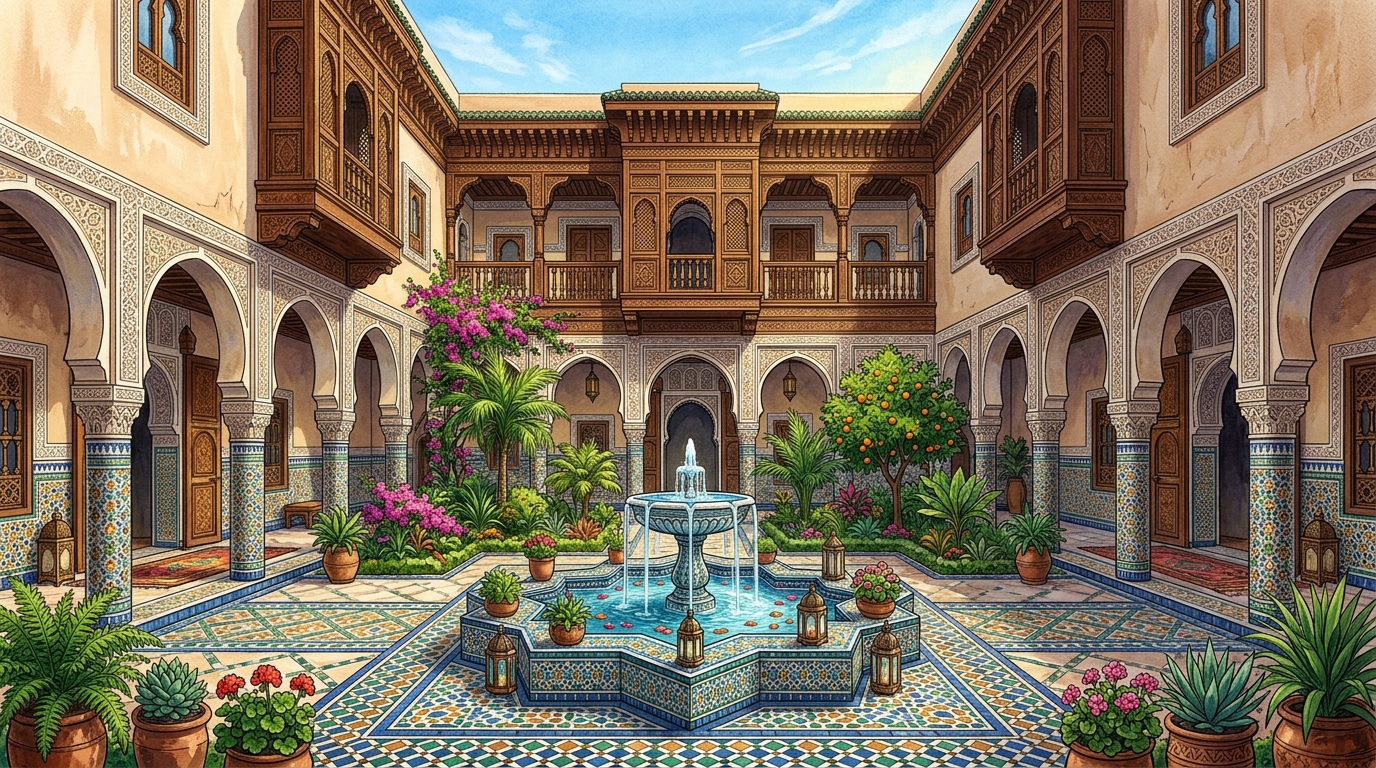
Riad: a garden, not just a courtyard
The word riad comes from the Arabic riyad, the plural of rawda, meaning 'garden' — in classical Arabic literature, specifically the kind of lush, walled, paradise-adjacent garden sheltered from a harsh outside world. That etymology is not incidental; it is the entire architectural point. A true riad is organized around a planted interior space, classically a rectangular garden divided into four quadrants by two intersecting paved paths, with a fountain positioned at the center where the paths cross. The planted quadrants typically sit slightly sunken below the level of the paths, so that from above the whole layout reads as a clear, deliberate geometric grid rather than an informal garden.
That four-part layout is not a uniquely Moroccan invention. It traces back to the Persian chahar bagh ('four gardens') tradition, itself connected to even older courtyard garden precedents documented archaeologically in ancient Mesopotamia, and carried into Islamic architecture broadly as the religion and its associated building traditions spread from the 7th century onward. The same basic four-quadrant garden logic shows up, with local variation, from Mughal India to Safavid Persia to Moorish Spain — Morocco's riad is a specifically North African, Andalusian-inflected branch of a much older and geographically wider architectural family.
In Morocco specifically, the design is generally traced to the 11th and 12th centuries, arriving with Andalusian influence during the Almoravid and Almohad dynasties. The first documented Moroccan riad-style garden is associated with a palace built in Marrakesh during the reign of the Almoravid ruler Ali ibn Yusuf in the early 12th century. From there, riad architecture continued to develop through later dynasties, reaching a particularly grand expression in the 16th-century Badi Palace and continuing to be refined in royal and elite residences through the 18th and 19th centuries.
Marrakesh's Bahia Palace, begun in the 1860s by the grand vizier Si Musa and greatly expanded between 1894 and 1900 by his son Ba Ahmed, offers an unusually clear real-world illustration of the riad-versus-dar vocabulary living side by side. The palace's roughly 150 rooms are organized around several distinct courtyards and riad gardens, and the large northern riad garden built during Si Musa's time is, notably, also known specifically as the Dar Si Moussa — a single sprawling complex containing both a proper riad garden and a section named, deliberately, using the plainer 'dar' terminology for what functions there as more of a residential courtyard quarter.

Dar: the same inward-facing idea, without the garden
A dar shares the riad's fundamental logic — an inward-facing family house wrapped around a central open space, with a blank, largely windowless facade at street level — but its central space is a courtyard rather than a garden. Where a riad's center is planted and divided by paths, a dar's central courtyard is typically a hard, open surface, often still featuring a fountain at its center but without the sunken garden quadrants, citrus trees or greenery that define the riad proper. It is, in effect, a plainer, more minimalist version of the same architectural concept.
That difference in ambition often tracked a difference in scale and resources: riads, with their more elaborate, labor- and water-intensive garden layouts, were historically the residences of Morocco's wealthiest urban families — merchants, courtiers, high officials — able to dedicate real space and upkeep to an interior garden. Dars were, and often still are, somewhat more modest family homes, though dars can in practice be larger overall than riads even while lacking the garden centerpiece; the terms describe a difference in central-space design, not strictly a hierarchy of size or grandeur.
Both house types share nearly everything else: a single street-level entrance door, no windows facing outward at ground level for privacy and security, several stories organized around the central space, and typically a roof terrace used for laundry, storage, sleeping in summer heat, or simply catching a breeze above the dense medina rooftops. The décor vocabulary is shared too — carved cedar wood, hand-troweled tadelakt plaster, ornate stucco and zellij tilework, often paired with Quranic calligraphy worked into wall panels, appear across both riads and dars of any real historical pedigree.
The word dar itself is simply the general Arabic word for 'house,' which is part of why it functions almost as a default term across the Arab world for a traditional courtyard dwelling, while 'riad' stays a more specific, garden-designating word confined mostly to Moroccan (and broader Maghrebi) usage. That linguistic asymmetry is itself a small clue to the relationship between the two: every riad is, in the broadest sense, also a dar (a house), but not every dar qualifies as a riad, because not every dar organizes itself around a true planted garden.

Why the inward-facing design exists at all
Both house types answer the same two practical problems: privacy and climate. Islamic social norms historically placed strong value on separating a family's private domestic life from public street life, and turning a house's most beautiful, decorated spaces entirely inward — away from any street-facing window — was a direct architectural expression of that value, protecting the household, and especially its women, from outside view.
Climate control was the second driver, and arguably the more universally practical one. An enclosed central courtyard or garden, especially one with a fountain and planting, creates a passive cooling effect: shaded walls, evaporative cooling from water and greenery, and airflow drawn upward through the open center act together to keep interior rooms noticeably cooler than the street outside during Morocco's hot summers, while the same enclosed mass helps retain warmth during cooler months. Multiple stories built around that same central void meant every room, regardless of floor, could draw on the same passive climate system rather than relying on separate cooling for each level.
This is also why both riads and dars look, from the street, almost deliberately unremarkable: plain walls, a single modest door, no hint of what lies inside. The entire architectural investment — garden or courtyard, fountain, carved wood, zellij, calligraphy — sits behind that door, visible only to family and invited guests, which is precisely the point of a design tradition built as much around social discretion as around aesthetics.
How tourism blurred the line
The distinction that once mattered enormously to a Moroccan family choosing or building a home has become, in the 21st-century tourism economy, almost decorative trivia. Beginning in earnest in the 1990s and accelerating through the 2000s, foreign and Moroccan investors began buying up crumbling historic houses in the medinas of Marrakesh, Fez and Essaouira and restoring them into boutique guesthouses, a wave of renovation that genuinely helped revive traditional craft trades — zellij cutting, tadelakt plastering, carved cedar work — that had been in decline.
But in marketing those restored properties, 'riad' became the default label of choice regardless of whether a given house technically had a garden or a plain courtyard, because the word had already accumulated more romantic, exotic connotation among international travelers than the comparatively plain-sounding 'dar.' The result is a tourism landscape where 'riad' functions today more as a genre label — atmospheric traditional medina house, converted into a guesthouse — than as the specific architectural term a Marrakshi builder or historian would have used a century ago.
For anyone who wants to use the terms correctly, the test is simple: stand in the center of the property and look down. Garden beds, sunken planting quadrants, citrus trees, a fountain set within greenery — that's a riad. A hard, open, largely unplanted courtyard, fountain or not — that's a dar. Everything else about the house, from the blank street facade to the zellij on the walls to the terrace on the roof, will very likely look exactly the same either way.
None of this loose usage is really a problem in practice, and it is worth saying so plainly: a guesthouse marketed as a 'riad' that is technically closer to a dar is not being fraudulent, since both terms describe genuine, historic Moroccan house types with a shared architectural DNA. The confusion is simply the natural result of a precise architectural vocabulary meeting a global tourism market that, understandably, cares more about the overall experience — a quiet, plant-filled, centuries-old courtyard house tucked behind an anonymous medina door — than about which of two closely related Arabic nouns best describes the exact contents of that courtyard.

Frequently asked
What is the main difference between a riad and a dar?
A riad is built around an interior garden, classically divided into four planted quadrants with a central fountain. A dar is built around a plain, open courtyard without a garden. Both share the same inward-facing, street-blank architectural style.
What does the word 'riad' mean?
Riad comes from the Arabic riyad, the plural of rawda, meaning 'garden' — specifically the kind of lush, enclosed garden evoked in classical Arabic literature.
Where did the riad's four-quadrant garden design come from?
It descends from the Persian chahar bagh ('four gardens') tradition, itself linked to ancient Mesopotamian courtyard garden precedents, spreading through the Islamic world from the 7th century onward and reaching Morocco with Andalusian influence around the 11th-12th centuries.
When did riads first appear in Morocco?
The first documented Moroccan riad-style garden is associated with a palace built in Marrakesh during the reign of the Almoravid ruler Ali ibn Yusuf in the early 12th century.
Is a dar bigger or smaller than a riad?
There is no strict rule; dars can in practice be as large or larger than riads. The core difference is about the design of the central space (courtyard vs. garden), not overall house size, though riads' elaborate gardens historically signaled greater family wealth.
Why do riads and dars have no windows facing the street?
The blank street facade reflects Islamic social values around privacy, keeping the family's domestic life hidden from public view, with all decoration and open space turned inward toward the courtyard or garden instead.
How do riads and dars stay cool without air conditioning?
The central open space, especially a planted riad garden with a fountain, creates passive evaporative cooling and airflow that keeps interior rooms cooler than the street, a design shaped around Morocco's hot climate.
Why does the tourism industry call almost everything a 'riad'?
Since the 1990s and 2000s wave of medina house restorations into guesthouses, 'riad' became the more marketable, romantic-sounding term for international travelers, and is now used loosely for both true riads and dars alike.
What materials are used to decorate riads and dars?
Both typically feature carved cedar wood, hand-applied tadelakt plaster, ornate stucco, zellij mosaic tilework and Quranic calligraphy, historically the domain of the same guild craftsmen regardless of which house type they were decorating.
How can you tell if a property is really a riad or a dar?
Look at the central space. A garden with sunken planted quadrants, citrus trees and a fountain set within greenery indicates a riad. A hard, open courtyard without garden beds, fountain or not, indicates a dar.
- Wikipedia — Riad (architecture) ↗
- Naturally Morocco — Moroccan Architecture: Riads and Dars ↗
- Best Life Morocco — History of Moroccan Riads: Architecture, Origins and Cultural Heritage ↗
- Best Life Morocco — What Is a Riad? Exploring Morocco's Traditional Courtyard Homes ↗
- Wikipedia — Bahia Palace ↗
Video via official YouTube embeds; photos via Wikimedia Commons under their stated licenses. All rights belong to the respective owners; 212 Daily claims no ownership.