Raja Casablanca: History, Trophies & Rivalry
The Birth of a People's Club
Raja Club Athletic was founded on 20 March 1949 in the working-class districts of Casablanca, Morocco's largest city and economic capital. From its earliest days the club positioned itself as a team of the people, drawing support from labourers, dockworkers and the urban poor of a rapidly growing metropolis still under the French protectorate.
This populist identity was no accident. Raja emerged from a milieu of social and political consciousness, and the club became a vehicle for collective pride and resistance during the late colonial period. That sense of representing the ordinary citizen has remained central to Raja's character for more than seven decades.
The name Raja translates loosely as "hope" in Arabic, a fitting label for a club that came to symbolise the aspirations of Casablanca's working communities. As Morocco moved toward independence in 1956, Raja's status as a grassroots institution only deepened its bond with its supporters.
From these humble origins, Raja would grow into one of the giants not just of Moroccan football but of the entire African continent, all while retaining the populist soul that distinguishes it from its more institutionally-backed rivals.
The Green Eagles Identity
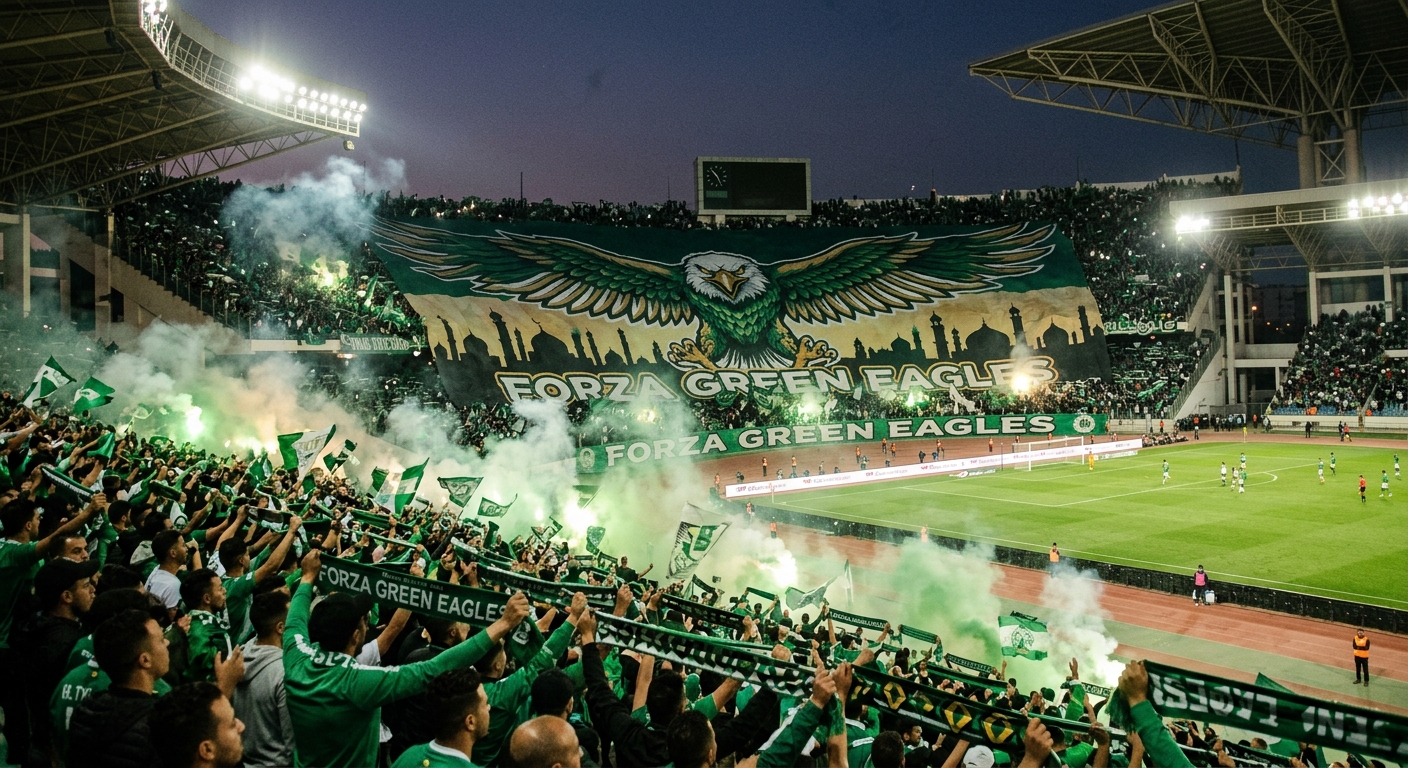
Raja play in green and white, colours that flood the Stade Mohammed V on match days and give rise to one of the club's nicknames, the Green Eagles or, in French, les Aigles Verts. The eagle is a recurring symbol in the club's iconography and its supporters' displays.
The club is also known affectionately by its supporters and across Morocco simply as Raja, a name that carries enormous cultural weight. To say you support Raja in Casablanca is to make a statement about identity, neighbourhood and class as much as about football.
Raja's home is the Stade Mohammed V, shared with arch-rivals Wydad, a curious arrangement that means the two great Casablanca clubs occupy the same ground. This shared home intensifies the local rivalry, with each derby effectively a battle for ownership of the city's central stadium.
The visual culture surrounding Raja — its green tifos, its eagle motifs, its choreographed stands — has made the club instantly recognisable across Africa and a frequent feature in compilations of the world's most spectacular football atmospheres.
Domestic Dominance
On the domestic front Raja has been a perennial force in the Botola Pro, accumulating a substantial collection of national league titles across the decades. The club has frequently traded the championship with rivals Wydad and AS FAR Rabat, and its periods of dominance have produced some of Moroccan football's most celebrated teams.
Beyond the league, Raja has also lifted the Moroccan Throne Cup, the country's premier knockout competition, on multiple occasions. Cup success has added to the club's trophy cabinet and reinforced its status as a habitual contender for every domestic honour available.
Raja's consistency at the top of Moroccan football has made it one of the two clubs — alongside Wydad — that define the competitive landscape of the Botola. A season without Raja challenging for honours is the exception rather than the rule.
The club's domestic success has provided the platform for its continental adventures. Strong Botola campaigns secured the qualification berths that allowed Raja to test itself against the best clubs in Africa, where it would go on to make history.
Continental Glory
Raja's greatest achievements have come on the African stage. The club has won the CAF Champions League, the premier continental club competition, on multiple occasions, establishing itself as one of the most successful clubs in the history of African football. These triumphs cemented Raja's reputation far beyond Morocco's borders.
Raja's first continental crown came in the late 1980s, and further Champions League successes followed in the following decades, with the club's green-and-white colours becoming familiar in finals across the continent. Each triumph was greeted with euphoric celebrations on the streets of Casablanca.
Beyond the Champions League, Raja has collected other continental honours including the CAF Confederation Cup, demonstrating versatility across Africa's club competitions. This breadth of continental silverware places Raja among the elite of African club football.
Raja also earned a place in global football folklore through its participation in the FIFA Club World Cup. When the tournament was hosted in Morocco, Raja famously progressed to the final, defeating illustrious opposition along the way before falling to European champions in the showpiece — a run that announced the club to a worldwide audience.
The Club World Cup Run
One of the defining moments in Raja's modern history came at the FIFA Club World Cup staged in Morocco in 2013. As host-nation representatives, Raja embarked on a remarkable run that captured the imagination of fans across Africa and the Arab world.
Raja overcame opponents from multiple confederations to reach the final, a stunning achievement for a club from the African domestic game competing against continental champions from around the globe. The run included a famous victory over the South American champions in the semi-final, sending Casablanca into raptures.
In the final Raja met Bayern Munich, the reigning European champions and one of the most formidable club sides on the planet. Although Raja ultimately lost, the team competed with pride and the very fact of reaching the final remains a high-water mark for Moroccan and African club football.
The Club World Cup run elevated Raja's global profile and reinforced the belief within Moroccan football that its clubs could compete on the biggest stages. For Raja's supporters it remains a cherished chapter in the club's storied history.
The Ultras and Fan Culture
Raja's supporter base is among the largest and most passionate in Africa, and its ultras groups have achieved international renown. The Green Boys and Ultras Eagles are at the forefront of the club's terrace culture, producing elaborate tifo displays, relentless chanting and a wall of sound that defines Raja's home matches.
Raja's ultras are notable not only for their visual spectacle but for the cultural reach of their songs. Chants composed in the stands have crossed over into wider Moroccan society, with some becoming anthems that articulate social and economic frustrations far beyond the world of football.
This phenomenon underlines how Raja transcends sport. The club functions as a focal point for working-class identity and collective expression in Casablanca, and its supporters carry that identity with fierce pride at home and away matches alike.
The intensity of Raja's support, while a defining strength, has also brought challenges around crowd management and security, leading authorities at times to impose restrictions. Nonetheless, the energy of the Raja faithful remains one of the great spectacles of African football.
The Casablanca Derby
No fixture defines Raja more than the Casablanca Derby against Wydad Athletic Club. Played between the two great clubs of the same city — and in the same stadium — the derby is among the most heated and atmospheric matches anywhere in world football, regularly cited alongside the great derbies of South America and Europe.
The rivalry carries layers of social meaning. While both clubs draw enormous support across Casablanca, their histories and self-images differ, and the derby becomes a contest for the soul of the city. The build-up consumes Casablanca for days, and the match itself is an event of huge social significance.
On the pitch the derby has produced countless dramatic moments, and the result reverberates through the city for weeks afterward. Bragging rights are fiercely contested, and a derby victory can define an entire season for either set of supporters regardless of league position.
In the stands the derby reaches its visual peak, with both sets of ultras unleashing their most ambitious choreographies. The images of green and red filling opposite ends of the Stade Mohammed V have become emblematic of the passion of Moroccan and African football.
Famous Players and Coaches
Over its long history Raja has been represented by a succession of celebrated Moroccan footballers, many of whom went on to star for the national team. The club has served as a launchpad for talents who progressed to careers abroad as well as a home for revered figures who became club legends.
Raja's successful continental campaigns were built on teams featuring gifted Moroccan internationals and shrewd recruitment of African talent. The club's identity as a producer and platform for Moroccan players has remained consistent across generations.
On the touchline Raja has been guided by a mix of Moroccan and foreign coaches, with the demands of the job famously intense given the club's enormous expectations and passionate following. Managing Raja is one of the most high-pressure roles in African club football.
The club's youth structures have also contributed players to the broader Moroccan game, reinforcing Raja's role not just as a winner of trophies but as a contributor to the national footballing ecosystem that ultimately fed Morocco's rise on the world stage.
Raja in the Modern Era
In recent seasons Raja has continued to compete for domestic and continental honours, adding to its trophy collection and maintaining its position as one of the standard-bearers of Moroccan football. The club remains a regular participant in CAF competitions, where its pedigree commands respect across the continent.
The modernisation of Moroccan football — improved stadiums, professionalisation of the Botola, and the national team's rising profile — has provided a favourable backdrop for Raja. The club's global brand, built on decades of success and its famous fanbase, gives it commercial potential that few African clubs can match.
Like many clubs of its size and history, Raja has navigated periods of administrative and financial turbulence, but its enormous support base and institutional weight have always carried it through. The hunger for further continental glory remains undiminished among supporters.
As Morocco prepares to co-host the 2030 World Cup and continues to invest heavily in football, Raja stands to benefit from the elevated profile of the Moroccan game. The Green Eagles remain ambitious to add to a trophy haul that already ranks among the most impressive on the African continent.
Why Raja Matters
Raja Club Athletic is far more than a football team. It is a cultural institution that embodies the spirit and aspirations of Casablanca's working communities, a symbol that has carried meaning through the late colonial period, independence and the decades since.
On the pitch the club's record speaks for itself: multiple continental titles, a haul of domestic championships and cups, and a Club World Cup final appearance that placed it among the global elite for one unforgettable tournament. Few African clubs can boast a comparable trophy cabinet.
Off the pitch, Raja's fan culture is a phenomenon in its own right, its songs and choreographies influencing how the world perceives African football atmospheres and even spilling into wider social discourse. The club's reach extends well beyond the touchline.
For anyone seeking to understand Moroccan football — its passion, its history and its global ambitions ahead of the 2030 World Cup — Raja Casablanca is an essential chapter. The Green Eagles remain one of Africa's grandest and most beloved clubs.
| Attribute | Detail |
|---|---|
| Founded | 20 March 1949 |
| City | Casablanca, Morocco |
| Nickname | Green Eagles (Aigles Verts) |
| Colours | Green and white |
| Home stadium | Stade Mohammed V (shared with Wydad) |
| Main ultras | Green Boys, Ultras Eagles |
| Major continental honour | CAF Champions League (multiple titles) |
| Global highlight | 2013 FIFA Club World Cup finalist |
Raja Casablanca key facts
FAQ
When was Raja Casablanca founded?
Raja Club Athletic was founded on 20 March 1949 in the working-class districts of Casablanca, establishing itself early on as a club of the people.
How many CAF Champions League titles has Raja won?
Raja has won the CAF Champions League multiple times, placing it among the most successful clubs in the history of African football, with its first triumph coming in the late 1980s.
What was Raja's run at the 2013 Club World Cup?
As host-nation representatives at the 2013 FIFA Club World Cup in Morocco, Raja reached the final by beating clubs from several confederations, including the South American champions, before losing to European champions Bayern Munich.
Who are Raja's biggest rivals?
Raja's fiercest rivals are Wydad Athletic Club, their Casablanca neighbours. The two clubs share the Stade Mohammed V and contest the Casablanca Derby, one of the most intense fixtures in world football.
Why is Raja called a "people's club"?
Raja emerged from Casablanca's working-class neighbourhoods and has always drawn its support from ordinary citizens. Its populist identity, reinforced by its name meaning "hope" and its socially conscious ultras culture, distinguishes it within Moroccan football.
Loved this? Useful? React below — your feedback helps other readers.