Raï Music in Morocco: How Oujda Became a Second Home for Algeria's Rebel Sound
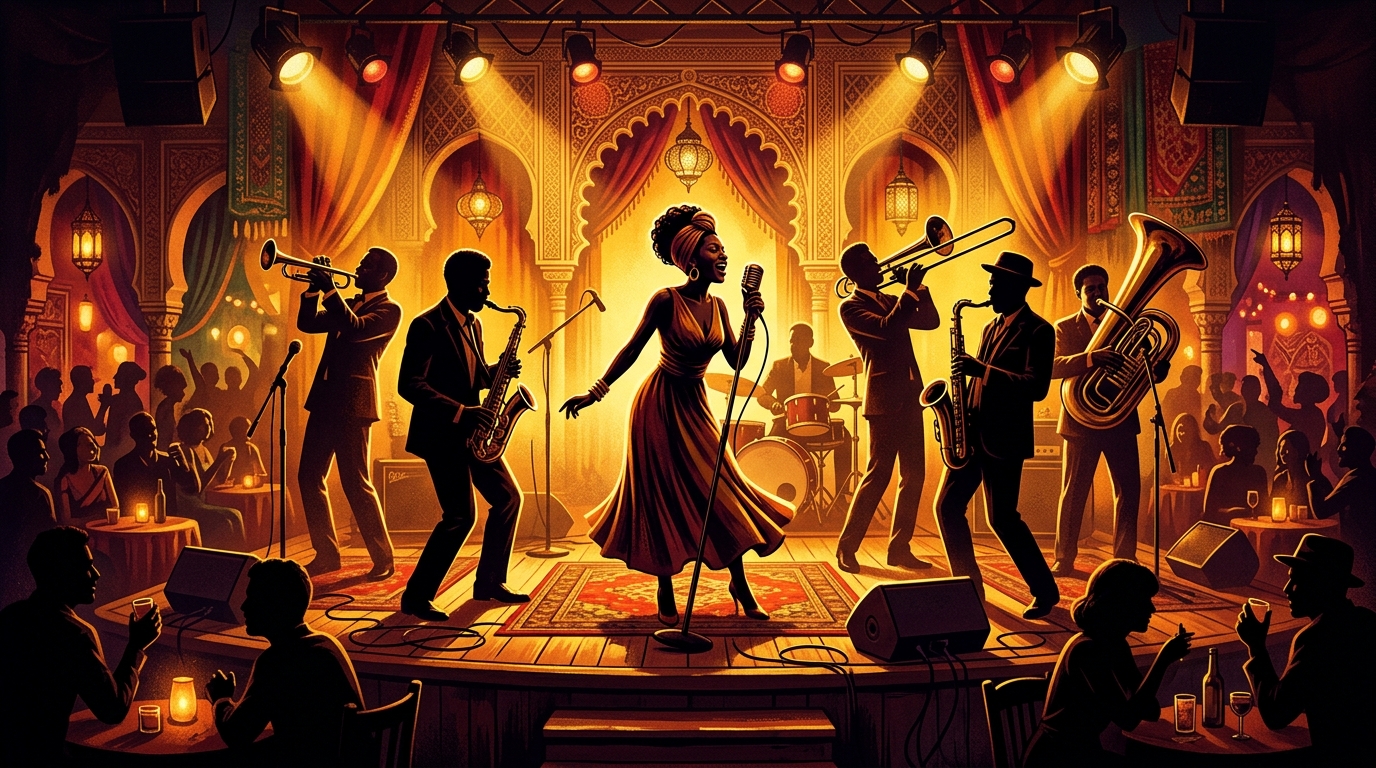
Born in Oran: the origins of raï
Raï's roots trace to Oran, Algeria's great western port city, in the 1920s, where itinerant singers performed for the poor and the socially marginalized in rural shrines, cafés and bars. The genre's name comes from the Arabic word for "opinion" or "view," a term singers would repeat as a kind of vocal punctuation while improvising verses on the spot — commentary on love, hardship, colonial-era police harassment, disease and daily survival.
The tradition's earliest stars were known as cheikhs (male) and cheikhas (female), performers who were frequently social outcasts themselves, singing frankly about subjects — wine, desire, marginal urban life — that ran against conservative norms. Cheikha Rimitti (1923-2006), often called the mother of raï, became one of the style's most influential figures from the early 1940s onward, helping shape what would become raï's defining blend of blunt lyricism and swaying, danceable melody.
A younger generation of performers later adopted the titles cheb (young man) and cheba (young woman) specifically to mark their distance from the older cheikh tradition, even as they built directly on its foundation. It was this cheb generation — most famously Cheb Khaled, crowned "King of Raï" at Oran's first official raï festival in 1985 — that would carry the genre out of Algeria and onto the world stage.
Because it dealt frankly with subjects considered taboo, raï had an uneasy relationship with authority from the start. It was often performed at weddings and private gatherings rather than sanctioned public events for much of the 20th century, and some of its most prominent singers faced serious risk for their work: Cheb Hasni, a hugely popular star of romantic raï, was murdered in Oran in 1994, in an act widely linked to the genre's contested, provocative reputation during a period of intense political violence in Algeria. That history has made raï, for many of its listeners on both sides of the border, as much a symbol of defiance as a style of party music.


From accordion and violin to synth-pop raï
Raï's instrumentation has shifted dramatically across its history. The earliest style leaned on the gasba, a simple reed flute, and the derbouka, a goblet-shaped hand drum, backing largely unaccompanied vocal lines built for outdoor and shrine settings. By the mid-20th century, that older, folk-rooted sound was increasingly supplemented, and in many recordings replaced, by violin and accordion, giving raï a fuller, more melodic, more "citadin" (urbanized) character as it moved from rural shrines into Oran's cafés and cabarets.
The modern "pop raï" sound that made the genre internationally famous, associated above all with Cheb Khaled from the 1980s onward, layered electric guitars, synthesizers and drum machines over the same vocal traditions, producing the polished, danceable style heard on global hits. Khaled's 1992 breakthrough "Didi" and his 1996 hit "Aïcha" exemplify that pop-raï sound, and Cheb Mami's 2000 collaboration with Sting on "Desert Rose" — which reached number 15 on the UK singles chart — brought the genre to one of its widest Western audiences yet.
Whichever instrumentation era a given recording comes from, raï's throughline has stayed remarkably consistent: frank, often provocative lyrics about love, longing, alcohol and the difficulties of everyday life, delivered over music built to be danced to rather than simply listened to. That consistency of subject matter, layered onto constantly updated production, is a large part of why the genre has managed to stay commercially relevant across roughly a century, from acoustic gasba recordings to Auto-Tuned club remixes played at weddings today.
Oujda: raï's Moroccan home on the border
Oujda sits in Morocco's Oriental region, a few dozen kilometers from the Algerian border and from Oran itself, and it shares deep linguistic, family and cultural ties with the Algerian side of that border — ties that long predate the modern border and that made raï's cross-border spread almost frictionless. Local dialect, musical taste and social life in Oujda have historically had more in common with western Algeria than with Morocco's Atlantic coast, and raï became one of the clearest expressions of that shared cultural zone.
That connection is now institutionalized. The International Festival of Raï launched in Oujda in 2007, organized by the local association Oujda Raï with the ambition of making the city the first in the Maghreb to host an international festival dedicated to the genre. Its first edition, held that July, featured Algerian stars Cheb Khaled and Cheb Bilal alongside the Algero-French act Group 113 and France's Orchestre National de Barbès; by its second edition in 2008 the lineup had expanded well beyond raï to include rap, R&B and electronic acts, reflecting how the festival — and Oujda's music scene generally — treats raï as the anchor of a broader regional sound rather than a museum piece.
The festival has since become one of the largest cultural draws in eastern Morocco, with organizers and local press describing crowds in the hundreds of thousands across its multi-day summer editions — a scale that reflects how central raï has become to Oujda's own cultural identity, not merely an imported Algerian import.
Beyond the festival itself, Oujda's everyday musical life reflects the same cross-border blend: local wedding bands and radio programming mix raï standards with Moroccan chaabi in a way that would sound unusual further west in Casablanca or Rabat but feels entirely ordinary in the Oriental region, where the two traditions have shared audiences, instruments and even performers for generations.

Whose music is it? The Morocco-Algeria raï dispute
Raï's cross-border popularity eventually produced a genuine diplomatic and cultural dispute. In August 2016, Algeria's National Center of Prehistoric, Historical and Anthropological Research formally applied to have raï recognized by UNESCO as Algerian intangible cultural heritage, describing it as a product of Oran's mix of Berber, Andalusian, African and Arab influences.
The move drew a swift response in Morocco, where commentators and cultural figures argued that the tradition, or elements closely related to it, existed in the border region "even before the creation of Algeria by the French colonist," as one Moroccan outlet put it at the time, and where the Oujda Raï association had itself hoped to see what it called "the Moroccan popular song" recognized as heritage in its own right, though Morocco's government did not pursue a competing formal UNESCO filing.
Ethnomusicologists studying the dispute generally point out that the border itself is a relatively recent colonial-era imposition across what was, for centuries, one continuous cultural and dialect zone, and that styles from both sides of it — Moroccan raguada rhythms and Algerian allaoui among them — likely fed into raï's development together rather than raï having a single, cleanly national origin point. The disagreement remains unresolved, and neither country has since completed a joint or unilateral UNESCO listing for the genre, but the argument itself has, if anything, only reinforced Oujda's role as raï's most visible Moroccan capital, since a city has to matter culturally before anyone bothers to fight over who it belongs to.
Raï's legacy in Moroccan popular music today
Raï's influence in Morocco extends beyond Oujda's festival calendar. Moroccan pop and chaabi artists in the country's eastern region have long absorbed raï's melodic sensibility and its synth-and-drum-machine pop production, and Moroccan audiences remain among the genre's most enthusiastic outside Algeria itself, filling concert halls for touring Algerian raï stars and supporting a homegrown scene of Moroccan singers working in a closely related style. Local Oujda-based bands routinely work both repertoires in a single set, moving from a straight Algerian raï classic into a Moroccan chaabi number without pausing, a fluency that outsiders often find surprising but that reflects nothing more than decades of shared airwaves and shared weddings across a border that, musically, has never been especially solid.
The genre's cross-border popularity has also fed into wider conversations about Maghreb identity in France, where large Algerian and Moroccan diaspora communities have supported raï's growth since the 1980s and 90s, turning it into one of the most internationally recognized North African music exports alongside Gnaoua and Chaabi. Whatever the outcome of the Algeria-Morocco heritage dispute, raï's day-to-day life in Oujda — packed festival grounds, wedding playlists, radio rotation — makes clear that the genre has been Moroccan as much as it has been Algerian for a very long time.
For visitors, Oujda in midsummer remains the clearest place to see that firsthand: a border city where an Algerian-born sound has become thoroughly, and proudly, its own — packed festival grounds by night, and by day, cafés where an older generation still argues, half-seriously, about exactly whose city, and whose century-old music, got there first.
Frequently asked
Where did raï music originate?
Raï originated in Oran, a port city in western Algeria, in the 1920s, among poor and marginalized communities performing in shrines, cafés and bars. Its name comes from the Arabic word for "opinion," used as a vocal refrain during improvised verses.
Why is raï music associated with Oujda, Morocco?
Oujda sits just across the Algerian border from Oran and shares deep dialect, family and cultural ties with western Algeria. Those ties allowed raï to spread into the city naturally, and Oujda has hosted its own International Festival of Raï since 2007.
Who are the most famous raï singers?
Cheikha Rimitti (1923-2006), known as the mother of raï, was one of its founding figures. Cheb Khaled, crowned "King of Raï" in 1985, became its biggest international star, followed by artists like Cheb Mami and Cheb Hasni.
What instruments are used in raï music?
Early raï used the gasba (reed flute) and derbouka (hand drum). By the mid-20th century, violin and accordion became central to the sound, and from the 1980s onward, modern pop raï added electric guitars, synthesizers and drum machines.
What does "cheb" and "cheikh" mean in raï music?
Cheikh (male) and cheikha (female) refer to raï's older generation of performers. Cheb (young man) and cheba (young woman) describe the younger generation, like Cheb Khaled and Cheb Mami, who adopted these titles partly to distinguish themselves from the older tradition.
What is the International Festival of Raï in Oujda?
Launched in 2007 by the local association Oujda Raï, it was conceived as the first international festival in the Maghreb dedicated to raï music. Its debut edition featured Cheb Khaled, Cheb Bilal and France's Orchestre National de Barbès, and it has since grown into one of eastern Morocco's largest cultural events.
Is raï music Algerian or Moroccan?
Raï's documented origins are in Oran, Algeria, but the genre developed in a border region where Moroccan and Algerian musical styles overlapped for centuries. Morocco and Algeria have publicly disputed the genre's heritage status since Algeria applied for UNESCO recognition in 2016.
What was the 2016 raï heritage dispute between Morocco and Algeria?
In August 2016, Algeria applied to UNESCO to have raï recognized as Algerian intangible cultural heritage. Moroccan commentators and the Oujda Raï association objected, arguing the tradition also has deep roots on the Moroccan side of the border, particularly around Oujda.
What is "pop raï"?
Pop raï is the modern, internationally popular version of the genre that emerged from the 1980s onward, layering electric guitars, synthesizers and drum machines over raï's traditional vocal style. Cheb Khaled's "Didi" (1992) and "Aïcha" (1996) are among its best-known examples.
How did raï reach Western audiences?
Raï spread internationally through Algerian and Moroccan diaspora communities in France from the 1980s and 90s onward. Its highest-profile Western crossover came with Cheb Mami's 2000 collaboration with Sting on "Desert Rose," which reached number 15 on the UK singles chart.
- Wikipedia — Raï ↗
- Wikipedia — Cheikha Rimitti ↗
- Wikipedia — Khaled (musician) ↗
- Morocco World News — Morocco and Algeria dispute over the origin of raï music ↗
- Wikipédia (FR) — Festival international du raï ↗
- Wikipedia — Oujda ↗
Video via official YouTube embeds; photos via Wikimedia Commons under their stated licenses. All rights belong to the respective owners; 212 Daily claims no ownership.