Rabat Travel Guide: Morocco's Capital
Why Visit Rabat
Rabat is often overlooked by travelers heading straight to Marrakech or Fez, but as the national capital it is clean, orderly, and notably relaxed, with much less hassle than other big Moroccan cities. Its blend of historic monuments, modern government buildings, and Atlantic beaches earned the city a UNESCO World Heritage listing in 2012 as a 'modern capital and historic city.'
It works well as a one- or two-day stop on the train line between Tangier, Fez, and Marrakech, and pairs naturally with neighboring Salé across the river. The pace here is gentler, the boulevards are wide and tree-lined, and the seafront promenade is a pleasant escape from the medina.
Kasbah of the Udayas
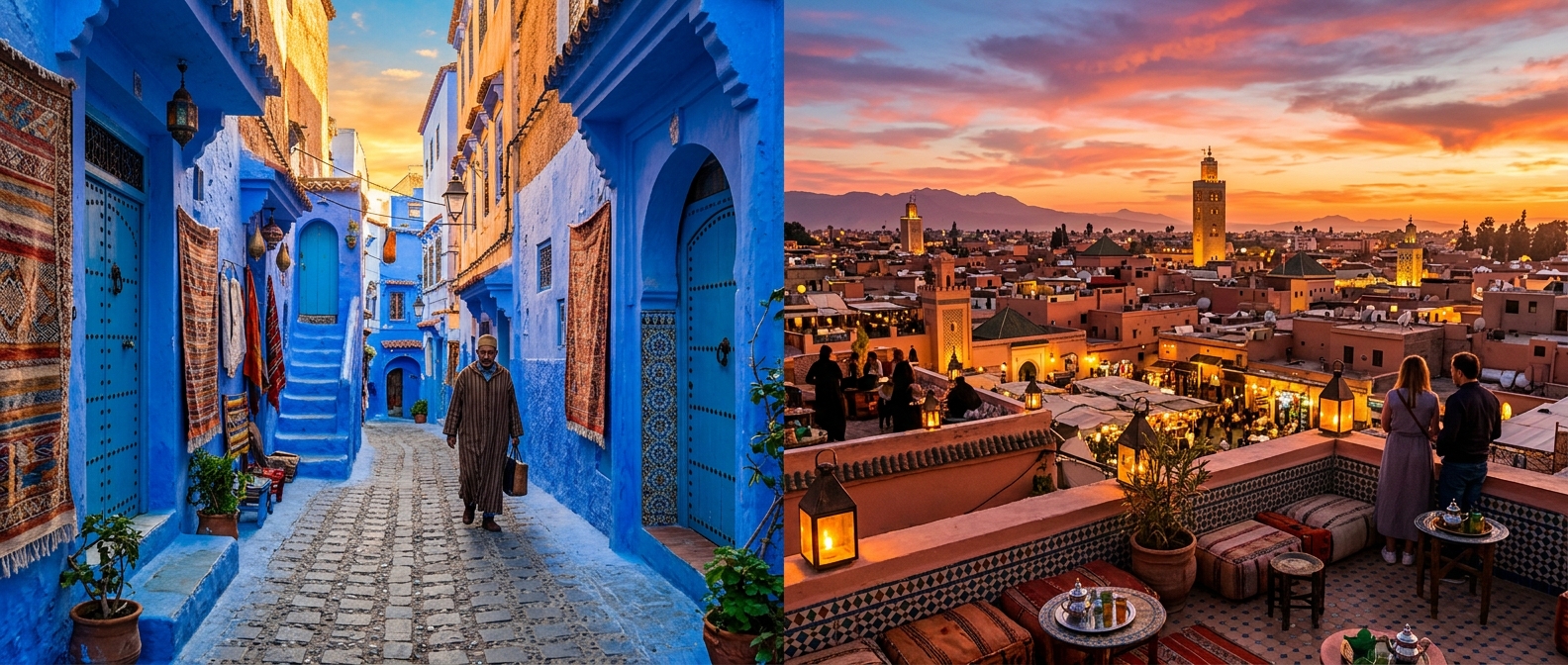
The Kasbah of the Udayas is Rabat's most photogenic quarter: a fortified 12th-century citadel of narrow lanes painted in blue and white, perched above the river mouth. Wander up to the Andalusian Gardens, sip mint tea at the cliff-top café overlooking the ocean, and admire the monumental Almohad-era gate, Bab Oudaia.
The kasbah is free to enter and pleasantly walkable, with viewpoints over the river toward Salé and out to the Atlantic. It is one of the few places in Morocco that genuinely rewards aimless wandering, and the blue-washed alleys make for excellent photos in the soft morning or late-afternoon light.
Hassan Tower and the Mausoleum
The Hassan Tower is Rabat's defining landmark: the unfinished minaret of a mosque begun in 1195 under the Almohad sultan Yacoub al-Mansour. The project was abandoned after his death, leaving a 44-metre tower (intended to be far taller) and a field of stubby columns where the prayer hall would have stood.
Facing it across the esplanade is the Mausoleum of Mohammed V, a masterpiece of modern Moroccan craftsmanship completed in 1971, holding the tombs of King Mohammed V and his sons. Non-Muslims may enter to view the richly decorated interior, and royal guards on horseback flank the entrances.
Chellah and the Medina
Chellah (also spelled Sala Colonia) is a walled necropolis built atop an ancient Roman town on the edge of the city. The atmospheric site combines Roman ruins, a medieval Islamic complex with minaret and tombs, lush gardens, and a famous colony of nesting storks, making it one of the most peaceful and unusual spots in Rabat.
Rabat's medina is smaller and far more manageable than Fez or Marrakech, with the long covered Rue des Consuls known for carpets and crafts. The adjoining Ville Nouvelle, laid out during the French Protectorate, has cafés, shops, and the impressive contemporary Mohammed VI Museum of Modern and Contemporary Art.
Where to Stay and Eat
For atmosphere, choose a riad in the medina or near the Kasbah of the Udayas. For modern comfort and easy transport links, the Hassan and Agdal districts in the Ville Nouvelle offer business-class hotels and a wide choice of restaurants, while the upscale Souissi area is leafy and residential.
Being on the coast, Rabat is strong on seafood; head to grilled-fish spots near the marina or in Salé's port area. The Ville Nouvelle has international restaurants and lively cafés, while the medina serves classic tagines, harira soup, and fresh bread at budget-friendly prices.
Getting There and Around
Rabat is exceptionally well connected by rail. The Al Boraq high-speed train links Tangier and Casablanca via Kenitra and Rabat, putting Casablanca around 50 minutes away and Tangier roughly an hour and a half. Standard ONCF trains continue to Fez, Meknes, and Marrakech.
Within the city, Rabat has a clean modern tramway connecting Rabat and Salé, plus blue petits taxis for short trips. The main sights cluster in a walkable area, so you can cover the kasbah, Hassan Tower, and medina largely on foot, using a taxi or tram only for Chellah or the new town.
| Detail | Information |
|---|---|
| Status | National capital, imperial city, UNESCO site |
| Signature landmark | Hassan Tower & Mohammed V Mausoleum |
| Most photogenic spot | Kasbah of the Udayas (blue & white) |
| Unique ruin | Chellah necropolis with storks |
| Fast train | Al Boraq to Casablanca (~50 min) |
| Local transport | Tramway + petits taxis |
Rabat at a glance
FAQ
Is Rabat worth visiting?
Yes, especially if you value a calm, low-hassle Moroccan city. Rabat offers world-class monuments, a manageable medina, an Atlantic seafront, and excellent train links, making it a refined one- or two-day stop.
How far is Rabat from Casablanca?
Rabat is about 90 km from Casablanca, reachable in roughly 50 minutes on the Al Boraq high-speed train or about an hour by road, making a day trip between the two cities easy.
What are the must-see sights in Rabat?
Prioritize the Kasbah of the Udayas, the Hassan Tower and Mohammed V Mausoleum, the Chellah necropolis, and a stroll through the medina and Rue des Consuls.
Is Rabat safe for tourists?
Rabat is considered one of Morocco's safest and most relaxed cities, with notably less aggressive touting than Marrakech or Fez. Normal urban precautions against petty theft still apply.
Loved this? Useful? React below — your feedback helps other readers.