Nayda: How a Casablanca Youth Movement Fused Rap, Rock and Gnaoua Into Modern Moroccan Music
What Nayda means, and where the name came from
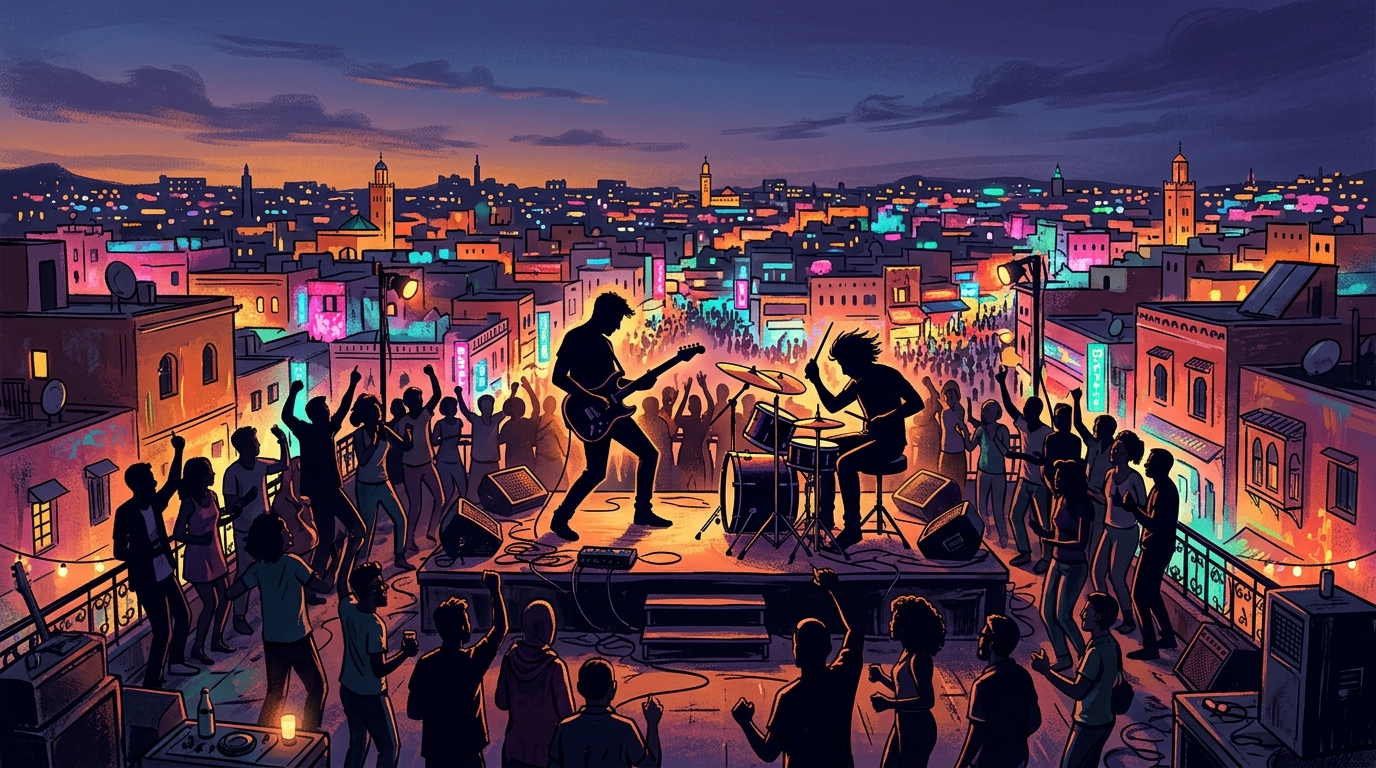
Nayda (sometimes transliterated Hayda) is a Darija term roughly meaning 'up,' 'rising' or 'in motion' — used colloquially to describe a lively, festive atmosphere. Journalists and critics adopted it in the 2000s as shorthand for a broader cultural shift: a new generation of Moroccan musicians drawing on local heritage while singing frankly, in their own dialect, about their own lives, and doing it in full public view rather than underground.
The movement is often compared to Spain's Movida, the explosion of youth culture and nightlife that followed the end of Francisco Franco's dictatorship in the mid-1970s. Nayda's own underground roots reach back to the mid-1990s, when small rock and hip-hop scenes began forming in Moroccan cities, but it was in the 2000s — after Mohammed VI's accession to the throne in 1999 — that the movement broke into the open and picked up its name.
What united the very different genres under the Nayda banner was less a shared sound than a shared attitude: young Moroccans, largely in Casablanca but also Rabat, Meknes and beyond, making music in Darija about real daily frustrations and hopes, freed from the more formal or state-sanctioned styles of Moroccan popular music that had dominated before them.
A generational opening under Mohammed VI
Nayda's timing was not a coincidence. Mohammed VI's arrival on the throne in 1999 brought a period of relative political and cultural opening compared to his father Hassan II's decades-long rule, including new private radio stations aimed at younger listeners and royal patronage for a wave of large public music festivals across the country. That climate gave young musicians more room, and more platforms, to be heard than the previous generation had.
The opening was real but not unconditional, and the movement's own history includes a sharp reminder of that. In February 2003, Moroccan police arrested fourteen young rock and metal fans — nine of them members of local heavy metal bands including Nekros, Infected Brain and Reborn — on charges connected to 'undermining the Muslim faith,' citing band T-shirts, imagery and Western-style dress as evidence of Satanism. Several were briefly jailed before the convictions were overturned on appeal, following public outcry and international attention. The episode became a rallying point precisely because it showed how contested the space for youth music culture still was, even as the scene grew.
Against that backdrop, the broader Nayda scene kept expanding through the 2000s: fusion bands, rappers and hard rock groups built real followings, government attitudes shifted from suspicion toward cautious acceptance, and by the end of the decade some of the same institutions that had once ignored or distrusted the scene were actively funding it.
L'Boulevard: the festival that built a movement
If Nayda has a birthplace, it is L'Boulevard (formally the Boulevard des Jeunes Musiciens, or Tremplin), founded in Casablanca in 1999 by Mohamed 'Momo' Merhari and Hicham Bahou. It began modestly, as a competition rewarding the best acts in three categories — hip-hop and rap, rock and metal, and fusion — giving young, self-taught musicians with no other real venue a stage, a crowd and a sense that their genres counted as legitimate Moroccan music.
L'Boulevard's importance was less about any single winner than about what it built: a shared space where rappers, metalheads, reggae musicians and fusion acts who might never otherwise have crossed paths performed on the same bills, met each other, and recognized themselves as part of one loosely connected scene. Acts including Don Bigg, H-Kayne, Fnaïre, Darga and Hoba Hoba Spirit all built early audiences through the festival.
The festival's own relationship with authority tracked Nayda's arc precisely: treated with suspicion or simply ignored in its earliest years, L'Boulevard eventually won official recognition, including a funding grant from King Mohammed VI in 2009. More than two decades on, it continues to run in Casablanca as a multi-day festival spanning hip-hop, rock, metal, fusion and electronic music, still positioning itself as a launchpad for new Moroccan talent.

The bands that defined the sound
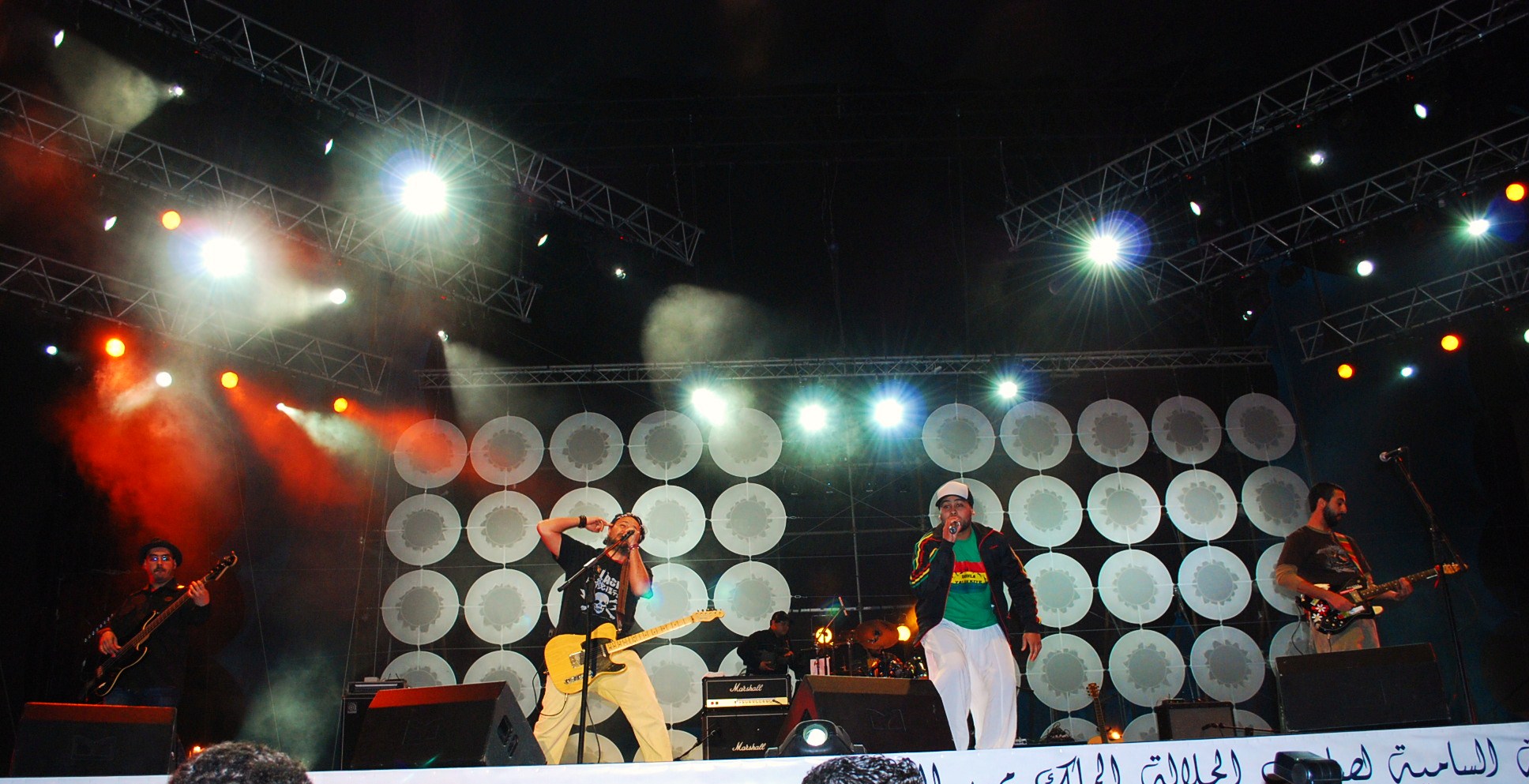
Hoba Hoba Spirit, formed in Casablanca in 1998 by Reda Allali, Anouar Zehouani, Adil Hanine, Saad Bouidi and Othmane Hmimar, became one of Nayda's flagship acts and one of Morocco's best-known bands internationally. Their sound blends rock, reggae and Gnawa trance with flashes of hard rock, sung mostly in Darija with French and occasional English, in a self-described style they call 'hayha' — chaos, spontaneity, pure vibes. Their 2007 album Trabando swept Maghreb Music Awards for best fusion artist, best album and best title track, and the band has remained a fixture of major Moroccan festivals including Mawazine in Rabat and the Gnaoua and World Music Festival in Essaouira.
Darga, formed in Casablanca in 2001 by art-school students, built a sound around Gnawa fused with reggae and other African and world-music influences, positioning themselves explicitly as custodians of Moroccan musical heritage even while borrowing freely from outside it — their name translates roughly as 'cactus.' H-Kayne, formed in Meknes in 1996, is widely considered the single most influential Moroccan rap group of its era, helping establish Darija-language hip-hop as a serious commercial and cultural force well before rap's later mainstream boom.
Fnaïre, a hip-hop group formed in Marrakech in 2001, pushed the fusion idea in its own direction, blending Western rap with Marrakshi folk, Issawa, Sahrawi and Amazigh musical traditions into a style sometimes called Ta9lidi ('traditional') rap — widely seen as a founding strand of what later became known more broadly as Morap, Moroccan-style hip-hop. The group broke through nationally in 2004 with 'Mat9ich Bladi' ('Don't Touch My Country'), a solidarity anthem released in response to the May 2003 Casablanca bombings that received heavy airplay across Moroccan radio and television. Alongside Fnaïre, rappers such as Don Bigg (Mafia C) and Muslim became, in the words of contemporary reporting, flagships of what the francophone Moroccan press had started calling a genuine musical revolution.
What tied these otherwise very different acts together was less genre than geography and generation: nearly all of them came up through the same handful of Casablanca-centered venues and competitions, above all L'Boulevard, at almost exactly the same historical moment.

Nayda's lasting influence on Moroccan pop culture
Nayda's most durable legacy may be linguistic as much as musical: it normalized Darija, rather than French, classical Arabic or imported English and American slang, as a fully legitimate language for ambitious, publicly celebrated Moroccan pop music. That shift opened the door for the wave of Darija-language rap, fusion and independent music that has continued to grow across Morocco in the years since, carried by artists who took the earlier generation's basic premise — sing about your own life, in your own voice, in your own language — largely for granted.
The movement also normalized genre fusion itself as a Moroccan musical default rather than an exception. Blending Gnaoua's trance rhythms with reggae, rock with Amazigh melody, or rap with traditional Moroccan percussion stopped being a novelty act and became simply how a large share of contemporary Moroccan popular music operates — a direct throughline from Hoba Hoba Spirit and Darga's early fusion experiments to much of today's scene.
Institutionally, Nayda's rise also reshaped how the Moroccan state related to youth culture, moving from the wary, occasionally punitive posture of the early 2000s toward active sponsorship of festivals and platforms for exactly the kind of music that had once been treated with suspicion. L'Boulevard's own trajectory, from ignored underground competition to royally funded institution, is the clearest single illustration of how far that relationship moved — and of how thoroughly a scrappy youth movement ended up changing the mainstream around it.
Several of the movement's original figures also became public voices well beyond music. Hoba Hoba Spirit's Reda Allali, for instance, has written a satirical weekly column for the Moroccan newsmagazine TelQuel since 2002, running in parallel with his two-decade career fronting the band — part of a broader pattern in which Nayda-generation musicians moved from underground stages into mainstream Moroccan cultural and media life. That crossover is further evidence that what began as a scrappy festival circuit for outsider genres ended up shaping the country's wider cultural conversation, not just its record shelves.
Frequently asked
What does 'Nayda' mean?
Nayda is a Darija (Moroccan Arabic) word meaning roughly 'up,' 'rising' or 'on the move,' commonly used to describe a lively, festive atmosphere. It became the name attached to Morocco's 2000s youth music movement.
What is the Nayda movement?
Nayda was a 2000s Moroccan youth music movement that fused rap, rock, metal, reggae and Gnaoua trance music, largely sung in Darija, incubated in venues and competitions like Casablanca's L'Boulevard festival and linked to a broader period of cultural opening under King Mohammed VI.
When and why did Nayda emerge?
Nayda's underground roots date to the mid-1990s, but it broke into wider public view in the 2000s, following Mohammed VI's accession to the Moroccan throne in 1999 and the relative political and cultural liberalization — including new youth radio stations and festival sponsorships — that followed.
What is L'Boulevard and why does it matter to Nayda?
L'Boulevard (formally the Boulevard des Jeunes Musiciens) is a Casablanca music festival and competition founded in 1999 by Mohamed 'Momo' Merhari and Hicham Bahou. It became the primary platform uniting Nayda-era rappers, rock, metal and fusion acts, launching artists including Don Bigg, H-Kayne, Fnaïre, Darga and Hoba Hoba Spirit.
Who are the key bands and artists associated with Nayda?
Key acts include Hoba Hoba Spirit (rock, reggae and Gnawa fusion, Casablanca, formed 1998), Darga (Gnawa-reggae fusion, formed 2001), H-Kayne (rap, formed in Meknes in 1996), Fnaïre, and rappers Don Bigg and Muslim.
What is Hoba Hoba Spirit's musical style?
Hoba Hoba Spirit blends rock, reggae and Gnawa trance music with elements of hard rock, singing mostly in Darija with French and occasional English. They call their approach 'hayha,' meaning chaos and pure vibes, and their 2007 album Trabando won three Maghreb Music Awards.
Was there ever backlash against Nayda-era musicians?
Yes. In February 2003, fourteen young rock and metal fans, including members of bands Nekros, Infected Brain and Reborn, were arrested and initially convicted on morality and religion-related charges tied to their music and dress. The convictions were overturned on appeal after public and international pressure.
How did the Moroccan government's relationship with the scene change?
Attitudes shifted from suspicion and occasional prosecution in the early 2000s to cautious acceptance and eventual sponsorship. L'Boulevard, once operating with no official support, received a funding grant from King Mohammed VI in 2009 and continues to run as an established festival today.
How is Nayda connected to the Movida in Spain?
Commentators have compared Nayda to Spain's Movida, the youth cultural explosion that followed the end of Francisco Franco's dictatorship in the mid-1970s — both movements marking a burst of youth-driven cultural expression following a political opening.
What is Nayda's lasting influence on Moroccan music today?
Nayda normalized Darija as a language for mainstream Moroccan pop music and made genre fusion — blending Gnaoua, reggae, rock and rap — a common default rather than a novelty, shaping the sound and language of much of Morocco's independent and popular music since.
- Wikipedia — L'Boulevard ↗
- Wikipedia — Hoba Hoba Spirit ↗
- Wikipedia — Darga (band) ↗
- Foreign Policy — Nayda: Morocco's Musical Revolution ↗
- Wikipedia — Moroccan hip-hop ↗
- Wikipedia — Fnaire ↗
Video via official YouTube embeds; photos via Wikimedia Commons under their stated licenses. All rights belong to the respective owners; 212 Daily claims no ownership.