Mustapha Hadji: Morocco's 1998 Golden Ball
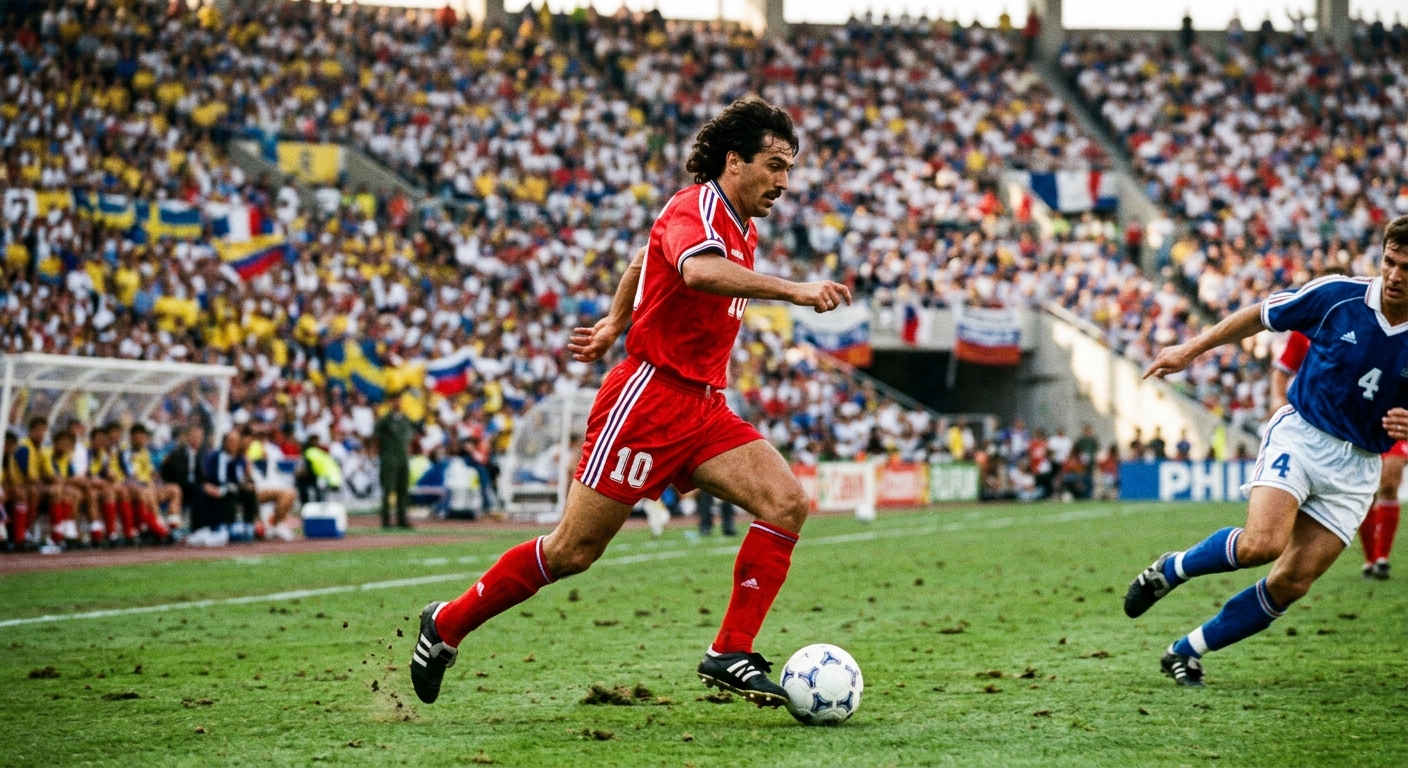
The Artist of Moroccan Football
If Noureddine Naybet was the defensive rock of Moroccan football, Mustapha Hadji was its artist. A gifted attacking midfielder blessed with flair, vision, and technical brilliance, Hadji embodied the creative, expressive side of the Moroccan game. At his peak, he was capable of moments of magic that could decide matches and lift crowds to their feet.
Hadji's brilliance reached its zenith in 1998, when he starred for Morocco at the World Cup in France and was subsequently named African Footballer of the Year. That honor placed him among the elite of the continent's players and cemented his status as one of the finest footballers Morocco has ever produced.
This profile celebrates the career of a true Moroccan icon: his rise as a creative force, his impact on the international stage, his journeyman career across some of Europe's biggest leagues, and the enduring legacy of a player whose elegance and impact made him beloved by fans across Morocco and beyond.
A Creative Talent Emerges
Hadji emerged as a player of rare creative gifts, marked out by his technical ability, close control, and vision. An attacking midfielder who could also operate on the wing, he possessed the kind of flair that set him apart, the ability to beat defenders, deliver incisive passes, and produce the unexpected.
His talent earned him opportunities in European football, where he developed into a sophisticated creative force. Comfortable in possession and capable of unlocking defenses with a single moment of inspiration, Hadji became the kind of player around whom attacks could be built and matches could turn.
From his early development, it was clear that Hadji possessed something special. His blend of technique and imagination marked him as a potential star, and he would go on to fulfil that promise both for his clubs across Europe and, most memorably, for the Moroccan national team on the biggest stage of all.
Starring at the 1998 World Cup
The 1998 World Cup in France was the stage on which Mustapha Hadji announced himself to the world. As Morocco competed in a campaign that brought them tantalizingly close to the knockout round, Hadji was the creative heartbeat of the team, producing performances of skill and influence that captured global attention.
Hadji's contributions, including memorable goals and moments of brilliance, lit up Morocco's tournament. Although the Atlas Lions were ultimately eliminated on the finest of margins at the group stage, Hadji's individual displays stood out as among the highlights of Morocco's campaign and of the tournament for African football.
His outstanding performances at that World Cup were the catalyst for his crowning individual honor. The combination of his impact in France and his quality throughout the year earned Hadji the African Footballer of the Year award for 1998, a recognition of his status as the finest player on the continent that season.
African Footballer of the Year 1998
Being named African Footballer of the Year for 1998 was the defining individual achievement of Hadji's career and one of the proudest moments in Moroccan football. The award placed him among an elite group of Moroccans to have received the continent's most prestigious individual honor, following in the footsteps of Ahmed Faras, Mohamed Timoumi, and Badou Zaki.
The recognition affirmed what fans across Morocco and Africa already knew: that Hadji was a player of genuine world class, a creative talent capable of competing with the best in the global game. The award validated his brilliant World Cup and his quality throughout a stellar year.
For Moroccan football, Hadji's honor was a source of immense pride, reinforcing the nation's standing as a producer of top continental talent. It marked Hadji as a worthy successor to the legends who had come before and secured his place in the pantheon of Moroccan footballing greats.
A Distinguished European Journey
Hadji enjoyed a rich and varied club career that took him across some of Europe's biggest footballing nations. He plied his trade in France, Portugal, Spain, Germany, and England, adapting to the differing demands and styles of each league and showcasing his talent on a broad European stage.
His time in these leagues exposed him to top-level competition and a range of footballing cultures, enriching his game and demonstrating his versatility. In England, his flair and technical ability won admirers, while across the continent his creative quality made him a valued performer wherever he played.
This journeyman career reflected both Hadji's talent and his adaptability. Few players successfully navigate so many different leagues, and Hadji's ability to do so underlined his quality and professionalism. His European odyssey added breadth and depth to a career that had already been illuminated by his international heroics.
Style of Play and Signature Qualities
Hadji's game was defined by elegance and invention. He had the technical ability to control and manipulate the ball in tight spaces, the vision to spot and execute incisive passes, and the flair to produce the spectacular. Defenders found him difficult to contain because of his unpredictability and creative range.
He was also capable of producing goals, including strikes of high quality from distance and in big moments. His combination of creativity and a goal threat made him a complete attacking midfielder, the kind of player who could both create chances for others and finish them himself.
Above all, Hadji played with a sense of artistry that endeared him to fans. He was a footballer who entertained as well as influenced results, the embodiment of the creative, expressive tradition in Moroccan football. That blend of substance and style is what made him so beloved and so memorable.
A Footballing Family
Hadji's contribution to football extended into the next generation through his family. His son Sami Hadji also pursued a footballing career, continuing the family's involvement in the game and underscoring Mustapha's lasting connection to the sport he graced with such distinction.
The Hadji name became synonymous with Moroccan footballing talent, and Mustapha's legacy as a player set a high bar. The passing of footballing ambition through the family reflects the deep roots that the sport puts down in those who excel at it, and the way legends like Hadji shape the generations that follow.
Beyond his own family, Hadji served as an inspiration to countless young Moroccan players who saw in his career a model of what was possible: a flair player from Morocco competing at the highest level of European and international football and being recognized as the best on the continent.
Service to the National Team
For the Moroccan national team, Hadji was a central figure during a notable era, providing the creative spark that the Atlas Lions relied upon. He represented his country with distinction at the World Cup and through continental campaigns, consistently delivering the quality and imagination that set Morocco's attack apart.
His role as a creative leader complemented the defensive solidity provided by players like Naybet, giving Morocco a balanced and competitive side during the 1990s. The combination of Hadji's flair and the team's organization made Morocco a respected and dangerous opponent on the international stage.
Hadji's commitment to the national cause and his big-game performances, most notably at the 1998 World Cup, endeared him to Moroccan fans. He carried the hopes of the nation with his creativity and earned a permanent place in the affections of supporters who cherished his ability to produce moments of magic.
Legacy and Influence
Mustapha Hadji's legacy in Moroccan football is that of a creative genius who reached the pinnacle of individual recognition. As one of only a handful of Moroccans to be named African Footballer of the Year, he occupies an elevated place in the nation's footballing history and is celebrated as one of its all-time greats.
His influence is felt in the creative tradition of Moroccan football, the lineage of flair players that has continued through to modern stars like Hakim Ziyech. Hadji demonstrated that Moroccan attacking talent could be recognized as the best on the continent, setting a standard for the creative players who followed.
Whenever Morocco's greatest-ever players or all-time XI are debated, Hadji's name features prominently as the embodiment of attacking artistry. His 1998 Golden Ball, his World Cup heroics, and his elegant style of play ensure that he remains one of the most cherished figures in the history of the Atlas Lions.
A Beloved Moroccan Icon
Few players have captured the affection of Moroccan football fans quite like Mustapha Hadji. His blend of flair, vision, and big-game impact, crowned by his 1998 African Footballer of the Year award, made him a hero to a generation and an enduring icon of the nation's game.
His career, spanning the World Cup stage and the major leagues of Europe, demonstrated both the depth of his talent and the breadth of his achievement. He was a player who could entertain and decide matches in equal measure, the creative jewel in Morocco's footballing crown during his peak years.
Today, Hadji is remembered with warmth and admiration as one of Morocco's greatest-ever players. The artist of his generation, the Golden Ball winner of 1998, and a symbol of the creative brilliance that has always run through Moroccan football, his legend remains undimmed in the memory of the nation he served with such distinction.
| Aspect | Detail |
|---|---|
| Position | Attacking midfielder / winger |
| Signature honor | African Footballer of the Year 1998 |
| Breakthrough stage | Starred at the 1998 World Cup in France |
| Club career | Played across France, Portugal, Spain, Germany, and England |
| Style | Flair, vision, technical brilliance, goal threat |
| Legacy | One of Morocco's greatest creative players |
Mustapha Hadji career highlights
FAQ
When did Mustapha Hadji win African Footballer of the Year?
Mustapha Hadji was named African Footballer of the Year in 1998, after his standout performances at that summer's World Cup in France.
What position did Mustapha Hadji play?
Hadji was an attacking midfielder who could also operate on the wing, known for his flair, vision, and technical brilliance.
Which leagues did Hadji play in?
Hadji enjoyed a distinguished club career across several major European nations, including France, Portugal, Spain, Germany, and England.
Why is Mustapha Hadji a Moroccan legend?
He combined dazzling creative talent with big-game impact, starred at the 1998 World Cup, and was named the best player in Africa that year, making him one of Morocco's greatest-ever players.
How does Hadji compare to modern Moroccan creators like Ziyech?
Hadji is seen as a forerunner in Morocco's tradition of flair attacking midfielders, a lineage of creative brilliance that continued through modern stars such as Hakim Ziyech.
Loved this? Useful? React below — your feedback helps other readers.