Morocco at the World Cup: Complete History
A Pioneering World Cup Nation
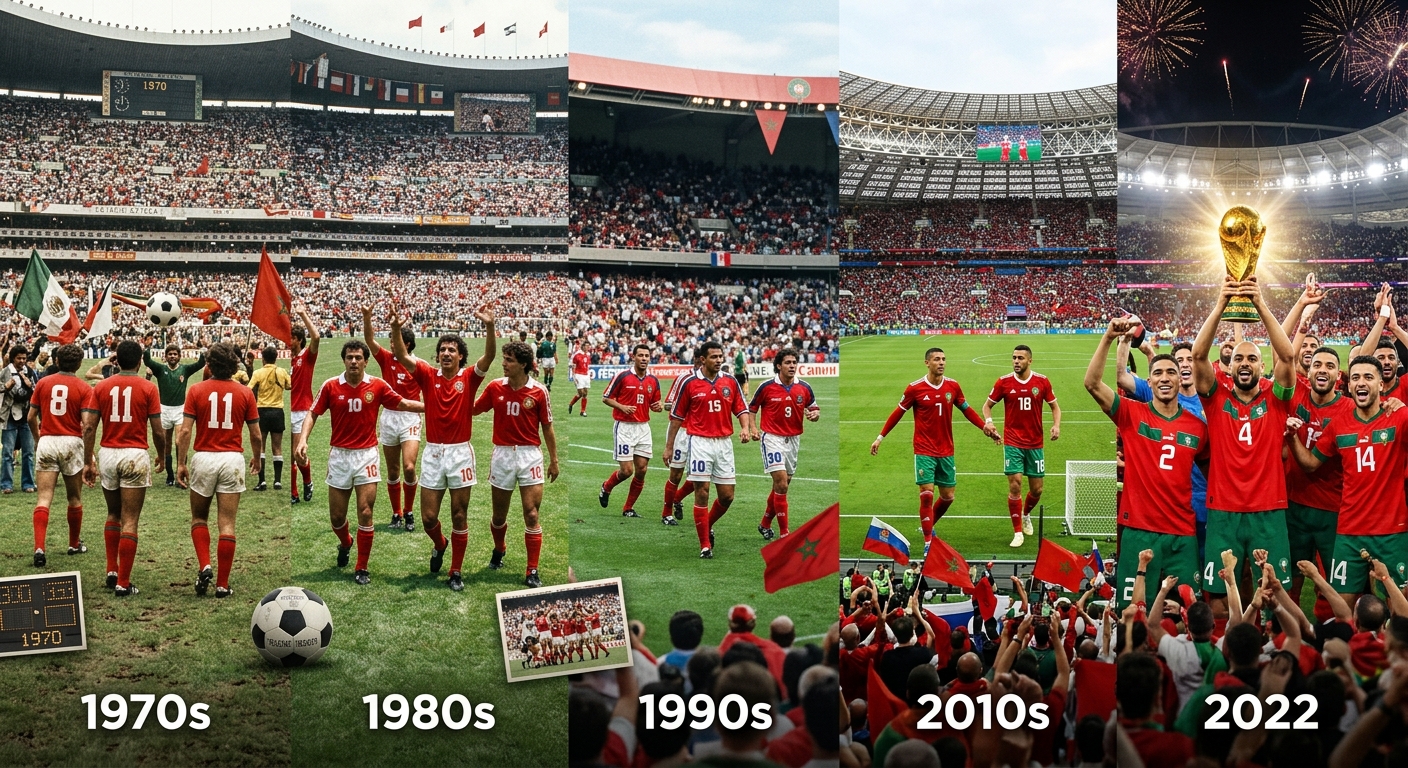
Morocco's relationship with the FIFA World Cup is one of the most compelling in African football history. The Atlas Lions have been trailblazers, repeatedly achieving firsts that opened doors not just for themselves but for an entire continent. From their pioneering debut in 1970 to their historic semifinal run in 2022, Morocco's World Cup story is one of steady, barrier-breaking progress.
Across their appearances, Morocco have established themselves as Africa's standard-bearers on the global stage. They were the first independent African nation of the modern era to qualify, the first African team to top a group and reach the knockout round, and the first African and Arab nation to reach a semifinal. Few nations can claim such a consistent record of historic achievement.
This complete history charts that journey: the brave debut, the lean years, the breakthrough of 1986, the heartbreak and near-misses, and the glorious culmination at Qatar 2022. It is the story of a nation that has repeatedly punched above its weight and inspired belief across Africa and the Arab world.
1970: The Pioneering Debut
Morocco's World Cup story began in 1970 in Mexico, where they became the first independent African nation of the modern era to compete at the finals. It was a landmark moment for African football, ending decades in which the continent had been largely absent from the global showpiece.
Drawn into a tough group, Morocco announced themselves in their opening match against West Germany, taking a surprise lead before the European powerhouse fought back to win. The Atlas Lions later earned a creditable draw, demonstrating that they could compete with established footballing nations despite their inexperience at this level.
While Morocco exited at the group stage, the 1970 appearance was hugely significant. It proved that African teams belonged at the World Cup and planted the seeds of belief that would grow into the historic achievements of later decades. Morocco had taken the first brave step, and the journey had begun.
1986: The Knockout Breakthrough
Sixteen years after their debut, Morocco returned to Mexico for the 1986 World Cup and produced one of the defining moments in African football history. Coached by Brazilian Jose Faria, the Atlas Lions were drawn into Group F alongside England, Poland, and Portugal, a daunting collection of European pedigree.
Morocco defied all expectations. They drew 0-0 with both Poland and England, the latter while England played with ten men, before producing a stunning 3-1 victory over Portugal. That win, featuring a brace from Abderrazak Khairi, sent Morocco to the top of the group, making them the first African team ever to advance past the World Cup group stage.
In the round of 16, Morocco pushed eventual finalists West Germany to the brink, holding them scoreless until an 88th-minute Lothar Matthaus free kick settled it 1-0. The Atlas Lions departed with their heads high, having shattered a barrier that had stood since Africa first appeared at the World Cup and inspiring a generation across the continent.
1994: Return to the Global Stage
Morocco qualified for the 1994 World Cup in the United States, returning to the global stage with a squad featuring emerging talents who would become national icons, including Mustapha Hadji and Noureddine Naybet. Expectations were high after the heroics of 1986, but the tournament proved a sobering experience.
Drawn into a competitive group, Morocco struggled to replicate their previous success and exited at the group stage. The results did not match the ambition, and the campaign served as a reminder that World Cup success is never guaranteed, even for a nation with Morocco's pedigree and talented squad.
Despite the disappointment, the 1994 appearance was valuable. It blooded a generation of players who would go on to enjoy distinguished careers and form the core of the side that would compete strongly at the next World Cup. The experience gained would feed into a more competitive campaign four years later.
1998: So Close to the Knockouts
The 1998 World Cup in France brought one of Morocco's most agonizing World Cup experiences. With a talented side starring Mustapha Hadji, who would be named African Footballer of the Year for his performances that year, Morocco played some excellent football and came tantalizingly close to reaching the knockout round.
In their final group match, Morocco produced a strong performance and looked set to qualify, only for results in the simultaneous match to conspire against them. A late goal elsewhere altered the permutations, and Morocco were eliminated on the finest of margins despite an impressive campaign that suggested they deserved to progress.
The 1998 near-miss was a cruel chapter, but it showcased the quality of Morocco's golden generation of that era. Hadji's brilliance lit up the tournament, and the team's competitive displays reinforced Morocco's status as one of Africa's leading footballing nations, even as the knockout breakthrough of 1986 remained unrepeated for the time being.
2018: The Long-Awaited Return
After a twenty-year absence from the finals, Morocco returned to the World Cup in 2018 in Russia, ending a long drought and signaling the emergence of a new generation of talent. The qualification itself was a cause for celebration, and the squad featured players plying their trade at top European clubs.
The tournament, however, brought heartbreak. Morocco were drawn into a difficult group and suffered narrow, painful defeats, including a late own goal that decided one match. Despite competitive performances and moments of quality, the Atlas Lions exited at the group stage once again, unable to convert their promise into points.
While the 2018 results disappointed, the campaign was a stepping stone. It re-established Morocco's presence at the World Cup and gave valuable tournament experience to a group of players who, just four years later, would make history. The foundations of the 2022 miracle were quietly laid amid the frustrations of Russia.
2022: The Historic Semifinal Run
At Qatar 2022, on Arab soil for the first time, Morocco produced the greatest campaign in African and Arab World Cup history. Under coach Walid Regragui, who had taken charge just months earlier, the Atlas Lions topped a group containing Croatia and Belgium, conceding only an own goal across three matches.
In the knockout rounds, Morocco knocked out Spain on penalties, with Yassine Bono saving and Achraf Hakimi sealing it with a Panenka, before beating Portugal 1-0 thanks to a soaring Youssef En-Nesyri header. That quarterfinal victory made Morocco the first African and Arab nation ever to reach a World Cup semifinal.
Although they lost 2-0 to defending champions France in the semifinal and 2-1 to Croatia in the third-place play-off, Morocco's fourth-place finish was a monumental achievement. They had beaten Belgium, Spain, and Portugal, captured the imagination of the world, and carried the hopes of a continent and a region to unprecedented heights.
The Defensive Identity Across Eras
A thread running through Morocco's most successful World Cup campaigns is defensive organization. The 1986 side under Jose Faria built its breakthrough on a compact, disciplined shape that frustrated England and Portugal and nearly held West Germany. The 2022 team under Walid Regragui took that identity to new heights, conceding just twice across seven matches.
This defensive solidity has been the foundation of Morocco's biggest achievements. Rather than relying on attacking flamboyance alone, the Atlas Lions have consistently prioritized structure, resilience, and collective discipline, allowing their technical and quick attacking players to strike on the counter or from set pieces.
The continuity of this identity across nearly four decades is striking. From Faria to Regragui, Morocco have understood that the path to World Cup success for a nation of their size runs through organization and unity at the back. It is a footballing philosophy that has defined their greatest moments and continues to shape their ambitions.
Inspiring a Continent
Morocco's World Cup achievements have resonated far beyond their own borders. The 1986 breakthrough proved that African teams could reach the knockout round, helping to spur FIFA's later expansion of Africa's allocation of World Cup places and inspiring nations like Cameroon, who reached the quarterfinals in 1990, and Senegal and Ghana, who reached the quarterfinals in 2002 and 2010.
The 2022 semifinal run took that inspirational role to a new level. Across Africa and the Arab world, Morocco became everyone's team, their matches drawing enormous audiences and their success sparking celebrations from Casablanca to Cairo and across diaspora communities worldwide. The achievement reshaped perceptions of what African and Arab teams could accomplish.
In both 1986 and 2022, Morocco served as pioneers and standard-bearers, carrying the hopes of millions and pushing the ceiling ever higher. Their World Cup history is not just a national story but a continental and regional one, a saga of barriers broken and possibilities expanded for football beyond the traditional European and South American powers.
Looking Ahead to 2030 and Beyond
Morocco's World Cup future is brighter than ever. Building on the 2022 semifinal run, the nation is set to play a central role as a co-host of the 2030 World Cup, a landmark moment that will bring the global showpiece to Moroccan soil for the first time. The prospect of competing for the trophy on home territory has captured the national imagination.
With a golden generation in its prime, a deep and growing talent pipeline fed by elite academies, and infrastructure and ambition to match, Morocco aims to build on its historic achievements. The dream of reaching, and perhaps winning, a World Cup final is no longer fanciful for a nation that came within one match of it in 2022.
As the Atlas Lions look to the future, their complete World Cup history provides both inspiration and a foundation. From the pioneering debut of 1970, through the breakthrough of 1986, to the semifinal heroics of 2022, Morocco have repeatedly defied expectations. The next chapters, including a home World Cup in 2030, promise to be the most exciting yet.
| Year | Host | Best result | Significance |
|---|---|---|---|
| 1970 | Mexico | Group stage | First modern independent African qualifier |
| 1986 | Mexico | Round of 16 | First African team to top a group |
| 1994 | USA | Group stage | Golden generation debut |
| 1998 | France | Group stage | Eliminated on fine margins, Hadji shines |
| 2018 | Russia | Group stage | Return after 20-year absence |
| 2022 | Qatar | Fourth place | First African and Arab semifinalist |
Morocco's FIFA World Cup appearances and outcomes
FAQ
How many times has Morocco qualified for the World Cup?
Morocco have appeared at six FIFA World Cups: 1970, 1986, 1994, 1998, 2018, and 2022.
When did Morocco first reach the World Cup knockout round?
Morocco first reached the knockout round in 1986, becoming the first African team to top a group, before losing 1-0 to West Germany in the round of 16.
What is Morocco's best World Cup result?
Morocco's best result is fourth place at Qatar 2022, when they became the first African and Arab nation to reach a World Cup semifinal.
Why was Morocco's 1970 World Cup appearance significant?
Morocco were the first independent African nation of the modern era to qualify for the World Cup, helping prove that African teams belonged on the global stage.
Will Morocco host the World Cup?
Yes, Morocco is set to be a co-host of the 2030 FIFA World Cup, bringing the tournament to Moroccan soil for the first time.
Loved this? Useful? React below — your feedback helps other readers.