Morocco Women's National Team: The Atlas Lionesses
Who Are the Atlas Lionesses?
The Morocco women's national football team, affectionately nicknamed the Atlas Lionesses (Lionnes de l'Atlas), is the senior national side representing Morocco in international women's football. Governed by the Royal Moroccan Football Federation (FRMF), the team has undergone one of the most dramatic transformations in the global women's game over the past decade, rising from a side that struggled to play regular international fixtures to a continental powerhouse and World Cup participant.
For most of their early history, the Lionesses were a peripheral presence in African football. Women's football in Morocco lacked structure, funding, and a professional pathway, and the national team often went months or even years without organized matches. The contrast with where the team stands today could hardly be sharper. The Atlas Lionesses are now widely regarded as the flagship women's side of the Arab world and one of the leading teams on the African continent.
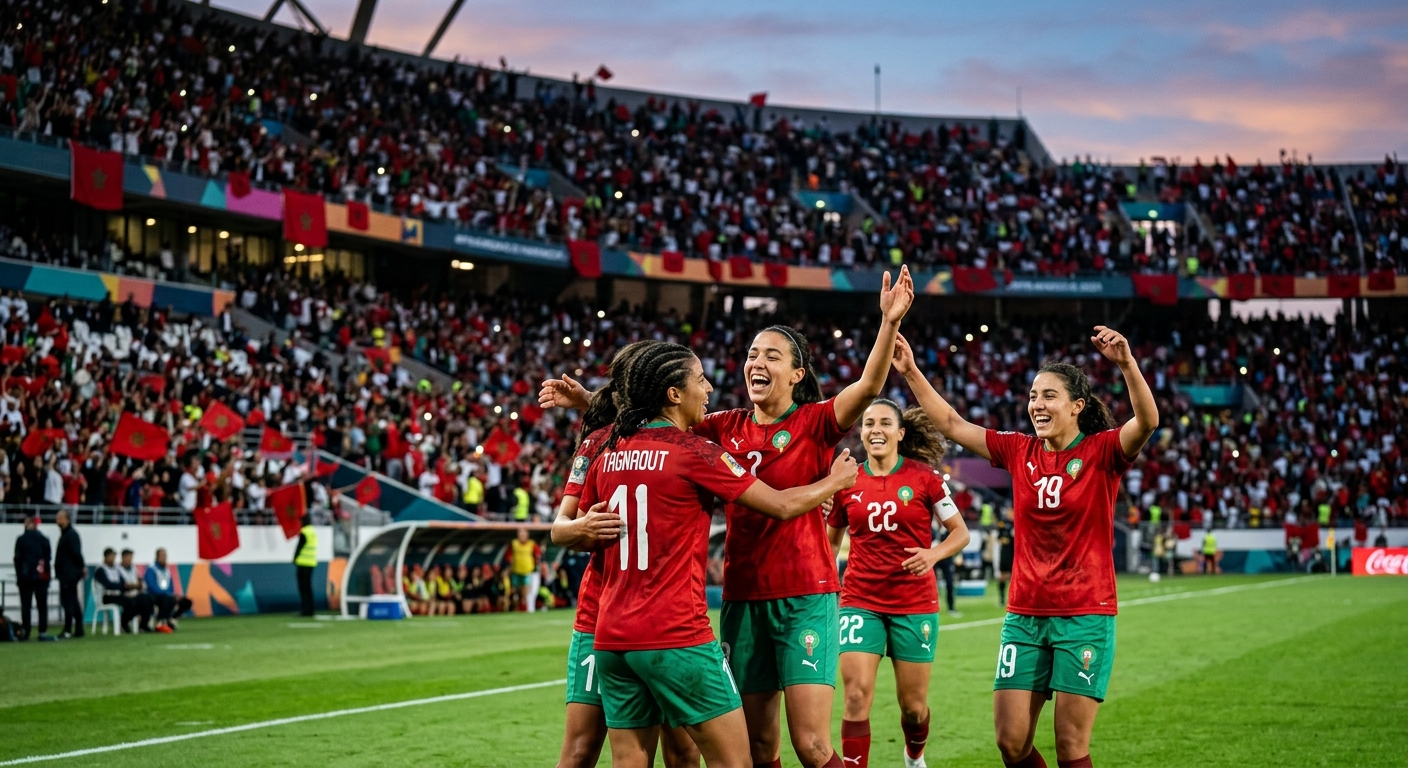
Their identity is built on a blend of technical North African flair, organized defensive discipline, and a fierce sense of national pride that mirrors the men's Atlas Lions. The feminine form of the nickname, 'Lionnes', has become a rallying cry for a generation of Moroccan girls who now see a credible professional future in the sport. The team plays in the iconic red home kit, with green accents drawn from the national flag's central star.
What makes the Lionesses distinctive within the global game is the sheer speed of their ascent. Whereas most established women's footballing nations built their programs gradually over thirty or forty years, Morocco compressed that journey into roughly a single decade, leapfrogging long-standing rivals through deliberate planning rather than slow organic growth. This makes the team a fascinating case study in how a federation can effectively manufacture competitiveness when the political will and financial commitment are genuinely present and sustained.
The squad that competes today is also notably cosmopolitan in its make-up, fusing players raised in Casablanca, Rabat and other Moroccan cities with athletes who grew up immersed in European footballing cultures before choosing to represent the country of their heritage. That dual character gives the Lionesses both a strong domestic anchor and a constant injection of elite professional standards, and it has become central to how the team understands itself and how it presents itself to supporters at home and observers abroad.
Early History and the Long Years of Neglect
Morocco's women's national team traces its competitive roots back to the late 1990s and early 2000s, but for much of that period the side existed more on paper than on the pitch. Africa Women's Cup of Nations qualifying campaigns came and went, often ending early, and the team rarely featured in continental conversations dominated by Nigeria, South Africa, Cameroon, Ghana, and Equatorial Guinea.
The structural problems were profound. There was no fully professional domestic women's league, limited access to quality coaching, and minimal financial backing. Players frequently balanced football with full-time jobs or studies, training in poor facilities with little support. Talented Moroccan players who emerged often did so through the diaspora, developing in European academies in France, the Netherlands, Belgium, and Spain rather than at home.
These lean years left a lasting mark, but they also created a hunger. A cohort of administrators, former players, and federation officials came to view the neglect of the women's game as both a moral and strategic failure. As Morocco's men's football infrastructure modernized in the 2010s, attention slowly began to turn toward what a properly funded women's program could achieve. That groundwork would prove decisive.
The experience of those early players should not be underestimated as a foundation for later success. Footballers who turned out for Morocco in the difficult years did so largely for love of the game and the shirt, with little reward or recognition, and several of them would go on to bridge the eras as coaches, mentors and administrators. Their persistence kept a competitive thread alive even when the wider system around them was failing, and it ensured that there was institutional memory and a core of expertise to build upon once the resources finally arrived.
It is also worth noting how unusual Morocco's eventual trajectory was within this context. Many nations that neglect their women's programs for decades never recover, because the talent that emerges drifts away, retires early or commits permanently to other countries through dual nationality. Morocco avoided that fate partly by luck and partly by timing, capturing a generation of gifted players just as the federation decided to act. Had the investment come a few years later, the window to harness that talent might have closed entirely.
The FRMF Revolution: Investing in Women's Football
The turning point came in 2019 and 2020, when the FRMF, under president Fouzi Lekjaa, launched a comprehensive strategy to professionalize and elevate women's football. This was not a token gesture. The federation committed significant resources to building a sustainable ecosystem, recognizing that elite national-team success required a foundation beneath it.
Central to the plan was the creation of a genuinely professional first division, the Championnat National Féminin, alongside a second tier, giving women players salaries, contracts, and a competitive domestic environment for the first time. The federation mandated that men's professional clubs establish women's sections, dramatically expanding the player base and the visibility of the female game across the country.
Investment also flowed into infrastructure and coaching. The Mohammed VI Football Complex, one of the finest training centers on the continent, was made available to the national women's setup, and the federation recruited experienced international coaching staff. Crucially, Morocco actively courted dual-national players from the European diaspora, persuading talented athletes to commit their futures to the Atlas Lionesses rather than their birth nations.
This top-down, well-financed approach stood in stark contrast to the underfunded reality across much of African women's football, and it rapidly closed the gap with the continent's traditional giants. Within just a few years, the results were impossible to ignore.
The logic behind the strategy was holistic rather than narrowly focused on the senior team. Federation planners understood that a national side cannot succeed in isolation: it needs a competitive league beneath it to harden players in week-to-week competition, qualified coaches to refine them, scouts to find them, and a cultural shift to ensure that families encourage their daughters to play. By addressing each of these layers simultaneously, the FRMF created conditions in which national-team success became a predictable outcome rather than a hopeful gamble.
Equally important was the question of visibility and money flowing into the women's game. Broadcasting matches, marketing the players, and treating the female national team as a genuine asset rather than a charitable obligation changed the incentives across the entire ecosystem. Clubs that once viewed women's sections as a cost began to see them as a route to prestige and even commercial value, and that change in mindset, as much as the direct spending, helps explain why the transformation took hold so firmly and so quickly.
Reynald Pedros and the Tactical Transformation
A defining decision in Morocco's rise was the appointment of French former international Reynald Pedros as head coach in 2020. Pedros arrived with elite pedigree, having won back-to-back UEFA Women's Champions League titles with Olympique Lyonnais, the dominant force in European women's club football. His hiring signaled the seriousness of Morocco's ambitions.
Pedros brought tactical sophistication and a winning mentality to a squad that had talent but lacked organization and belief at the highest level. He instilled a structured defensive shape, sharpened the team's pressing and transitions, and gave the side a clear identity. Just as importantly, he leveraged his European network and reputation to help integrate diaspora players and build cohesion between locally developed talent and players raised abroad.
Under Pedros, the Lionesses became greater than the sum of their parts. The blend of disciplined organization and individual quality turned Morocco into a team that could trouble anyone on the continent, setting the stage for the breakthrough achievements that followed in 2022 and 2023.
The appointment also sent a message about expectations, both within the squad and beyond it. Bringing in a coach who had operated at the summit of the European club game made clear that the federation was no longer content with participation or respectable defeats; it wanted to win, and it was prepared to recruit the expertise required to do so. That ambition filtered down to the players, who began to carry themselves with the confidence of a team that believed it deserved to share a pitch with the best.
Pedros's familiarity with the Lyon model, where elite talent is welded to ruthless professional habits, was particularly valuable for Morocco. He understood how the best women's teams in the world prepared, recovered and managed the small details that separate good sides from great ones, and he imported that culture wholesale. The result was a team that not only played with a clearer structure but trained, traveled and competed like a genuine elite operation, narrowing the intangible gap in professionalism that often holds emerging nations back.
Key Players Who Built the Modern Team
The Atlas Lionesses' rise has been powered by a remarkable generation of players. Goalkeeper Khadija Er-Rmichi has been a long-serving leader and a symbol of continuity, captaining the side through its transformative years and producing decisive performances in the biggest matches.
In attack, Ghizlane Chebbak emerged as the team's talisman and arguably the face of the program. The daughter of a former men's international, Chebbak combined creativity, leadership, and goalscoring, and her contributions earned individual recognition as one of the best players in African women's football. Forward Ibtissam Jraidi and midfielders such as Sakina Ouzraoui added cutting edge and dynamism.
The diaspora dimension proved transformative. Players developed in top European systems brought professional habits and tactical maturity. The combination of homegrown stars who came through Morocco's new domestic structures and seasoned dual-nationals created a deep, balanced squad. This fusion of local pride and international experience became the defining characteristic of the team that made history.
Chebbak in particular came to embody the program's identity. As the daughter of a footballer who represented Morocco's men's side, she carried a sense of footballing lineage that resonated with supporters, and her durability and consistency across the team's transformative years made her a natural leader. Her individual recognition as one of the continent's outstanding players gave the Lionesses a marquee name around whom the rest of the squad could organize, both on the pitch and in the public imagination.
Beyond the headline names, the strength of the modern team lies in its competition for places. Where earlier Morocco sides often relied on a handful of standout individuals with little behind them, the post-2019 squad could call on credible options across every position, blending experienced internationals with younger players emerging from the new domestic league. That depth allowed Pedros and his successors to rotate, to manage injuries, and to maintain intensity, and it is one of the clearest signs that Morocco had moved from being a one-off overachiever to a structurally sound footballing nation.
Hosting and Reaching the 2022 WAFCON Final
Morocco's investment paid its most spectacular early dividend in 2022, when the country hosted the Women's Africa Cup of Nations. Playing in front of huge, passionate home crowds, the Atlas Lionesses delivered a tournament run that captured the imagination of the nation and the wider region.
Match by match, Morocco advanced through the group stage and knockout rounds, with the support inside stadiums in Rabat and Casablanca creating an atmosphere rarely seen in African women's football. The semi-final victory over Nigeria, achieved on penalties against the continent's most decorated women's nation, was a landmark moment that announced Morocco's arrival at the very top table.
Although they ultimately fell to South Africa in the final, reaching the WAFCON showpiece as hosts was a historic achievement and the best-ever finish for an Arab women's team. Crucially, the run to the final also secured qualification for the 2023 FIFA Women's World Cup, turning the tournament into a springboard for an even bigger stage.
The atmosphere generated around the tournament was arguably as significant as the results. Filling major stadiums for women's football was something African nations had rarely managed, and the sight of large, vocal crowds following the Lionesses helped normalize the women's game in a way that statistics alone could not. Families attended, children waved flags, and the team's matches became genuine national events, embedding the side in the public consciousness in a manner that would prove durable long after the final whistle.
The semi-final shootout against Nigeria deserves particular emphasis as a psychological turning point. Penalty shootouts are a brutal test of composure, and beating the continent's most successful nation in such circumstances proved that Morocco could handle the highest-pressure moments rather than wilting under them. That hardened mentality, forged in front of an anxious home crowd, would be drawn upon repeatedly when the team faced adversity on the world stage the following year.
Making History at the 2023 World Cup
The 2023 FIFA Women's World Cup in Australia and New Zealand became the platform for Morocco to write itself into the global history books. The Atlas Lionesses became the first Arab nation ever to qualify for a Women's World Cup, a milestone that carried enormous symbolic weight far beyond the football pitch.
Their tournament began with a chastening 6-0 defeat to Germany, a result that suggested the gulf to the world's elite remained vast. But the Lionesses responded with extraordinary character. A 1-0 victory over South Korea, sealed by Ibtissam Jraidi's header, gave Morocco its first-ever World Cup win and breathed life into the campaign.
Needing a result in their final group match, Morocco beat Colombia 1-0 through a Anissa Lahmari goal to finish second in the group and reach the knockout rounds at the very first attempt. It was a stunning achievement that few outside the squad had predicted. Although they lost to France in the round of 16, the Lionesses had become the first Arab team and only the second African women's side at the time to reach a World Cup knockout stage, cementing their status as trailblazers.
The contrast between the Germany defeat and the two subsequent wins illustrates the maturity of the group. A heavy opening loss can spiral into a lost tournament for an inexperienced side, yet Morocco compartmentalized the result, addressed what had gone wrong, and reset its approach without losing belief. The ability to absorb such a blow and respond with consecutive clean sheets and victories spoke to both the coaching staff's management and the players' character, and it is a sequence that will be studied as a model of in-tournament recovery.
Reaching the last 16 also carried meaning that extended beyond Morocco. As one of a strong cohort of African sides at the expanded 2023 tournament, the Lionesses contributed to a broader narrative of the continent closing the gap on the traditional powers. For a region whose women's football had been almost invisible at this level only a short time earlier, advancing past the group stage at the first attempt reframed expectations of what African and Arab teams could realistically achieve on the global stage.
Cultural Impact Across Morocco and the Arab World
The significance of the Atlas Lionesses extends well beyond results. Their success has reshaped perceptions of women's sport in Morocco and across the Arab and Islamic world. Images of Moroccan players competing at the highest level, including those who wear the hijab, challenged stereotypes and offered powerful role models to millions of young women.
Defender Nouhaila Benzina became a focal point of this story when she became the first player to wear a hijab at a senior FIFA World Cup during the 2023 tournament, a moment of major cultural resonance that was celebrated as a victory for inclusion and choice in the sport.
Domestically, participation in girls' and women's football has surged, supported by the federation's grassroots programs. The Lionesses have demonstrated that investment, vision, and belief can transform a national program in just a few years, providing a blueprint that other nations in the region have begun to study and emulate.
Benzina's moment held layers of meaning that went well beyond a single match. For years, the question of whether players could wear the hijab in elite football was a subject of debate and, at times, restriction, and her appearance on the sport's biggest stage settled the matter visibly and powerfully. It demonstrated that observant Muslim women could compete at the very highest level without being asked to choose between their faith and their footballing ambitions, a message that resonated with countless young women who had previously seen no place for themselves in the game.
The broader cultural shift can be measured in attitudes as much as in numbers. Where women's football was once viewed in parts of the region as marginal or even inappropriate, the Lionesses turned it into a source of collective national pride, celebrated by political leaders, media and ordinary supporters alike. By winning admiration on merit, the team helped change the conversation about women's participation in sport more effectively than any campaign could, making their success a genuinely social as well as sporting achievement.
Building for the Future
Morocco's ambition shows no sign of slowing. The country was awarded hosting rights for multiple editions of the Women's Africa Cup of Nations, reinforcing its position as a continental hub for the women's game and guaranteeing the Lionesses regular high-profile competition on home soil with strong support behind them.
The federation continues to deepen the domestic league, expand youth pathways from the Mohammed VI complex and regional academies, and recruit promising diaspora talent. The goal is no longer simply to compete but to win, with WAFCON glory and deeper World Cup runs firmly in the team's sights.
The challenge now is sustainability and squad renewal, ensuring that the next generation can match and surpass the achievements of the pioneers. With the structures in place and momentum on their side, the Atlas Lionesses are positioned to remain among Africa's elite for the foreseeable future, carrying the hopes of a football-mad nation and a wider region watching closely.
Regular hosting of major continental competition is itself a strategic asset for the program. Playing important matches at home in front of supportive crowds accelerates development, builds the kind of big-occasion experience that cannot be replicated in friendlies, and keeps the women's game in the public eye between World Cup cycles. It also helps retain talent and attract diaspora players, who can see a vibrant, well-supported environment rather than a neglected backwater.
Sustaining success will nonetheless require discipline. The risk for any program that rises quickly is complacency once the initial breakthrough has been achieved, and Morocco's planners are conscious that rivals across Africa and the Arab world are now studying and copying their methods. Continuing to refresh the squad, invest in youth, and raise the standard of the domestic league will be essential if the Lionesses are to convert their pioneering status into lasting dominance rather than a memorable but isolated golden generation.
Why the Lionesses Matter to Moroccan Football as a Whole
The rise of the women's team has become inseparable from the broader narrative of Moroccan football's modern golden age. The same era that produced the men's stunning run to the 2022 World Cup semi-finals also produced the Lionesses' historic breakthroughs, and both stories share a common root: deliberate, sustained investment and a long-term federation strategy.
This dual success has amplified national pride and helped position Morocco as one of the most exciting football nations in the world, a status reinforced by the country's role in hosting major continental and global tournaments. The women's program is no longer an afterthought but a central pillar of the national football identity.
For supporters, the Atlas Lionesses represent proof that ambition backed by resources and patience produces results. Their journey from neglect to the world stage is one of the most inspiring stories in contemporary football, and it continues to unfold with each passing year.
There is also a practical footballing benefit to treating the men's and women's programs as parts of a single national project. Shared facilities such as the Mohammed VI complex, shared coaching expertise, and a unified federation strategy create efficiencies and a common culture that strengthen both sides. The success of one program reinforces belief and attracts investment in the other, producing a virtuous cycle that has helped make Morocco one of the most complete footballing nations of its era.
Ultimately, the Lionesses matter because they expanded the definition of what Moroccan football could be. For decades the national footballing identity was built almost entirely around the men's game; today it encompasses women, youth and futsal sides competing and succeeding on the world stage. That broadening of the national football story, achieved within a remarkably short span, is perhaps the team's most lasting contribution, and it ensures that their influence will be felt long after the specific results of 2022 and 2023 have receded into history.
| Year | Competition | Achievement |
|---|---|---|
| 2020 | Coaching change | Reynald Pedros appointed head coach |
| 2022 | WAFCON (hosts) | Runners-up, lost final to South Africa |
| 2022 | WAFCON semi-final | Beat Nigeria on penalties |
| 2023 | FIFA Women's World Cup | First Arab nation to qualify |
| 2023 | World Cup group stage | Beat South Korea and Colombia |
| 2023 | World Cup knockout | Reached round of 16, lost to France |
Atlas Lionesses key milestones and tournament results
FAQ
What is the nickname of Morocco's women's national football team?
They are nicknamed the Atlas Lionesses (Lionnes de l'Atlas), the feminine equivalent of the men's Atlas Lions, reflecting their national identity and fighting spirit.
Did Morocco qualify for the Women's World Cup?
Yes. Morocco qualified for the 2023 FIFA Women's World Cup in Australia and New Zealand, becoming the first Arab nation ever to reach a Women's World Cup, and they advanced to the round of 16.
How far did Morocco go at the 2022 Women's AFCON?
Morocco reached the final of the 2022 Women's Africa Cup of Nations as hosts, beating Nigeria in the semi-final before losing the final to South Africa. It was the best finish ever by an Arab women's team.
Who is the most important player for the Atlas Lionesses?
Ghizlane Chebbak has been the team's talisman and captain figure, recognized among the best players in African women's football, while goalkeeper Khadija Er-Rmichi provided long-serving leadership.
Why did Morocco's women's team improve so quickly?
The FRMF launched a major investment program from 2019-2020, creating a professional domestic league, building infrastructure, hiring elite coach Reynald Pedros, and recruiting talented diaspora players.
Loved this? Useful? React below — your feedback helps other readers.