Morocco Women at AFCON 2022 & World Cup 2023
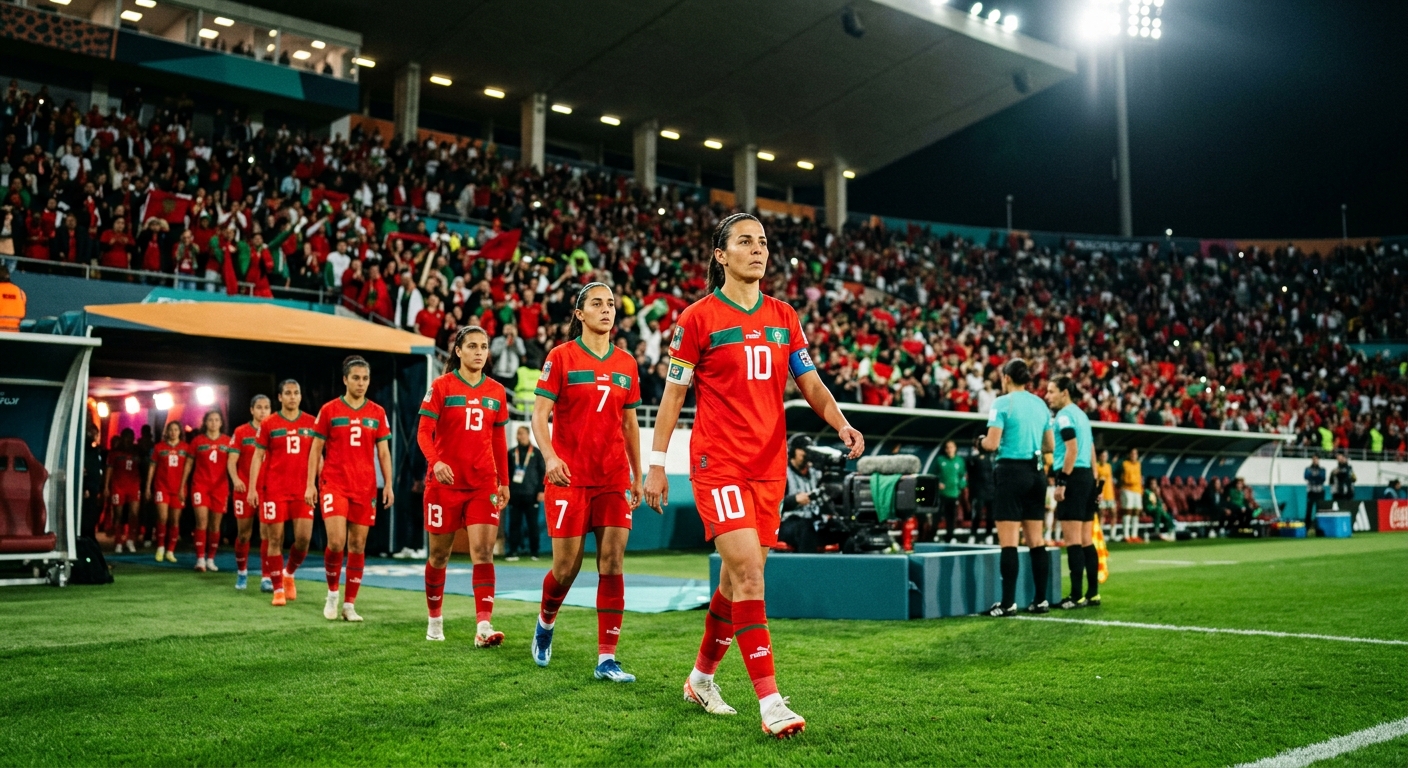
A Defining Two-Year Window
Between 2022 and 2023, Morocco's women's national team compressed decades of ambition into a breathtaking two-year window that transformed them from continental hopefuls into global pioneers. The story of these years is really the story of how careful investment, smart recruitment, and home advantage combined to deliver back-to-back historic achievements.
The 2022 Women's Africa Cup of Nations on home soil and the 2023 FIFA Women's World Cup in Australia and New Zealand were not isolated events but a single connected journey. Success in the first directly enabled participation in the second, and the confidence built in front of home crowds carried over onto the world's biggest stage.
Together, these campaigns rewrote the record books for Arab women's football and inspired a region. This article examines both tournaments in depth, the matches that defined them, the players who delivered, and the lasting significance of what the Atlas Lionesses accomplished.
To appreciate the scale of what happened, it helps to recall where Morocco's women's football had been only a few years earlier. The national side had no major-tournament pedigree to speak of, a thin domestic structure, and little public profile. That a team emerging from such a starting point could reach a continental final and then advance through a World Cup group containing a former world champion is, by any reasonable measure, one of the steepest competitive trajectories the women's game has witnessed.
The architect of this leap was a federation strategy that treated the two tournaments as deliberate, sequential objectives rather than separate hopes. Hosting WAFCON was engineered in part to maximize the chance of World Cup qualification, and the World Cup campaign was approached as the next rung on a ladder the team had been carefully climbing. Understanding the period as a single planned project, rather than a lucky run of form, is essential to grasping how Morocco achieved so much in so little time.
Setting the Stage: Hosting WAFCON 2022
Morocco was awarded hosting rights for the 2022 Women's Africa Cup of Nations as part of the FRMF's broader strategy to position the country as a continental football hub. Hosting was both an opportunity and a pressure: it guaranteed a place in the tournament and home support, but it also carried the weight of national expectation.
The federation prepared meticulously, deploying its world-class facilities, ensuring strong organization, and promoting the tournament heavily to fill stadiums. Crowds in Rabat and Casablanca turned out in unprecedented numbers for women's football in Africa, creating an electric backdrop that lifted the home side.
Under coach Reynald Pedros, Morocco entered the tournament as a side that had quietly built genuine quality but had yet to prove itself on a major stage. The competition would be a defining test of whether the investment of recent years had truly produced an elite team.
Hosting also offered tangible competitive advantages beyond crowd support. The squad could prepare in familiar surroundings, sleep in its own beds, train at the facilities it knew best, and avoid the disruption of long-haul travel and unfamiliar conditions. For a team still accumulating experience at the highest level, these logistical comforts removed variables and allowed the players to focus purely on performance, an edge that should not be discounted when assessing how far Morocco progressed.
There was, however, a flip side to the home advantage. Hosts carry an unusual psychological burden, expected to perform for a watching nation and exposed to intense scrutiny if they falter. How the Lionesses handled that pressure was an open question heading into the tournament, and their ability to channel rather than be paralyzed by it would ultimately prove central to the story of the next few weeks.
Morocco's Run Through the 2022 Group Stage
The Lionesses navigated the group stage with growing assurance, balancing the nerves of being hosts with the talent at their disposal. Strong defensive organization, a hallmark of the Pedros era, gave the team a platform, while attacking talents provided moments of inspiration in front of the passionate home support.
Progressing from the group not only kept the home dream alive but also moved Morocco closer to the World Cup qualification places that were on offer to the tournament's leading nations. Every result carried double significance: continental ambition and global opportunity.
By the time the knockout rounds arrived, the team had grown into the competition and the crowds had grown with them, setting up the defining matches that would decide whether Morocco's golden generation could deliver history.
The group phase also served an important developmental purpose, allowing the squad to settle its nerves and find its rhythm before the stakes became unforgiving. Early matches gave Pedros the chance to assess his options, test combinations, and confirm which players were ready for the pressure of the knockout rounds, while letting the team accumulate the kind of winning momentum that breeds confidence at exactly the right moment.
Underpinning the run was the team's defensive resilience, which would become the defining feature of both the WAFCON campaign and the World Cup that followed. Rather than relying on outscoring opponents, Morocco built its success on keeping matches tight, frustrating more fancied sides, and trusting that quality in attack would eventually find a decisive moment. It was a pragmatic identity well suited to a team punching above its historical weight, and the group stage was where it was first forged under tournament conditions.
The Semi-Final: Beating Nigeria on Penalties
The semi-final against Nigeria was the match that announced Morocco as a genuine African superpower. Nigeria's Super Falcons are the most decorated women's team in African history, having dominated the continent for decades. Defeating them was the ultimate measure of progress.
The contest was tense and tight, befitting a semi-final with so much at stake. Morocco's discipline and resilience held firm, and after a goalless, attritional battle, the tie went to a penalty shootout in front of a roaring home crowd. The Lionesses held their nerve from the spot to eliminate the continental giants.
The victory was monumental on multiple levels. It guaranteed a place in the WAFCON final and, just as importantly, secured Morocco's qualification for the 2023 World Cup. For a program that had been an afterthought a few years earlier, beating Nigeria to reach a continental final and a maiden World Cup was a staggering leap.
The symbolic weight of the opponent magnified the achievement. Nigeria's Super Falcons were not merely strong; they were the institutional benchmark of African women's football, the side every aspiring nation measured itself against. Eliminating them was therefore more than a single result, it was a passing of a torch, a public signal that the established hierarchy of the continental game could no longer be taken for granted.
The shootout itself encapsulated everything Morocco had been building toward. Holding firm through a tense, goalless contest required discipline and nerve, and converting under the most extreme pressure imaginable, with a nation holding its breath, demonstrated a steeliness that earlier Moroccan teams had never had the chance to display. It was the moment the Lionesses stopped being promising and became genuinely formidable, and the belief it generated carried directly into everything that followed.
The 2022 Final and Its Legacy
Morocco faced South Africa's Banyana Banyana in the final, with a sold-out home crowd dreaming of continental glory. South Africa, long-time bridesmaids in African women's football, were a battle-hardened and talented side hungry for their own breakthrough.
Despite the fervent support, the Lionesses fell short on the day, with South Africa winning the final to claim their first WAFCON title. For Morocco, the disappointment of losing a home final was real, but it could not overshadow the historic nature of the achievement.
Reaching the final was the best result ever by an Arab women's national team and a powerful validation of the federation's strategy. More importantly, the World Cup ticket secured in the semi-final meant that the story was far from over. The final was not an ending but a launchpad.
It is worth recognizing the quality of the opponent that denied Morocco on the day. South Africa's Banyana Banyana had endured years of near-misses in continental football and arrived in the final as a seasoned, hungry side determined to shed their reputation as perennial runners-up. Their victory was a deserved breakthrough for one of African women's football's most committed programs, and losing to such opposition, on the biggest occasion, was no disgrace for a team still early in its own elite journey.
For Morocco, the defeat carried a useful lesson about the final margins separating very good teams from champions. Reaching a final demonstrated that the program belonged at the summit of the continental game, but failing to win it underlined how much experience, ruthlessness and squad depth still needed to be accumulated. That clear-eyed understanding, rather than any sense of having arrived, was perhaps the healthiest mindset the team could have carried into its World Cup adventure.
Preparing for a Maiden World Cup
Qualification for the 2023 FIFA Women's World Cup made Morocco the first Arab nation ever to reach the competition, an achievement that resonated far beyond football. The months leading up to the tournament were spent fine-tuning the squad, arranging high-quality friendlies, and integrating the blend of homegrown and diaspora talent into a cohesive unit.
Expectations among neutrals were modest. Morocco had been drawn into a difficult group alongside two-time champions Germany, plus South Korea and Colombia. Few outside the camp gave the debutants a serious chance of advancing from such company.
Internally, however, belief was high. The team had tasted success against elite opposition at WAFCON, possessed a clear tactical identity, and carried the pride of representing a region for the first time. The stage was set for the Lionesses to surprise the world.
The preparation period was about more than fitness and tactics; it was also about acclimatizing a squad to the unfamiliar demands of a global tournament. Travelling to the other side of the world, adjusting to time zones and conditions in Australia and New Zealand, and managing the scrutiny that comes with being a historic first-time qualifier were all challenges the staff worked to address in advance, drawing on the professional standards Pedros had embedded in the group.
The integration of homegrown and diaspora players took on particular importance in this context. A World Cup squad must function as a single unit under pressure, and the months before the tournament were spent ensuring that players from very different football cultures shared a common understanding of roles, pressing triggers and game management. The cohesion the team would later display under duress was not accidental; it was the product of deliberate work to fuse a diverse group into something greater than its parts.
A Brutal Start Against Germany
Morocco's World Cup debut was a harsh reality check. Facing the powerful Germany side, the Lionesses were overwhelmed and lost 6-0, a scoreline that exposed the gap between a debutant and one of the sport's traditional heavyweights.
Such a result could have shattered a young team's confidence and ended the campaign before it really began. The manner of the defeat raised questions about whether Morocco belonged at this level and whether the WAFCON run had flattered them.
Yet the response of the squad in the aftermath would define their World Cup. Rather than crumbling, the Lionesses regrouped, drew on their resilience, and prepared to fight for their tournament lives in the two matches that remained. What followed was one of the great turnarounds of the competition.
In hindsight, the Germany match should be read in context rather than in isolation. Germany were among the most powerful teams in the world, and many established footballing nations have suffered heavy defeats on their World Cup debuts. For a side stepping onto the global stage for the very first time, against opposition of that caliber, a chastening result was always a possibility, and judging the entire campaign on a single match would have been both premature and unfair.
What mattered was how the staff framed the setback internally. Rather than treating the defeat as evidence that the team did not belong, the coaching group emphasized the specific, correctable errors that had led to the scoreline and reinforced the message that the team's identity, built on defensive solidity and resilience, remained intact. That ability to absorb a public humiliation without losing collective belief is rare, and it set up the remarkable response that would follow against South Korea and Colombia.
The Breakthrough Win Over South Korea
Morocco's second group match against South Korea became the moment the Atlas Lionesses made history. Ibtissam Jraidi headed home an early goal, and the team then dug in with the defensive discipline that had become their signature, defending a slender 1-0 lead with composure and courage.
When the final whistle blew, Morocco had recorded its first-ever victory at a FIFA Women's World Cup. It was a watershed moment, the first World Cup win by an Arab nation in the women's game, and it transformed the mood of the campaign from survival to genuine possibility.
The win meant that qualification for the knockout rounds was suddenly within reach. Far from being humiliated debutants, the Lionesses had shown the world they could compete and win on the sport's grandest stage, and they now controlled their own destiny heading into the final group game.
Jraidi's goal carried a significance out of all proportion to the manner in which it was scored. A headed finish became a historic landmark, the first time an Arab nation had ever found the net in a winning cause at a Women's World Cup, and it instantly etched her name into the record books. For the player and the program alike, it was the kind of defining moment that careers and reputations are built upon.
Just as telling was the way Morocco defended the lead. Protecting a slender advantage on the world stage, against a side pressing for an equalizer, demanded concentration, organization and composure for the remainder of the match. The Lionesses produced exactly that, channeling the discipline that had defined their tournament identity, and in doing so converted a famous goal into an even more famous victory that fundamentally changed the trajectory of their campaign.
Sealing Knockout Qualification Against Colombia
Morocco's final group match against Colombia was a winner-takes-progress occasion. A victory would send the Lionesses through to the round of 16 at the very first attempt, an outcome that would have seemed fanciful after the Germany hammering.
The Lionesses delivered when it mattered. A goal from Anissa Lahmari secured a 1-0 win, and Morocco's disciplined defending preserved the result against a strong Colombian side that had already impressed in the tournament. The triumph confirmed second place in the group and a place in the knockout rounds.
It was an astonishing achievement: a World Cup debutant from a region with no prior representation had navigated a tough group containing a former champion to reach the last 16. The Lionesses had not just participated in history, they had advanced through it.
Lahmari's decisive goal completed a striking statistical story: Morocco had qualified for the knockout rounds having scored only twice in the group stage, both times by a single goal, while relying on its defense to do the rest. Far from being a weakness, this efficiency reflected a clear-eyed understanding of the team's strengths and limitations, a willingness to win ugly when winning was all that mattered, which is often the hallmark of tournament football.
The result also reverberated beyond the pitch. Colombia were one of the tournament's most watchable and ambitious sides, and overcoming them confirmed that Morocco's earlier win had been no fluke. Two clean sheets and two victories against quality opposition, achieved immediately after a six-goal defeat, represented a turnaround so complete that it forced the wider football world to recalibrate its assessment of where the Lionesses, and Arab women's football generally, now stood.
The Round of 16 and the Final Whistle
Morocco's reward for topping their dramatic group-stage turnaround was a round-of-16 tie against France, one of the tournament favorites and a side packed with elite talent. The gulf in experience and depth was significant, and France controlled the contest to win and end Morocco's run.
While the defeat closed the campaign, it could do nothing to diminish what had been accomplished. The Lionesses had become the first Arab team and, at the time, only the second African women's side to reach a Women's World Cup knockout stage, an extraordinary marker of progress.
Players returned home as national heroes. The combination of the WAFCON final and the World Cup knockout run within roughly a year established Morocco as the standard-bearer for Arab women's football and a genuine force on the African continent.
Drawing France in the last 16 was, in some respects, the toughest possible reward for topping a dramatic group recovery. The French were genuine contenders with strength in every area of the pitch and a depth of experience the debutants could not match, and the tie underlined the next frontier the program would need to cross: competing not just to reach knockout rounds but to win them against the world's established elite.
Even in defeat, the manner of Morocco's exit told a story of progress. There was no collapse and no embarrassment, simply a younger, less experienced side being edged out by a superior one on the day. The Lionesses left the tournament with their reputation enhanced rather than diminished, having proved over four matches that they could share a stage with anyone, and that their breakthrough was the beginning of a journey rather than its conclusion.
The Lasting Significance of 2022-2023
The twin campaigns left a legacy that extends far beyond the scorelines. They proved that Morocco's model of sustained investment, professionalization, and diaspora recruitment could deliver elite results in a remarkably short time, offering a template for the wider region.
Culturally, the tournaments produced landmark moments, including Nouhaila Benzina becoming the first player to wear a hijab at a senior FIFA World Cup, a symbol of inclusion that was celebrated worldwide. Participation in women's football across Morocco surged in the wake of the team's exploits.
Most importantly, the period shifted the ceiling of ambition. Having reached a continental final and a World Cup knockout stage, the Atlas Lionesses no longer measure themselves against survival but against silverware. The 2022-2023 window did not just make history; it redefined what is possible for the program going forward.
The legacy is also visible in the validation it provided for Morocco's development model. The twin campaigns demonstrated, in the most public way possible, that sustained investment, professionalization of the domestic game, elite coaching and the integration of diaspora talent could deliver results on the biggest stages in a remarkably compressed timeframe. That proof of concept has hardened the federation's commitment and given other nations in the region a concrete example to study rather than an abstract aspiration.
Perhaps the most enduring effect, however, is on the imaginations of young people watching at home. A generation of Moroccan girls grew up in these two years seeing women in the national shirt celebrated as heroes, competing and winning against the best in the world, with figures like Benzina showing that there was room for them in the game exactly as they were. The matches will eventually fade from memory, but the expectation they created, that Moroccan women belong at the highest level of football, is the kind of legacy that compounds with every passing year.
| Tournament | Match | Result |
|---|---|---|
| WAFCON 2022 | Semi-final vs Nigeria | Win on penalties |
| WAFCON 2022 | Final vs South Africa | Loss (runners-up) |
| World Cup 2023 | Group vs Germany | Loss 0-6 |
| World Cup 2023 | Group vs South Korea | Win 1-0 |
| World Cup 2023 | Group vs Colombia | Win 1-0 |
| World Cup 2023 | Round of 16 vs France | Loss |
Morocco's WAFCON 2022 and World Cup 2023 results summary
FAQ
How did Morocco qualify for the 2023 Women's World Cup?
Morocco qualified by reaching the semi-finals and ultimately the final of the 2022 Women's Africa Cup of Nations, where the leading teams earned World Cup berths. Their semi-final win over Nigeria secured the ticket.
What was Morocco's first-ever Women's World Cup win?
Morocco's first Women's World Cup victory came against South Korea in 2023, a 1-0 win sealed by an Ibtissam Jraidi header. It was the first World Cup win by any Arab nation in the women's game.
Did Morocco reach the knockout stage at the 2023 World Cup?
Yes. After beating South Korea and Colombia, Morocco finished second in their group and reached the round of 16, where they lost to France. They were the first Arab team to reach a Women's World Cup knockout round.
Who scored Morocco's goals at the 2023 Women's World Cup?
Ibtissam Jraidi scored the winning header against South Korea and Anissa Lahmari netted the decisive goal against Colombia, both crucial to Morocco reaching the knockout stage.
Why was Nouhaila Benzina's appearance historic?
Defender Nouhaila Benzina became the first player to wear a hijab at a senior FIFA World Cup during the 2023 tournament, a landmark moment celebrated as a victory for inclusion in the sport.
Loved this? Useful? React below — your feedback helps other readers.