Morocco vs Spain 2022: The Shootout
A Round of 16 Heavyweight Clash
On December 6, 2022, at the Education City Stadium in Qatar, Morocco faced Spain in a World Cup round-of-16 tie that pitted defensive discipline against possession dominance in its purest form. Spain, under Luis Enrique, had built their entire identity around control of the ball, a philosophy descended from the tiki-taka era that had brought them a World Cup and two European Championships.
Morocco arrived as group winners, having topped a section containing Croatia, Belgium and Canada. They had impressed with their organisation and resilience, but few outside Morocco expected them to withstand ninety minutes, let alone two hours, of Spanish pressure. The narrative was set as patient artists against stubborn defenders.
What unfolded was a tactical chess match that drained both sides physically and mentally, and which would ultimately be decided by the cruellest and most theatrical means in football: the penalty shootout. By the end of the night, the script had been completely rewritten, and a Moroccan goalkeeper had become a global icon.
Spain's Possession, Morocco's Patience
Spain did exactly what everyone expected. They dominated possession, recording figures that at times exceeded seventy-five percent, knocking the ball around in front of Morocco's defensive block with metronomic patience. But possession without penetration is hollow, and Morocco's structure was built precisely to neutralise it.
Walid Regragui set his team up to defend deep and narrow, conceding the ball and the wide areas while protecting the central zones where Spain most wanted to play. The midfield trio worked tirelessly to screen passing lanes, and the back four held its shape with remarkable discipline across long, exhausting stretches of the match.
Morocco were not purely defensive. They threatened on the counter, with Hakim Ziyech and the pace of their wide players causing Spain problems on the break. But the overriding picture was of a team comfortable without the ball, trusting their shape and their goalkeeper, and waiting for the contest to reach the lottery they fancied their chances in.
Ninety Minutes Without a Goal
Regulation time produced no goals, which in itself was a moral victory for Morocco and a source of growing anxiety for Spain. The Spanish created chances but found Bounou and the Moroccan defence in obstinate form, while Morocco's best moments came in transition, exploiting the space behind Spain's high line.
As the match wore on, the psychological pressure shifted. Spain were the team expected to win, and every minute without a goal increased the tension on their players. Morocco, by contrast, grew in confidence with each cleared cross and each repelled attack. The longer the game stayed level, the more it suited Regragui's plan.
Both managers turned to their benches. Spain introduced fresh attacking options in search of a breakthrough, while Morocco brought on legs to maintain the intensity of their pressing and the integrity of their block. The 0-0 scoreline held, and the match marched into extra time.
Extra Time: The Pablo Sarabia Moment
Extra time brought the closest the match came to a decisive goal in open play. Deep into the additional thirty minutes, Spain substitute Pablo Sarabia, brought on specifically with penalties in mind, struck a shot that rattled the post in the dying seconds. It was the finest of margins between a Spanish winner and the shootout that followed.
That moment, with the woodwork denying Spain, would prove enormously significant. Had Sarabia's effort been a few centimetres to one side, the entire history of the match, and arguably of the tournament, might have been different. Instead, the ball stayed out, the whistle blew, and the tie went to penalties.
For Morocco, surviving 120 minutes against Spain without conceding was an achievement in itself. They had absorbed everything Spain could throw at them and remained level. Now everything came down to the duel between takers and goalkeepers, a contest in which Morocco believed they held the edge.
Bounou's Masterclass: Saving Two
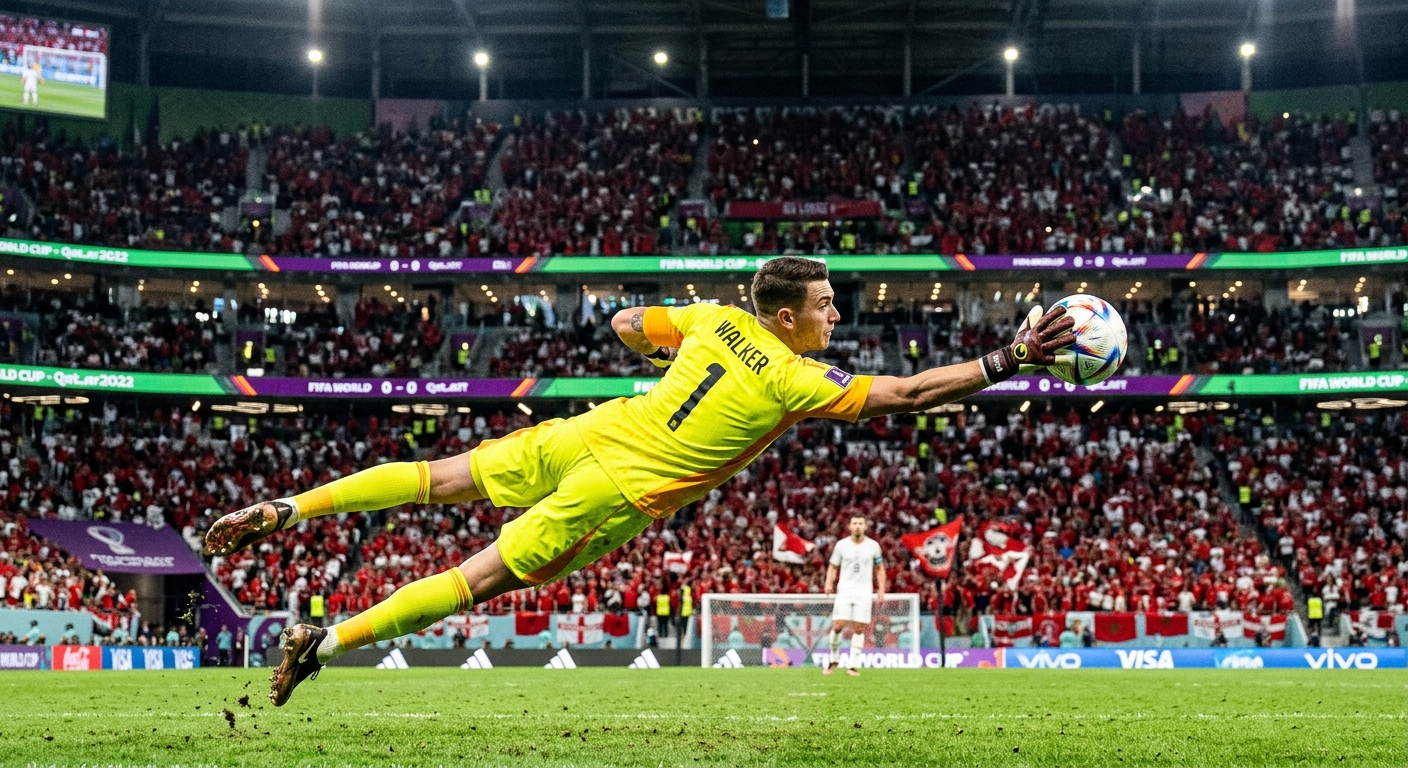
The shootout became the Yassine Bounou show. Spain, remarkably for a nation with such technical pedigree, failed to convert a single one of their penalties. Pablo Sarabia, who had hit the post moments earlier, saw his effort miss. Carlos Soler had his penalty saved by Bounou. And Sergio Busquets, one of the most experienced and composed players in the squad, was also denied by the Moroccan goalkeeper.
Bounou's performance was a study in goalkeeping psychology as much as reflexes. He delayed, he engaged with the takers, he commanded his line, and he read the kicks with the confidence of a man who believed this was his moment. His double save, against Soler and Busquets, swung the shootout decisively in Morocco's favour and sent the Moroccan fans behind the goal into delirium.
It was the kind of performance that defines careers and tournaments. Bounou had already established himself as one of La Liga's best goalkeepers with Sevilla, but on this night, on the world's biggest stage, against the country whose league he plied his trade in, he produced the defining display of his life.
Hakimi's Panenka to Win It
With Spain having failed to score and Morocco needing only to convert, the responsibility of taking the decisive penalty fell to Achraf Hakimi. The full-back, born and raised in Madrid, having come through Real Madrid's academy, stepped up against the country of his birth in the most pressurised moment imaginable.
What he did next was both audacious and unforgettable. Rather than blasting the ball or aiming for a corner, Hakimi chose a Panenka, the chipped, dinked penalty that floats gently down the middle as the goalkeeper dives away. Unai Simon committed early to his left, and the ball settled softly into the net. It was the coolest of finishes in the hottest of moments.
The symbolism was rich. A son of the Madrid suburbs, who could have represented Spain but chose Morocco, sealed Spain's elimination with a penalty of supreme cheek and confidence. Hakimi sprinted away in celebration, mobbed by teammates, and the round-of-16 tie was over. Morocco were through to a World Cup quarterfinal.
Why Spain's Penalty Strategy Failed
In the aftermath, much was made of Spain's preparation for the shootout. Luis Enrique had spoken before the tournament about asking his players to practise penalties extensively, suggesting they should arrive in Qatar having each taken a thousand. The reality on the night made those comments look painfully ironic, as Spain failed to convert a single kick.
Penalty shootouts are notoriously resistant to preparation, because the pressure of the live moment cannot be replicated in training. Spain's takers, several of them young and inexperienced at this level, wilted, while Bounou's presence and gamesmanship added to the burden. The contrast with Morocco, whose takers were calm and decisive, was stark.
There is also a tactical lesson. Spain's domination of possession across 120 minutes had produced control without enough cutting edge, and the failure to score in open play left them exposed to exactly the lottery Morocco had been hoping for. A team built entirely around keeping the ball discovered that keeping the ball is not the same as winning matches.
The Defensive Foundation Behind the Win
While the shootout grabbed the headlines, the victory was built across 120 minutes of defensive excellence. Morocco's back four of Hakimi, Saiss, Aguerd and Mazraoui, shielded by Amrabat, gave Spain almost nothing in the central areas they craved. The full-backs defended their flanks intelligently, and the centre-backs won their aerial and ground duels.
Sofyan Amrabat again stood out, breaking up Spanish attacks and recycling possession with composure when Morocco won the ball. His engine and reading of the game allowed the defence to hold its narrow shape, confident that the space in front of them was being patrolled. It was a performance that would soon attract attention from major European clubs.
This was the blueprint Morocco would carry into the quarterfinal against Portugal: defend deep, stay compact, trust Bounou, and strike when the chance came. Against Spain, the chance came in the shootout. The result confirmed that Morocco's organisation was no accident, and that they could neutralise even the most technically gifted opponents.
Celebrations Across the Arab and African World
The final penalty triggered scenes of euphoria that stretched far beyond the stadium. Morocco's players celebrated by performing prayers of gratitude on the pitch, and the famous images of players celebrating with their mothers, who had travelled to Qatar to support them, became symbols of the team's deep connection to family and country.
In Morocco, the streets filled instantly. Across the diaspora in France, Belgium, the Netherlands and Spain itself, Moroccan fans celebrated a result that resonated with identity and pride. For the Arab world, hosting its first World Cup in Qatar, an Arab nation reaching the quarterfinals added an extra layer of meaning to the tournament.
The victory over Spain was the moment Morocco stopped being a surprise and started being a story. The world began to pay attention, and the team's belief, already strong, hardened into something close to destiny as they advanced to face Portugal.
A Result That Echoes
Morocco's defeat of Spain on penalties has entered the canon of great World Cup knockout dramas. It combined everything the tournament can offer: a clash of philosophies, a goalkeeper's heroics, an audacious match-winning penalty, and a result that defied expectations and reshaped a tournament.
For Bounou, the night cemented a reputation that would carry him to a lucrative move and lasting fame. For Hakimi, the Panenka against his country of birth became a defining moment of his career. And for Morocco, the win was the gateway to the historic semifinal run that followed.
The match also fed into a broader narrative about the evolution of international football, in which well-organised, smartly recruited sides can dethrone the traditional powers. Spain's possession model, once revolutionary, was exposed by a team that simply refused to be broken. December 6, 2022 will be remembered as the night Morocco out-thought, out-fought and out-nerved Spain, and stepped into history.
| Taker | Team | Outcome |
|---|---|---|
| Pablo Sarabia | Spain | Missed (hit post) |
| Abdelhamid Sabiri | Morocco | Scored |
| Carlos Soler | Spain | Saved by Bounou |
| Hakim Ziyech | Morocco | Scored |
| Sergio Busquets | Spain | Saved by Bounou |
| Achraf Hakimi | Morocco | Scored (Panenka, winner) |
Morocco vs Spain 2022 World Cup penalty shootout
FAQ
What was the final result of Morocco vs Spain in 2022?
The match finished 0-0 after 120 minutes, and Morocco won the penalty shootout 3-0 on December 6, 2022.
How many penalties did Bounou save against Spain?
Yassine Bounou saved two penalties, from Carlos Soler and Sergio Busquets, and Pablo Sarabia missed his, meaning Spain scored none.
Who scored the winning penalty for Morocco?
Achraf Hakimi scored the decisive penalty with a Panenka chip down the middle against Unai Simon.
Why was Hakimi's penalty so symbolic?
Hakimi was born and raised in Madrid and came through Real Madrid's academy, so scoring the winner against Spain carried deep personal significance.
Did Spain score any penalties in the shootout?
No, Spain failed to convert a single penalty, with two saved by Bounou and one striking the post.
Loved this? Useful? React below — your feedback helps other readers.