Morocco U23: Paris 2024 Olympic Bronze
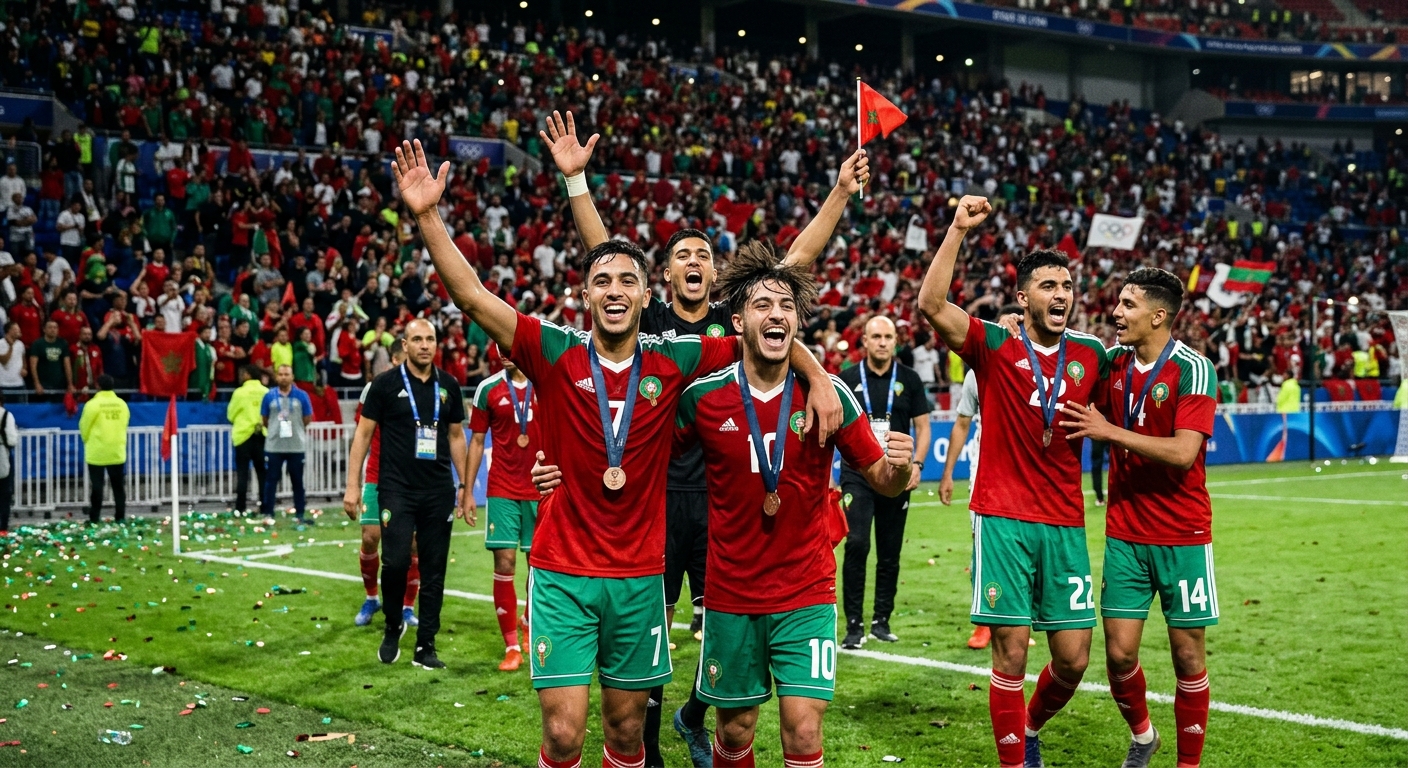
A Historic Olympic Breakthrough
At the Paris 2024 Olympic Games, Morocco's under-23 men's football team achieved something no Moroccan side had ever managed before: an Olympic medal in football. Their bronze-medal triumph marked a new chapter in the nation's golden era of football and confirmed the depth of talent emerging from Morocco's much-praised development system.
The achievement did not come from nowhere. It built directly on the senior team's historic run to the 2022 World Cup semi-finals in Qatar, demonstrating that Morocco's success was not a one-off but the product of a deep, sustainable football culture spanning age groups. The same waves of celebration that had swept through Casablanca, Rabat, and Marrakech during the World Cup returned in the summer of 2024, this time for a group of players many of whom were barely out of their teens.
For decades, Olympic football had been a source of frustration rather than pride for Morocco. Generation after generation of talented young footballers had returned from the Games without a medal, often unable even to escape the group stage. To finally break that long drought, and to do so while contesting some of the most dramatic and widely discussed matches of the entire tournament, gave the accomplishment a resonance that went well beyond the colour of the medal itself.
The Olympic football tournament, contested primarily by under-23 squads with a small number of overage players permitted, offered a platform for Morocco's next generation. The Atlas Lions' young guard seized it emphatically, thrilling supporters and announcing a wave of talent ready to follow in the footsteps of the senior stars. For a country that had spent years investing patiently in academies, coaching, and youth competition, Paris 2024 was the moment that long-term planning paid off at the very highest level of age-grade football.
The Olympic Football Format Explained
Olympic men's football operates differently from most senior international competitions. The tournament is fundamentally an under-23 event, designed to showcase emerging talent rather than full senior squads. Each team is permitted to include a limited number of overage players, typically three, to add experience and leadership.
This format means Olympic football blends youthful energy with a sprinkling of seasoned professionals, creating a unique competitive environment. For nations with strong youth pipelines, it represents a chance to win a major honor and to blood future senior internationals on a global stage. It also rewards squads that can withstand a congested schedule, since the tournament packs group matches and knockout rounds into a short window with minimal recovery time.
That compressed calendar tends to favour teams with depth, fitness, and tactical clarity rather than simply the biggest names, and it is one reason the Olympic football competition has so often produced surprises. A well-drilled collective that defends as a unit and counters with pace can overcome opponents who arrive with more celebrated individuals but less cohesion, a dynamic that played directly into Morocco's hands.
Qualification for Morocco came through African age-group competition, where the team established itself among the continent's best young sides. Arriving in France, the Atlas Lions carried genuine ambition rather than simply hoping to make up the numbers, a confidence rooted in the broader success of Moroccan football. They were no longer a nation content merely to qualify; they had come to compete for a place on the podium.
Tarik Sektioui's Young Atlas Lions
The team was guided by head coach Tarik Sektioui, himself a former Morocco international who understood the demands of representing the nation at the highest level. Sektioui assembled a squad blending products of Morocco's academy system with talented players developed in Europe, mirroring the formula that had powered the senior team's success.
Sektioui's side played with a clear identity: organized defensively, dangerous in transition, and unafraid of any opponent. The coach instilled belief that this group could compete with anyone, an attitude that would be repeatedly validated as the tournament unfolded. His own experience as a player who had represented Morocco on big occasions lent his message credibility in the dressing room, and the squad bought into the discipline he demanded without sacrificing the flair that made them dangerous.
Much of Sektioui's work happened long before the Games began, in the preparation phase where he forged a coherent unit out of players drawn from very different footballing environments. Integrating individuals used to the rhythms of European leagues with those schooled in Morocco's domestic system required careful man-management, and the cohesion the team displayed in France suggested that groundwork had been done thoroughly.
The squad featured names already familiar to followers of Moroccan football alongside emerging prospects. Several players had professional experience at notable European clubs, while others had honed their skills at the Mohammed VI Football Academy and within the domestic system. This mix of pathways underlined how Morocco's investment across the board was bearing fruit, with academy graduates and diaspora talents pulling in the same direction toward a common national goal.
The Group Stage and Early Drama
Morocco's tournament was eventful from the outset. The opening match against Argentina became one of the most chaotic and talked-about games of the Games, featuring a contentious late equalizer, a lengthy delay, and a VAR review that ultimately ruled out the goal and handed Morocco a controversial but historic victory over the South American powerhouse.
The scenes surrounding that match were extraordinary even by the standards of major tournaments. After Argentina appeared to have snatched a dramatic late leveller, an extended stoppage and a video review eventually overturned the goal, and the result stood in Morocco's favour. Few opening fixtures at any Olympics have generated such immediate global attention, and the episode thrust the young Atlas Lions into the spotlight from their very first appearance.
The dramatic win set the tone for a memorable campaign and announced that the young Atlas Lions had arrived with serious intent. It also showcased their resilience and ability to handle pressure and adversity, qualities that would define their run. To withstand the chaos of that finish, to keep their composure through the long delay, and to emerge with three points spoke to a maturity well beyond the average age of the squad.
Building on that statement result, Morocco navigated the rest of the group with growing confidence, securing progression to the knockout rounds and establishing themselves as one of the form teams of the tournament. The early drama had galvanized the squad and ignited belief back home, where supporters who had only recently celebrated the senior team's World Cup heroics found themselves swept up in another improbable adventure.
The Stunning Win Over the United States
In the knockout rounds, Morocco delivered one of the most emphatic performances of the entire tournament, dismantling the United States by a resounding margin to reach the semi-finals. The comprehensive victory underlined the gulf in quality and showcased the attacking talent at Sektioui's disposal.
The performance was notable not just for the scale of the win but for the manner of it. Morocco combined their trademark defensive solidity with a ruthless edge in attack, turning periods of control into goals and refusing to ease off once the result was secured. It was the display of a team that had grown comfortable on the big stage and trusted entirely in its own approach.
The win was a statement to the wider football world. Beating a well-resourced and improving United States program in such convincing fashion demonstrated that Morocco's young players could perform at an elite level against strong opposition, not merely grind out narrow results. For observers who had wondered whether the dramatic opening victory over Argentina was a fortunate one-off, the response against the USA was an unambiguous answer.
Reaching the Olympic semi-finals was already historic territory for Moroccan football, but the manner of the achievement, allied to the earlier drama against Argentina, made the run captivating. A medal was now firmly within reach, and the nation's hopes soared. With every round, the young Atlas Lions were rewriting expectations of how far a Moroccan side could go at the Games.
The Semi-Final and the Medal Match
Morocco's semi-final ended in defeat against Spain, who proved too strong on the day and advanced to the gold-medal match. The loss was a disappointment, denying the Atlas Lions a shot at the title, but it set up a bronze-medal contest with enormous significance. Spain, one of the most technically accomplished footballing nations in the world, represented a formidable hurdle, and the experience offered Morocco's young players a valuable measure of the level required to reach the very summit.
Defeats in semi-finals can leave squads deflated heading into a third-place play-off, and the psychological challenge of refocusing after falling short of a final is considerable. For a young team carrying the hopes of a nation, the test was as much mental as physical: to absorb the setback against Spain and channel the disappointment into a determined performance in the match that would still decide whether Morocco returned home with a medal.
The third-place play-off pitted Morocco against Egypt, a meeting of two North African and Arab heavyweights with a medal on the line. For Morocco, the match represented the chance to secure the country's first-ever Olympic football medal, an opportunity the young squad was determined not to waste. The regional dimension added an extra layer of intensity, with two of the continent's most storied footballing nations going head to head for a place on the podium.
The bronze-medal match carried weight beyond the result itself. It was a chance to convert a thrilling tournament into tangible silverware and to provide a fitting reward for a generation of players who had captured the nation's imagination. A loss would have framed the run as a near-miss; a win would etch it permanently into the record books as a historic first.
Winning Bronze and Making History
Morocco defeated Egypt in the bronze-medal match to claim third place and, with it, the first Olympic football medal in the country's history. The achievement was met with jubilation across Morocco and the wider region, adding another landmark to a remarkable period for the nation's football.
The bronze was historic on several fronts. It was Morocco's maiden Olympic football honor and a powerful endorsement of the development pathways that had produced the squad. It also extended the narrative of Moroccan and African football's growing competitiveness at the highest levels of the global game, reinforcing the impression that the continent's leading sides could now go toe to toe with traditional powers across every age group and format.
The reaction back home mirrored the scenes that had followed the senior team's World Cup exploits, with celebrations spilling into the streets and the players returning as heroes. For a nation that had waited so long for an Olympic football medal of any colour, the bronze carried the emotional weight of a far grander prize, precisely because it was a first.
For the players, many of whom were on the cusp of senior international careers, the medal was both a reward and a launchpad. It validated their potential and signaled to the football world that Morocco's conveyor belt of talent showed no signs of slowing. Several members of the squad could now expect their profiles to rise sharply, with the medal serving as a powerful endorsement of their readiness for the demands of elite football.
The Players Who Lit Up Paris
The bronze-winning squad featured a number of standout performers who enhanced their reputations during the Games. Several were already established at professional clubs in Europe, while others used the tournament as a springboard to wider recognition and bigger opportunities. The Olympic stage, watched by a global audience, offered an ideal showcase for young talent to demonstrate it belonged at the highest level.
Attacking talents provided the cutting edge that powered Morocco's most memorable results, while a disciplined defensive unit gave the team its foundation. The blend of academy graduates and diaspora players reflected the modern Moroccan model, with both pathways contributing to success. Goalkeepers and defenders who kept the team in matches were as important to the run as the forwards who delivered the decisive moments, a balance that defined Sektioui's side.
What made the squad especially compelling was its collective character. Rather than relying on one or two outstanding individuals, Morocco functioned as a genuine team, with different players stepping forward in different matches. That distribution of responsibility is often a hallmark of well-coached sides, and it allowed the Atlas Lions to absorb pressure and keep performing even when key figures were marked out of games.
Crucially, the tournament served as a proving ground for future senior internationals. The experience of competing and winning a medal on a global stage accelerated the development of these young players and deepened the talent pool available to the senior national team, reinforcing Morocco's long-term prospects. Many would carry the lessons of Paris, and the confidence gained there, into the next phase of their careers.
How Bronze Fits Morocco's Golden Era
The Olympic bronze cannot be understood in isolation. It is part of a sustained surge that includes the senior men's run to the 2022 World Cup semi-finals, the women's team reaching the 2022 WAFCON final and the 2023 World Cup knockouts, and consistent success at youth and futsal level.
Together these achievements paint a picture of a football nation operating at a level rarely seen in its history. The common thread is structure: serious investment in academies, infrastructure, coaching, and competitions, combined with effective recruitment of diaspora talent. No single triumph explains the surge; rather, it is the accumulation of results across men's, women's, youth, and futsal football that reveals a system functioning at full capacity.
This breadth of success is what distinguishes a genuine golden era from a fleeting purple patch. A nation can stumble upon one extraordinary generation, but to produce strong sides simultaneously across multiple categories points to deliberate, institution-level planning rather than luck. Morocco's results at Paris 2024 slotted neatly into that broader pattern of systemic strength.
The U23 medal demonstrated that the senior team's exploits were not a fluke but a reflection of systemic strength. With young players now medal-winners on the world stage, the foundations for continued success at every level look firmly in place, and the pipeline feeding the senior squad appears as healthy as at any point in the country's footballing history.
What the Medal Means for the Future
The Paris 2024 bronze has practical and symbolic implications for Moroccan football. Practically, it deepens the experience and confidence of a generation that will populate senior squads for years to come, strengthening Morocco's hand heading into future major tournaments. Tournament experience of this intensity is difficult to manufacture in friendlies, and the players who came through it will be better equipped for the pressures of senior international football.
Symbolically, it reinforces Morocco's status as a rising global football force and a model for how investment can transform a nation's prospects. It also fuels domestic enthusiasm, encouraging more young players to pursue the sport and more support for the development system. Every historic result strengthens the case for continued backing of academies, coaching, and youth competitions, creating a virtuous cycle of investment and achievement.
There is also a powerful inspirational dimension. Young Moroccans watching their peers win an Olympic medal can now picture a credible pathway from local pitches to the global stage, and that aspiration feeds the grassroots base on which all future success depends. The medal is not just a trophy in a cabinet but a recruiting tool for the next generation.
With major tournaments on the horizon and Morocco set to play a prominent role in hosting global and continental football, the Olympic medal arrives at a moment of soaring ambition. The young Atlas Lions of Paris 2024 have ensured the future looks every bit as bright as the present, and the expectation now is that this generation will push Moroccan football to even greater heights in the years ahead.
| Stage | Opponent | Outcome |
|---|---|---|
| Group stage | Argentina | Win (controversial, VAR) |
| Knockout | United States | Emphatic win |
| Semi-final | Spain | Loss |
| Bronze match | Egypt | Win (bronze medal) |
| Coach | Tarik Sektioui | Former Morocco international |
| Significance | First Olympic football medal | Historic for Morocco |
Morocco U23 at the Paris 2024 Olympics
FAQ
What medal did Morocco win at the Paris 2024 Olympics in football?
Morocco's U23 team won the bronze medal in men's football at Paris 2024, beating Egypt in the third-place play-off. It was the first Olympic football medal in the country's history.
Who coached Morocco's U23 team at the 2024 Olympics?
The team was coached by Tarik Sektioui, a former Morocco international, who blended academy graduates with diaspora-developed players into a competitive squad.
Did Morocco beat the USA at the 2024 Olympics?
Yes. Morocco defeated the United States by a comprehensive margin in the knockout rounds to reach the semi-finals, one of the standout performances of the tournament.
Why was Morocco's opening match against Argentina controversial?
The match featured a contentious late Argentina equalizer, a long delay, and a VAR review that ultimately disallowed the goal, handing Morocco a dramatic and historic victory.
How does the Olympic bronze fit Morocco's recent football success?
It complements the senior men's 2022 World Cup semi-final run and the women's team's 2022 WAFCON final and 2023 World Cup knockout run, showing systemic strength across age groups.
Loved this? Useful? React below — your feedback helps other readers.