Morocco's Startup and Tech Ecosystem: Casablanca, Talent and the Next Digital Frontier
An Ecosystem Coming of Age
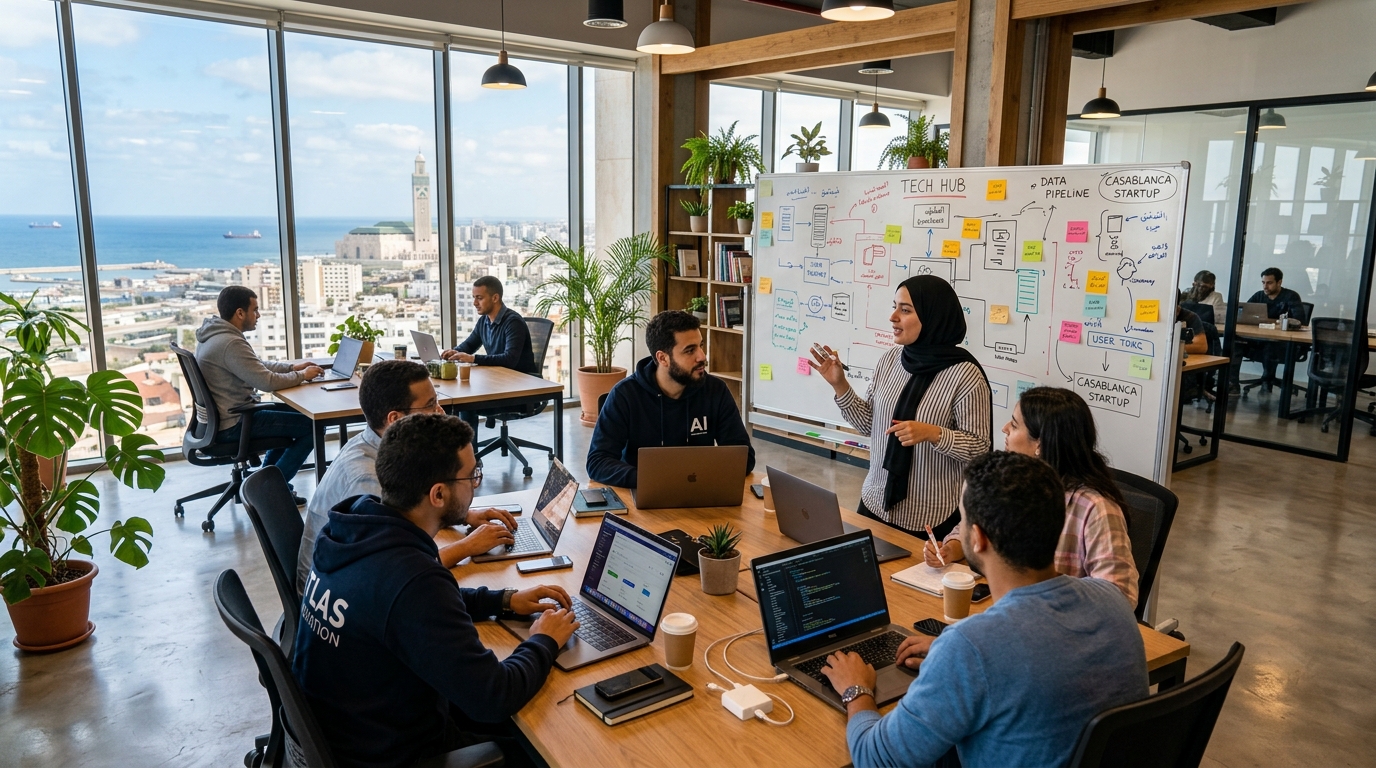
Morocco's technology and startup ecosystem has matured rapidly over the past decade, evolving from a handful of scattered ventures into a recognizable, if still emerging, hub for North and West Africa. Centred primarily on Casablanca, the country's economic capital, with growing activity in Rabat and other cities, the ecosystem now features incubators, accelerators, co-working spaces, university programmes and a steadily expanding community of founders, engineers and investors.
The drivers behind this growth are structural. Morocco has a large, young population, with a substantial share under the age of thirty, and rising rates of higher education, internet access and smartphone penetration. This combination creates both a deep talent pool and a sizeable domestic market of digitally engaged consumers, the two ingredients most essential for a startup ecosystem to take root and scale beyond a few isolated successes.
Government policy has reinforced the trend. National digital strategies have aimed to modernize public services, expand connectivity, support entrepreneurship and position Morocco as a digital gateway to Africa. Public and quasi-public funds, alongside development-finance institutions, have channelled capital toward startups, while initiatives to ease company formation and support innovation have gradually improved the environment in which young companies operate.
Fintech and the Push to Banked Africa
Among the sectors driving Morocco's tech story, fintech stands out as one of the most dynamic. Like much of Africa, Morocco has historically been a cash-heavy, partially banked economy, with a significant share of the population lacking full access to formal financial services. This gap represents precisely the kind of large, underserved market in which fintech startups thrive, building digital wallets, payment platforms, lending products and remittance services.
Remittances are a particularly important angle. Millions of Moroccans live and work abroad, especially in Europe, and the money they send home is a major pillar of the national economy. Reducing the cost and friction of these transfers through digital solutions is both commercially attractive and economically significant, and several ventures focus on modernizing this flow alongside domestic mobile-money and payment innovation.
Regulators have been gradually opening the door to digital finance, encouraging mobile payments and electronic money while balancing the need for stability and consumer protection. As digital-payment infrastructure improves and trust grows, fintech has the potential to accelerate the formalization of large parts of the economy, pulling informal activity into the measured, taxed and bankable mainstream, with benefits that ripple far beyond the startups themselves.
Outsourcing, IT Services and the Talent Advantage
One of Morocco's most established and underappreciated tech strengths is its business-process and IT-outsourcing industry. For years, the country has hosted call centres, customer-service operations, software-development teams and IT-services providers serving European clients, particularly French-speaking ones. This sector employs large numbers of young Moroccans and has built a reservoir of digital and language skills that feeds directly into the broader ecosystem.
The talent advantage is real and distinctive. Morocco's workforce is notably multilingual, with widespread fluency in Arabic and French and growing competence in English and Spanish, alongside engineering and technical education. This linguistic range makes Moroccan talent unusually well-suited to serving both European and African markets, and to working within international teams, a genuine competitive edge for both outsourcing firms and home-grown startups.
Increasingly, the ambition is to move up the value chain from low-cost outsourcing toward higher-value services such as software engineering, digital design, data and even research and development. The presence of multinational technology and engineering centres in Morocco, drawn by cost-competitive skilled labour and proximity to Europe, helps train talent and seed the kind of expertise from which ambitious local founders eventually emerge to build their own companies.
E-Commerce, Logistics and the Consumer Internet
As internet and smartphone use climb and digital payments slowly displace cash, Morocco's consumer-internet sector is expanding. E-commerce platforms, marketplaces, delivery services, online travel, edtech, healthtech and digital media are all finding growing audiences among a young, connected population eager for convenient online services. The pandemic-era acceleration of digital habits gave many of these models a durable boost.
Logistics is the crucial enabler and a sector ripe for innovation in its own right. Reliable delivery, address systems, payment-on-delivery handling and last-mile networks are essential for e-commerce to flourish, and startups working on these problems sit at the intersection of the digital and physical economies. Solving logistics friction unlocks growth not only for online retail but for a wide range of service businesses.
The domestic market, while sizeable, is also a launchpad for regional ambition. Successful Moroccan ventures increasingly look to expand across French-speaking West Africa and the wider continent, using the country's connectivity, talent and Casablanca's role as a business gateway. The dream for the most ambitious founders is to build pan-African champions from a Moroccan base, leveraging the kingdom's bridge position between Europe and Africa.
The Funding Gap and Other Hurdles
For all its promise, Morocco's startup ecosystem still faces meaningful obstacles, and the most frequently cited is access to capital. While early-stage and seed funding has grown, the pool of venture capital, particularly for larger growth rounds, remains thin compared with more mature ecosystems. Many promising startups struggle to raise the scale of funding needed to expand aggressively, sometimes looking abroad or to regional funds to fill the gap.
A related challenge is the relative shallowness of the exit environment. Vibrant ecosystems depend on founders and early investors eventually realizing returns through acquisitions or public listings, which then recycles capital and experience back into new ventures. With fewer large local acquirers and a still-developing market for tech exits, this flywheel turns more slowly in Morocco than founders would like, though it is gradually strengthening.
Other hurdles include bureaucratic friction, the pace of regulatory modernization for digital business, and the need to retain top talent that is often tempted by opportunities in Europe. Yet each of these is being actively addressed, and the trajectory is clearly upward. The combination of demographics, talent, strategic location and growing institutional support gives Morocco a credible path to becoming a leading African digital hub.
Why the Next Decade Looks Bright
Several tailwinds suggest Morocco's tech ecosystem is poised for an inflection. The same infrastructure investment, global visibility and economic momentum generated by the 2030 World Cup will benefit digital businesses indirectly, from improved connectivity and tourism-tech demand to a higher international profile that helps attract investment and partnerships. A more visible, dynamic Morocco is an easier place to fund and sell into.
The broader economic strategy also reinforces the digital one. As Morocco deepens its automotive, aerospace, renewable-energy and financial sectors, demand grows for software, data, automation and digital services to support them, creating local business-to-business opportunities for startups. Casablanca Finance City and the country's role as a gateway to African markets give fintech and enterprise-software founders a natural springboard for regional expansion.
Ultimately, Morocco's greatest startup asset is its people: a young, multilingual, increasingly well-educated and connected generation hungry for opportunity. As capital deepens, regulation modernizes and a few breakout successes inspire the next wave of founders, the ingredients are in place for the kingdom to cement its status as one of Africa's most important emerging technology ecosystems over the coming decade.
| Dimension | Strength | Challenge |
|---|---|---|
| Talent | Young, multilingual, technically educated workforce | Risk of talent leaving for Europe |
| Fintech | Large underbanked market and major remittance flows | Building trust and digital-payment adoption |
| Outsourcing / IT | Established BPO and IT-services base serving Europe | Moving up from low-cost to high-value work |
| E-commerce | Growing connected consumer market | Logistics, addressing and payment friction |
| Funding | Rising seed and early-stage activity | Thin growth-stage venture capital |
| Exits | Improving regional investor interest | Few large acquirers and limited exit market |
Strengths and challenges of Morocco's tech ecosystem
FAQ
Where is Morocco's startup activity concentrated?
The ecosystem is centred mainly on Casablanca, the economic capital, with significant and growing activity in Rabat and other cities. Casablanca's role as a business and financial gateway makes it the natural hub for founders and investors.
What are Morocco's strongest tech sectors?
Fintech, IT and business-process outsourcing, e-commerce and logistics are among the strongest areas. Fintech is especially promising given a large underbanked population and major remittance flows from Moroccans living abroad.
What is Morocco's biggest startup advantage?
Its people. Morocco has a large, young, multilingual workforce fluent in Arabic and French with growing English and Spanish skills, well-suited to serving both European and African markets and to working in international teams.
What is the main challenge for Moroccan startups?
Access to capital, especially larger growth-stage venture funding, remains the most cited hurdle, along with a still-developing market for exits through acquisitions or listings. Both are improving but lag more mature ecosystems.
Can Moroccan startups expand across Africa?
Yes. Many ambitious founders use Morocco's connectivity, multilingual talent and Casablanca's gateway role to expand into French-speaking West Africa and the wider continent, aiming to build pan-African companies from a Moroccan base.
Loved this? Useful? React below — your feedback helps other readers.