Building the Cathedrals of 2030: Inside Morocco's Stadium Megaprojects for the World Cup
Stadiums as Statements
Every World Cup leaves behind a skyline of stadiums, and those buildings become the most tangible physical memory of the tournament. For Morocco's 2030 co-hosting, the stadium programme is both a practical necessity and a statement of national ambition, a chance to show the world that the kingdom can build at the scale and quality of any nation on earth.
The portfolio spans renovation of existing grounds and the construction of new venues across six principal host cities: Casablanca, Rabat, Tangier, Marrakech, Agadir and Fez. This geographic spread is deliberate, distributing investment and attention across regions rather than concentrating everything in the economic heartland around Casablanca and Rabat.
Stadiums are also among the most scrutinised elements of any World Cup, because they carry the greatest risk of becoming costly burdens once the tournament ends. Morocco's planners must therefore design not only for a spectacular month in 2030 but for the decades that follow, when these cathedrals of sport need a reason to exist.
The Grand Stade Hassan II: A Colossus Rises
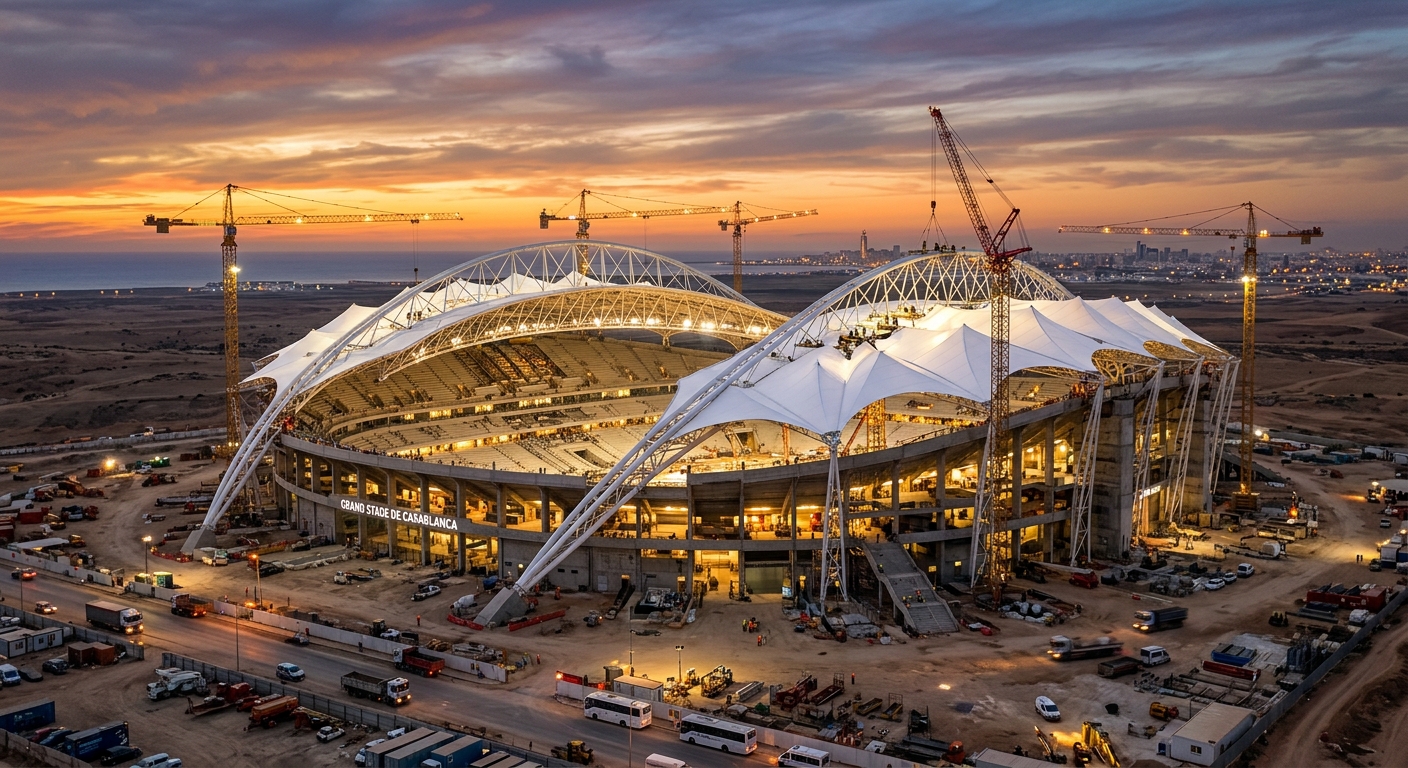
The undisputed centrepiece is the Grand Stade Hassan II, rising at El Mansouria between Casablanca and Rabat. Planned with a capacity of around 115,000, it is set to be among the largest football stadiums in the world and a leading candidate to host the 2030 final, the match that would crown Morocco's hosting in front of the entire planet.
The design ambition matches the scale. Renderings depict a vast tented roof structure, drawing on Moroccan and Berber cultural motifs and the imagery of a traditional encampment writ enormous, intended to be a landmark recognisable the moment it appears on screen. It is conceived not as a standalone arena but as the heart of a surrounding sports city, with training facilities, transport links and supporting development.
A stadium of this magnitude is an engineering and logistical undertaking of the first order. Beyond the structure itself, it requires road and rail access capable of moving more than a hundred thousand people, parking and transit solutions, and the integration of the venue into the wider region's infrastructure. The Grand Stade is therefore not just a building but the anchor of an entire planning ecosystem.
Its size is also its defining long-term risk. A 115,000-seat venue is a magnificent stage for a World Cup final, but filling it consistently afterward is a formidable challenge. The plan to make it a multi-use sports city and event venue is the answer to the question every observer immediately asks: what happens to this colossus when the World Cup leaves town.
The Host City Venues
Beyond the Casablanca showpiece, the host city venues form the working body of the tournament. Rabat, the capital, brings its sporting infrastructure into the programme. Tangier, the northern gateway facing Spain across the Strait of Gibraltar, offers strategic significance given the cross-continental nature of the 2030 tournament. Marrakech, the country's tourism jewel, adds a venue in one of its most internationally famous cities.
Agadir on the Atlantic coast and Fez, one of the great historic cities of the Islamic world, complete the principal host roster, each combining a renovated or new stadium with the surrounding upgrades needed to welcome international crowds. Together they create a network of venues distributed across the country's geography, ensuring the tournament's footprint and benefits reach widely.
These venues serve a dual purpose that begins well before 2030. Morocco hosted the 2025 Africa Cup of Nations, which gave several of these grounds a live, high-stakes rehearsal years ahead of the World Cup. That sequencing is a significant advantage, allowing organisers to test capacity, logistics and fan experience and to refine the venues based on real tournament use rather than projections alone.
The legacy case for these mid-sized venues is generally stronger than for the Grand Stade. Stadiums in the 40,000 to 70,000 range can plausibly serve domestic clubs, national team fixtures, concerts and events, fitting more comfortably into the realistic demand of Moroccan football and entertainment than a 115,000-seat colossus.
Designing for Heat, Crowds and Culture
Modern World Cup stadium design must solve a demanding equation. Comfort for spectators and players in summer conditions is a priority, pushing designers toward shading, ventilation and increasingly sophisticated cooling and roof solutions. Morocco's climate varies across its host cities, from Atlantic-tempered coasts to hotter interiors, requiring designs tuned to local conditions.
Crowd flow and safety are equally central. Lessons from past tournaments and stadium tragedies have made the safe movement of massive crowds, entry and exit, emergency access and clear sightlines non-negotiable elements of design. For a venue the size of the Grand Stade, these considerations scale to extraordinary complexity.
Cultural expression is the third pillar, and one Morocco is leaning into hard. The aspiration is for venues that are unmistakably Moroccan in character, drawing on the country's rich architectural heritage of geometric patterns, tilework traditions and Berber and Islamic design, rather than generic international arenas. A stadium that tells a story about its host nation adds to the tournament's identity and to the country's brand long after the final whistle.
Sustainability has also become a standard expectation, with modern venues judged on energy efficiency, water management and environmental footprint. For a country positioning itself as a forward-looking leader, meeting contemporary sustainability standards in its flagship stadiums is part of the message the buildings are meant to send.
The Legacy Question
No discussion of World Cup stadiums is complete without confronting the legacy problem. The history of mega-events is littered with venues that thrilled for a tournament and then sat half-empty or abandoned, costly monuments to a month of glory. Avoiding that fate is the single greatest long-term challenge of Morocco's stadium programme.
The strategies for legacy are well understood, if hard to execute. Tie venues to resident clubs and the national team, programme them with concerts and events, integrate them into surrounding commercial and residential development, and where appropriate design for partial reconfiguration to a more sustainable everyday capacity. Morocco's framing of its biggest venue as a sports city rather than an isolated stadium reflects this thinking.
The honest reality is that legacy success is uneven and difficult to guarantee. Mid-sized venues in cities with established football and event demand have a reasonable path. The Grand Stade Hassan II, by virtue of its sheer scale, faces the steepest challenge, and its long-term story will be one of the most closely watched legacy questions of any 2030 venue.
There is, however, a counterargument worth weighing. Even venues that struggle commercially can deliver intangible returns, in national pride, in global image and in the inspiration of a generation of young athletes and fans. Whether those returns justify the cost is a genuine debate, but it is not as one-sided as the harshest critics of stadium spending sometimes suggest.
Beyond the Stadiums: The Wider Build
Stadiums never stand alone. Each venue sits at the centre of a web of supporting infrastructure that is often more economically significant than the building itself. Transport links, including Morocco's high-speed rail extension toward Marrakech and major airport expansions at Casablanca and beyond, are what make the venues function and what deliver lasting value to the country.
Hospitality is the other essential layer, with new hotel capacity rising across host cities to accommodate the surge of visitors, capacity that supports Morocco's broader tourism target of around 26 million annual visitors by 2030. The stadiums generate the event; the wider build determines whether the country can absorb and benefit from it.
This is the crucial framing for understanding Morocco's stadium megaprojects. They are the visible, headline-grabbing tip of a far larger transformation. The true measure of the 2030 build will not be the beauty of the arenas alone, but whether the connected infrastructure of rail, air, roads and hotels leaves Morocco a more capable, connected and prosperous country once the crowds have gone home.
Cathedrals With a Purpose, or Without
Morocco's stadium megaprojects for 2030 are ambitious, culturally rooted and genuinely impressive in scope, led by a colossus near Casablanca that aims to rank among the great football venues of the world. They will give the kingdom an unforgettable stage on which to host football's biggest event for the first time in its history.
The architecture and engineering are, in a sense, the easier part. The harder, longer challenge is purpose: ensuring these cathedrals of sport remain alive and useful long after the final of 2030 is played. That depends on football culture, event demand, careful programming and the honest matching of capacity to need, the unglamorous work that determines whether a stadium is an asset or an anchor.
If Morocco gets it right, the 2030 venues become permanent landmarks of a confident, modern nation and the homes of a footballing culture on the rise. If it gets it wrong, the largest of them risk becoming expensive reminders of overreach. The renderings are spectacular and the ambition is real. The verdict, as always with World Cup stadiums, will be written in the decade after the tournament, not the month of it.
| Host city | Stadium role | Legacy outlook |
|---|---|---|
| Casablanca (El Mansouria) | Grand Stade Hassan II, ~115,000, final candidate | Highest ambition, steepest legacy challenge |
| Rabat | Capital city venue | National team and institutional use |
| Tangier | Northern gateway facing Spain | Strategic for cross-continental tournament |
| Marrakech | Tourism-hub venue | Strong event and tourism demand |
| Agadir | Atlantic coast venue | Regional and club football base |
| Fez | Historic-city venue | Cultural showcase and regional use |
Morocco's principal 2030 World Cup host cities and stadium roles
FAQ
How big is the Grand Stade Hassan II?
The Grand Stade Hassan II, being built at El Mansouria near Casablanca, is planned with a capacity of around 115,000, making it one of the largest football stadiums in the world and a candidate to host the 2030 World Cup final.
Which Moroccan cities will host 2030 World Cup matches?
Morocco's principal host cities include Casablanca, Rabat, Tangier, Marrakech, Agadir and Fez, with a mix of newly built and renovated stadiums distributed across the country.
Why did Morocco host the 2025 Africa Cup of Nations first?
Hosting the 2025 Africa Cup of Nations gave Morocco a live, large-scale rehearsal of several World Cup venues and logistics years before 2030, helping reduce the risk of costly surprises.
What is the white-elephant risk for Morocco's stadiums?
The white-elephant risk is that large venues, especially the 115,000-seat Grand Stade Hassan II, become costly to maintain if there is not enough sustained demand to fill them after the World Cup.
How does stadium design reflect Moroccan culture?
Morocco's 2030 venues aim to draw on the country's architectural heritage, including geometric patterns, tilework and Berber and Islamic design, with the Grand Stade evoking a giant traditional tented encampment.
Loved this? Useful? React below — your feedback helps other readers.