Morocco's Renewable Energy Revolution: The Noor Solar Megaproject and a Green Future
From Energy Importer to Renewable Pioneer
For most of its modern history, Morocco faced an awkward energy reality: it imported the overwhelming majority of the fossil fuels it burned to keep the lights on. With little domestic oil and gas, the country was exposed to volatile global prices and the strategic vulnerability of dependence on foreign energy. That dependence became a powerful motivation to reinvent the kingdom's energy model from the ground up.
What Morocco lacked in hydrocarbons it possessed in abundance in sun and wind. The country enjoys some of the highest levels of solar irradiation in the world, particularly across its vast southern and desert regions, alongside strong and consistent winds along its long Atlantic coastline. Recognizing this natural advantage, Moroccan leadership made a strategic bet in the 2010s to become a renewable-energy power, setting ambitious national targets for the share of electricity generated from clean sources.
This was not framed merely as an environmental gesture but as economic and industrial strategy. By generating power domestically from sun and wind, Morocco could cut its costly fuel-import bill, insulate its economy from energy-price shocks, attract green-focused manufacturers and ultimately turn energy from a weakness into a competitive strength and even an export. That vision has guided more than a decade of large-scale investment and now underpins the country's industrial decarbonization ambitions.
Noor Ouarzazate: A Solar Cathedral in the Desert
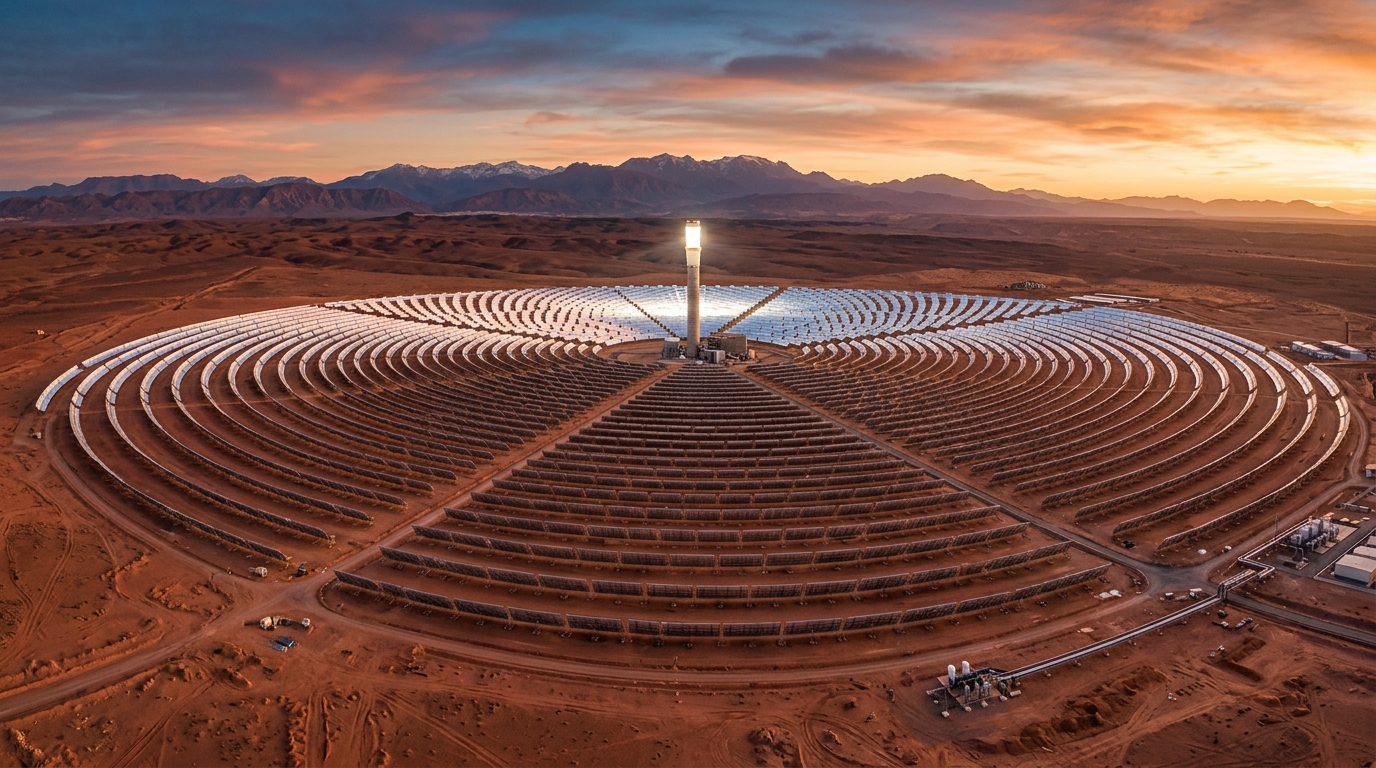
The flagship and global symbol of Morocco's renewable revolution is the Noor Ouarzazate solar complex, built on the edge of the Sahara near the city of Ouarzazate. Developed in successive phases, it became one of the largest concentrated-solar power facilities in the world, spread across thousands of hectares of desert and visible even from space. Noor, meaning light in Arabic, was conceived as a statement of national ambition as much as a power station.
What makes Noor technically remarkable is its use of concentrated-solar power, or CSP, in addition to conventional photovoltaic panels. CSP works by using vast fields of curved mirrors to focus sunlight onto receivers, heating a fluid to drive turbines. Crucially, several of Noor's phases incorporate thermal-energy storage using molten salt, which allows the plant to keep generating electricity for hours after the sun has set. This storage capability addresses one of solar power's classic weaknesses, intermittency, making the output far more useful to the grid.
The complex also features a towering central receiver in one of its phases, a solar tower surrounded by a sea of tracking mirrors that concentrate light to a single glowing point. Beyond the engineering, Noor delivered tangible development benefits to a historically underdeveloped region, including jobs, roads, training and technology transfer. It turned Ouarzazate, long known as a film-industry backdrop, into a worldwide reference point for ambitious solar deployment in emerging economies.
Wind, Hydro and a Diversified Clean Grid
Solar is the headline, but Morocco's renewable strategy is deliberately diversified across multiple technologies. The country has built a substantial fleet of wind farms, particularly in the breezy regions around Tangier, Tarfaya and the Atlantic south, where some of Africa's largest onshore wind projects spin almost continuously. Wind complements solar nicely, often blowing strongly at night and during seasons when solar output dips, smoothing the overall renewable supply.
Hydropower, long a part of Morocco's energy mix, continues to play a role, including pumped-storage schemes that act like giant batteries, storing energy by pumping water uphill when power is plentiful and releasing it to generate electricity when demand peaks. Combined with the molten-salt storage at Noor, these technologies help Morocco manage the variability inherent in a renewable-heavy grid and maintain stability as the share of clean power rises.
The cumulative effect has been a rapid climb in the proportion of Morocco's installed generating capacity that comes from renewables, moving the country toward its stated goal of having a majority of its electricity capacity derived from clean sources. Achieving and exceeding such targets requires not only building plants but also modernizing transmission networks and interconnections, including high-voltage links that allow power to flow efficiently across the country and, increasingly, toward Europe.
Green Hydrogen and the Export Ambition
The most forward-looking dimension of Morocco's energy strategy is green hydrogen. By using abundant, cheap renewable electricity to split water into hydrogen and oxygen through electrolysis, Morocco aims to produce clean hydrogen and hydrogen-derived fuels such as green ammonia. These products can decarbonize heavy industry, fertilizer production and shipping, and can be exported to energy-hungry European markets seeking to cut their carbon footprints.
Morocco's pitch to investors and partners is compelling: world-class solar and wind resources, proximity to Europe, political stability and existing industrial demand, notably from the phosphate-and-fertilizer giant that needs ammonia and could green its own supply chain. The government has signalled strong support for green-hydrogen development, earmarking land and crafting a national framework intended to attract billions of dollars in investment from international energy companies and funds.
If these ambitions materialize, Morocco could evolve from an energy importer into a clean-energy exporter, shipping green hydrogen and its derivatives, and potentially electricity via undersea cables, to Europe. This would represent one of the most dramatic energy reversals of any country in a generation. The chief constraints are the enormous capital required, the need for vast quantities of water for electrolysis, which intersects with the country's water-scarcity challenge, and the pace at which global hydrogen markets mature.
Challenges Behind the Sunshine
Morocco's renewable success story is genuine, but it comes with real complications. Concentrated-solar power, while elegant, has historically been more expensive than plain photovoltaic panels, whose costs have fallen dramatically worldwide. The financing of megaprojects like Noor relied heavily on international development banks and required careful structuring to keep electricity affordable, and managing the long-term economics of such assets remains an ongoing task.
Water is the recurring constraint. Solar-thermal plants need water for cooling and cleaning mirrors, and green hydrogen needs vast amounts for electrolysis, all in a country already under severe water stress. The solution increasingly involves coupling renewable projects with desalination, using clean power to produce fresh water, but this adds cost and complexity. Balancing energy ambitions against water realities is one of the central engineering and policy puzzles of the coming decade.
There is also the matter of ensuring that the energy transition translates into broad domestic benefit, not just exports. Building local manufacturing of solar and wind components, training a skilled green-energy workforce and ensuring rural and underdeveloped regions share in the gains are all part of making the transition durable and politically sustainable. Even so, Morocco's combination of natural endowment, strategic clarity and willingness to invest has made it one of the most credible clean-energy stories in the developing world.
What Morocco's Energy Model Means for the Region
Morocco's renewable journey carries lessons well beyond its borders. It demonstrates how a country with limited fossil resources but rich sun and wind can flip a strategic vulnerability into an advantage through long-term planning and decisive investment. For other African and emerging economies, Noor and its successors serve as proof that utility-scale renewable deployment is achievable outside the wealthy industrialized world.
The model also reshapes Morocco's geopolitical position. As Europe seeks reliable, lower-carbon energy supplies and looks to diversify away from less stable suppliers, a stable neighbour across the strait offering green electrons and green molecules becomes strategically valuable. Energy could become a new axis of the deep Morocco-Europe relationship, alongside trade, migration and security cooperation, strengthening the kingdom's hand.
Looking toward the World Cup decade and beyond, renewable energy is woven into Morocco's broader development narrative. Clean power feeds the automotive and EV-battery ambitions, the green-hydrogen push, the desalination needed for water security and the sustainable image the country wants to project to the world. The sun-baked mirrors of Ouarzazate are, in a real sense, a foundation stone of the modern Moroccan economy.
| Technology / Initiative | What it does | Strategic significance |
|---|---|---|
| Noor Ouarzazate CSP | Concentrated solar with molten-salt storage | Flagship plant, power even after sunset |
| Photovoltaic solar | Direct sunlight-to-electricity panels | Low-cost, scalable clean generation |
| Onshore wind | Large wind farms along the coast and south | Complements solar, strong at night |
| Hydro & pumped storage | Water-based generation and energy storage | Grid stability and balancing |
| Green hydrogen | Renewable-powered water electrolysis | Future clean-fuel export to Europe |
| Desalination + renewables | Clean power producing fresh water | Links energy ambitions to water security |
Pillars of Morocco's renewable energy strategy
FAQ
What is the Noor Ouarzazate solar complex?
It is one of the largest concentrated-solar power facilities in the world, built in the Moroccan desert near Ouarzazate. Developed in phases, it uses fields of mirrors and a solar tower, along with molten-salt storage that lets it generate electricity even after the sun sets.
What share of Morocco's electricity comes from renewables?
Morocco has rapidly increased the renewable share of its installed capacity and is targeting having a majority of its electricity capacity come from clean sources. The exact share rises year by year as new solar and wind projects come online.
Why is Morocco investing in green hydrogen?
Green hydrogen lets Morocco turn its cheap, abundant solar and wind power into a storable, exportable clean fuel. It can decarbonize local industry such as fertilizer production and be sold to European markets seeking to cut emissions, potentially turning Morocco into an energy exporter.
What is the biggest challenge for Morocco's clean energy plans?
Water is the central constraint. Solar-thermal plants and hydrogen electrolysis both need significant water in a country facing severe water stress, which is why renewables are increasingly paired with desalination. Financing and grid modernization are also major challenges.
How does renewable energy help Morocco's broader economy?
Domestic clean power reduces costly fuel imports, shields the economy from energy-price shocks, attracts green-focused manufacturers and supports the automotive, EV-battery and green-hydrogen industries while feeding the desalination needed for water security.
Loved this? Useful? React below — your feedback helps other readers.