Morocco Knock Out Netherlands on Penalties, Reach Last 16
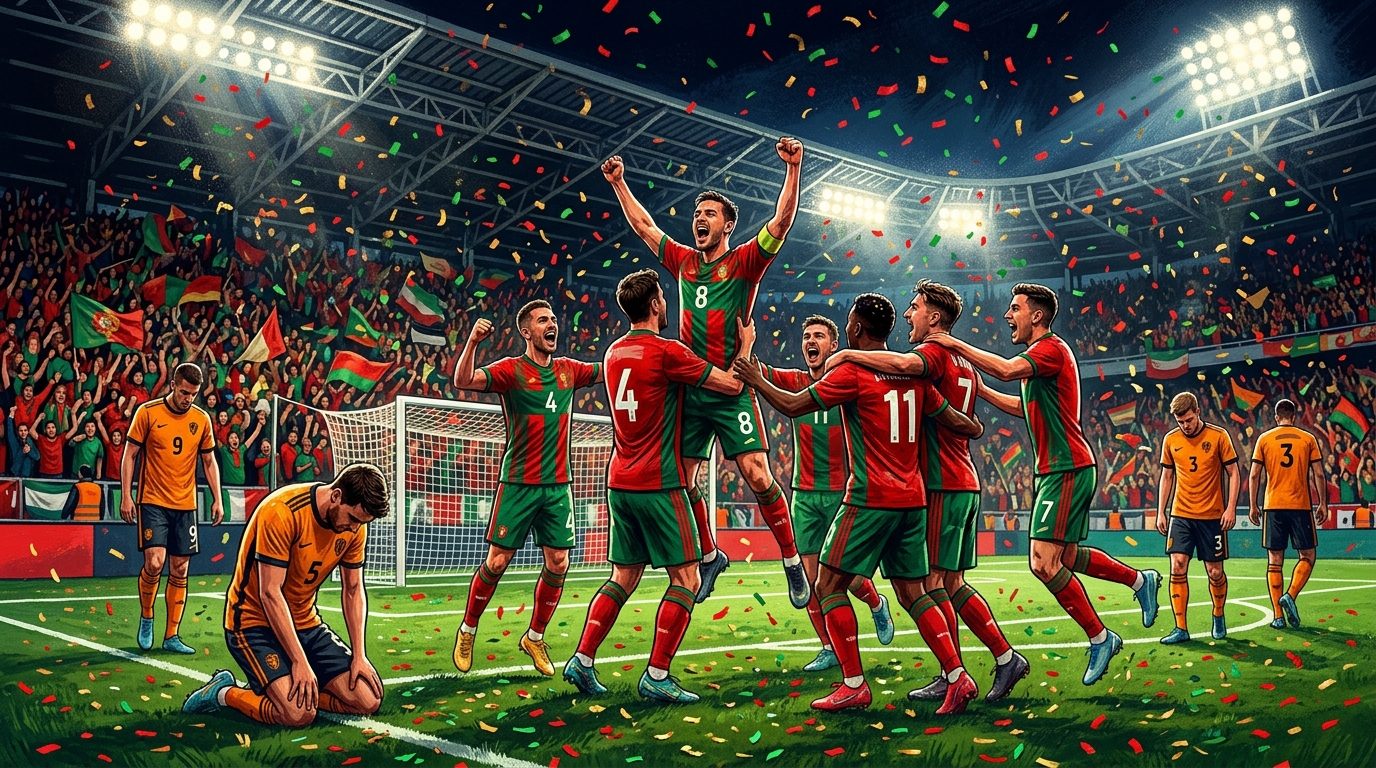
Morocco Hold Their Nerve to Eliminate the Netherlands
Morocco are through to the round of 16 of the 2026 World Cup, and they got there the hard way. On a tense night at Estadio BBVA in Monterrey, the Atlas Lions and the Netherlands could not be separated across 120 minutes, the match locked at 1-1 after extra time. It went to a penalty shootout, the cruelest and most theatrical way to settle a knockout tie, and it was Morocco who held their nerve. They won the shootout 3-2, and in doing so dumped one of European football's most storied nations out of the tournament.
The decisive moments belonged to two men. Yassine Bounou, the goalkeeper the world came to know simply as Bono during Morocco's 2022 run, produced the save that defined the night, diving low to push away Crysencio Summerville's penalty. Moments later, Ismael Saibari stepped up with the chance to win it and buried his spot-kick, sending the Moroccan bench sprinting toward him and the green-and-red sections of the stadium into delirium. The Netherlands, who had spent so much of the contest defending and so little of it creating, were left to contemplate another World Cup exit on penalties.
For Morocco, this was not just a win; it was a statement. Four years on from their historic semifinal run in Qatar, the Atlas Lions arrived at the 2026 tournament carrying the weight of expectation rather than the freedom of surprise. To come back from a goal down in the final minute of normal time, to survive the lottery of penalties against a side as experienced as the Dutch, and to do it with the composure they showed in Monterrey, told you everything about how far this team has travelled. The golden generation is no fluke, and Morocco vs Netherlands was the night they proved it all over again.
The Result, the Scorers and What Happened
Here is the bottom line for anyone catching up. The Netherlands and Morocco finished 1-1 after extra time in the round of 32 of the World Cup 2026. Cody Gakpo gave the Dutch the lead in the 72nd minute. Issa Diop, the Morocco centre-back, headed home an equalizer in the first minute of second-half stoppage time, the 90+1 mark, to drag the tie into extra time. Neither side could find a winner in the additional 30 minutes, and so the match was decided by a penalty shootout, which Morocco won 3-2.
The shootout itself was a rollercoaster. The Netherlands actually scored first through Teun Koopmeiners, and Morocco missed their opening attempt. But the Dutch then unravelled, missing through Justin Kluivert and Quinten Timber, while Morocco found their rhythm with successful kicks from Soufiane Rahimi and Chemsdine Talbi. Bounou's save from Summerville was the hammer blow, and Saibari delivered the knockout, converting the penalty that confirmed a 3-2 shootout win and a place in the last 16.
Morocco will play co-hosts Canada in the round of 16. That fixture is scheduled for July 4 in Houston, Texas, one of the 16 host cities of the first 48-team World Cup. For the Atlas Lions it is a winnable tie against opposition they will fancy, and a genuine chance to push deep into a tournament that is increasingly opening up for them. The road from Monterrey to the latter stages of this World Cup now runs through Texas.
Monterrey Sets the Stage
Estadio BBVA in Monterrey is one of the great modern venues in North American football, a striking, mountain-framed bowl on the edge of the city, and it was close to full for this round of 32 tie, with an attendance of 51,243 packed in for the occasion. The crowd was loud, partisan and overwhelmingly behind Morocco. The Atlas Lions have, over the past two World Cups, become something close to a neutral's second team and a diaspora's first, and the green flags and chants that filled the Mexican night made it feel at times like a home fixture.
Morocco's support has been one of the defining features of their rise. From the streets of Casablanca and Rabat to the Moroccan communities of Europe and the Americas, this team carries a following that few nations can match. In Monterrey, that following turned a neutral venue into a cauldron, drumming and singing through every Moroccan attack and every Dutch clearance. The atmosphere mattered, because this was a match that demanded patience and nerve, and a crowd behind you can carry a team through the longest, tensest passages of a knockout game.
The Netherlands, by contrast, were the visitors in every sense. They came into the tie as one of the heavyweight names of the bracket, an established European power with a deep squad and a manager in Ronald Koeman who has seen everything the game can throw at him. But on the night, in front of this crowd and against this opponent, the Dutch found themselves penned in, forced to defend, and ultimately unable to escape the grip Morocco placed on the contest.
How the Teams Lined Up
Morocco coach Mohamed Ouahbi set his side up in a 4-2-3-1, built to dominate possession and squeeze the Netherlands into their own half. Bounou started in goal behind a back four of Achraf Hakimi, Issa Diop, Riad and Noussair Mazraoui. A double pivot of Bouaddi and Ounahi anchored the midfield, with a creative trio of Eliesse Ben Seghir alternatives in El Khannouss, Brahim Diaz and Saibari supporting the attack, and El Aynaoui leading the line. It was a set-up designed for control, and control is exactly what Morocco got.
Ronald Koeman's Netherlands lined up in a 3-4-2-1, a shape that on paper promised attacking width and a front-loaded threat. Bart Verbruggen started in goal, protected by a back three of van Hecke, captain Virgil van Dijk and Nathan Aké. Denzel Dumfries and Micky van de Ven provided the wing-back energy, with Ryan Gravenberch and Frenkie de Jong in the centre. Gakpo and Summerville played off Brobbey at the top. The intention was to give the Dutch a platform to hurt Morocco on the counter; the reality is that they rarely got the ball long enough to try.
The match was refereed by Wilton Pereira Sampaio of Brazil, an experienced official for a fixture that always carried the potential to boil over. In the end, the contest was fierce but largely clean, a battle of systems and wills rather than a stop-start affair of cards and complaints. The tactical chess between Ouahbi and Koeman ran through the whole 120 minutes, and it was the Moroccan plan that proved the more durable.
The Opening Exchanges
From the first whistle, Morocco established the pattern that would define the match. They wanted the ball, and they took it. The Atlas Lions pressed high, circulated possession with patience, and forced the Netherlands to spend long stretches camped in their own half. The early statistics told the story before the goals did: Morocco dominated the ball, knocking it around with a calm authority that suggested a team entirely comfortable with the stage and the moment.
The Netherlands, for their part, settled into a deep, compact block. Koeman's side were content, at least initially, to absorb pressure and look for moments to spring forward through Gakpo and Summerville. It was a pragmatic approach against an opponent with Morocco's quality in possession, and for a long time it worked in the sense that it kept the scoreline blank. But it also surrendered the initiative, and against a side as patient as Morocco, surrendering the initiative is a dangerous game to play.
The first half ebbed without a goal, but not without warning signs for the Dutch. Morocco probed down both flanks, with Hakimi a constant menace overlapping on the right and Mazraoui pushing up on the left. The Atlas Lions created the better openings and looked the more likely to score, even if the final ball or the finishing touch eluded them. The Netherlands reached the interval level, but they had been made to work for it, and the shape of the contest was already clear.
Morocco Dominate the Ball
If there is a single set of numbers that captures this match, it is the possession and expected-goals data. Morocco finished the night with around 70 percent of the ball, completing some 800 passes at an accuracy of better than 90 percent. The Netherlands managed roughly 30 percent possession and fewer than 300 passes. In a knockout tie at a World Cup, that kind of imbalance is remarkable, and it speaks to the degree of control Ouahbi's side imposed.
The expected-goals figures were just as lopsided. Morocco generated around 1.40 xG to the Netherlands' 0.23, and registered five shots on goal to the Dutch two. By almost every underlying metric, this was a match Morocco shaded comfortably. They were the more threatening side, the more incisive side and the more relentless side. That they did not win inside 90 minutes was down to a combination of their own profligacy and some excellent Dutch goalkeeping, rather than any failure to create.
Domination of possession can be a double-edged sword, of course. Teams that enjoy the lion's share of the ball can find themselves exposed on the counter, and the Netherlands carried exactly that threat in Gakpo and Summerville. But Morocco managed the risk well for long stretches, defending their transitions with discipline and snuffing out Dutch breaks before they could become genuine chances. The one time they switched off, the Netherlands made them pay, and the goal arrived from precisely the kind of moment Morocco had spent the night trying to avoid.
Gakpo Strikes for the Netherlands
For all of Morocco's control, it was the Netherlands who broke the deadlock. In the 72nd minute, Cody Gakpo struck to give the Dutch the lead. It was, in many ways, against the run of play, a reward for the patience and the counter-attacking threat that Koeman had built his game plan around. Gakpo, one of the most dangerous forwards in the Dutch squad, found the space he needed and finished, and suddenly the Netherlands had the advantage their performance had scarcely merited.
The goal changed the complexion of the match. The Netherlands, ahead and organized, now had every incentive to retreat further into their shell and protect the lead. Morocco, who had dominated without reward, were left chasing a game they had spent more than an hour controlling. For a side carrying the weight of expectation, it was the worst kind of scenario: total command of the ball, but a deficit on the scoreboard and the clock ticking down toward elimination.
It would have broken lesser teams. Going behind late in a knockout game, against a defensively organized opponent, is the moment when nerves fray and patience curdles into panic. But Morocco have built their identity on resilience, and rather than abandon their principles, they doubled down. They kept the ball, kept pushing bodies forward, and kept believing that the equalizer would come. With the seconds bleeding away, it did, in the most dramatic fashion imaginable.
Diop's Stoppage-Time Header
The 90th minute came and went, and the fourth official's board went up. Into stoppage time Morocco poured, and in the very first minute of added time, the 90+1 mark, they found their reward. Issa Diop, the centre-back, rose highest to meet a delivery into the Dutch box and powered a header past Verbruggen. The equalizer. The stadium erupted. From the edge of elimination, Morocco had hauled themselves level with a goal of pure defiance.
There was a poetry to the scorer. Diop is a defender, a man whose job is to keep the ball out of his own net, and here he was popping up at the other end at the most critical moment to rescue his country's World Cup. It was the kind of goal that knockout football lives for, a centre-back charging forward in the dying embers of normal time and delivering when it mattered most. For Morocco, it was salvation; for the Netherlands, it was a gut punch from which they never truly recovered.
The timing could hardly have been more cruel for the Dutch. They had been within touching distance of seeing out the win, the clock almost run down, the round of 16 almost secured. To concede in the first minute of stoppage time, to a header from a defender, after defending for so long, was the kind of blow that drains the legs and the belief. Extra time loomed, and with it the sense that momentum had swung decisively, and irreversibly, toward Morocco.
Extra Time and Verbruggen's Heroics
The 30 minutes of extra time followed the same script as the 90 that preceded them. Morocco pressed, probed and dominated; the Netherlands defended, scrambled and survived. The Atlas Lions sensed that the tie was theirs for the taking, and they threw everything at a Dutch side now visibly hanging on. Chance after chance came and went, and the longer the additional period wore on, the more it felt like Morocco's night, even as the scoreboard refused to budge.
The reason it stayed level was Bart Verbruggen. The Netherlands goalkeeper produced a string of important interventions to keep his team alive, none more spectacular than a point-blank stop to deny Soufiane Rahimi, a save described in the aftermath as one of the finest of the entire tournament. It was the kind of reflex stop that wins matches single-handedly, and for a while it threatened to be the moment that broke Moroccan hearts. Verbruggen could not be beaten in open play, and the longer his resistance held, the more the spectre of penalties loomed.
And so it came to a shootout. After 120 minutes in which Morocco had bossed the ball, created the better chances and twice looked the more likely to win, the tie would be decided from 12 yards. It is the great equalizer of knockout football, a contest in which possession statistics and expected goals count for nothing, in which the better team over two hours can lose in the space of a few kicks. For Morocco, it was a nervous prospect; for the Netherlands, a lifeline. Both knew the margins would be razor-thin.
The Penalty Shootout, Kick by Kick
The shootout opened in the worst possible way for Morocco. Teun Koopmeiners stepped up first for the Netherlands and scored, putting the Dutch 1-0 ahead. Then Nayef Aguerd's compatriots watched as the first Moroccan kick, taken by Neil El Aynaoui, was missed, leaving the Atlas Lions a goal behind in the shootout and the early psychological advantage with the Dutch. It was exactly the kind of start that can spiral on a team in the lottery of penalties.
But the Netherlands handed the initiative straight back. Justin Kluivert, up next for the Dutch, missed his penalty, wiping out the advantage Koopmeiners had given them. Morocco seized the reprieve. Soufiane Rahimi, the man Verbruggen had denied so spectacularly in extra time, made no mistake from the spot, levelling the shootout at 1-1 and steadying Moroccan nerves. The momentum, so briefly with the Netherlands, had swung back.
Wout Weghorst restored the Dutch lead with a converted penalty to make it 2-1, only for Chemsdine Talbi to answer immediately for Morocco, slotting home to bring it back to 2-2. The tension was now unbearable. Quinten Timber then missed for the Netherlands, and when Achraf Hakimi, Morocco's captain and talisman, also failed to convert, the shootout remained level at 2-2 with the drama stretched to breaking point. It all came down to the final pair of kicks.
Bounou the Hero
Up stepped Crysencio Summerville for the Netherlands, needing to score to keep the Dutch alive. Waiting for him was Yassine Bounou, and there are few goalkeepers in world football you would less want to face in this exact situation. Bounou guessed right, dived low and strong, and pushed Summerville's penalty away. The save. The Moroccan bench leapt as one, and the stadium roared. With that single act, Bounou had handed his country the chance to win the tie.
It was a moment that carried echoes of 2022, when Bounou's heroics in the shootout against Spain in Qatar helped Morocco reach the quarterfinals on their way to a historic semifinal. The big goalkeeper has built a reputation as a penalty specialist, a man who rises to precisely these occasions, and once again he delivered on the grandest stage. For Morocco, Bounou is more than a goalkeeper; he is a security blanket, a guarantor of belief, the man you want behind you when a World Cup tie comes down to 12 yards.
The save did not, on its own, win the match, but it created the opening, and in a shootout that is everything. Bounou's stop meant that the next Moroccan kick, if converted, would send the Atlas Lions through. The pressure shifted entirely onto the Netherlands and away from Morocco, and the man walking forward to take that next penalty knew that the destiny of his country's World Cup was, quite literally, at his feet.
Saibari Scores the Winner
Ismael Saibari was that man. With the shootout at 2-2 and Bounou's save still ringing in everyone's ears, Saibari placed the ball on the spot needing only to score to win it. He kept his composure, ran up, and converted, making it 3-2 in the shootout and sending Morocco into the round of 16. The midfielder wheeled away in celebration as his teammates engulfed him, the relief and the joy pouring out of a team that had been to the edge and back.
It was a fitting way to end the contest. Morocco had been the better side across 120 minutes, and while penalties can make a mockery of merit, on this occasion the team that deserved to win did win. Saibari's kick was the punctuation mark on a performance built on control, resilience and nerve, the calm finish that capped a night of high tension. For the young midfielder, it was the kind of moment that careers are remembered for, the decisive penalty in a World Cup knockout tie.
The contrast at the final whistle could not have been starker. Moroccan players sank to their knees, embraced, and turned to celebrate with the supporters who had carried them all night. The Netherlands stood frozen, the realization sinking in that their World Cup was over, beaten on penalties for the second time in recent memory at this tournament's knockout stages. Koeman's side trudged off, while Morocco's celebration spilled across the pitch and into the stands, a release four years in the making.
A Second Penalty Triumph Over a European Giant
There was history in this result beyond the immediate. For the second time, Morocco overcame a major European power on penalties at a World Cup. Four years ago in Qatar, it was Spain, beaten on spot-kicks in the round of 16 as Bounou starred. Now it is the Netherlands, eliminated in similar fashion. For a nation that for so long was on the wrong side of these knockout-stage margins, the shift is profound: Morocco have become a team that wins the big penalty shootouts rather than losing them.
That is not an accident. Penalty success at the highest level is part nerve, part preparation, and part the quality of your goalkeeper, and Morocco have all three in abundance. Bounou's record from the spot is now the stuff of national legend, and the team's collective composure under the most extreme pressure speaks to a mentality that has been forged over consecutive deep tournament runs. The Atlas Lions no longer fear the shootout; if anything, opponents fear facing them in one.
Beating the Netherlands also carries its own symbolic heft. The Dutch are one of the great names of the international game, a three-time World Cup finalist with a footballing culture admired the world over. To knock them out, and to do it while dominating the ball and the chances, is the kind of result that announces a team as a genuine contender rather than a romantic outsider. Morocco are no longer the surprise package of world football; they are a side that the giants must now fear.
Echoes of 2022 and the Golden Generation
It is impossible to talk about this Morocco team without invoking 2022. In Qatar, the Atlas Lions wrote one of the great World Cup stories, becoming the first African and first Arab nation to reach the semifinals of the tournament. They beat Belgium, Spain and Portugal along the way, captured the imagination of the globe, and changed forever the conversation about what African and Arab football could achieve at the very highest level. That run was a watershed, and it raised the bar of expectation for everything that followed.
The challenge for any team that produces a fairy-tale run is to prove it was not a one-off. Morocco arrived at the 2026 World Cup with that question hanging over them, the burden of having to live up to the standard they set themselves. The night in Monterrey was an emphatic answer. This is not a flash in the pan or a lucky bracket; this is a serious, deep, well-coached team capable of beating elite opposition and grinding out results when the football is not flowing. The golden generation has staying power.
Much of the core that lit up Qatar remains, supplemented by emerging talent that has deepened the squad. Hakimi is still the captain and the engine, Bounou still the immovable last line, while younger players like Saibari, Talbi and the creative options around the front have added fresh dynamism. The blend of experience and youth gives Ouahbi a group capable of competing on every front, and the manner of this win, ugly when it had to be, suggests a maturity that the 2022 vintage was still developing.
Ouahbi's Imprint on the Team
Mohamed Ouahbi has guided Morocco to the round of 16 with a clear and coherent footballing identity. The possession-dominant, high-pressing approach on display against the Netherlands is no accident; it is the product of a deliberate philosophy, one that asks his players to control matches through the ball and to suffocate opponents who would rather sit deep and counter. The numbers from Monterrey, 70 percent possession and a comprehensive edge in expected goals, are the signature of a team coached to dominate.
What stood out most, though, was the composure Ouahbi's side showed when the plan was not yielding goals. Falling behind in the 72nd minute could have prompted a frantic, disorganized chase. Instead, Morocco stayed true to their principles, trusted that the equalizer would come, and were rewarded in stoppage time. That kind of discipline under pressure is a coaching achievement as much as a player one, the mark of a group that knows exactly what it is trying to do and refuses to be knocked off course by the scoreboard.
Ouahbi inherited a team carrying enormous expectation, and the early signs of this campaign suggest he has managed that pressure shrewdly. Picking the right balance, keeping faith with a possession game against an opponent built to punish it, and trusting his goalkeeper and his takers when the tie went to penalties, are all decisions that paid off in Monterrey. There is a long way to go in this tournament, but the manager has already demonstrated that he can guide this golden generation through the kind of white-knuckle knockout night that separates the contenders from the also-rans.
Heartbreak for Koeman and the Netherlands
For Ronald Koeman and the Netherlands, this was a chastening exit. The Dutch came to North America as one of the favorites to go deep, a squad rich in talent and tournament pedigree, and they leave at the round of 32 stage, beaten by a side that out-played them for the best part of two hours. The post-match assessment was unflinching: Koeman's defensive approach, and the substitutions that reinforced it, were seen by many as the very thing that ultimately undid his team, inviting the pressure that produced Diop's equalizer.
There is a hard truth for the Netherlands in the underlying numbers. To register barely 0.23 expected goals, to manage only two shots on target, and to spend the night with 30 percent of the ball is not the profile of a team that controlled its own destiny. The Dutch survived as long as they did on the brilliance of Verbruggen and the resilience of their back line, but a game plan built on absorbing pressure and protecting a single goal proved too passive against a Morocco side that simply would not stop coming.
Koeman will face questions about the approach, but credit must also go to the opponent. Sometimes a team is simply beaten by a better side on the night, and the manner of Morocco's dominance suggests that even a more proactive Dutch performance might have struggled. For the Netherlands, it is another World Cup that ends in the cruelty of a shootout, another generation of talent sent home earlier than its quality promised. The inquest will be long, but the headline is simple: they were out-played, and they were out-nerved.
What the Players Said
Speaking after the match, Morocco defender Noussair Mazraoui captured the mixture of difficulty and pride that defined the night. "A really tough game against a really tough opponent," he said. "The way that we managed to win today is a huge acknowledgement for us." It was a measured reflection from a player who had just helped eliminate one of European football's heavyweights, and it spoke to the respect Morocco held for the Netherlands even as they sent them home.
Mazraoui's words also hinted at something deeper about this Morocco team: a sense that results like this are validation of a long, collective journey. The reference to acknowledgement is telling. For years, African and Arab teams were patronized as plucky underdogs; for Morocco, beating the Netherlands the way they did is recognition, hard-earned and on merit, that they belong among the elite. The Atlas Lions are no longer asking to be taken seriously; they are demanding it through performances like this.
The emotion at full time told its own story without the need for words. Players who had run themselves into the ground for 120 minutes found one last surge of energy to celebrate with a support that had roared them on all night. There were tears, embraces and the kind of unfiltered joy that only knockout football can produce. For a squad that has carried the hopes of a nation and a diaspora, the release at the final whistle in Monterrey was as powerful as anything that happened on the pitch.
The Road So Far in 2026
Morocco's progress to the round of 16 has been built on a campaign that has steadily gathered momentum. Earlier in the tournament, the Atlas Lions came through a high-scoring encounter with Haiti, winning 4-2 in a match that showcased their attacking firepower even as it exposed the occasional defensive lapse. That result, and the performances around it, established Morocco as a side capable of scoring goals as well as grinding out the tight ones, a balance that serves any team well in the unforgiving environment of a World Cup knockout bracket.
The expanded 48-team format of the 2026 World Cup, co-hosted by the United States, Canada and Mexico, has reshaped the path to the latter stages. With the round of 32 now an additional hurdle, teams must navigate one more knockout tie than in previous editions, and the margins for error are slimmer than ever. Morocco have negotiated that extra round, surviving the kind of tie, level after 120 minutes and decided on penalties, that so easily ends a tournament. Reaching the last 16 in this format is a genuine achievement, not a formality.
What the Haiti result and the Netherlands win together demonstrate is a team comfortable in different kinds of matches. Against Haiti, Morocco could open up and trade goals; against the Netherlands, they could control, contain and dig in for the long haul. That versatility, the ability to win a 4-2 shootout of a game and a 1-1 war of attrition, is the hallmark of a side built for a deep tournament run. The further this World Cup goes, the more those qualities will be tested, and the more they will matter.
Next Up: Co-Hosts Canada in Houston
Attention now turns to the round of 16 and a meeting with the tournament's co-hosts, Canada. The fixture is set for July 4 in Houston, Texas, and it represents both an opportunity and a challenge for Morocco. Canada will carry home-nation momentum and the backing of a continent that has embraced this World Cup, while Morocco will arrive as the more battle-hardened side, fresh from eliminating the Netherlands and brimming with the confidence that such a result brings.
On paper, it is a tie Morocco will fancy. The Atlas Lions have just out-played one of the genuine powers of world football, and their blend of experience, organization and individual quality should give them an edge against a Canadian side still establishing itself on the global stage. But co-hosts are dangerous opponents, lifted by their crowds and playing with the freedom of a nation enjoying its moment. Morocco will know that complacency, after the high of beating the Dutch, would be the quickest route to an upset.
The prize on offer is significant. A win in Houston would carry Morocco into the quarterfinals, matching the stage they reached so memorably in 2022 and putting them within touching distance of another deep run. For a team that has made resilience and big-game nerve its calling card, the prospect of a knockout tie against a host nation, in front of a partisan crowd, is exactly the sort of test they have shown they can pass. July 4 in Houston now looms as the next chapter in Morocco's 2026 story.
A Diaspora and a Nation Celebrate
Beyond the stadium, the win triggered celebrations across Morocco and throughout the global Moroccan diaspora. In Casablanca, Rabat, Marrakech and Tangier, and in the Moroccan communities of Paris, Brussels, Amsterdam, Madrid, Montreal and beyond, supporters poured into the streets to mark another famous night. The Atlas Lions have become a unifying force, a source of collective pride that reaches far beyond the football pitch, and results like the victory over the Netherlands ripple outward into something much larger than sport.
There is a particular resonance to beating the Netherlands for many in the diaspora. The Dutch national team has long featured players of Moroccan heritage, and the cultural ties between the two countries run deep through generations of migration. For Moroccan-Dutch communities, and for a diaspora spread across Europe and the Americas, a Moroccan win on this stage carries layers of meaning that go beyond the scoreline, a moment of identity and pride as much as a sporting result.
This is the broader story of Morocco's footballing rise. The team has become a symbol of what is possible, a source of joy and belonging for millions who see themselves reflected in the green and red. Every deep run, every famous win, every dramatic shootout victory adds to a narrative that has captivated not just Morocco but Africa, the Arab world and the wider football-loving public. The celebrations that followed the win over the Netherlands were not just about reaching the last 16; they were about a nation, and a global community, daring to dream again.
The Bigger Picture for African Football
Morocco's continued success at the World Cup matters for African football as a whole. The 2022 semifinal run shattered a glass ceiling, proving that an African nation could not only compete with but beat the established powers of Europe and South America on the sport's biggest stage. By backing it up in 2026 with a knockout win over the Netherlands, Morocco are reinforcing the message that the gap between the continents has closed, and that African teams must now be regarded as genuine contenders rather than tournament makeweights.
The Atlas Lions have become a model for what is achievable with the right combination of infrastructure, planning and talent development. Morocco's investment in football, from its national academy system to its hosting ambitions, has produced a team that competes at the highest level and a structure built to sustain that success. Other African federations look to Morocco not as an outlier but as a blueprint, evidence that consistent excellence on the world stage is possible with the right foundations.
Every time Morocco win a match like this, the perception shifts a little further. The days of African teams being framed purely as romantic underdogs are receding, and in their place is a new reality in which a side like Morocco is expected to beat a nation like the Netherlands and is disappointed when it does not go deep. That change in expectation, from hope to demand, is perhaps the truest measure of how far Morocco, and African football with them, has come.
Why This Win Defines Morocco's Campaign
Of all the ways to win a World Cup knockout tie, the manner of Morocco's victory over the Netherlands may prove the most valuable to their campaign. To dominate a match for 120 minutes and then have the nerve to win it on penalties is a complete test of a team's character, and Morocco passed every part of it. They showed they can control a game, they showed they can respond to adversity with Diop's late equalizer, and they showed they can hold their composure when the tie came down to the cruelest of margins.
Tournaments are often won by the teams that survive these kinds of nights, the matches that could have gone either way and that demand everything a squad has to give. Morocco have now banked one of those, and the experience of coming through it, the belief that it instils, can carry a team a long way. There is a confidence that comes from beating a side like the Netherlands in this fashion, a sense that whatever the next round throws up, you have already proven you can handle the worst of it.
The road ahead runs through Canada in Houston on July 4 and, should they prevail, into the quarterfinals and beyond. For now, though, Morocco can savour a night in Monterrey that had everything: a slow-burning battle of styles, a hammer blow conceded, a stoppage-time rescue, extra-time drama, a goalkeeper's heroics and a winning penalty struck with ice in the veins. The Atlas Lions are in the last 16 of the 2026 World Cup, they got there by knocking out the Netherlands, and on this evidence, nobody left in the tournament will relish the prospect of facing them next.
The Tactical Battle That Decided It
Strip the night down to its tactical bones and it was a contest between two opposing footballing philosophies. Morocco wanted to dominate possession and asphyxiate the game, building patiently from the back, overloading the flanks through Hakimi and Mazraoui, and trusting that sustained pressure would eventually crack a deep defensive block. The Netherlands, in their 3-4-2-1, wanted the opposite: to cede the ball, stay compact between the lines, and strike on the transition through the pace of Gakpo and Summerville. For roughly 70 minutes, the Dutch plan held and then, briefly, paid off.
But the flaw in a containment strategy is that it hands the opponent the entire match to find a way through, and it requires near-perfect concentration for the duration. Morocco's relentlessness meant the Netherlands were defending almost without respite, and fatigue and the sheer volume of Moroccan attacks finally told in stoppage time. Koeman's decision to reinforce the rearguard with defensive substitutions, rather than seek a second goal to kill the tie, was the gamble that backfired, inviting the very pressure that produced Diop's equalizer.
Ouahbi, by contrast, never wavered from his plan even when his side trailed. Where another manager might have abandoned the patient build-up and resorted to hopeful long balls, Morocco simply intensified what they were already doing. That conviction is a tactical asset in itself: players who know the game plan will not change under pressure tend to execute it more calmly. In the end, the side that imposed its identity on the match was rewarded, and the side that surrendered the initiative was punished.
Bounou's Place in Morocco's History
It is worth pausing on what Yassine Bounou has become for Morocco. A goalkeeper is, by the nature of the position, often a peripheral figure in the broader narrative of a team, judged on errors more than heroics. But Bounou has inverted that, turning himself into one of the central characters of Morocco's modern story. His save from Summerville was not an isolated piece of brilliance; it was the latest entry in a growing catalogue of decisive interventions on the biggest stages, and it cements his status as one of the finest big-game goalkeepers in the world.
The 2022 shootout win over Spain, in which Bounou saved twice, was the moment his legend took hold, and the stop against the Netherlands in 2026 only deepens it. There is a psychological dimension to having a goalkeeper like this. Opposing takers walk to the spot knowing his record; teammates step up to their own kicks reassured that even a miss might be survivable. That collective confidence, the sense that Bounou will keep you in any shootout, is an intangible edge that few teams in the tournament can match.
For Morocco, the implications stretch beyond this single tie. As long as Bounou stands between the posts, every knockout match that goes the distance carries the promise of his intervention. In a tournament increasingly defined by fine margins and extra rounds, having a goalkeeper who thrives in precisely those moments is close to a competitive advantage in itself. The save in Monterrey was another reminder that, when a Morocco match goes to penalties, the Atlas Lions are rarely the team to fear it.
Frequently asked
What was the score of Morocco vs Netherlands at the 2026 World Cup?
Morocco and the Netherlands finished 1-1 after extra time in the round of 32 on June 29, 2026, and Morocco won the penalty shootout 3-2 to advance to the round of 16.
Who scored for Morocco against the Netherlands?
Issa Diop scored Morocco's goal in normal time, a header in the first minute of stoppage time (90+1). In the shootout, Soufiane Rahimi, Chemsdine Talbi and Ismael Saibari converted their penalties, with Saibari scoring the decisive one.
Who scored for the Netherlands?
Cody Gakpo gave the Netherlands the lead in the 72nd minute. In the penalty shootout, Teun Koopmeiners and Wout Weghorst scored for the Dutch, while Justin Kluivert, Quinten Timber and Crysencio Summerville failed to convert.
Who saved the penalty in the shootout?
Morocco goalkeeper Yassine Bounou (Bono) saved Crysencio Summerville's penalty in the shootout, the decisive stop that gave Morocco the chance to win the tie.
Who scored the winning penalty for Morocco?
Ismael Saibari scored the winning penalty, converting to seal a 3-2 shootout victory and send Morocco into the round of 16 of the 2026 World Cup.
What was the full penalty shootout order?
Koopmeiners (Netherlands) scored, El Aynaoui (Morocco) missed, Kluivert (Netherlands) missed, Rahimi (Morocco) scored, Weghorst (Netherlands) scored, Talbi (Morocco) scored, Timber (Netherlands) missed, Hakimi (Morocco) missed, Summerville (Netherlands) saved by Bounou, and Saibari (Morocco) scored the winner for a 3-2 result.
Where was the Morocco vs Netherlands match played?
The match was played at Estadio BBVA in Monterrey, Mexico, in front of an attendance of 51,243.
Who does Morocco play next at the 2026 World Cup?
Morocco face co-hosts Canada in the round of 16. The match is scheduled for July 4, 2026, in Houston, Texas.
When is Morocco vs Canada?
Morocco vs Canada is scheduled for July 4, 2026, in Houston, as part of the round of 16 of the 2026 World Cup.
Who is Morocco's coach at the 2026 World Cup?
Morocco are coached by Mohamed Ouahbi, who set the Atlas Lions up in a possession-dominant 4-2-3-1 against the Netherlands.
Is this the second time Morocco beat a European team on penalties at a World Cup?
Yes. Morocco beat Spain on penalties at the 2022 World Cup in Qatar on their way to the semifinals, and beating the Netherlands on penalties in 2026 is the second time they have eliminated a major European power in a World Cup shootout.
How did Morocco perform statistically against the Netherlands?
Morocco dominated the match, with around 70 percent possession, roughly 800 completed passes at over 90 percent accuracy, five shots on goal to the Netherlands' two, and an expected-goals advantage of about 1.40 to 0.23.