Morocco's Greatest Players of All Time
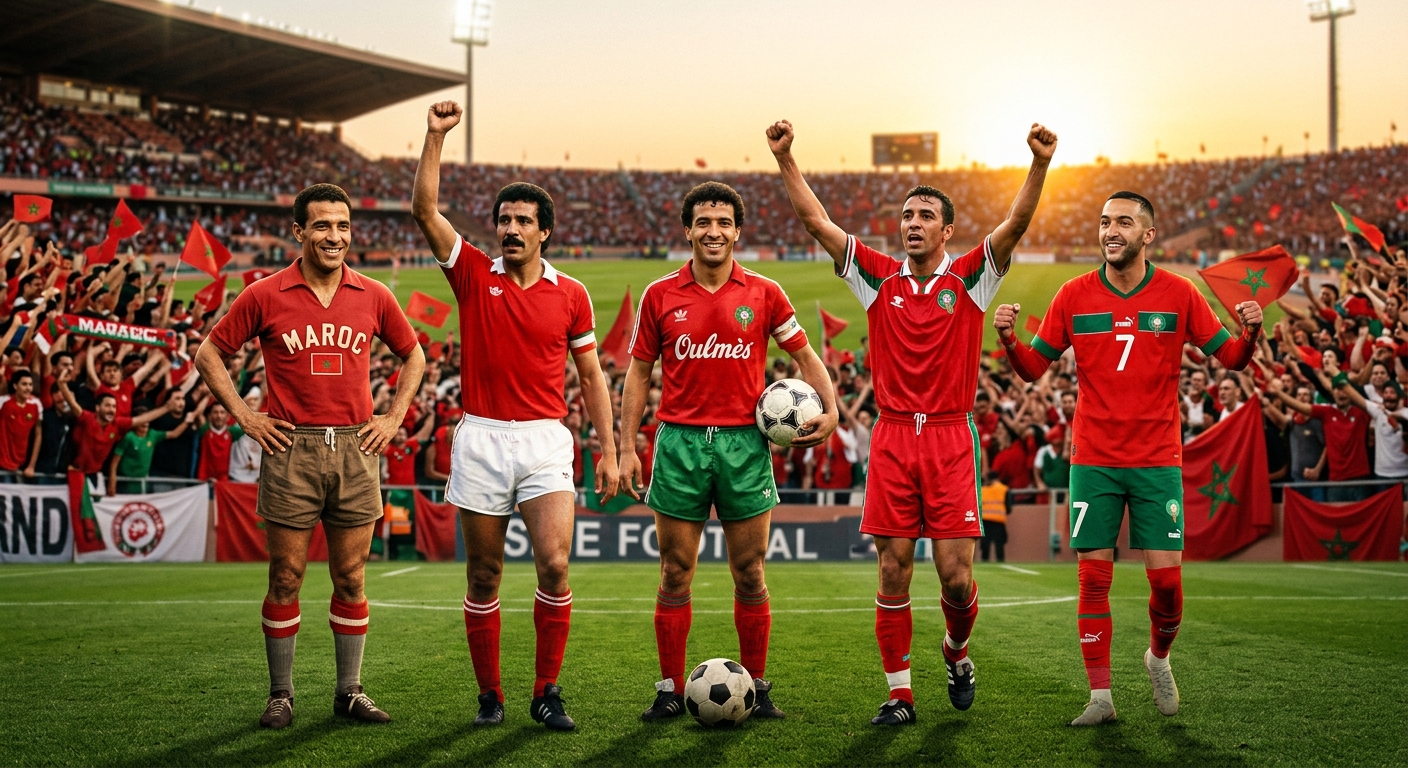
A Nation of Footballing Talent
Morocco has long punched above its weight in producing footballing talent, a nation whose players have graced major European leagues and inspired historic achievements on the international stage. From the pioneers of the 1970s to the golden generation of the 2020s, the Atlas Lions have been blessed with individuals of genuine world class.
Ranking the greatest of them is a delightful but difficult task, spanning eras with vastly different contexts. The technical forwards of the 1970s, the European exports of the 1990s, and the global superstars of the modern game all contributed to Morocco's standing. Each generation built on the last, and the legends of one era inspired the heroes of the next.
This celebration of Morocco's greatest players honors that continuity. It recognizes the captains who lifted trophies, the artists who won individual awards, the defenders who anchored historic runs, and the modern stars who took Morocco to the brink of the World Cup final. Together, they form a lineage of excellence that defines Moroccan football.
Ahmed Faras: The Original Icon
At the head of any list of Moroccan greats stands Ahmed Faras. The captain and star of the 1976 AFCON-winning side, Faras delivered the nation its only continental title and was named African Footballer of the Year that same year, the first Moroccan to receive the honor. His combination of leadership and clinical forward play set the standard for all who followed.
Faras was a one-club man, spending his entire career in Morocco, a loyalty that endeared him to fans and made him a symbol of the domestic game. His goals and his guidance carried Morocco to the summit of African football, and his legacy as the architect of the nation's finest continental hour is unmatched.
To this day, Faras is invoked as the benchmark of Moroccan greatness. He achieved what no Moroccan has since: leading his country to be crowned champions of Africa while being recognized as the continent's finest individual player. That dual achievement secures his place at the very top of the pantheon.
Mustapha Hadji: The Golden Ball Winner
Mustapha Hadji represents the artistry of Moroccan football at its finest. A gifted attacking midfielder with flair, vision, and an eye for the spectacular, Hadji was the standout star of Morocco's 1998 World Cup campaign in France, a tournament at which he shone so brightly that he was named African Footballer of the Year for 1998.
Hadji enjoyed a distinguished club career across Europe, including spells in France, Portugal, Spain, Germany, and England, where his technical brilliance won admirers wherever he played. For the national team, he was the creative heartbeat, capable of unlocking defenses and producing moments of magic that fans still recall fondly.
His individual recognition as the continent's best player in 1998 places him alongside Faras as one of only a handful of Moroccans to win the prestigious award. Hadji's blend of elegance and impact made him a generational talent and one of the most beloved players in the nation's history.
Noureddine Naybet: The Defensive Colossus
If Faras and Hadji represent attacking brilliance, Noureddine Naybet embodies defensive excellence. A commanding, intelligent central defender, Naybet was the rock at the heart of the Moroccan defense for over a decade and earned a reputation as one of the finest defenders Africa has produced.
Naybet enjoyed a celebrated club career, most notably with Deportivo La Coruna in Spain, where he was part of a side that won La Liga and competed at the highest level of European football, and later with Tottenham Hotspur in England. His reading of the game, composure, and leadership made him a defender of true international class.
As one of Morocco's most-capped players and a long-serving captain, Naybet was a pillar of the national team across multiple World Cup and AFCON campaigns. His longevity, consistency, and quality at the back established him as the defensive standard-bearer of Moroccan football and a certainty in any list of the nation's greatest players.
Larbi Ben Barek: The Pioneer
No history of Moroccan footballing greatness is complete without Larbi Ben Barek, a player whose career predated Morocco's independence but who is widely regarded as one of the first truly world-class footballers of North African origin. Known as the Black Pearl, Ben Barek was a forward of extraordinary skill who starred in French football and was even courted by the giants of the European game.
Ben Barek's brilliance earned him the admiration of footballing legends, with even Pele reportedly speaking of him in reverential terms. He played at a time when opportunities for North African players on the global stage were limited, yet his talent transcended those barriers and earned him a place among the pioneers of the international game.
As a foundational figure, Ben Barek represents the deep roots of Moroccan footballing talent. He demonstrated, long before the modern era, that Morocco could produce players of genuine world class, paving the way for the generations of Atlas Lions who would follow in his footsteps.
Badou Zaki and the 1986 Heroes
The 1986 World Cup side that became the first African team to reach the knockout round produced several players worthy of inclusion among Morocco's greats. Goalkeeper Badou Zaki was outstanding throughout that tournament and was himself a former African Footballer of the Year, one of the finest goalkeepers the continent has produced.
Midfielder Mohamed Timoumi, named African Footballer of the Year for 1985, was the creative engine of that historic side, while captain Aziz Bouderbala provided elegance and leadership. These players combined to top a World Cup group containing England, Poland, and Portugal, a feat that earned them permanent places in Moroccan football history.
Zaki's later career as a coach, including leading Morocco to the 2004 AFCON final, extended his legacy beyond his playing days. The 1986 heroes collectively represent a golden chapter in Moroccan football, and their individual qualities, from Zaki's goalkeeping to Timoumi's creativity, earn them recognition among the nation's finest.
Achraf Hakimi: The Modern Superstar
Among the modern generation, Achraf Hakimi stands out as a genuine global superstar. A dynamic, attacking fullback with blistering pace and end product, Hakimi has played for some of the biggest clubs in Europe, including Real Madrid, Borussia Dortmund, Inter Milan, and Paris Saint-Germain, establishing himself as one of the world's best in his position.
For Morocco, Hakimi was a central figure in the historic 2022 World Cup run, his attacking thrust down the right flank a constant weapon and his nerveless Panenka penalty against Spain one of the defining moments of the tournament. His ability to defend and attack at the highest level makes him an irreplaceable asset for the Atlas Lions.
Hakimi embodies the modern Moroccan player: world-class, born and developed in part within the European system, yet deeply committed to the national cause. As a leader of the golden generation, he carries the hopes of the nation and stands as one of the greatest Moroccan players of the contemporary era.
Hakim Ziyech and the Creative Force
Hakim Ziyech brought a level of creative quality that lit up Moroccan football in the late 2010s and early 2020s. A left-footed attacking midfielder and winger with exceptional vision, set-piece ability, and a wand of a left foot, Ziyech starred for Ajax and Chelsea, the latter of which he helped win the UEFA Champions League.
For Morocco, Ziyech was a key creative force whose ability to deliver telling passes, crosses, and goals from distance made him a focal point of the attack. His role in the 2022 World Cup, following his reconciliation with the squad after a period of tension, underlined his importance to the team's historic achievement.
Ziyech's flair and technical excellence placed him among the most exciting Moroccan players of his generation. At his best, he was a match-winner capable of producing moments of brilliance that few in world football could match, securing his status as one of the modern greats of the Atlas Lions.
Yassine Bono, Amrabat, and the 2022 Generation
The 2022 World Cup run elevated several players to legendary status in Moroccan football. Goalkeeper Yassine Bono was magnificent throughout, his commanding presence and penalty-shootout heroics against Spain making him a national hero and one of the standout goalkeepers of the tournament.
Sofyan Amrabat emerged as one of the players of the World Cup, his tireless midfield work, ball-winning, and ground coverage providing the platform for Morocco's defensive solidity. Captain Romain Saiss led with courage, repeatedly playing through injury, while striker Youssef En-Nesyri produced the soaring header that knocked out Portugal.
This generation, guided by coach Walid Regragui, achieved what no African or Arab team had before by reaching a World Cup semifinal. Their collective brilliance and individual quality have earned them an enduring place among Morocco's greatest, the heroes who carried the nation further than ever before on the global stage.
Comparing Across the Eras
Comparing players across such different eras is inherently subjective, but certain figures rise above debate. Ahmed Faras, with his AFCON title and African Footballer of the Year award, holds a unique status as the man who delivered Morocco's only continental crown. Mustapha Hadji and his 1998 Golden Ball, and Noureddine Naybet with his defensive mastery and elite club career, are similarly beyond dispute.
The modern generation, led by Hakimi, Ziyech, Bono, and Amrabat, brought Morocco its greatest-ever World Cup achievement, and their global club profiles arguably make them the most accomplished collection of talent the nation has ever fielded simultaneously. Yet they have not, as yet, captured the continental title that Faras delivered.
Ultimately, Morocco's greatest players form a continuum rather than a strict hierarchy. From Ben Barek the pioneer, through Faras, Hadji, and Naybet, to the World Cup semifinalists of 2022, each contributed to a rich and proud footballing heritage. Together they represent the very best of a nation that has consistently produced players capable of competing with and beating the world's finest.
| Player | Position | Key distinction |
|---|---|---|
| Ahmed Faras | Forward | 1976 AFCON title, 1976 African Footballer of the Year |
| Mustapha Hadji | Attacking midfielder | 1998 African Footballer of the Year |
| Noureddine Naybet | Central defender | La Liga title with Deportivo, long-serving captain |
| Larbi Ben Barek | Forward | Pioneering world-class talent, the Black Pearl |
| Badou Zaki | Goalkeeper | 1986 World Cup hero, former African Footballer of the Year |
| Achraf Hakimi | Fullback | Modern superstar, 2022 World Cup key player |
| Hakim Ziyech | Winger | Champions League winner, creative force |
| Yassine Bono | Goalkeeper | 2022 World Cup penalty hero |
Selected Moroccan footballing greats and their distinctions
FAQ
Who is considered Morocco's greatest player of all time?
Ahmed Faras is often regarded as the greatest, having captained Morocco to their only AFCON title in 1976 and been named African Footballer of the Year that same year.
Which Moroccan players have won African Footballer of the Year?
Moroccan winners include Ahmed Faras (1976), Mohamed Timoumi (1985), Badou Zaki (1986), and Mustapha Hadji (1998).
Who is Morocco's best defender ever?
Noureddine Naybet is widely considered Morocco's finest defender, a long-serving captain who won La Liga with Deportivo La Coruna and played for Tottenham.
Who are Morocco's greatest modern players?
Achraf Hakimi, Hakim Ziyech, Yassine Bono, Sofyan Amrabat, and Youssef En-Nesyri are among the modern greats who powered the 2022 World Cup semifinal run.
Who was Larbi Ben Barek?
Larbi Ben Barek, nicknamed the Black Pearl, was a pioneering Moroccan forward of world-class ability who starred in French football and is regarded as one of the first great North African players.
Loved this? Useful? React below — your feedback helps other readers.