Morocco's Biggest Football Rivalries
The Heartbeat of Moroccan Football
Rivalries are the lifeblood of football, and Morocco possesses some of the most intense and storied in Africa and the Arab world. These contests, at both club and international level, carry layers of history, geography, politics, and identity that elevate them far beyond ninety minutes of football.
From the deafening cauldron of the Casablanca derby to the charged geopolitics of clashes with neighboring Algeria, Moroccan football rivalries stir deep emotions and produce unforgettable moments. They are occasions when the stakes feel existential and the passion reaches fever pitch.
Understanding these rivalries is essential to understanding Moroccan football culture itself. They reveal the social fault lines, regional pride, and national sentiments that the sport channels and amplifies. This article explores the great rivalries that define the Moroccan game and the stories behind them.
What distinguishes the Moroccan rivalry landscape is its layered character. There is the white-hot intimacy of a city derby between two clubs that share the same streets; the simmering geopolitical edge of matches against a neighboring nation; the regional prestige battles that pit North Africa's traditional powers against one another; and the global theater of World Cup knockout ties against Europe's elite. Each layer carries its own emotional logic, yet together they form a coherent picture of a footballing nation that increasingly defines itself through whom it competes against.
It is also worth stressing that rivalry in the Moroccan context is rarely about hatred for its own sake. More often it is an expression of identity sharpened by contrast, with supporters and players alike coming to understand themselves more clearly through the prism of opposition. Some of the fiercest fixtures are steeped in mutual respect, where the hunger to win is heightened precisely because the opponent is regarded as a worthy and formidable adversary rather than dismissed.
The Casablanca Derby: Raja vs Wydad
The most celebrated rivalry in Moroccan football is the Casablanca derby between Raja Casablanca and Wydad Casablanca, two of the biggest clubs in Africa. Contested in the country's largest city before enormous, fervent crowds, it is one of the fiercest and most atmospheric derbies on the continent.
The rivalry carries social and cultural dimensions, with the clubs historically associated with different identities and supporter bases within Casablanca. This has imbued the fixture with meaning beyond sport, making it a contest of pride, identity, and belonging for hundreds of thousands of fans.
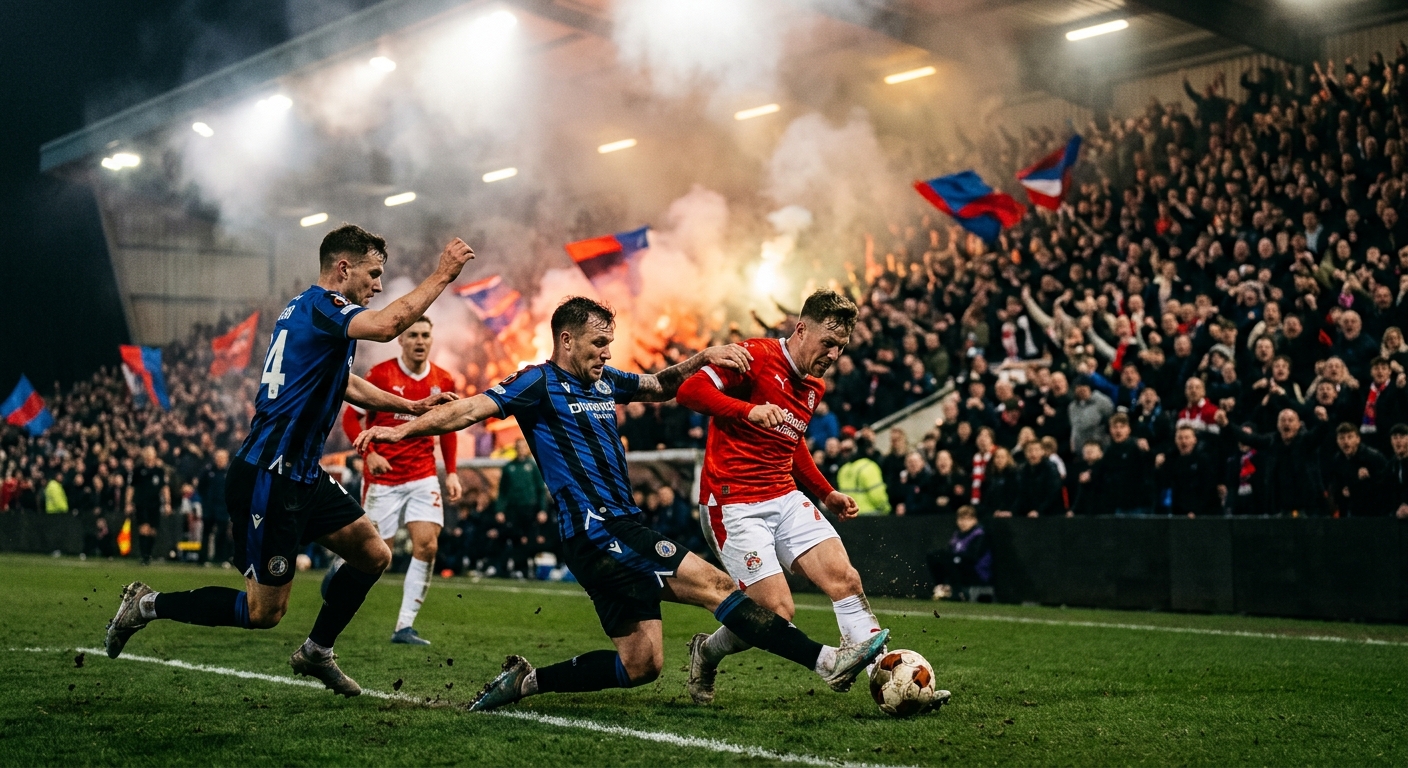
On the pitch, the derby is fiercely competitive and frequently dramatic. Off it, the rivalry produces some of the most spectacular tifo displays and electric atmospheres in world football. The Casablanca derby is the centerpiece of the domestic calendar and a global showcase for Moroccan fan culture's intensity.
Part of what makes the derby so combustible is that both clubs draw their support from the same sprawling metropolis, meaning the rivalry plays out not only inside the stadium but in workplaces, neighborhoods, schools, and families across Casablanca. Allegiance is frequently inherited and worn as a lifelong badge, so a single match can carry the weight of years of accumulated pride, banter, and the longing to silence the other half of the city for another season.
The fixture has also become a magnet for the wider footballing world, with neutrals tuning in for the spectacle as much as the football. The sheer scale of the crowds, the wall of sound, and the choreographed visual displays turn the derby into an event that transcends the result, a recurring carnival of devotion that showcases why Casablanca is regarded as one of the great football cities on the African continent.
Continental Glory and Club Pride
The rivalry between Raja and Wydad is sharpened by both clubs' considerable success in African club competitions. Both have won the continent's premier club title and other major honors, establishing themselves among Africa's most decorated sides and adding continental bragging rights to their domestic battles.
This success means the derby is not merely a local affair but a clash between genuine African giants. Each club's achievements on the continental stage feed into the rivalry, as supporters measure their team's greatness partly against that of their bitter neighbors.
The clubs' continental exploits have also carried Moroccan club football's reputation across Africa, drawing admiration for the quality of play and the extraordinary support. The rivalry thus operates on multiple levels: local pride, national prestige, and continental supremacy all intertwined.
Continental success has historically given each club a powerful argument in the endless debate over which is the greater institution. A run to an African final, or the lifting of a continental trophy, becomes ammunition in the rivalry, a tangible measure of supremacy that fans invoke long after the confetti has settled. The pursuit of these honors is therefore partly driven by the desire to outdo a neighbor as much as to conquer the continent.
Because both clubs have represented Morocco with distinction on the African stage, the rivalry also feeds a sense of shared national prestige that briefly unites supporters when either side carries the country's banner abroad. Yet that unity is fragile and temporary; once the continental campaign ends, the focus snaps back to the domestic battle, where each club is measured first and foremost against the other.
Morocco vs Algeria: More Than a Game
At international level, the rivalry between Morocco and Algeria is among the most charged in African and Arab football. The two neighboring North African nations share deep historical, cultural, and linguistic ties, but their relationship has also been marked by political tension, which inevitably spills onto the football pitch.
Matches between the national teams, and between their clubs in continental competition, are highly anticipated and emotionally fraught affairs. The football rivalry serves as a proxy for broader sentiments, with victories carrying significance that extends well beyond sport into the realm of national pride and identity.
This combination of footballing competition and geopolitical undercurrents makes the Morocco-Algeria rivalry uniquely intense. When the two meet, the matches are followed obsessively across both nations and the wider region, and the results resonate deeply in the collective consciousness of each country.
The intensity of the fixture is heightened by how evenly matched and historically significant both footballing nations are. Algeria, African champions in their own right, and Morocco, semi-finalists on the world stage, each carry genuine pedigree, so neither side can dismiss the other as inferior. That parity ensures every meeting is approached as a genuine test of standing, with bragging rights for the entire region hanging in the balance.
Beyond the senior men, the rivalry threads through club competitions, age-group tournaments, and even off-pitch matters such as sporting diplomacy and federation relations. This breadth means the contest rarely fully cools between fixtures; instead it lingers in the background of North African football, ready to flare into life whenever the two nations or their clubs are drawn together again.
North African Competition
Beyond Algeria, Morocco competes intensely with other North African football powers, notably Tunisia and Egypt. These nations have historically been among the strongest in African football, and contests between them carry regional prestige and competitive significance.
Egypt, the most successful nation in Africa Cup of Nations history, represents a benchmark of continental achievement, while Tunisia has long been a competitive force. Matches against these sides, whether in qualifiers, the Africa Cup of Nations, or other competitions, are keenly contested affairs.
These North African rivalries reflect a region rich in footballing tradition and ambition. The competition between Morocco, Algeria, Tunisia, and Egypt has driven standards higher and produced memorable encounters, contributing to North Africa's status as a powerhouse region within African football.
Egypt's record haul of Africa Cup of Nations titles makes the Pharaohs a particular benchmark for Moroccan ambition, the standard against which sustained continental greatness is measured. For Morocco, matching or surpassing such a legacy is a long-term aspiration, and every meeting with Egypt carries an implicit question about whether the balance of power in African football is shifting toward the modern Moroccan project.
Tunisia, meanwhile, represents a familiar and respected adversary whose competitive history with Morocco stretches across generations. The two share stylistic similarities and a comparable footballing culture, which lends their encounters a chess-like quality. Collectively, the rivalries among Morocco, Algeria, Tunisia, and Egypt have made North Africa a self-sharpening region, where the constant proximity of strong neighbors forces every nation to keep raising its standards.
Sub-Saharan Giants and Continental Battles
Morocco's quest for African glory has produced compelling rivalries with sub-Saharan powers such as Nigeria, Ivory Coast, Ghana, Cameroon, and Senegal. These nations boast rich footballing histories and have repeatedly stood between Morocco and continental success.
Encounters with these sides at the Africa Cup of Nations and in qualifiers have produced dramatic, high-quality football. Morocco's pursuit of an elusive second Africa Cup of Nations title, after their lone triumph decades ago, has often run through these formidable opponents.
These continental battles, both for the men's and women's teams, have shaped Morocco's footballing identity and ambitions. The women's semi-final victory over Nigeria at the 2022 WAFCON, for instance, was a landmark in a rivalry with the continent's most decorated women's nation, illustrating how these contests define eras.
These fixtures often serve as a clash of footballing philosophies, with the athletic power and flair long associated with sides such as Nigeria, Ghana, Cameroon, Ivory Coast, and Senegal tested against Morocco's increasingly organized, technical, and possession-oriented approach. The contrast makes for absorbing contests in which tactical discipline is pitted against individual brilliance, and the outcome frequently hinges on fine margins.
For the men's team, the long wait to add a second continental crown to their solitary historic triumph has made these opponents recurring obstacles and motivators in equal measure. For the women's team, the breakthrough victory over Nigeria's Super Falcons at the 2022 WAFCON carried enormous symbolic weight, signaling that Morocco could now challenge the most decorated names in the African game across both the men's and women's spheres.
World Cup Rivalries and Iconic Clashes
On the global stage, Morocco has forged memorable rivalries and iconic clashes at the World Cup. The 2022 tournament alone produced unforgettable encounters, as the Atlas Lions eliminated European heavyweights Spain and Portugal in the knockout rounds on their historic march to the semi-finals.
The dramatic penalty shootout victory over Spain and the stunning win against Portugal became instant classics, etched into football history and the memories of fans worldwide. These results announced Morocco as a side capable of toppling the game's traditional powers on the biggest stage.
Morocco also shares a notable connection with France, having faced them in the emotionally charged 2022 semi-final, a fixture loaded with historical and cultural significance given the deep ties between the two nations. Such World Cup clashes have added a global dimension to Morocco's rivalry landscape.
What elevated these encounters beyond ordinary upsets was the manner in which they were achieved. Against Spain, Morocco absorbed pressure with extraordinary discipline before holding their nerve in the shootout; against Portugal, they defended a lead with collective courage. These were not flukes but the product of a clear identity and an unshakeable belief, which is precisely why the victories resonated so widely and turned admiration into genuine respect.
The semi-final against France added a final, poignant layer to the 2022 story. With a large Moroccan diaspora in France and many players connected to both countries through heritage or careers, the match was charged with emotion and shared history. Though Morocco fell short, the dignity of the contest and the closeness of the ties between the two nations ensured the fixture would be remembered as one of the tournament's most meaningful occasions rather than a bitter defeat.
The Role of Fans in Rivalries
Morocco's rivalries are intensified by the passion and creativity of the country's renowned fans. Whether in the Casablanca derby or in international clashes, supporters bring extraordinary energy, producing spectacular tifos, deafening atmospheres, and powerful displays of allegiance.
The ultras culture, particularly around the great Casablanca clubs, plays a central role in giving rivalries their distinctive character. The visual and sonic spectacle created by fans transforms these fixtures into events of cultural significance, not merely sporting contests.
At international level, the vast Moroccan diaspora ensures that rivalries are contested with massive support wherever the Atlas Lions play. This fan involvement amplifies the emotion and stakes of every great rivalry, making Moroccan football among the most passionately followed in the world.
The artistry of Moroccan supporters means that rivalry matches double as cultural events, with rival ultras effectively competing in a parallel contest of choreography, voice, and visual creativity. A derby or a charged international can be judged almost as much on the magnificence of the stands as on the scoreline, and the desire to outshine an opponent's display adds yet another competitive dimension to the occasion.
This fan-driven energy also travels. When the Atlas Lions play abroad, the diaspora transforms neutral venues into something approaching home fixtures, surrounding rival supporters with a sea of red and green. The phenomenon ensures that Morocco's rivalries are never confined to home soil; they are carried across continents by a global community for whom supporting the team is a profound expression of belonging.
How Rivalries Drive Progress
While rivalries are defined by intense competition, they also play a constructive role in driving the progress of Moroccan football. The fierce contest between Raja and Wydad pushes both clubs to higher standards, benefiting the domestic game and producing players for the national team.
Similarly, international rivalries with the continent's and the world's best compel Morocco to raise its level continually. Measuring themselves against Algeria, Egypt, Nigeria, and the European powers has sharpened Morocco's ambitions and contributed to the development that underpinned recent successes.
In this sense, rivalries are not merely sources of drama and emotion but engines of improvement. The desire to triumph over respected and resented opponents has long motivated Moroccan football, helping to fuel the rise that has made the nation a global force.
The competitive pressure generated by rivalry has tangible developmental benefits. Clubs locked in a battle for supremacy invest more heavily in recruitment, coaching, and youth development, raising the overall quality of the domestic game and producing better-prepared players for the national setup. The derby, in other words, is not only a spectacle but a forge in which talent and standards are continually tested and refined.
At international level, the habit of facing elite opposition has accelerated Morocco's maturation. Repeatedly measuring themselves against Algeria, Egypt, the sub-Saharan giants, and ultimately the world's best taught the national teams how to manage pressure, defend leads, and seize decisive moments. The lessons absorbed in these high-stakes rivalries fed directly into the resilience and composure that defined Morocco's historic recent achievements.
Rivalries in Morocco's Golden Era
As Morocco enjoys an unprecedented golden era across men's, women's, youth, and futsal football, its great rivalries take on fresh significance. Each historic achievement adds new chapters to old rivalries and creates the potential for new ones as Morocco competes ever more frequently at the highest levels.
Hosting major tournaments will bring more high-profile rivalry matches to home soil, where the passion of Moroccan fans will be on full display. These occasions promise to deepen existing rivalries and forge memorable new clashes against the world's leading teams.
Ultimately, Morocco's rivalries, from the streets of Casablanca to the global stage, are an integral part of the nation's footballing soul. They embody the passion, pride, and ambition that have driven Moroccan football to remarkable heights and will continue to define its journey in the years ahead.
The golden era has also reframed how Morocco's rivals view them. Where the Atlas Lions were once dangerous but inconsistent, they are now treated as a benchmark side to be feared and studied, which subtly shifts the psychology of every rivalry. Opponents prepare for Morocco with greater caution, and that elevated respect is itself a marker of how far the nation's football has travelled.
Looking ahead, the prospect of hosting marquee tournaments promises to script entirely new rivalry narratives on home soil, where the roar of Moroccan crowds could become a decisive factor. Old enmities with North African neighbors and continental giants will be renewed, while fresh clashes with global powers wait to be written, ensuring that the story of Moroccan football's rivalries remains very much unfinished.
| Rivalry | Nature |
|---|---|
| Raja vs Wydad | Casablanca derby, fierce club clash |
| Morocco vs Algeria | Charged national rivalry with political weight |
| Morocco vs Egypt/Tunisia | North African competitive prestige |
| Morocco vs Nigeria | Continental battles (men's and women's) |
| Morocco vs Spain/Portugal | 2022 World Cup knockout classics |
| Morocco vs France | Historic 2022 World Cup semi-final |
Morocco's biggest football rivalries
FAQ
What is the biggest club rivalry in Moroccan football?
The Casablanca derby between Raja Casablanca and Wydad Casablanca is the biggest, one of the fiercest and most atmospheric derbies in Africa, contested before enormous crowds with spectacular tifo displays.
Why is the Morocco-Algeria football rivalry so intense?
The two neighboring North African nations share deep historical and cultural ties but also significant political tension, which spills onto the pitch and makes their football matches highly charged affairs.
Which World Cup rivalries did Morocco create in 2022?
Morocco produced instant classics by eliminating Spain on penalties and beating Portugal in the knockout rounds, then faced France in an emotionally charged semi-final, on their way to fourth place.
Are Raja and Wydad successful in African football?
Yes. Both clubs have won the premier African club title and other major honors, establishing themselves among the continent's most decorated sides, which intensifies their derby rivalry.
Do rivalries help Moroccan football improve?
Yes. Fierce domestic and international rivalries push clubs and the national teams to higher standards, driving the development and ambition that have contributed to Morocco's recent golden era.
Loved this? Useful? React below — your feedback helps other readers.