The Business of the Atlas Lions: How Football Became a Pillar of Morocco's Economic Strategy
Football as Economic Policy
Most countries treat football as entertainment with a side of national pride. Morocco has gone further, positioning the sport as an explicit lever of economic development. The decision to pursue and win the 2030 World Cup bid, alongside hosting the 2025 Africa Cup of Nations, reflects a deliberate strategy to use major sporting events as deadlines that force through modernisation the kingdom wants regardless.
This is not unique in concept; Qatar, the UAE and Saudi Arabia have all pursued sport as a tool of diversification and soft power. But Morocco's version is distinctive because it is not built on hydrocarbon wealth. The kingdom must make the economics work without bottomless reserves, which forces a sharper focus on infrastructure that has standalone value rather than spectacle for its own sake.
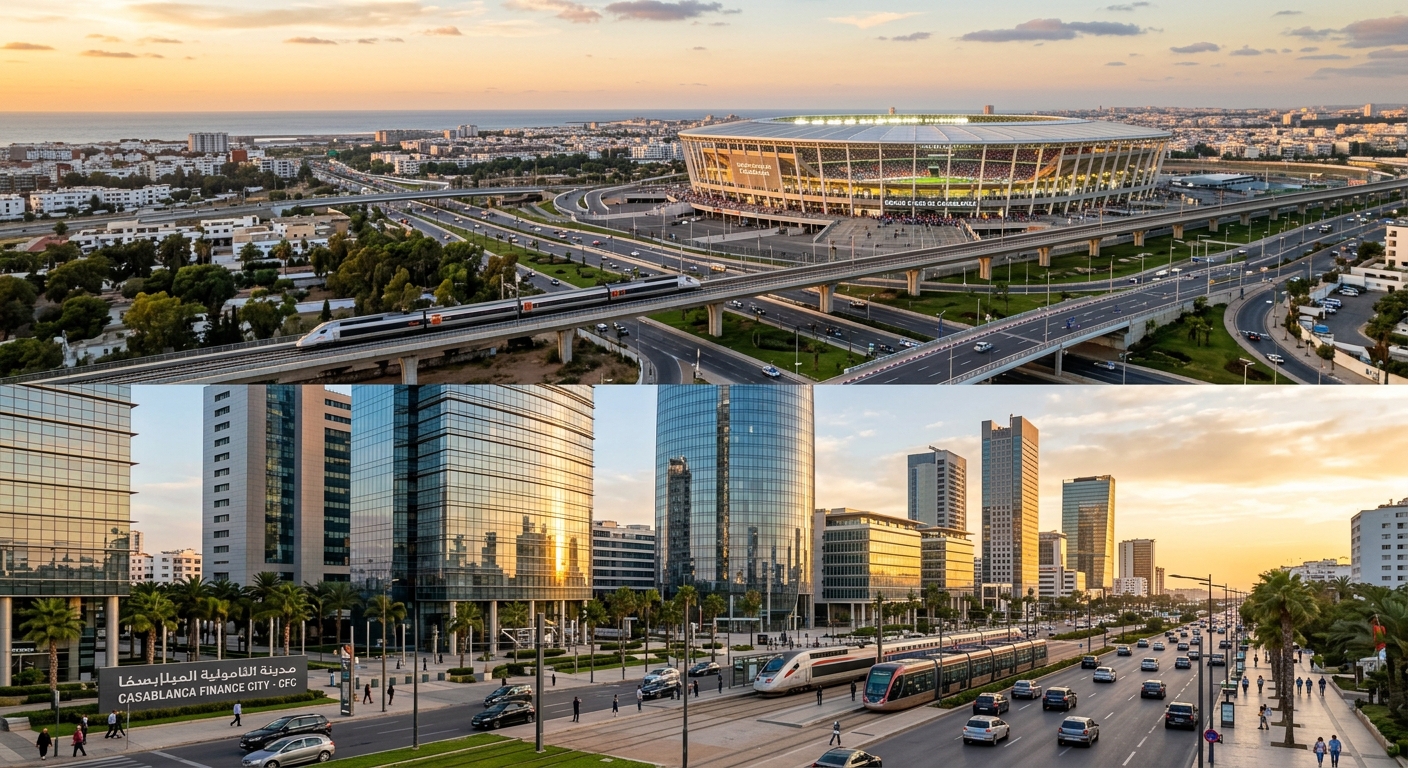
The throughline of Morocco's approach is dual-use. The high-speed rail that carries fans in 2030 carries commuters forever. The airports that absorb a tournament surge serve trade and tourism for decades. The stadiums are the most visible and most economically questionable element, but even they are framed as anchors for sports cities and regional development rather than isolated arenas.
The Infrastructure Investment Wave
The clearest expression of Morocco's football-as-economy thesis is the construction wave now underway. The Grand Stade Hassan II near Casablanca, planned at roughly 115,000 capacity, headlines a programme that also covers renovated and new venues in Rabat, Tangier, Marrakech, Agadir and Fez. Each represents a substantial capital injection into its region.
Transport investment dwarfs the stadiums in long-term significance. Morocco's Al Boraq high-speed line between Tangier and Casablanca, Africa's first, is being extended toward Marrakech, while airports including Casablanca's Mohammed V are slated for major expansion. These are the investments economists view most favourably because connectivity infrastructure reliably raises productivity and attractiveness to investors.
Hospitality construction completes the picture, with new hotel capacity rising across host cities to meet a tourism target near 26 million annual visitors by 2030. The sequencing matters: by hosting the Africa Cup of Nations first, Morocco gets a live test of this infrastructure years before the World Cup, reducing the risk of expensive surprises.
The financing of all this is the perennial concern. Large sporting infrastructure programmes are notorious for cost overruns, and the burden of servicing the associated debt can outlast the goodwill of the event. Morocco's bet is that the productive infrastructure will generate enough growth, directly and indirectly, to justify the outlay over a horizon measured in decades rather than the tournament month.
Tourism: The Revenue Engine
Tourism is already among Morocco's largest sources of foreign currency and employment, and football is being used to supercharge it. The 2030 World Cup offers a month of unmatched global advertising, beaming the country's destinations to billions, while the infrastructure built for the event raises capacity and quality for the years that follow.
The target of roughly 26 million visitors a year by 2030 is ambitious but builds on real momentum; Morocco was already among Africa's most visited countries before the World Cup was awarded. The strategy is to convert event-driven attention into durable visitor growth, the so-called halo effect that South Africa and Qatar both reported after hosting.
Tourism's appeal as an economic engine is its labour intensity. Hotels, restaurants, transport and services employ large numbers of people across skill levels, directly addressing the youth employment challenge that is one of Morocco's central social and political concerns. A visitor economy that grows sustainably is among the most effective job-creation tools available to a middle-income country.
The risk is the boom-and-bust pattern that haunts event tourism: building for a peak that does not return. Moroccan planners are therefore careful to frame capacity growth against the longer-term 2030 target rather than the tournament alone, aiming for infrastructure sized to a permanently larger industry rather than a single summer.
Sponsorship, Broadcasting and the Brand
The Atlas Lions' rise has commercial value in its own right. The 2022 semifinal run dramatically raised the global profile of Moroccan football, increasing the marketability of the national team, its players and the broader brand of Moroccan sport. Commercial partners and broadcasters pay attention to teams that capture global imagination, and few captured it like Morocco in Qatar.
Hosting major tournaments multiplies these commercial flows. World Cups and continental championships bring sponsorship, broadcasting and hospitality revenues, alongside the spending of visiting fans. While the largest of these flows accrue to FIFA and the confederations, host nations capture significant economic activity through tourism, services and the lasting visibility of being on the world stage.
There is also a player-export dimension. As Moroccan footballers prove themselves at the highest level, the pathway from domestic and diaspora football to elite European clubs strengthens, raising the value and prestige of Moroccan talent development. A successful national team is, in effect, a showcase that lifts the market value of an entire footballing ecosystem.
Positioning Between Two Continents
Morocco's economic strategy extends well beyond sport, and football slots into a broader ambition to be the bridge between Africa and Europe. The country has built substantial automotive and aerospace manufacturing industries in recent years, leveraging its proximity to Europe, competitive costs and improving infrastructure. World Cup-grade connectivity reinforces that pitch to global investors.
Co-hosting the 2030 World Cup with Spain and Portugal deepens these European ties at a strategic moment. The shared tournament across the Strait of Gibraltar is a logistical and diplomatic partnership as much as a sporting one, the kind of cooperation that can spill into trade, energy and investment relationships beyond the football.
For Africa, Morocco is positioning itself as a continental leader and gateway. Hosting the Africa Cup of Nations and World Cup matches, combined with significant Moroccan investment elsewhere on the continent, supports an ambition to be a hub for African business and finance. Sport is the high-visibility front end of a much larger geo-economic strategy.
The Risks Beneath the Ambition
No honest assessment can ignore the risks. Sport-led development has a mixed historical record. Many hosts have discovered that the projected economic windfalls evaporate, leaving underused venues and debt. The pressure of a fixed World Cup deadline can also distort priorities, pulling public spending toward visible projects and away from less glamorous but socially vital needs.
The white-elephant problem is acute for the largest stadiums. A 100,000-plus seat arena requires sustained demand to justify its operating costs, and Morocco's domestic league, for all its passion, does not consistently fill venues at that scale. The viability of the showpiece grounds after 2030 depends on creative programming and a genuine uplift in football culture and attendances.
Debt sustainability is the overarching concern. The strategy works if growth outpaces the cost of borrowing and the infrastructure proves genuinely productive. It fails if the spending is essentially consumption dressed as investment. The verdict will not be clear until the 2030s, when commuter numbers, tourist arrivals and investment flows reveal whether the bet paid off.
A High-Stakes Wager on Sport
Morocco's integration of football into economic policy is one of the more sophisticated examples of the strategy anywhere. By insisting on dual-use infrastructure, sequencing the Africa Cup of Nations as a rehearsal and tying everything to a credible long-term tourism target, the kingdom has tried to learn from the failures of past hosts rather than repeat them.
The ultimate logic is that a fixed, unmissable deadline can achieve what slower bureaucratic processes cannot: it concentrates political will, capital and public attention on transforming the country's connective tissue in a compressed window. If it works, Morocco emerges from 2030 a faster, better-connected, more visible economy with a durable tourism uplift and strengthened position between Africa and Europe.
It is, unmistakably, a high-stakes wager. The kingdom is using the beautiful game to underwrite a generational economic gamble, betting that the legacy of stadiums, rails and runways will long outlive the roar of the crowds. Whether the gamble pays off is the defining economic story Morocco will tell about itself in the decade to come.
| Channel | Mechanism | Economic goal |
|---|---|---|
| Infrastructure | Stadiums, high-speed rail extension, airport expansion | Long-term productivity and connectivity |
| Tourism | Global exposure plus new hotel capacity | ~26m annual visitors by 2030, jobs, foreign currency |
| Sponsorship & broadcast | Atlas Lions brand value and event revenues | Commercial inflows and visibility |
| Player development | Stronger pathway to elite European clubs | Higher value for Moroccan talent ecosystem |
| Geo-economic position | Co-hosting with Spain/Portugal, African leadership | Hub status linking Africa and Europe |
How football feeds Morocco's economic strategy
FAQ
Why does Morocco treat football as economic strategy?
Morocco uses major tournaments like the 2030 World Cup and 2025 Africa Cup of Nations as fixed deadlines to accelerate infrastructure, tourism and investment, treating sport as a catalyst for broader economic modernization.
What is dual-use infrastructure in Morocco's plan?
Dual-use means infrastructure built for the World Cup that retains standalone value afterward, such as high-speed rail that later serves commuters and airports that support long-term trade and tourism.
How big is tourism to Morocco's economy?
Tourism is one of Morocco's largest sources of foreign currency and employment, and the kingdom is targeting roughly 26 million annual visitors by 2030, using the World Cup as a global marketing showcase.
What is the biggest economic risk of Morocco's strategy?
The main risks are cost overruns, debt sustainability and the white-elephant problem, where large stadiums become costly to maintain if demand does not justify them after the tournament.
How does football support Morocco's position between Africa and Europe?
Co-hosting the 2030 World Cup with Spain and Portugal and leading African football reinforce Morocco's ambition to be a logistics, manufacturing and tourism hub bridging the two continents.
Loved this? Useful? React below — your feedback helps other readers.