Morocco's Economy in 2026: A Comprehensive Overview of North Africa's Rising Star
A Diversified Economy Built on Decades of Strategy
Morocco enters 2026 with one of the most diversified economies on the African continent, the product of more than two decades of deliberate industrial policy. Unlike many resource-dependent neighbours, the kingdom has spread its bets across automotive manufacturing, aerospace, agriculture and agri-food, tourism, phosphates and fertilizers, textiles, renewable energy and an expanding services sector. This breadth has given the economy a resilience that became especially visible in the turbulent global years of the early 2020s, when commodity shocks and supply-chain disruptions hit single-sector economies far harder.
The foundations of this diversification were laid by a succession of national strategies, from the Plan Émergence for industry to the Plan Maroc Vert for agriculture and later the Generation Green plan. Each aimed to move the country up the value chain rather than simply exporting raw materials. The result is an economy where Morocco no longer just grows tomatoes and mines phosphate rock, but assembles cars for the European market, manufactures aircraft components and processes phosphate into high-value fertilizers sold across Africa, Latin America and Asia.
Gross domestic product growth in the mid-2020s has generally hovered in a moderate but steady range, typically estimated between roughly three and four percent per year depending on the agricultural cycle, with non-agricultural activity often outpacing the headline figure. That sensitivity to rainfall remains one of the economy's structural features: a good rainy season can lift growth meaningfully, while drought years drag it down, underscoring why water security has become a central policy obsession heading into the World Cup decade.
The Automotive Engine: Morocco's Industrial Success Story
If one sector symbolizes Morocco's economic transformation, it is automotive manufacturing. Over the past decade the country has emerged as one of the largest vehicle producers in Africa, with annual production capacity that has climbed into the hundreds of thousands of units and ambitions to reach well beyond a million. Major global manufacturers operate large assembly plants near Tangier and Kenitra, drawing on Morocco's proximity to Europe, competitive labour costs, free-trade agreements and the logistics power of Tanger Med port.
Crucially, Morocco has built more than just assembly lines. A dense ecosystem of suppliers producing wiring harnesses, seats, interiors, batteries and other components has clustered around the major plants, deepening local value addition and creating tens of thousands of skilled jobs. The automotive sector has become the country's leading export industry by value, a remarkable achievement for a nation that built its first integrated vehicle plants only relatively recently.
The next frontier is electric mobility. Morocco is positioning itself within the global battery and electric-vehicle supply chain, leveraging its mineral resources, including phosphate and cobalt-bearing deposits, alongside investments in gigafactory-scale battery production announced by international players. If these projects mature as planned, the kingdom could become a significant node in Europe's effort to localize EV supply chains closer to home, reducing dependence on distant Asian suppliers.
Phosphates, Fertilizers and Food Security Diplomacy
Morocco sits on the largest phosphate reserves in the world, a geological endowment that gives it outsized influence over global food production. Phosphate is an irreplaceable ingredient in fertilizers, and the state-linked group OCP has evolved from a simple miner of rock into a vertically integrated global fertilizer champion. Rather than exporting raw phosphate, the strategy has been to capture value by transforming it into processed fertilizers and phosphoric acid for export markets.
This positions Morocco at the heart of global food-security conversations. As populations grow and arable land per capita shrinks, demand for fertilizer remains structurally strong, particularly across Africa where soils are often nutrient-depleted. Morocco has leaned into a narrative of African agricultural development, offering tailored fertilizer blends and building production and distribution partnerships across the continent, blending commercial expansion with soft-power diplomacy.
The phosphate sector also illustrates a broader theme in the Moroccan economy: the use of large, partially state-owned national champions to drive industrial ambition. These entities, with their scale and access to capital, often anchor entire value chains and serve as platforms for technology, training and the green-energy transition, including significant investments in solar power and green hydrogen to decarbonize fertilizer production.
Tourism, Services and the Consumer Economy
Tourism is one of Morocco's most important foreign-currency earners and a major employer, drawing millions of visitors each year to Marrakech, Fez, the Atlas Mountains, the Sahara and the Atlantic and Mediterranean coasts. The sector rebounded strongly after the global travel disruptions of the early 2020s, and arrivals have climbed back toward and beyond previous records, supported by an expanding network of air links, hotel investment and a globally recognized brand of culture, cuisine and hospitality.
The 2030 FIFA World Cup, which Morocco will co-host with Spain and Portugal, has supercharged ambitions in this space. Authorities have set out goals to dramatically increase annual tourist arrivals over the coming years, with the tournament serving as both a deadline and a marketing showcase. New and upgraded stadiums, expanded airports, high-speed and conventional rail extensions and hotel construction are all being mobilized around this target.
Beyond tourism, a broader consumer and services economy is maturing. A young, increasingly urban and connected population is fuelling demand for retail, telecommunications, financial services, healthcare and digital platforms. Rising smartphone penetration and improving mobile-money and digital-payment infrastructure are gradually formalizing parts of an economy where cash and informal activity still play a large role, opening opportunities for fintech and e-commerce.
Reforms, Finance and the Casablanca Hub
Underpinning the sectoral story is a wave of structural reform. Morocco has pursued an ambitious agenda to expand social protection, including a major push to extend health coverage and family allowances to far broader segments of the population, financed in part through reforms to subsidies and the tax system. The aim is to build a stronger social contract while gradually moving away from blanket subsidies toward more targeted support.
On the monetary side, the central bank, Bank Al-Maghrib, has managed inflation that spiked in the global price surge of the early 2020s and has since moderated, while pursuing a gradual transition toward a more flexible exchange-rate regime for the dirham. This careful liberalization is designed to make the economy more shock-absorbent without triggering destabilizing currency swings, a balancing act watched closely by investors and the International Monetary Fund.
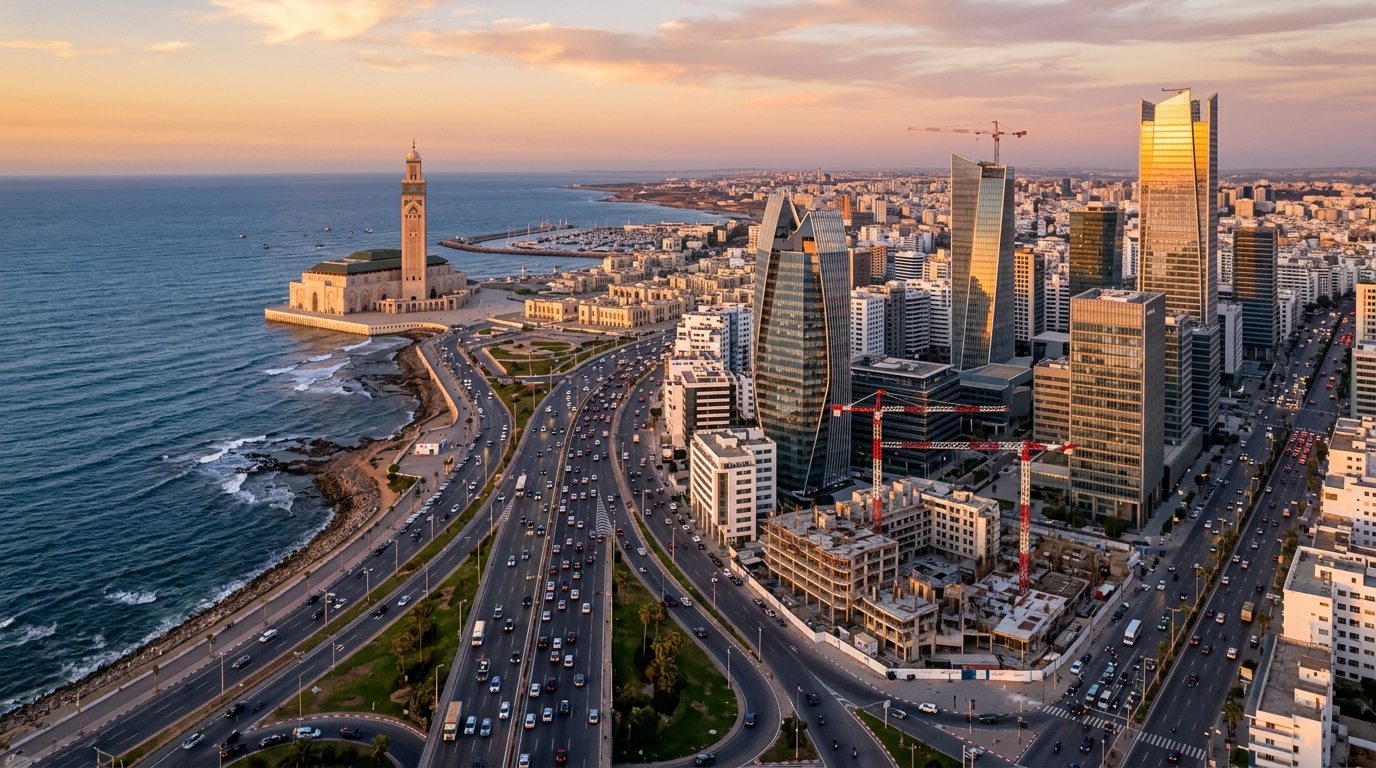
Casablanca Finance City, the kingdom's financial hub, has become a regional platform connecting international capital with opportunities across West and Central Africa. By offering a business-friendly regulatory environment, tax incentives and a concentration of banks, insurers, asset managers and professional services firms, it reinforces Morocco's positioning as a gateway for investors seeking African exposure from a stable, well-connected base.
Challenges, Risks and the Road Ahead
For all its momentum, Morocco faces real challenges. Unemployment, particularly among young people and university graduates, remains stubbornly high, and the gap between a dynamic export-oriented modern sector and a large informal economy persists. Translating headline growth into broadly shared prosperity, quality jobs and reduced regional inequality between thriving coastal cities and the rural interior is the defining socio-economic test of the coming decade.
Water scarcity is arguably the most pressing environmental and economic risk. Recurring droughts have strained agriculture and reservoirs, prompting heavy investment in desalination plants powered increasingly by renewable energy, water-transfer projects between river basins and more efficient irrigation. How successfully Morocco secures its water future will shape not only farm output but also the viability of industry, tourism and the green-hydrogen ambitions that depend on abundant water and power.
The outlook nonetheless remains constructive. With a strategic location bridging Europe and Africa, a deepening industrial base, world-class renewable-energy resources, a flagship port in Tanger Med and the galvanizing effect of the 2030 World Cup, Morocco is widely seen as one of the more compelling growth and investment stories in the region. The execution risk is real, but the trajectory points toward an economy steadily climbing the global value chain and asserting itself as North Africa's rising star.
| Sector | Role in the economy | Outlook |
|---|---|---|
| Automotive | Leading export industry, major assembly and components hub | Strong, expanding into EV and battery supply chains |
| Phosphates & fertilizers | World's largest phosphate reserves, global fertilizer exporter | Steady, driven by global food-security demand |
| Tourism | Major foreign-currency earner and employer | Rising, boosted by 2030 World Cup investment |
| Renewable energy | Solar and wind capacity, green-hydrogen ambitions | High-growth, central to industrial decarbonization |
| Finance & services | Casablanca Finance City, banking, digital services | Expanding as a gateway to African markets |
| Agriculture | Significant employer, food and export crops | Volatile, highly sensitive to rainfall and drought |
Key pillars of the Moroccan economy heading into 2026
FAQ
How fast is Morocco's economy growing in 2026?
Growth in the mid-2020s has generally fallen in a moderate range of roughly three to four percent per year, with non-agricultural sectors often growing faster. The exact figure varies year to year because agriculture, and therefore rainfall, has a large impact on the headline number.
What are Morocco's biggest export industries?
Automotive manufacturing has become the leading export industry by value, followed by phosphates and processed fertilizers, aerospace components, textiles and agri-food products. Tourism and remittances from Moroccans abroad are also major sources of foreign currency.
How is the 2030 World Cup affecting the economy?
The tournament, co-hosted with Spain and Portugal, is driving large-scale investment in stadiums, airports, rail and hotels, while accelerating tourism-growth targets. It acts as both a deadline and a global showcase for Moroccan infrastructure and hospitality.
What are the main risks to Morocco's economy?
The principal risks are recurring drought and water scarcity, high youth unemployment, a large informal sector and global trade or commodity shocks. Managing the energy and water transitions while creating quality jobs is the central challenge of the coming decade.
Why is Morocco considered a gateway between Europe and Africa?
Its location at the Strait of Gibraltar, free-trade agreements with Europe and many African states, the Tanger Med port, Casablanca Finance City and strong air links make it a natural base for companies and investors seeking access to both European and African markets.
Loved this? Useful? React below — your feedback helps other readers.