How the 2030 World Cup Is Rewiring Morocco: Megaprojects, Money and a Generational Legacy
A Continental First, Anchored in North Africa
When FIFA confirmed in December 2024 that the 2030 World Cup would be staged jointly by Morocco, Spain and Portugal, with three celebratory opening matches in South America, it marked one of the most unusual hosting arrangements in the tournament's century-long history. For Morocco, however, the headline was simpler and far more consequential: after five failed bids stretching back to 1994, the kingdom would finally host football's biggest event on home soil.
The symbolism runs deep. Morocco becomes only the second African nation, after South Africa in 2010, to host World Cup matches, and the tournament arrives just as the country is positioning itself as a bridge between Africa and Europe. The Strait of Gibraltar, barely 14 kilometres wide at its narrowest point, will separate two of the three host nations, turning a geographic accident into a marketing story about continents drawn together by sport.
But beneath the ceremony lies a hard-nosed strategy. Rabat is not treating 2030 as a four-week sporting party. Government planners describe it as an accelerant, a fixed deadline that forces through infrastructure the country wanted anyway. In the words of officials close to the bid, the World Cup is less the destination than the reason to build the road. That framing shapes every megaproject now rising across the kingdom.
The Stadium Building Boom
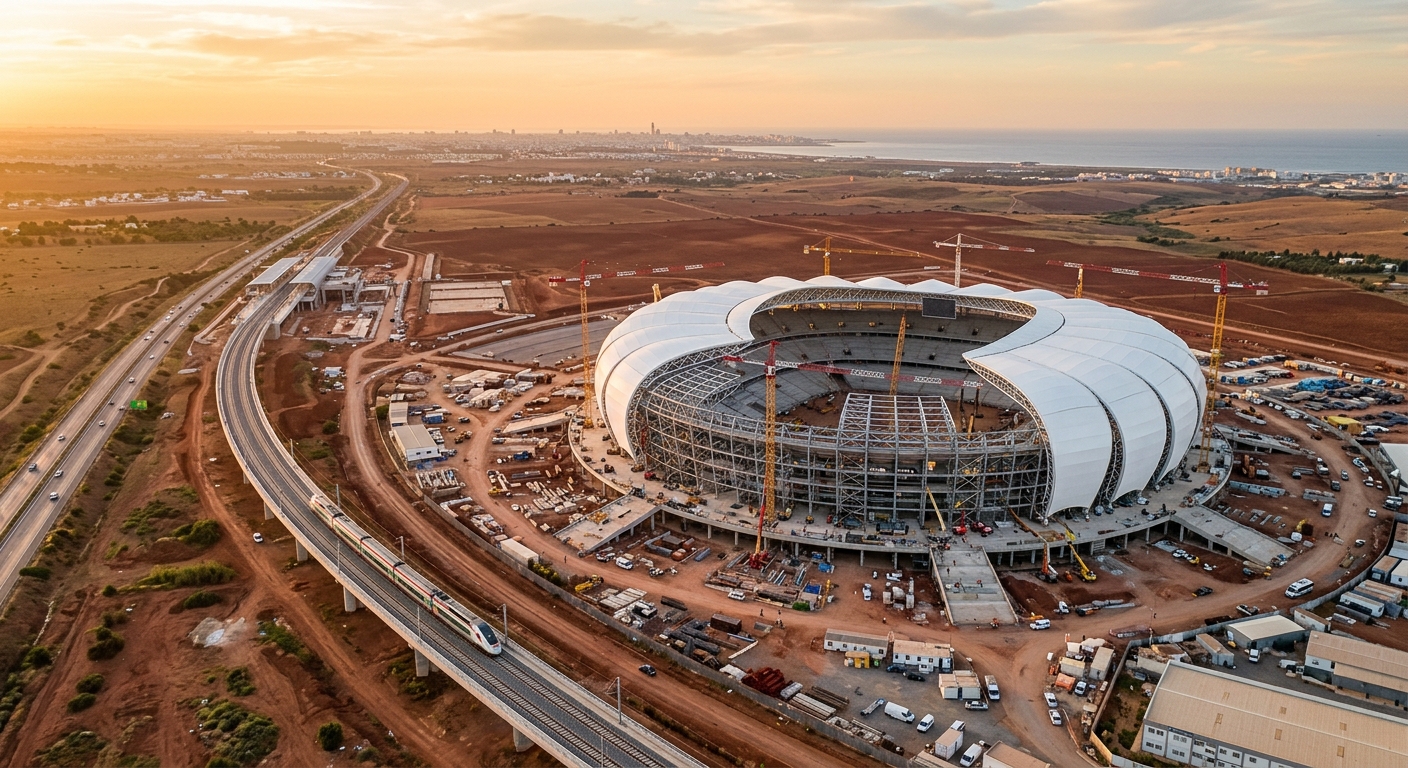
At the centre of the construction surge is the Grand Stade Hassan II, taking shape at El Mansouria between Casablanca and Rabat. Designed with a planned capacity of around 115,000 spectators, it is set to be one of the largest football stadiums on the planet and is being lined up as a candidate to host the 2030 final itself. Its tented, oversized roof and surrounding sports city are intended to be a statement of ambition visible from the air as travellers fly into the country.
Beyond the showpiece, Morocco is renovating and expanding venues in Casablanca, Rabat, Tangier, Marrakech, Agadir and Fez, blending upgrades to existing grounds with brand-new builds. The portfolio is deliberately spread across the country rather than concentrated in the economic capital, a decision that channels investment into regions that have historically lagged behind Casablanca and Rabat in public spending.
This stadium programme also doubles as preparation for the 2025 Africa Cup of Nations, which Morocco hosted, giving contractors and organisers a live rehearsal years before the World Cup. That sequencing is no accident: the kingdom has effectively staged a dress rehearsal at continental scale, ironing out logistics and testing venues before the global spotlight arrives.
The risk, as every host nation discovers, is the white-elephant problem. Stadiums that thrill for a summer can become costly burdens once the crowds leave. Moroccan planners insist the venues are tied to local clubs, federation use and concert and event programming, but the long-term viability of 100,000-seat arenas in a domestic league with modest attendances remains one of the project's open questions.
Rails, Runways and the Connectivity Push
If the stadiums are the visible trophy, transport is the real backbone of Morocco's 2030 plan. The country already operates Africa's first high-speed rail line, the Al Boraq service linking Tangier and Casablanca at speeds up to 320 km/h, which opened in 2018. The World Cup deadline is driving the extension of that network southward toward Marrakech, knitting the major host cities into a single fast-rail spine.
Airports are being enlarged in parallel. Mohammed V International in Casablanca, the country's primary gateway, is slated for major capacity expansion, with parallel upgrades planned at airports serving Marrakech, Agadir, Tangier, Rabat and Fez. The goal is to absorb a surge of international arrivals without the bottlenecks that have plagued other tournaments.
Urban transit, road networks and port capacity round out the programme. These are not glamorous projects, but they are the ones economists watch most closely, because connectivity infrastructure tends to deliver returns long after the final whistle. A faster, better-linked Morocco is a more attractive place to invest, visit and do business in 2031 and beyond, regardless of how the Atlas Lions perform.
The Tourism Gamble
Tourism sits at the heart of Morocco's economic case for hosting. The sector is already one of the kingdom's largest sources of foreign currency and employment, and the government has set an ambitious target of attracting around 26 million visitors annually by 2030, using the World Cup as both a marketing showcase and a forcing function for hotel and hospitality investment.
The logic is straightforward. A month of global television coverage delivers the kind of destination marketing money usually cannot buy, beaming images of Marrakech's medinas, Tangier's coastline and the Atlas Mountains to billions of viewers. South Africa 2010 and Qatar 2022 both reported lasting tourism halo effects, and Morocco wants to capture the same uplift while already being an established, accessible Mediterranean-rim destination.
Hotel construction has accelerated to meet projected demand, with new rooms planned across all host cities and a push to upgrade quality standards to international expectations. The challenge is balance: building enough capacity for a one-month spike without overbuilding for the years that follow, when demand returns to a steadier baseline.
There is also a softer dividend. Hosting forces a country to confront the practical details of welcoming the world, from signage and language services to digital payments and visitor safety. Those improvements outlast the tournament and benefit the everyday traveller, which is precisely the kind of legacy Moroccan officials emphasise when defending the spending.
The Economic Multiplier and the Jobs Question
World Cup economics are notoriously contested. Critics point out that the rosy projections hosts publish before tournaments rarely survive contact with reality, and that construction booms can crowd out other public spending. Supporters counter that the infrastructure has standalone value and that the global exposure is genuinely difficult to replicate.
Morocco's case leans heavily on the multiplier argument: every dirham spent on rail, airports and hospitality is meant to ripple through construction, services, manufacturing and small business. Job creation, particularly for the country's large youth population, is the political prize. Youth unemployment has long been one of Morocco's most stubborn social challenges, and a multi-year construction surge offers at least a temporary outlet and a pipeline of skills.
The kingdom is also using the moment to attract foreign direct investment, positioning itself as a stable, well-connected manufacturing and logistics hub on Europe's doorstep. Automotive and aerospace industries have already grown rapidly in recent years, and World Cup-grade infrastructure strengthens that pitch to global firms weighing where to locate.
The honest assessment is that the true economic verdict will not be clear until well into the 2030s. If the rail lines fill with commuters, the airports stay busy and the tourism numbers hold, Morocco will have a textbook case for sport-driven development. If the venues sit idle and debt service bites, it will join the long list of hosts whose legacy was more memory than money.
Soft Power and a Story About Itself
Beyond the spreadsheets, 2030 is an exercise in soft power. Hosting the World Cup places Morocco on a very short list of nations trusted to stage the planet's most-watched single-sport event, an implicit endorsement of its stability, organisation and global standing. For a country that has spent years cultivating its image as a forward-looking African leader, that endorsement carries weight.
The shared bid with Spain and Portugal also deepens Morocco's ties to Europe at a moment when migration, trade and security make the relationship across the Strait of Gibraltar more important than ever. Co-hosting turns a sometimes fraught neighbourhood into a partnership, with logistical cooperation that will outlast the tournament.
There is, finally, the emotional dimension that no balance sheet captures. The 2022 run to the semi-finals transformed how Moroccans and the wider Arab and African worlds saw the national team. Hosting matches at home, in stadiums built for the occasion, in front of crowds that waited decades for the chance, is its own form of return on investment, even if it never appears in a finance ministry report.
The Road From Here to 2030
Between now and kickoff lies the hardest part: delivery. Megaprojects slip, budgets balloon and the gap between renderings and reality has humbled more ambitious hosts than Morocco. The compressed timeline, with the Africa Cup of Nations as a midpoint test, leaves little margin for the kind of delays that plague large construction programmes.
Yet Morocco arrives at this challenge with genuine advantages: an existing high-speed rail backbone, a proven tourism industry, a track record of large infrastructure delivery and a government that has tied its credibility to getting this right. The kingdom is not building from zero, which separates its task from some previous first-time hosts.
What is certain is the scale of the bet. Morocco is using a football tournament to compress a decade of modernisation into a few intense years, wagering that the deadline will deliver what slower processes could not. Whether history records 2030 as the moment Morocco accelerated into a new economic gear, or an expensive month of glory, will be decided not on the pitch but in the years of grinding construction and careful planning that come first.
| Pillar | What it involves | Intended legacy |
|---|---|---|
| Stadiums | Grand Stade Hassan II (~115,000) plus venues in Casablanca, Rabat, Tangier, Marrakech, Agadir, Fez | Final-ready showpiece and regional sports infrastructure |
| High-speed rail | Extension of the Al Boraq network (Tangier-Casablanca) toward Marrakech | Faster intercity travel and long-term commuter capacity |
| Airports | Major expansion at Casablanca Mohammed V and regional airports | Higher international arrival capacity |
| Tourism | Hotel building and a target near 26 million visitors a year by 2030 | Sustained foreign currency and jobs |
| Soft power | First two-continent World Cup, co-hosted with Spain and Portugal | Enhanced global standing and Euro-African ties |
Key pillars of Morocco's 2030 World Cup transformation
FAQ
Who is hosting the 2030 World Cup with Morocco?
Morocco is co-hosting the 2030 FIFA World Cup with Spain and Portugal, with three centenary celebration matches also staged in Uruguay, Argentina and Paraguay, making it the first finals spread across two continents.
How big will the Grand Stade Hassan II be?
The Grand Stade Hassan II, being built near Casablanca at El Mansouria, is planned with a capacity of around 115,000, making it one of the largest football stadiums in the world and a candidate to host the 2030 final.
What is Morocco's tourism target for 2030?
Morocco aims to attract roughly 26 million visitors annually by 2030, using the World Cup as a global marketing showcase to accelerate hotel and hospitality investment.
Does Morocco already have high-speed rail?
Yes. Morocco's Al Boraq line, linking Tangier and Casablanca at up to 320 km/h, opened in 2018 as Africa's first high-speed rail service, and is being extended toward Marrakech ahead of 2030.
Why is Morocco investing so heavily in the World Cup?
Morocco views the tournament as an accelerator for infrastructure, jobs, tourism and soft power, using the fixed deadline to fast-track modernization it wanted regardless of the event.
Loved this? Useful? React below — your feedback helps other readers.