Morocco at Qatar 2022: The Historic Semifinal Run
A Tournament That Changed Everything
For decades, the World Cup semifinal had been the exclusive preserve of Europe and South America. Every single team to reach the last four in the tournament's history had come from one of those two continents. Africa, Asia, and the Arab world had produced great teams and famous upsets, but the semifinal ceiling had never been broken. At Qatar 2022, on Arab soil for the first time, Morocco shattered it.
The Atlas Lions did not back into the achievement. They earned it the hard way, beating Belgium, Spain, and Portugal, three sides ranked among the world's elite, and topping a group of death that also contained World Cup runners-up Croatia. By the time they walked out for their semifinal against France, Morocco were no longer a feel-good story; they were a genuine force that the world's best could not solve.
It was a run powered by an iron defense, a fearless midfield, and a coach who had taken charge only months before the tournament. Above all, it was carried by an extraordinary bond between the players, the Moroccan public, and a watching Arab and African world that adopted the team as its own.
Walid Regragui's Late Arrival
Morocco's journey nearly looked very different. Just three months before the World Cup, the federation dismissed coach Vahid Halilhodzic following a fractured relationship with key players, most notably the brilliant winger Hakim Ziyech. In stepped Walid Regragui, a former Morocco international and a coach who had just won the CAF Champions League with Wydad Casablanca.
Regragui's first act was reconciliation. He brought Ziyech back into the fold, mended fractured relationships, and rebuilt squad harmony at speed. His tactical vision was clear and pragmatic: defend deep and compact, deny space, and strike on the counter or from set pieces. It was a plan that suited Morocco's personnel perfectly, with quick attackers and a disciplined, athletic spine.
Few outside Morocco gave Regragui's hastily assembled project much chance against the heavyweights in the group. But the new coach radiated calm confidence, repeatedly framing his team's ambitions in bold terms. He spoke of Morocco as the Rocky Balboa of the tournament, the underdog who keeps getting up. By the end, the underdog had floored some of the biggest names in world football.
The Group of Death
Morocco were drawn into Group F alongside Croatia, the 2018 World Cup runners-up, Belgium, ranked second in the world and stacked with golden-generation talent, and Canada, returning to the World Cup for the first time since 1986. It was widely labeled a group of death, and most predictions had Morocco finishing third or fourth.
The opening match against Croatia ended 0-0, a tight, tactical affair that hinted at Morocco's defensive resilience. Then came the statement: a 2-0 victory over Belgium that stunned the football world. Abdelhamid Sabiri's free kick and a late Zakaria Aboukhlal strike sealed a famous win over a team many had tipped to challenge for the trophy.
Morocco completed the job against Canada, winning 2-1 to top the group with seven points. They had conceded just once across three games, and that an own goal. Finishing above both Croatia and Belgium, the Atlas Lions announced themselves as one of the tournament's outstanding defensive units and set up a round-of-16 meeting with Spain.
Beating Spain on Penalties
The round-of-16 clash with Spain was a masterclass in defensive discipline and collective sacrifice. Spain dominated possession, as expected, passing endlessly around the edge of Morocco's compact block, but the Atlas Lions barely conceded a clear chance across 120 minutes. The match ended goalless, sending it to a penalty shootout.
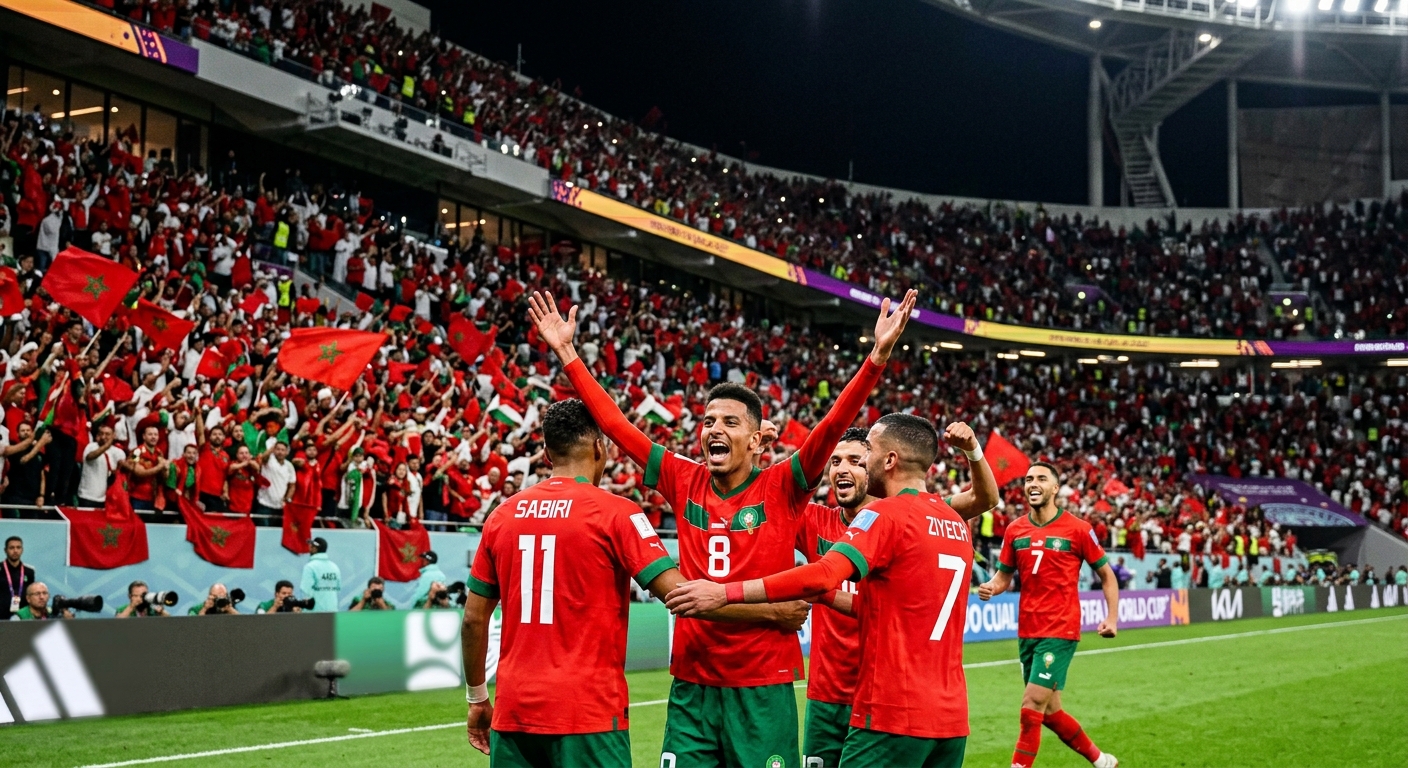
In the shootout, Morocco were ruthless and Spain fell apart. Goalkeeper Yassine Bono, who had been imperious throughout, saved from the spot, and Spain missed three of their penalties. Achraf Hakimi stepped up to take the decisive kick and, with supreme audacity, dinked a Panenka straight down the middle to send Morocco through. The image of Hakimi celebrating, embraced by his teammates, became one of the defining pictures of the tournament.
Defeating Spain, the 2010 world champions and a side built on the tiki-taka philosophy that had dominated the global game, was a colossal scalp. Morocco had not just survived; they had nullified one of football's most sophisticated attacking machines and won the mental battle of the shootout. The dream was now very real.
Toppling Portugal in the Quarterfinal
If beating Spain was a statement, knocking out Portugal in the quarterfinal was history. No African team had ever reached a World Cup semifinal. Portugal, fresh off thrashing Switzerland 6-1 in the previous round and boasting Cristiano Ronaldo, Bruno Fernandes, and a deep pool of talent, were favorites.
Morocco produced the perfect performance. Youssef En-Nesyri rose magnificently to head home a first-half goal, climbing higher than the Portuguese goalkeeper in a leap that seemed to defy physics. From there, the Atlas Lions defended with everything they had, throwing bodies in the way, with Bono once again commanding his box and the back line, marshaled by the returning captain Romain Saiss, holding firm.
Despite playing a stretch with ten men late on after a red card, Morocco held on for a 1-0 victory. The final whistle triggered scenes of pure delirium. Morocco were in the semifinals of the World Cup, the first African and Arab nation ever to get there. Players prayed on the pitch, embraced their mothers in the stands, and a continent and an entire region celebrated as one.
The Defensive Wall: Bono, Saiss, and Aguerd
At the heart of Morocco's run was one of the most miserly defenses in modern World Cup history. Across their seven matches, Morocco conceded just twice in open or set play, and one of those was an own goal in the group stage. The other came against France in the semifinal. No team built its tournament on a more solid foundation.
Goalkeeper Yassine Bono was a wall, producing crucial saves and exuding calm, and his penalty heroics against Spain made him a national hero. In front of him, the central-defensive pairing and the screening midfield, anchored by the tireless Sofyan Amrabat, smothered some of the planet's most dangerous attackers. Amrabat in particular emerged as one of the players of the tournament, covering enormous ground and breaking up play relentlessly.
Captain Romain Saiss embodied the team's spirit, repeatedly playing through injury to lead the line of defense. The fullbacks Achraf Hakimi and Noussair Mazraoui combined defensive duty with attacking threat. It was a unit that defended as one, and that collective resilience was the engine of everything Morocco achieved.
The Semifinal Against France
Morocco's semifinal opponent was France, the defending world champions and the team that had eliminated so many before them. To add a layer of poignancy, the match carried deep historical and cultural weight given the relationship between the two nations and the large Moroccan and North African community in France. Several players had family ties spanning both countries.
France struck early, with Theo Hernandez volleying home inside the opening five minutes after Morocco failed to clear, an uncharacteristic lapse from a defense that had been so reliable. Morocco responded with courage, dominating long spells, hitting the woodwork, and creating chances that on another night might have leveled the tie. Bono and the defense kept France at bay for long periods.
But France's quality and a second goal from substitute Randal Kolo Muani late on settled it 2-0. Morocco's run was over at the semifinal stage. There was heartbreak, but also enormous pride. They had taken the world champions to the wire and left the pitch to a standing ovation, having achieved more than any African or Arab team before them.
The Third-Place Play-Off
Morocco's tournament ended with the third-place play-off against Croatia, a rematch of their goalless group-stage opener. Fatigue, the emotional comedown from the semifinal, and a long list of injuries to key players hampered the Atlas Lions, but they competed to the very end.
Croatia, with their characteristic experience and resolve, edged a tight contest 2-1. Morocco scored through Achraf Dari, who headed home to briefly level the match, but Croatia's quality told and they secured third place. For Morocco, fourth place at a World Cup was nonetheless the greatest finish in their history and in the history of African football.
There was no shame in the result. Morocco had played seven matches against elite opposition, carried the hopes of millions, and absorbed enormous physical and emotional demands. Finishing fourth, ahead of teams like Brazil, Portugal, and Spain in the final reckoning, was an extraordinary achievement for a nation that had never previously won a knockout match at a World Cup.
A Team for a Continent and a Region
What made Morocco's run resonate so widely was the way it transcended national borders. Across the Arab world and across Africa, Morocco became everyone's team. Their matches drew enormous audiences, their goals sparked celebrations from Casablanca to Cairo to the streets of European cities with large diaspora populations.
The players leaned into that role with grace. Images of them celebrating with their mothers, of Hakimi dancing with his mother on the pitch, of the squad performing prayers and raising the Palestinian flag in solidarity, gave the run a human and cultural depth that went beyond sport. Morocco were not just winning matches; they were carrying a story of pride, identity, and unity.
Regragui, born in France to Moroccan parents, understood the symbolism deeply and spoke of representing the diaspora and the entire continent. The team's diverse makeup, drawing on players born in Morocco, the Netherlands, Spain, France, and beyond, made them a mirror of the modern Moroccan nation and its global community.
The Lasting Legacy of Qatar 2022
Morocco's semifinal run will be remembered as one of the defining stories of World Cup history. It broke a barrier that had stood for nearly a century and proved that an African and Arab nation could not only compete with the world's best but beat them repeatedly on the sport's grandest stage.
The achievement built directly on the foundation laid by the 1986 side that became the first African team to reach the knockout round. Where 1986 cracked the door open, 2022 blew it off its hinges, raising expectations not just for Morocco but for the entire continent. African football would never again be viewed as a collection of plucky underdogs incapable of going deep.
For Morocco specifically, the run accelerated investment and ambition. Combined with the nation's growing role in hosting major tournaments and its co-hosting of the 2030 World Cup, the legacy of Qatar 2022 positioned Morocco as a footballing power with genuine designs on global trophies. The class of 2022, led by Regragui, Bono, Hakimi, Amrabat, and a fearless collective, had changed the ceiling forever.
| Stage | Opponent | Result | Outcome |
|---|---|---|---|
| Group F | Croatia | 0-0 draw | Solid opener |
| Group F | Belgium | 2-0 win | Stunning upset |
| Group F | Canada | 2-1 win | Topped the group |
| Round of 16 | Spain | 0-0 (3-0 pens) | Bono saves, Hakimi Panenka |
| Quarterfinal | Portugal | 1-0 win | En-Nesyri header, history made |
| Semifinal | France | 0-2 loss | Pushed champions to the end |
| Third place | Croatia | 1-2 loss | Finished fourth |
Morocco's full Qatar 2022 World Cup campaign
FAQ
What did Morocco achieve at the 2022 World Cup?
Morocco became the first African and first Arab nation to reach a World Cup semifinal, finishing fourth after beating Belgium, Spain, and Portugal and topping a group containing Croatia.
Who coached Morocco at Qatar 2022?
Walid Regragui took over just three months before the tournament, replacing Vahid Halilhodzic, and rebuilt squad harmony while implementing a disciplined, counterattacking defensive system.
How did Morocco beat Spain at the 2022 World Cup?
Morocco defended brilliantly across 120 goalless minutes, then won the penalty shootout 3-0 as Yassine Bono made saves and Achraf Hakimi sealed it with a Panenka.
Who were Morocco's standout players in 2022?
Goalkeeper Yassine Bono, midfield anchor Sofyan Amrabat, captain Romain Saiss, fullback Achraf Hakimi, and striker Youssef En-Nesyri were central to the historic run.
How far did Morocco go and who knocked them out?
Morocco reached the semifinals before losing 2-0 to defending champions France, then finished fourth after a 2-1 defeat to Croatia in the third-place play-off.
Loved this? Useful? React below — your feedback helps other readers.