Morocco 1986: First African Team to Reach the Knockouts
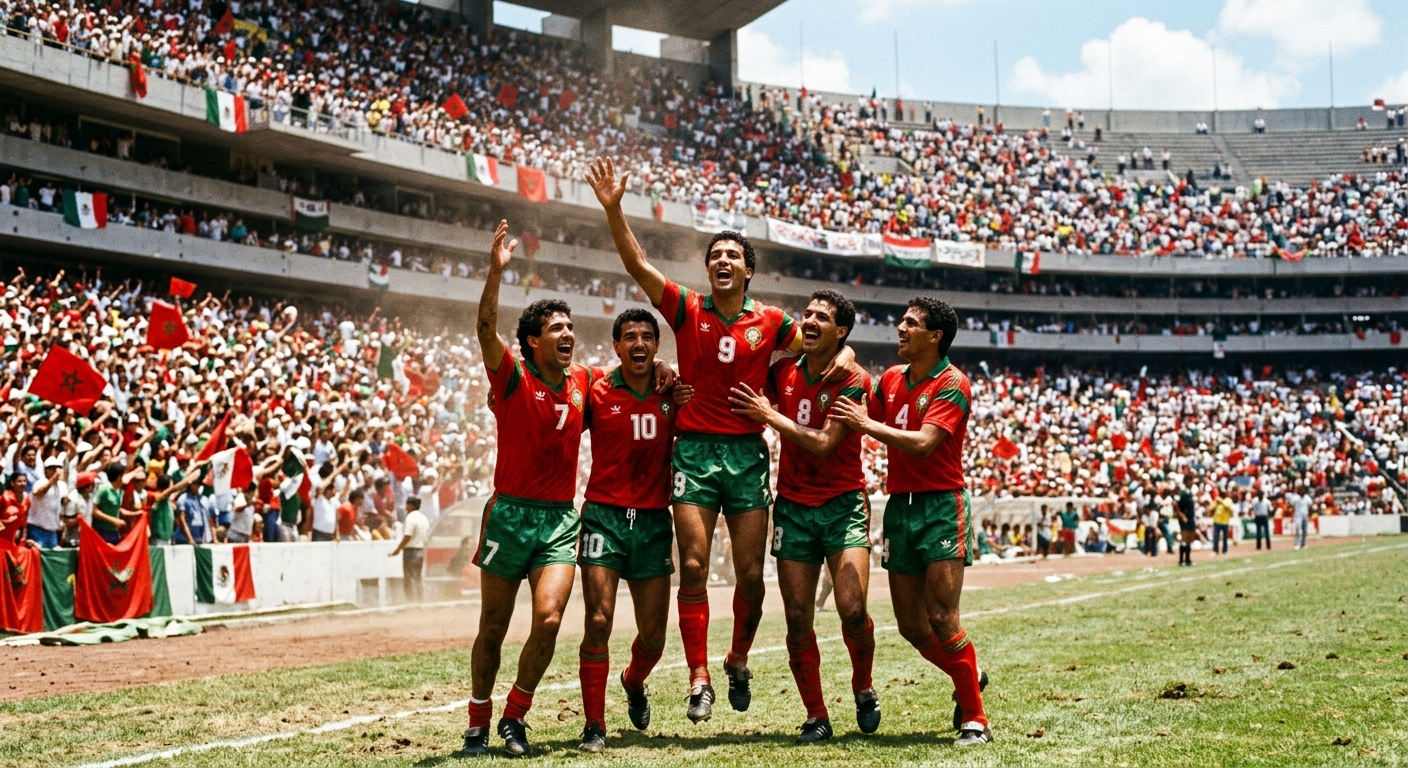
A Continent Waiting for a Breakthrough
Before the summer of 1986, African football at the World Cup was a story of brave appearances without reward. Egypt had debuted as far back as 1934, and through the 1970s and early 1980s teams like Zaire, Tunisia, Algeria, and Cameroon had shown flashes of quality, none more so than Algeria's famous victory over West Germany in 1982. Yet no African nation had ever escaped the group stage of a World Cup. The continent carried a reputation, fair or not, for technical talent undermined by tactical naivety and big-stage nerves.
Morocco arrived in Mexico carrying that weight as much as any team. The Atlas Lions had qualified for the 1970 World Cup, becoming the first independent African nation to reach the finals in the modern era, and had pushed West Germany in their opening match before bowing out. But 1970 had ended in the group phase, and sixteen years later the expectation was modest. FIFA still allotted Africa only two places at the finals, a number that itself spoke to how the global game underrated the region.
What unfolded over three weeks in Mexico would not just be a good run for Morocco. It would rewrite the narrative for an entire continent, proving that an African side could be organized, disciplined, and clinical enough to finish ahead of European football aristocracy on the world's biggest stage.
Jose Faria and the Building of a Team
The man tasked with leading Morocco was Jose Faria, a Brazilian coach who had spent years working in the Moroccan league and understood the domestic game intimately. Faria was not a celebrity name, but he was pragmatic, calm, and deeply respected by his players. He built a side rooted in defensive solidity and patient possession rather than the chaotic, individualistic approach that critics expected of an African team.
Faria's Morocco was a blend of experienced campaigners and players who plied their trade both at home and in Europe. The squad had a clear identity: compact in midfield, disciplined in shape, and dangerous on the counter and from set pieces. Faria drilled his players relentlessly on positioning, insisting they hold their structure even under pressure from more celebrated opponents.
Crucially, Faria instilled belief. Where previous African sides had sometimes arrived simply happy to be present, Morocco came to Mexico convinced they could compete. That mindset, combined with a tactically intelligent plan, set the foundation for what was to come in Group F, a group that contained England, Poland, and Portugal.
The Spine of the Side: Captain Bouderbala and the Leaders
Every memorable team has a spine, and Morocco's 1986 vintage had several pillars. Captain Aziz Bouderbala was the creative heartbeat, an elegant midfielder with vision and the ability to dictate tempo. Alongside him, Mohamed Timoumi pulled the strings, a player so admired that he was later named African Footballer of the Year for 1985, the season before the tournament.
In goal and defense, Morocco was reliable and unflustered. The backline absorbed pressure without panic, a hallmark of Faria's coaching, while the midfield screened them intelligently. Up front, Abdelkrim Merry, known as Krimau, provided the cutting edge and would score one of the tournament's most important goals for African football.
This was a team without a single global superstar but with a collective intelligence that made it more than the sum of its parts. They communicated, they covered for one another, and they trusted the plan. That cohesion would prove decisive against opponents who, on paper, boasted greater individual reputations.
Group F Opens: Holding Poland and England
Morocco's campaign began against Poland, a side that had finished third at the 1982 World Cup and still carried a fearsome reputation. The match in Monterrey ended goalless, a result that quietly announced Morocco's intentions. They were organized, hard to break down, and entirely comfortable trading blows with a European semifinalist of recent vintage.
Their second match brought England, with Bryan Robson, Gary Lineker, and a squad of household names. Once again Morocco refused to wilt. The game finished 0-0, but the subplot was dramatic: England lost captain Bryan Robson to injury and saw Ray Wilkins sent off. Morocco, playing against ten men for a stretch, held firm and even threatened to win it.
Two matches, two clean sheets, two points against the two most fancied teams in the group. Morocco had proven they belonged. But points were still scarce in an era of two-for-a-win scoring, and the final group match against Portugal would decide everything. A draw might not be enough; Morocco needed to be bold.
The Defining Victory: Morocco 3, Portugal 1
On 11 June 1986 in Guadalajara, Morocco produced the performance that would define their tournament and, in many ways, African football for a generation. Facing a Portugal side led by the gifted Paulo Futre and others, Morocco did not sit back. They attacked with purpose and clinical edge.
Abderrazak Khairi scored twice in the first half, punishing Portuguese errors and capitalizing on Morocco's growing confidence. Krimau added a third, and although Portugal pulled one back through Diamantino late on, the result was never truly in doubt. Morocco 3, Portugal 1. It was not a smash-and-grab; it was a deserved, controlled demolition.
The victory did more than secure points. Combined with England's 3-0 win over Poland, it sent Morocco to the top of Group F. For the first time in World Cup history, an African nation had won a group at the finals. The Atlas Lions had finished ahead of England, Poland, and Portugal, three European sides with deep pedigrees, and the football world took notice.
Topping the Group: A Historic First
Finishing first in Group F was the headline achievement, and its significance cannot be overstated. No African team had ever advanced past the group stage of a World Cup, let alone topped a group containing three European nations. Morocco's three points, earned through two draws and a commanding win, were enough to place them above England on goal difference at the summit.
The accomplishment shattered a psychological barrier. African teams were no longer novelties making up the numbers. Morocco had shown that with organization, discipline, and tactical clarity, a side from the continent could outthink and outplay established powers. The achievement would be referenced for decades as the moment African football arrived at the top table.
It also vindicated Faria's methodical approach. The compact shape, the patience, the refusal to be drawn into a frantic shootout, all of it paid off. Morocco had earned their place in the round of 16, where they would meet a familiar foe from their 1970 debut: West Germany.
The Round of 16: West Germany and a Cruel Ending
On 17 June 1986 in Monterrey, Morocco faced West Germany in the round of 16. The Germans were a tournament machine, perennial contenders who would go on to reach the final that year. Yet Morocco did not shrink. They defended with the same discipline that had carried them through the group and frustrated their illustrious opponents for almost the entire ninety minutes.
For 87 minutes, the match remained scoreless, and Morocco looked capable of taking West Germany to extra time and perhaps the lottery of penalties. The Atlas Lions held their shape, blocked, and chased, refusing to give the Germans the space they craved. It was a performance of immense character against one of the favorites for the trophy.
Then, in the 88th minute, came the moment that ended the dream. Lothar Matthaus, one of the finest midfielders of his generation, struck a free kick that found the net. West Germany 1, Morocco 0. The Atlas Lions were eliminated, but they left Mexico with their heads high, having pushed the eventual finalists to the very last minutes and having achieved something no African team had done before.
What the World Said
In the immediate aftermath, the reaction was a mixture of admiration and surprise. Pundits who had arrived in Mexico expecting Morocco to be group-stage cannon fodder were forced to recalibrate. Here was a side that had outperformed England and Portugal and given West Germany a genuine scare. The condescension that often accompanied coverage of African teams was harder to sustain.
For the continent, Morocco's run was a source of enormous pride and a template. Cameroon would build on it spectacularly at Italia 1990, reaching the quarterfinals, and the success of both nations contributed to FIFA expanding Africa's allocation of World Cup places in the years that followed. Morocco had cracked open a door that others would push through.
Within Morocco itself, the players returned as heroes. Timoumi's status as African Footballer of the Year was reinforced, Bouderbala's leadership was celebrated, and Faria's quiet competence was finally given its due. The 1986 squad entered national folklore as the team that made Morocco, and Africa, believe.
The Legacy of the Class of 1986
The legacy of Morocco's 1986 World Cup extends far beyond a single tournament. It established the Atlas Lions as Africa's standard-bearers, a reputation they would carry through subsequent World Cup appearances and which would reach its zenith at Qatar 2022 when Morocco became the first African and Arab nation to reach a World Cup semifinal.
The 1986 side also demonstrated a footballing philosophy that has echoed through Moroccan teams since: defensive organization as a foundation, paired with intelligent, technical players capable of hurting opponents when chances arise. Walid Regragui's 2022 team, built on a miserly defense and clinical counterattacking, was in many ways a spiritual descendant of Faria's blueprint.
More than a result, 1986 was a statement of identity. It told a young generation of Moroccan and African players that the World Cup knockout rounds were not off-limits, that European reputations could be beaten, and that belief, discipline, and unity could carry a team further than anyone expected. The free kick that ended their run hurt, but the door they opened never closed again.
Where They Rank in Moroccan History
When Moroccan fans debate the greatest national teams of all time, the conversation inevitably begins with two sides: the 1986 group-toppers and the 2022 semifinalists. The 2022 team went further in raw terms, beating Belgium, Spain, and Portugal on the way to the last four. But the 1986 side did it first, when no one expected it and when the global game still doubted whether an African team could compete at this level.
That pioneering quality is what gives the 1986 squad its enduring romance. They were trailblazers in a way the 2022 team, for all its brilliance, built upon rather than created. Without the breakthrough of Mexico, the belief that fueled Qatar might never have taken root so deeply in the national footballing psyche.
The names Bouderbala, Timoumi, Krimau, Khairi, and coach Jose Faria remain etched in Moroccan football history. They were the first to show that the Atlas Lions could roar on the biggest stage of all, and for that, they occupy a permanent and cherished place in the story of the nation's game.
| Stage | Opponent | Result | Key moment |
|---|---|---|---|
| Group F | Poland | 0-0 draw | Solid opening clean sheet |
| Group F | England | 0-0 draw | Held 10-man England after Wilkins red |
| Group F | Portugal | 3-1 win | Khairi brace, Krimau goal |
| Group F finish | 1st place | 3 points | First African team to top a group |
| Round of 16 | West Germany | 0-1 loss | Matthaus 88th-minute free kick |
Morocco's 1986 World Cup results in Mexico
FAQ
Why is Morocco's 1986 World Cup so historically important?
Morocco became the first African and first Arab nation to top a World Cup group and advance to the knockout round, breaking a barrier that had stood since Africa first appeared at the finals in 1934.
Who coached Morocco at the 1986 World Cup?
Morocco was coached by Brazilian Jose Faria, who emphasized defensive organization, patience, and tactical discipline, building a cohesive team without relying on a single star.
How did Morocco get knocked out in 1986?
Morocco lost 1-0 to West Germany in the round of 16, conceding an 88th-minute free kick from Lothar Matthaus after holding the eventual finalists scoreless for nearly the entire match.
Who were Morocco's key players in 1986?
Captain Aziz Bouderbala and reigning African Footballer of the Year Mohamed Timoumi ran the midfield, while Abderrazak Khairi and Abdelkrim Krimau supplied the goals against Portugal.
How did the 1986 run influence later Moroccan teams?
It established a blueprint of defensive solidity and clinical counterattacking that echoed through later sides, most notably Walid Regragui's 2022 team that reached the World Cup semifinals.
Loved this? Useful? React below — your feedback helps other readers.