Darija, Data and Don Bigg: Inside Morocco's Youth Culture and Social Media Revolution
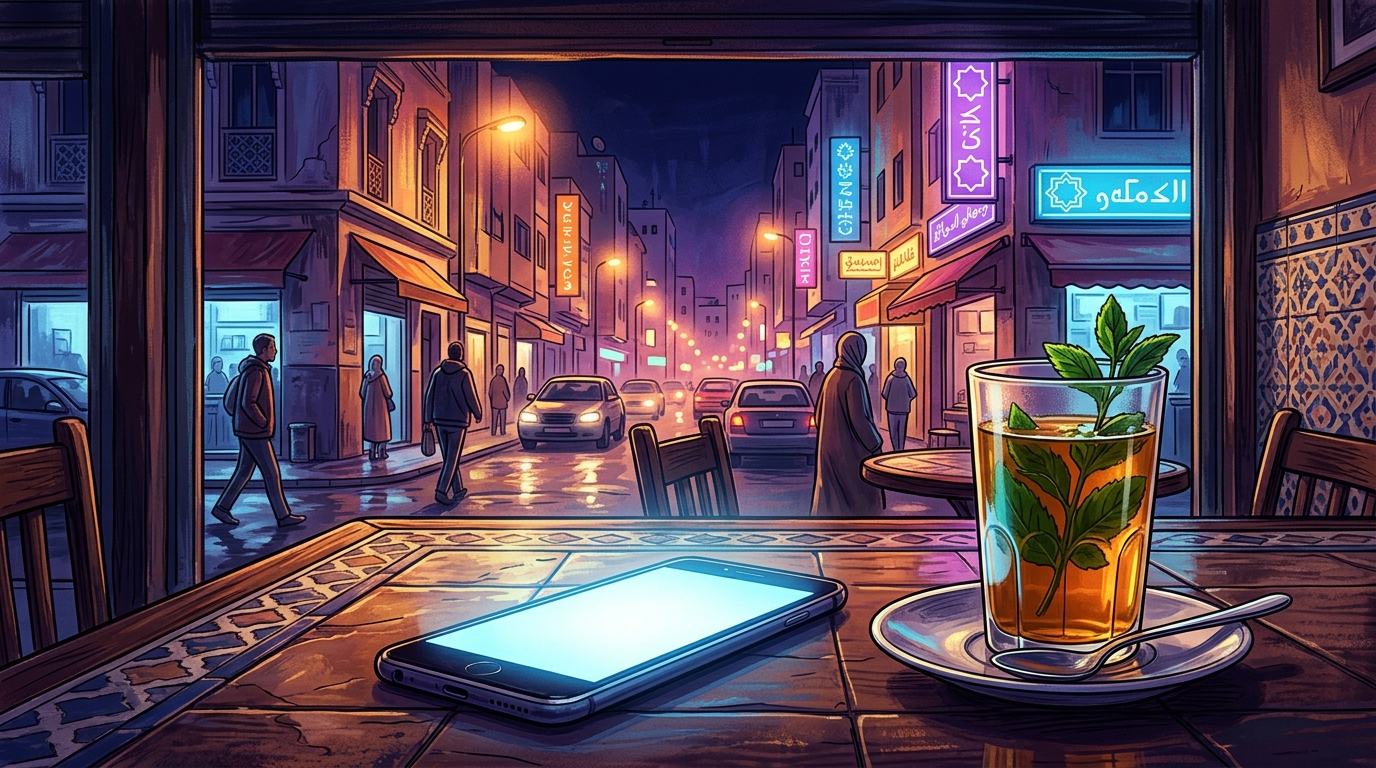
Darija, French, English and Arabizi: the language young Moroccans actually speak
Moroccan Darija has always been a spoken language first, an oral dialect of Arabic layered with Amazigh, French and Spanish influence long before anyone tried to type it. What changed with the rise of mobile phones and social networks in the early 2000s was that young Moroccans suddenly needed to write it, fast, on keyboards that had no Arabic script installed. The solution they invented on their own, without any academy or ministry telling them how, was Arabizi: Darija spelled out in Latin letters, with numbers standing in for Arabic sounds that French or English letters cannot capture — a 3 for the guttural 'ayn, a 7 for the breathy ha, a 9 for qaf. Linguists who have studied the phenomenon, including the French sociolinguist Dominique Caubet, describe a generation that grew up reading both Arabic and Latin scripts from infancy and then, largely through texting and social media rather than any classroom, taught itself to write its own spoken dialect fluently for the first time.
Layered on top of that script is a constant three-way code-switching between Darija, French and English that defines how Moroccan youth actually talk online. A single Instagram caption might open in Darija, drop a French phrase for something considered more precise or more stylish, and close on an English word borrowed straight from global internet culture — 'trop' next to 'zwina' next to 'lowkey'. French remains the dominant foreign layer, a legacy of the colonial period that still runs through education, business and media, which is why so much of Arabizi's orthography — using 'ch' for the sh sound, for instance — follows French rather than English spelling conventions. English has moved in fast behind it, carried less by schooling than by gaming chat, YouTube comment sections and the vocabulary of TikTok itself.
None of this is considered a decline of Darija by the people using it; if anything, the opposite. Where Darija was once treated by parts of the establishment as a spoken-only dialect unfit for serious writing, a new generation now writes it constantly, in public, on the same phones their parents use to call them for dinner. The result is a living, mutating youth register that is unmistakably Moroccan, legible only to people who grew up inside the same mix of influences — which is precisely the point.

TikTok, Instagram, YouTube and Snapchat: where Moroccan youth actually live
By early 2025, Morocco counted roughly 21 million social media user identities out of a population of about 38 million, with internet penetration above 92 percent according to the Digital 2025 Morocco report from DataReportal. Facebook remains the broadest platform by raw numbers, but the platforms that define youth culture specifically are TikTok, Instagram, YouTube and Snapchat. TikTok reported around 14.6 million users aged 18 and over in early 2025, a figure that kept climbing through the year, while Instagram's audience sat above 13 million and YouTube reached more than 21 million viewers, over half the country's population. TikTok trends move through Moroccan youth culture on the same rhythm as anywhere else, but they are almost always re-recorded in Darija or reworked around a local joke, while Snapchat remains a favorite for private, everyday messaging valued precisely because it feels less performative.
YouTube is where Moroccan creators build the longest-lasting followings, and cooking channels have become an unlikely national institution online: the television chef Choumicha, already a household name from Moroccan TV, and the YouTuber Halima Filali, known for traditional Moroccan cooking and Ramadan recipes, both built multi-million subscriber audiences by translating a very old domestic skill — the family kitchen — into a very new medium. Alongside them, a newer wave of Moroccan TikTok and Instagram personalities has built fame on comedy sketches, lifestyle vlogging and beauty content aimed at a young, mobile-first audience, part of the same creator-economy shift reshaping fame everywhere from Paris to Los Angeles.
What is harder to pin down, and worth being honest about, is exactly who counts as 'the' biggest Moroccan influencer at any moment, since follower counts on third-party trackers shift constantly. What is consistent is the shape of the phenomenon: young Moroccans, often self-taught with nothing but a smartphone, build large audiences by narrating ordinary Moroccan life — family dynamics, dating norms, university stress, street food — in the mixed Darija-French-English register described above. They do not chase global celebrities for relatability; they follow other Moroccans who sound like their own cousins. The content is local. The feed is global. Most young Moroccans move fluently between both without registering any contradiction.
The sound of a generation: Moroccan rap, trap and youth identity
If any single art form has become the soundtrack of young Morocco, it is rap. What locals sometimes call 'Morap' has moved in little more than a decade from a marginal underground scene to the dominant popular music of anyone under thirty. Dizzy DROS, born in Casablanca's Bine El-Mdoune neighborhood, helped kick off the modern era with his 2011 breakthrough single 'Casafonia' and his 2013 debut album '3azzy 3ando Stylo,' widely regarded as one of the most influential Moroccan rap records ever released. A newer generation, led by ElGrandeToto — the most streamed artist in Morocco for five consecutive years running through 2025 and the top-streamed act in the entire MENA region on Spotify in 2021 and again in 2023 — pushed the sound further toward a darker, harder trap style shaped by Atlanta hip-hop and French drill, sung and rapped in a fluid mix of Darija, French, Spanish and English that mirrors exactly how its young fans actually talk.
Older voices remain part of the same continuum. Don Bigg, one of the pioneers who helped legitimize Moroccan rap in the 2000s, is still active and still respected as an elder statesman of the genre, while the sound itself keeps absorbing older Moroccan traditions — chaabi rhythms, gnawa textures, and the raw, socially direct storytelling that raï brought to North African popular music a generation earlier. The result is a genre that feels both completely modern and unmistakably rooted, which is exactly why it resonates: it lets a generation raised on smartphones speak in a musical language built from what came before them.
Crucially, this music is not escapism. Moroccan rap's lyrical terrain runs straight through the same material as this article — unemployment, blocked ambition, family pressure, the pull of emigration, the gap between what young people are promised and what the job market delivers. That is precisely why, when a youth protest movement erupted across Morocco in the autumn of 2025, it was rappers, not politicians or pop stars, whom young demonstrators looked to first.

The backdrop: unemployment, NEET rates and the pull of leaving
None of this culture exists in a vacuum, and the numbers behind it are stark. According to Morocco's High Commission for Planning (HCP), unemployment among Moroccans aged 15 to 24 stood at roughly 37 percent through 2025, among the highest youth jobless rates in the region, and HCP data has repeatedly shown that roughly one in three young Moroccans falls into the NEET category — not in education, employment or training. Of the roughly 390,000 young people entering Morocco's labor force each year, independent analyses built on HCP figures estimate that barely a third find work in either the formal or informal economy, leaving hundreds of thousands of young people every year with a smartphone, a diploma or a trade, and nowhere obvious to put either to use.
That gap between aspiration and opportunity feeds directly into one of the most consistent findings in Moroccan public-opinion research: the desire to leave. Arab Barometer's most recent in-depth Morocco survey, conducted face-to-face with more than 2,400 Moroccans in late 2023 and early 2024, found that roughly a third of Moroccans want to emigrate, with economic motives cited by a plurality — about 45 percent — as the primary driver, and more than half of would-be migrants saying they would be willing to leave without official papers if necessary. Separate Afrobarometer research published in 2025 found that interest in emigration among Moroccan youth continued to grow even as young people expressed broad optimism about the country's general direction — a contradiction that captures the mood precisely: pride in being Moroccan, paired with an acute sense that opportunity lies elsewhere.
This is the economic floor beneath everything described above. The Arabizi slang, the TikTok fame, the rap verses about hustle and blocked ambition — all of it is being produced by a generation that is simultaneously more connected to the rest of the world than any before it, and more shut out of stable, well-paid work at home than most Moroccans would like to admit.
From memes to the street: Gen Z 212 and a networked generation's politics
The clearest collision of all these threads — language, platforms, music and economic frustration — arrived in the autumn of 2025, when a leaderless, largely anonymous youth movement calling itself GenZ 212 organized nationwide protests that ran from late September to mid-October. According to Wikipedia's documented account of the events, corroborated by international reporting at the time, the movement's Discord server grew from fewer than 1,000 members when it launched on September 18, 2025 to roughly 250,000 within about three weeks, while TikTok and Instagram carried its slogans and livestreams far beyond the server itself. Demonstrators, many of them teenagers and young adults, demanded better-funded public education and healthcare, affordable housing and job creation, and openly criticized government spending on major sporting projects tied to the 2030 World Cup and the 2025 Africa Cup of Nations, which many young Moroccans felt was crowding out investment in their own futures.
The response from Morocco's cultural establishment was telling: rappers, not politicians, became the movement's most visible allies. ElGrandeToto, Dizzy DROS and the veteran Don Bigg all publicly condemned the state's forceful dispersal of demonstrations, alongside dozens of writers and artists who signed an open letter to King Mohammed VI. Some of the same rappers who had spent a decade putting unemployment and blocked ambition into their lyrics were now being asked, directly, to speak for the generation living those lyrics in real time. The protests themselves carried a real cost — official tallies cited three deaths and more than 2,400 arrests — and the tension has not fully subsided since: as recently as mid-July 2026, Moroccan authorities arrested the outspoken rapper Mehdi El Youbi in Casablanca, a reminder that the relationship between Morocco's young digital culture and its state remains unsettled.
What Gen Z 212 demonstrated, more than any single demand it raised, is that Moroccan youth culture is no longer only a matter of slang and streaming numbers. The same generation swapping Arabizi memes and rap verses on TikTok proved it could also organize an entire national movement almost overnight, using tools — an anonymous chat server, a hashtag, a leaderless structure — that were largely invisible to the institutions meant to be watching.
Old values, new feeds: the generational divide in a globalized Morocco
The friction beneath all of this is generational, and it runs through nearly every Moroccan household with a teenager and a smartphone. Parents and grandparents raised in a more religiously observant, extended-family-centered, French-and-Darija world often see the imported vocabulary, the public self-display of TikTok and Instagram, and the blunt language of rap lyrics as a genuine erosion of adab — the deep-rooted Moroccan and Islamic concept of propriety and respect for elders. Younger Moroccans, for their part, frequently describe the same behavior not as rejection of tradition but as a different, faster way of carrying it: they still fast for Ramadan, still attend family Friday lunches, still speak Darija at home, even as they build entirely separate identities and, sometimes, incomes online.
Gender adds another layer to that tension. Young Moroccan women who build public followings as content creators, comedians or fashion influencers often face a sharper version of the same scrutiny that young men rapping about hustle and frustration do not, reflecting broader debates about women's visibility in Moroccan public life that predate social media by decades but have been sharpened by it. At the same time, plenty of Moroccan parents now watch their children's cooking or comedy channels with genuine pride, and no shortage of the country's most successful digital creators, Choumicha chief among them, are women who built their fame by modernizing, rather than abandoning, distinctly Moroccan domestic traditions.
The honest picture is neither a generation in open revolt nor a country sliding uncritically into globalized digital culture, but something messier and more interesting: a young population that speaks three languages in one sentence, watches Moroccan cooking channels and global TikTok trends in the same scrolling session, listens to rap that samples both Atlanta trap and gnawa rhythm, and — when pushed hard enough by unemployment and a sense of being unheard — can turn a Discord server into a national reckoning within three weeks. That is Moroccan youth culture in 2026: fluently local, fluently global, and impossible to understand through either lens alone.
Frequently asked
What is Arabizi and why do Moroccan youth use it?
Arabizi spells Moroccan Darija using Latin letters and numbers, with digits like 3, 7 and 9 standing in for Arabic sounds Latin script cannot represent. It emerged in the early 2000s as young Moroccans began texting on keyboards without Arabic script, and it remains the default way most Moroccan youth write their own dialect online today.
Which languages do young Moroccans mix together online?
Most commonly Darija, French and English, often within a single sentence or caption. French carries the deepest historical influence, shaping even the spelling conventions of Arabizi, while English has moved in quickly through gaming, YouTube and global internet culture, especially among younger teenagers.
What are the most popular social media platforms among Moroccan youth?
TikTok, Instagram, YouTube and Snapchat dominate youth usage, alongside Facebook, still the largest platform overall. Morocco had roughly 21 million social media identities and over 92 percent internet penetration in early 2025, per the DataReportal Digital 2025 Morocco report, with TikTok and Instagram both growing through the year.
Who are some well-known Moroccan social media content creators?
Cooking creators have built some of the largest and most durable followings, including television chef Choumicha and YouTuber Halima Filali, both known for traditional Moroccan recipes. Alongside them, a newer wave of Moroccan comedians, beauty vloggers and lifestyle creators has built large TikTok and Instagram audiences, though exact rankings shift constantly across different tracking platforms.
What role does rap music play in Moroccan youth culture?
Rap, sometimes called 'Morap' locally, has become the dominant popular music for Moroccan youth, blending Darija, French and English lyrics over trap and hip-hop production influenced by older chaabi, gnawa and raï traditions. Artists like Dizzy DROS, ElGrandeToto and Don Bigg address unemployment, ambition and identity, themes that mirror the daily concerns of their young audience.
What is Morocco's youth unemployment rate?
According to Morocco's High Commission for Planning (HCP), unemployment among Moroccans aged 15 to 24 stood at roughly 37 percent through 2025, one of the highest youth jobless rates in the region, with roughly one in three young Moroccans classified as NEET (not in education, employment or training).
How many young Moroccans want to emigrate, and why?
Arab Barometer's late 2023/early 2024 survey of more than 2,400 Moroccans found that roughly a third want to emigrate, with economic factors cited by about 45 percent as the main reason, and more than half of prospective migrants saying they would leave without official papers if needed.
What was the Gen Z 212 movement in Morocco?
GenZ 212 was a decentralized, largely anonymous youth movement that organized nationwide protests from late September to mid-October 2025, demanding better public education, healthcare, housing and jobs, and criticizing government spending on 2030 World Cup and 2025 Africa Cup of Nations infrastructure. It grew from a Discord server with fewer than 1,000 members to roughly 250,000 within about three weeks.
How did social media enable the Gen Z 212 protests?
Organizers used Discord for coordination, partly because it was less familiar to Moroccan authorities, while TikTok and Instagram amplified slogans, livestreams and calls to demonstrate to a much wider youth audience. Prominent rappers including ElGrandeToto, Dizzy DROS and Don Bigg publicly backed the movement, lending it cultural credibility beyond its online organizers.
Is there tension between traditional values and Moroccan youth digital culture?
Yes. Many older Moroccans view youth slang, public self-display on social media and blunt rap lyrics as a departure from adab, the traditional concept of propriety and respect for elders. Younger Moroccans generally describe their online lives as a different way of carrying the same traditions, and popular creators like Choumicha show the two impulses can coexist rather than conflict.
- DataReportal — Digital 2025: Morocco ↗
- Afrobarometer — Youth like Morocco's direction even as jobs remain scarce and interest in emigration grows ↗
- Arab Barometer — Survey: Four in Ten Moroccans Hope to Emigrate ↗
- Wikipedia — 2025 Moroccan Gen Z protests ↗
- Wikipedia — Moroccan hip-hop ↗
- Al Jazeera — Outspoken Moroccan rapper Mehdi El Youbi arrested in Casablanca ↗
Video via official YouTube embeds; photos via Wikimedia Commons under their stated licenses. All rights belong to the respective owners; 212 Daily claims no ownership.