What Berber Silver Jewelry Actually Means: Fibulas, Amber and 2,000 Years of Symbols
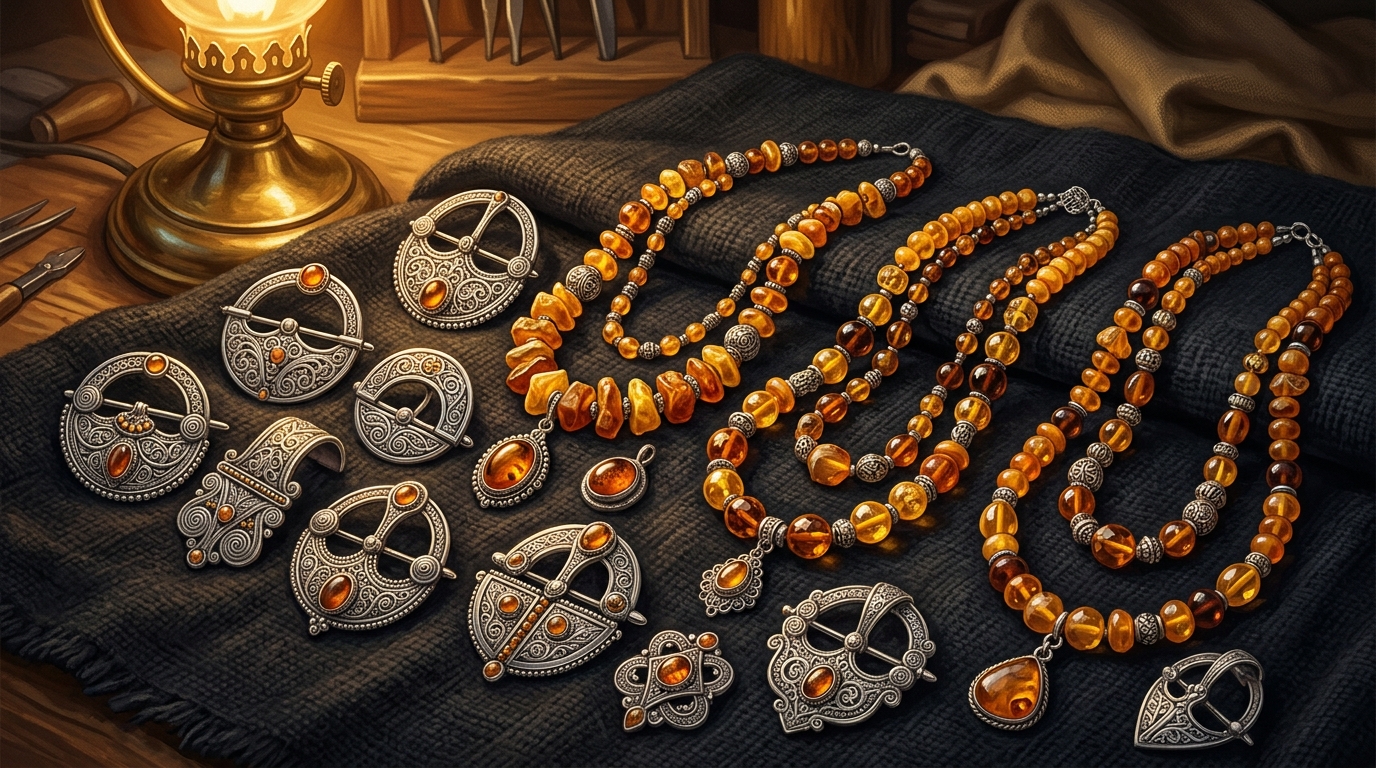
Why silver, not gold
The single most distinctive fact about Amazigh jewelry is the metal itself. While Arabized and urban populations across North Africa historically preferred gold jewelry, rural Berber communities held onto silver for centuries, a divide documented by ethnographers well into the 20th century. Part of the explanation is religious: with the arrival of Islam in Morocco in the 7th century, certain interpretations of Quranic teaching were understood to discourage men from wearing gold, which reinforced an existing cultural preference and gave silver an additional layer of religious legitimacy it did not need in purely rural, pre-Islamic contexts.
Silver also carried its own folk symbolism, independent of any religious ruling: it was widely believed to reflect light and, by extension, to repel darkness and ward off evil, connecting the wearer to a kind of protective purity that gold, in the same belief systems, did not confer. Whether the historical preference for silver over gold ultimately traces to economics, religion, folklore, or some mix of all three is, honestly, not fully settled by the historical record — but the preference itself, sustained across centuries and across an enormous geographic range, is not in dispute.
Production centered on specific towns that became genuine silver-crafting hubs: Tiznit in the Souss region, still marketed today as Morocco's 'Silver Capital'; Sefrou; and workshops scattered across the Anti-Atlas. In many of these centers, silversmithing was historically dominated by Morocco's Jewish communities, whose presence in the south is documented back to at least the second century BCE and whose craftsmen produced jewelry for their Amazigh Muslim neighbors right up until the large-scale Jewish emigration from Morocco in the late 1950s — meaning a huge share of what is now marketed simply as 'Berber silver' was, historically, the product of a specifically Jewish-Amazigh craft economy working side by side.
Manufacturing technique varied by region and workshop, but the core methods stayed remarkably consistent across centuries: pieces were typically cast in molds and then finished entirely by hand, with fine detail work added through engraving and niello (a black metallic inlay technique used to darken and define engraved lines). Cloisonné enameling — colored glass paste fired into compartmentalized metal cells — is generally credited to Sephardi Jewish goldsmiths who carried the technique from Al-Andalus into Morocco, while filigree wirework combined with colored enamels in yellow, green and blue became a signature look of several regional schools, particularly in the Anti-Atlas and Souss workshops surrounding Tiznit.

The fibula: a brooch that could tell your tribe and your heart
No single object carries more encoded information than the fibula — a penannular brooch, locally called tizerzaï, consisting of a symmetrical pair of triangular plates connected by pins that hold a woman's unsewn, draped outer garment in place. Fibula-style brooches are believed to have been in use across the Maghreb since ancient times, with origins that scholars trace back to Bronze Age precedents, making the basic form one of the oldest continuously used jewelry types in North Africa.
The triangle itself is widely read symbolically as representing fertility and the household — an abstracted woman and tent, femininity and shelter combined in one geometric shape. Beyond that shared meaning, the specific style of fibula a woman wore functioned as a genuine tribal marker: the Ait Atta of the Anti-Atlas favored a triangular brooch style distinct from the double fibulas, joined by connecting chains, favored by the Ait Youssi further north. A trained eye could read a woman's tribal affiliation from her brooch alone, the way a flag or a uniform pattern might signal group identity elsewhere.
Even the placement of the fibula on the body carried meaning. Worn on the right side of the chest, it signaled an unmarried woman; worn on the left, closer to the heart, it signaled that her heart — and her marital status — was already taken. Size mattered too: the scale and weight of a fibula could indicate a woman's social status within her community, with larger, more elaborate pairs generally signaling greater family wealth or standing.
Fibulas were typically worn in pairs, one on each side of the chest, connected by a chain from which additional pendants, coins or amulets could hang — turning a purely functional garment fastener into the visual centerpiece of an entire outfit. Major museum collections, including the Musée du Quai Branly in Paris, hold extensive fibula collections precisely because the form varied so distinctly from region to region, giving researchers a genuinely reliable material record of tribal geography across the Atlas and Anti-Atlas that written sources from the same communities and periods simply do not provide in comparable detail.

Amber, coral and the color code of a necklace
Beyond silver metalwork, Amazigh jewelry traditionally incorporated a specific set of materials, each carrying its own attributed properties. Amber was prized for its warmth and believed protective and even medicinal qualities — folk belief held it could guard against colds, and it was credited with both aphrodisiac and protective, anti-witchcraft powers. Coral was worn specifically to ward off the evil eye and was associated with vitality and life force. Silver itself was tied to ideas of purity and, as noted above, protective light.
Color carried its own separate symbolic code within beadwork: red beads were associated with life force and fertility, blue with divine protection, and green with renewal and growth. In southern Morocco, brides were traditionally adorned with elaborate necklaces combining amber, coral and smooth, agate-colored stones like carnelian — jewelry that functioned simultaneously as a display of wealth and prestige and as what amounts to a visible 'slogan' identifying the wearer's specific tribe to anyone who understood the visual vocabulary.
Perhaps the best-known individual symbol across this entire tradition is the khamsa (also spelled khmissa), the open right hand or 'hand of Fatima' motif, believed by both Muslim and Jewish communities in the region to protect against the evil eye. That shared symbol, along with the frequent appearance of the Star of David alongside more explicitly Islamic motifs in pieces from southern Moroccan workshops, is itself physical evidence of how thoroughly intertwined Jewish and Amazigh Muslim craft traditions were before the mid-20th-century Jewish emigration reshaped the region's silversmithing economy.
Jewelry as a bank account
In societies without widespread access to banking, Amazigh silver jewelry served a very literal economic function beyond ornamentation: it was a portable, wearable store of wealth. Pieces constituted the most significant part of a husband's wedding gifts and a bride's dowry, and critically, that jewelry remained the woman's own personal property even in the event of divorce — making it one of the few forms of independent wealth many rural Amazigh women could reliably hold and control across their lifetime.
That savings function extended down to the level of individual coins. Official currency was frequently worked directly into headdresses, necklaces and other pieces, and in moments of genuine financial need, coins could simply be broken off a piece of jewelry and spent, then in principle replaced or re-added later. A woman's jewelry collection was, in a very direct sense, her visible net worth, accumulated over a lifetime of marriage, family events and inheritance, then passed down to the next generation rather than sold off or melted down.
That is precisely why the second half of the 20th century marks such a sharp turning point in the historical record. As traditional silver styles were gradually abandoned in favor of gold from the 1960s onward, and as documented by researchers like art historian Cynthia Becker by the 1990s, only a small number of Amazigh women still wore silver jewelry daily; for most, it had narrowed down to wedding ceremonies and other major life events. Much of the older material was sold off to traveling buyers and entered international art and tourist markets, which is how significant Berber jewelry collections ended up in major museums, including the Musée du Quai Branly in Paris, the Metropolitan Museum in New York, the Brooklyn Museum and Amsterdam's Tropenmuseum — institutional homes for objects that were never originally meant to sit still in a display case.

Frequently asked
Why did Amazigh (Berber) communities traditionally wear silver instead of gold?
Rural Berber communities held onto silver for centuries even as urban, Arabized populations preferred gold. The reasons likely combine religious factors (some Islamic teaching discourages men from wearing gold), folk belief that silver reflects light and repels evil, and long-standing regional economic and cultural preference.
What is a fibula in Amazigh jewelry?
A fibula, or tizerzaï, is a penannular brooch made of a symmetrical pair of triangular silver plates joined by pins, traditionally used to fasten a woman's draped outer garment. Its origins are traced back to Bronze Age precedents in the Maghreb.
What does the triangle shape symbolize in Berber jewelry?
The triangle is widely interpreted as representing fertility and the household, often read as an abstracted symbol of a woman and a tent, combining femininity and shelter into one geometric form.
How could you tell a woman's marital status from her jewelry?
A fibula worn on the right side of the chest traditionally signaled an unmarried woman, while one worn on the left, near the heart, signaled that her heart was already taken, i.e., that she was married or engaged.
What is a khamsa (khmissa)?
The khamsa, or 'hand of Fatima,' is an open-hand motif believed by both Muslim and Jewish communities in North Africa to protect the wearer against the evil eye. It appears frequently in Amazigh and Moroccan Jewish silverwork alike.
What role did Jewish silversmiths play in Berber jewelry?
Jewish communities in southern Morocco, documented from at least the 2nd century BCE until their large-scale emigration in the late 1950s, were renowned silversmiths who produced jewelry for Amazigh Muslim communities, blending motifs like the khamsa and the Star of David.
Why is Tiznit called the Silver Capital of Morocco?
Tiznit, in Morocco's Souss region, developed as one of the country's major silversmithing centers, historically home to many of the workshops, including Jewish-run ateliers, that produced traditional Amazigh silver jewelry.
What do amber and coral symbolize in Berber jewelry?
Amber was believed to offer warmth, protection and even medicinal properties. Coral was worn specifically to ward off the evil eye and was associated with vitality. Both were commonly combined with silver in southern Moroccan bridal jewelry.
Was Berber jewelry actually used as money?
Yes, functionally. In societies without widespread banking, jewelry served as portable savings; official coins were often worked directly into pieces and could be broken off and spent when needed, making jewelry a woman's visible, personal store of wealth that legally remained hers even after a divorce.
Is traditional Berber silver jewelry still worn daily in Morocco?
Largely no. From the 1960s onward, traditional silver styles were gradually replaced by gold, and by the 1990s researchers found only a small number of Amazigh women still wore silver jewelry daily, with most pieces reserved for weddings and major ceremonies or sold into art and tourist markets.
- Wikipedia — Jewellery of the Berber cultures ↗
- Wikipedia — Amazigh fibula ↗
- Best Travel Morocco — What is Berber (Amazigh) Jewellery? ↗
- iwziwn — Symbolism of Moroccan Jewelry: Sacred Meanings Behind Moroccan Silver Art ↗
- The Bead Chest — Moroccan Beads: Berber Silver, Amber, Coral & Enamel ↗
Video via official YouTube embeds; photos via Wikimedia Commons under their stated licenses. All rights belong to the respective owners; 212 Daily claims no ownership.