Moroccan Hospitality: The Unwritten Rules of Being a Guest
Why hospitality carries so much weight in Morocco
Moroccan hospitality draws on more than one source at once: Islamic teachings that place high value on generosity and the treatment of guests and strangers, older Amazigh (Berber) traditions of hospitality rooted in the practical realities of desert and mountain travel, where a stranger's welcome could be a matter of survival, and a broader Arab cultural emphasis on honor tied to how a household treats those who cross its threshold. The result is a hospitality ethic that long predates modern tourism and has nothing to do with commerce — it is simply how households, rich or modest, are expected to behave.
The clearest expression of this is the proverb dyaf Allah, "guests of God," which frames a visitor not as an imposition but as a kind of blessing. In practice, this means an unexpected guest — a neighbor stopping by, a relative arriving unannounced, even a lost tourist asking for directions — is met with the same instinct: insist that they sit, offer them something to drink or eat, and make them feel that their visit, however brief, matters.
This same ethic extends outward from the home into daily public life: it is common for shopkeepers, taxi drivers, or passersby to go out of their way to help a confused visitor, offer directions, or share a small kindness with no expectation of payment, an extension of the same underlying value rather than a separate custom.
It also helps explain why hospitality in Morocco is rarely transactional in the way a hotel stay or a restaurant meal is. A host's generosity is not calibrated to what a guest can offer in return; it is calibrated to the household's own sense of honor and the belief that how you treat a guest reflects directly on your family's character. Visitors who arrive expecting hospitality to work like a paid service sometimes misread this warmth, when in fact it is closer to being folded, temporarily, into someone else's family circle.
The mint tea ritual
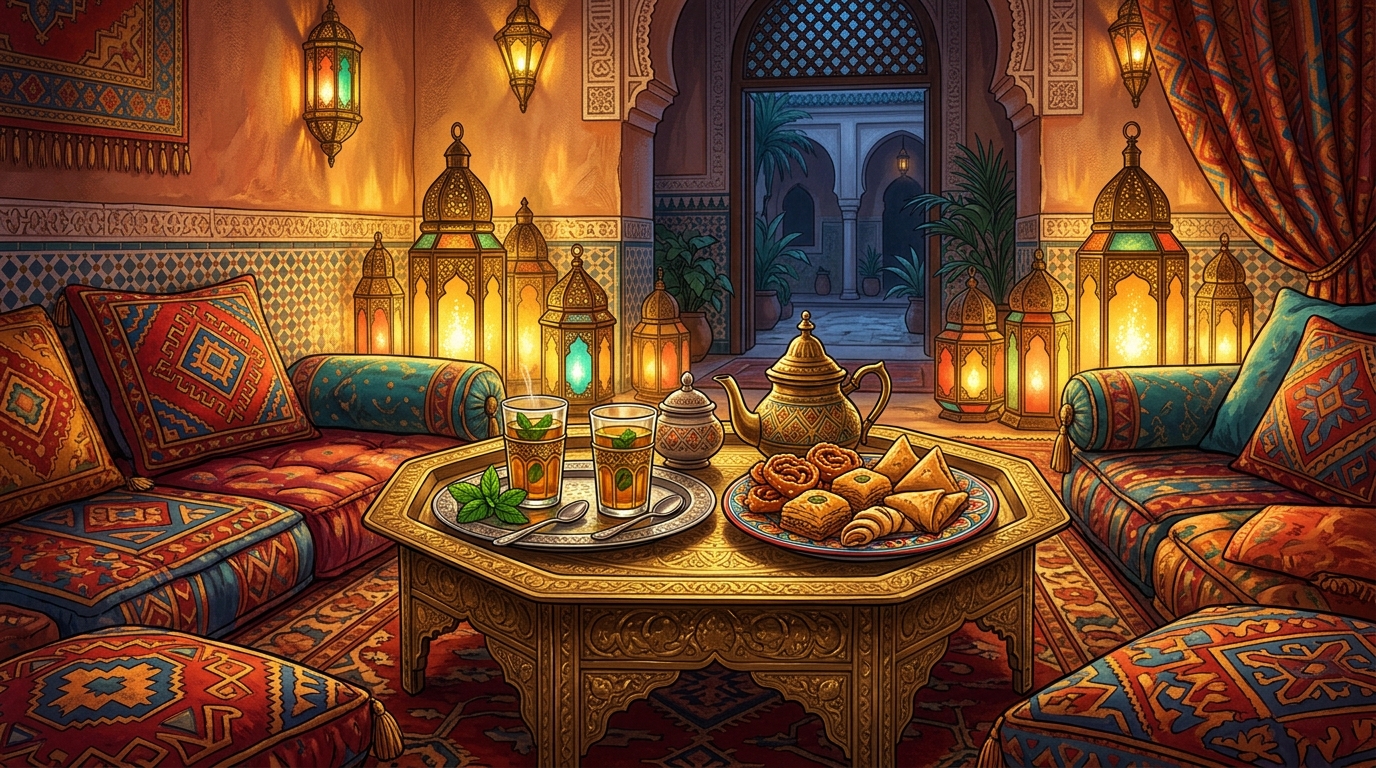
No Moroccan hospitality custom is more visible to outsiders than mint tea. Freshly brewed green tea with mint leaves and sugar, poured from a height into small glasses to create a light foam on top, is the near-universal welcome drink offered to any guest, in homes, shops, and offices alike. Declining it outright can read as a small social rupture; accepting, even a small glass, is the expected response to being welcomed somewhere.
Tradition holds that tea should be served and, ideally, drunk across three rounds, sometimes summarized in a well-known saying about the three glasses: the first as gentle as life, the second as strong as love, and the third as bitter as death — a poetic way of describing how the same leaves, steeped repeatedly, change character glass by glass. Etiquette around refusing more is gentler than it might seem: a polite decline of a second or third glass is generally acceptable, but flatly refusing the first pour, especially in someone's home, is considered impolite.
Pouring itself is part of the performance — tea is poured from a raised teapot, sometimes quite high above the glass, both to aerate it and as a small display of skill, and it is common for the host, or the youngest member of the household, to handle the pouring for guests throughout the visit rather than leaving guests to serve themselves.

Arriving as a guest: gifts, shoes, and greetings
If you are invited to a Moroccan home, arriving empty-handed is generally avoided; a small gift is customary, and the safest, most appreciated choices are simple: pastries, dates, a box of good tea, or fruit. Elaborate or expensive gifts are not expected and can even feel awkward — the gesture of bringing something matters more than its value.
At the door, it is standard to remove your shoes before entering the main living areas, especially where carpets or cushions cover the floor; hosts will often provide indoor slippers, or going in socks or barefoot is entirely acceptable. Greetings tend to be warm and unhurried — handshakes, and among people who know each other well, a cheek-to-cheek greeting — accompanied by an exchange of pleasantries about health and family that is not rushed through, since taking time to ask after someone properly is itself part of showing respect.
One well-known quirk of Moroccan hospitality worth knowing in advance: openly and repeatedly admiring a specific object in someone's home — a rug, a piece of jewelry, a decorative item — can sometimes prompt a host to insist on giving it to you, following the same generosity-first instinct that governs everything else. Genuine compliments are of course welcome; the custom is simply good to be aware of if you would rather not receive an object you only meant to praise.
At the table: hands, boundaries, and the shared plate
Before a meal, especially a more traditional or family one, a ritual hand-washing often takes place at the table itself: a family member, often one of the younger ones, brings around a kettle of warm water, a basin, and a towel, pouring water over each guest's cupped hands in turn rather than sending guests off to a separate sink. It is a small ceremony, not just a hygiene step, and guests are expected to participate rather than wave it off.
Meals are frequently communal, built around a single large dish — a tagine or a mound of couscous — placed in the center of the table for everyone to share directly, rather than everyone receiving individual plates. Where hands are used instead of cutlery, which is common and normal in more traditional settings, the etiquette is specific: eat only with the right hand, since the left is traditionally reserved for less clean tasks and considered inappropriate for shared food, and confine yourself to the section of the communal dish directly in front of you rather than reaching across to a further part of the plate.
Bread plays its own role at the table, often used instead of a fork to scoop up food or sauce — torn into small pieces with the right hand and used as a practical utensil, which is one reason bread is treated with particular respect in Moroccan households and is rarely thrown away.

The diffa and the deeper logic of "more than enough"
For a special guest, Moroccan hospitality can escalate into a diffa, an elaborate, multi-course feast historically prepared to honor an important visitor, whether in a wealthy household or a modest one stretching its resources for the occasion. A diffa is a striking demonstration of the same underlying principle scaled up: hosting should never feel minimal, and a guest should leave with the clear impression that they were genuinely valued, not simply accommodated.
This logic of deliberate abundance shows up on an everyday scale too. Moroccan hosts will typically prepare noticeably more food than guests could possibly finish, insist repeatedly that guests eat more even after they say they are full, and treat a guest's protest of "I'm satisfied" as an opening remark rather than a final answer. This is not about pressuring guests for its own sake; it reflects real anxiety, on the host's side, about seeming stingy or unwelcoming, which culturally ranks as a far worse outcome than a guest politely declining a third helping.
For a foreign guest, understanding this dynamic changes how the whole interaction reads: repeated offers of more food or tea are not a test of willpower, they are the host visibly performing generosity, and a warm, appreciative decline — rather than a flat one — tends to land far better than simply saying no.
The same instinct shows up at the end of a visit as well. Moroccan farewells are rarely quick: a guest preparing to leave is often walked to the door, sometimes to the street or the car, with a final round of well-wishes, and it is common for a departure to take considerably longer than a first-time visitor expects, simply because ending the visit crisply would feel, to the host, like cutting the hospitality short before it was properly finished.

Frequently asked
What does "dyaf Allah" mean?
Dyaf Allah, or "guests of God," is a Moroccan Arabic phrase and cultural principle holding that a guest — expected or not — should be treated as a gift and welcomed with genuine warmth and generosity, rooted in Islamic and Amazigh traditions of hospitality.
Is it rude to refuse Moroccan mint tea?
Refusing the very first offer of tea, especially in someone's home, is generally considered impolite. Declining a second or third round after that is usually acceptable and not seen as a serious breach of etiquette.
What does the saying about the three glasses of tea mean?
It refers to a traditional description of Moroccan mint tea served across three successive pourings from the same leaves, sometimes summarized poetically as the first glass gentle as life, the second strong as love, and the third bitter as death — a nod to how the flavor changes with each round.
Should I bring a gift when visiting a Moroccan home?
Yes, it's customary to bring a small gift such as pastries, dates, fruit, or good tea rather than arriving empty-handed. The gift does not need to be expensive — the gesture itself is what matters.
Do you take your shoes off in a Moroccan home?
Generally yes, especially before entering carpeted living or dining areas. Hosts often provide indoor slippers, or guests may simply go in socks or barefoot.
Which hand should you eat with in Morocco?
The right hand. The left hand is traditionally considered unclean and reserved for less sanitary tasks, so eating, passing food, and pouring drinks are done with the right hand, especially when sharing a communal dish.
What are the rules for eating from a shared tagine or couscous dish?
Diners generally eat only from the section of the communal dish directly in front of them rather than reaching across to another part of the plate, unless a host specifically offers a piece from elsewhere, such as a choice cut of meat.
What is a diffa?
A diffa is an elaborate, multi-course feast traditionally prepared in Morocco to honor an important guest, served in both wealthy households and modest homes stretching their means for the occasion. It represents Moroccan hospitality's emphasis on generous, abundant welcome.
Why do Moroccan hosts keep insisting I eat more?
Preparing and offering more food than a guest can finish, and pressing guests to keep eating even after they say they're full, reflects a cultural anxiety about appearing insufficiently generous — considered a worse outcome than a guest politely declining more food.
Is it true that admiring an object in a Moroccan home can lead to being given it?
It can happen. Repeatedly and openly admiring a specific item, such as a rug or piece of jewelry, sometimes prompts a host to offer it as a gift, following the same instinct toward generosity that shapes the rest of Moroccan hospitality — worth knowing if you'd rather just compliment something.
- Daily Darija — Moroccan Hospitality: The Art of Welcoming Guests ↗
- Marrakeche — Complete Guide to the Moroccan Tea Ceremony ↗
- Riadma Travel Blog — Moroccan Traditions and Etiquette: What Tourists Need to Know ↗
- Gateway2Morocco — Understanding Moroccan Hospitality: What Every North American Visitor Should Know ↗
- Roaming Camels Morocco — Moroccan Tea Culture: Traditions, Rituals, and Heritage ↗
- Arab America — Moroccan Diffa: The Mother of All Feasts ↗
Video via official YouTube embeds; photos via Wikimedia Commons under their stated licenses. All rights belong to the respective owners; 212 Daily claims no ownership.