Moroccan Festivals: A Complete Guide to the Kingdom's Celebrations
A Calendar Full of Celebration
Morocco's festival calendar is one of the richest in the Arab and African worlds, a tapestry woven from three great threads: the Islamic religious year, the deep-rooted Amazigh and rural traditions of the land, and a flourishing contemporary culture of music, film, and arts festivals. Across the seasons, the country moves from solemn fasting to riotous music, from ancient pilgrimages to glittering international events.
Many of these celebrations follow the Islamic lunar calendar, which is about eleven days shorter than the Gregorian year, so their dates shift earlier each year. Others are tied to the agricultural seasons, the harvest of roses, dates, or almonds, or to fixed cultural festivals scheduled for the tourist-friendly months of late spring and summer. Understanding this rhythm helps travelers time their visits to coincide with the experiences they most want.
What unites Moroccan festivals is their communal spirit. Whether religious or secular, they are occasions for gathering, hospitality, and the affirmation of shared identity. Food, music, dress, and ritual all come together, and visitors who happen upon a festival often describe it as the highlight of their trip, a window into the living heart of Moroccan culture rather than its tourist surface.
Ramadan: The Sacred Month
The most significant period in the Moroccan year is Ramadan, the holy month during which Muslims fast from dawn to sunset. Far more than abstaining from food and drink, Ramadan is a time of spiritual reflection, increased prayer, charity, and family togetherness. The rhythm of daily life transforms: streets quiet during the day, then surge with energy after the breaking of the fast.
The daily fast is broken at sunset with the iftar, traditionally beginning with dates and milk or water, followed by the warming bowl of harira soup, chebakia (sticky sesame-and-honey pastries), boiled eggs, and an array of breads and sweets. The evening meal becomes a feast, and families and neighbors share generously. Later, many head to mosques for the special nightly taraweeh prayers, and cafes and streets stay lively well into the small hours.
For visitors, Ramadan offers a unique window into Moroccan devotion and hospitality, though it requires sensitivity. Many restaurants close during daylight hours, the pace of business slows, and eating or drinking openly in public during the fast is considered disrespectful. The reward for those who adapt is to witness, and often to be invited into, the extraordinary warmth of the iftar table, where strangers are welcomed as guests.
Eid al-Fitr and Eid al-Adha
Ramadan culminates in Eid al-Fitr, the joyful 'festival of breaking the fast,' a time of new clothes, special sweets, family visits, and charity to the poor. Morning prayers fill the mosques and open-air grounds, and the days that follow are devoted to feasting and visiting relatives. It is one of the most beloved holidays of the year, charged with relief and celebration after a month of discipline.
Roughly two months later comes Eid al-Adha, the 'festival of sacrifice,' which Moroccans often call simply Eid el-Kebir, the great feast. It commemorates the Prophet Ibrahim's (Abraham's) willingness to sacrifice his son in obedience to God. Families who can afford to do so purchase a sheep, which is ritually slaughtered, with portions shared among relatives, neighbors, and the needy, reflecting the holiday's themes of devotion, sacrifice, and generosity.
In the weeks before Eid al-Adha, the country fills with livestock markets and the bleating of sheep in courtyards and on rooftops. The holiday is intensely family-centered, and cities can empty as people return to their hometowns. For Moroccans abroad, these Eids are powerful anchors of identity, and back home they are perhaps the truest expression of the country's blend of faith, family, and feasting.
Moussems: Saints, Pilgrimage, and Tbourida
Among the most distinctively Moroccan celebrations are the moussems, regional festivals that originated as religious pilgrimages honoring a local saint, or marabout. Held at the saint's shrine, often on an annual cycle tied to the agricultural calendar, a moussem combines devotion with a great fair, drawing crowds for trade, music, feasting, and social gathering. There are hundreds across the country.
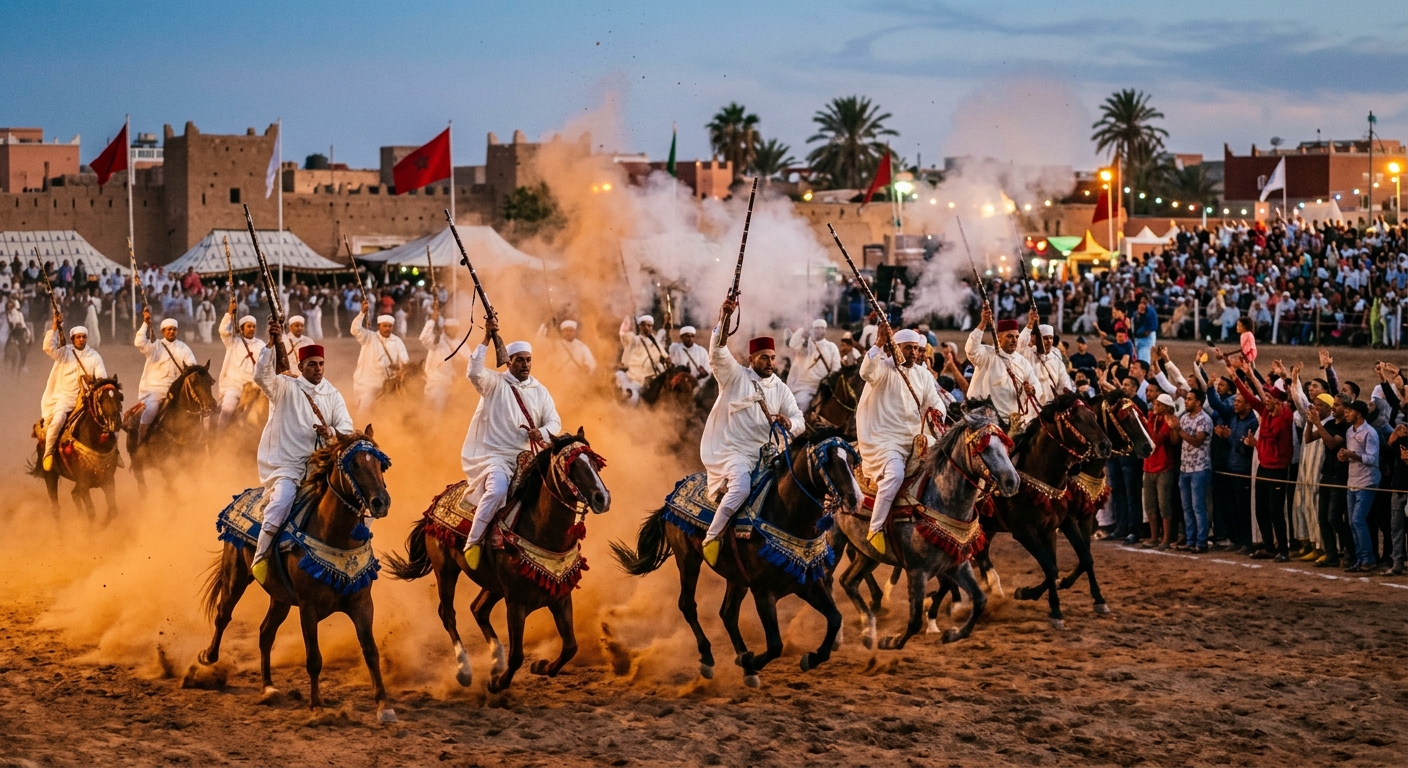
A signature spectacle of many moussems is the tbourida, also known as fantasia, a dramatic equestrian performance rooted in Amazigh and Arab cavalry tradition. Troupes of riders in matching ceremonial dress line up on horseback, then charge together at full gallop before discharging their antique muzzle-loading rifles in a single thunderous, synchronized volley. The sight of the dust, the gunsmoke, and the perfectly timed shot is electrifying, and tbourida has been recognized by UNESCO as intangible cultural heritage.
Some moussems are famous in their own right. The Moussem of Moulay Idriss honors the founder of the first Moroccan Muslim dynasty. The Imilchil Marriage Festival in the High Atlas, tied to a Berber legend of star-crossed lovers, became known as an occasion where families arranged engagements. And the spectacular Tan-Tan Moussem in the south, a vast gathering of nomadic and Saharan tribes, was among the first Moroccan traditions inscribed by UNESCO. Together, the moussems preserve a deeply rooted rural and spiritual culture.
Harvest and Seasonal Festivals
Morocco's agricultural abundance gives rise to a series of joyful harvest festivals that celebrate the land's gifts. The most famous is the Rose Festival of the Dades Valley, held each spring in and around the town of Kelaat M'Gouna when the Damask roses bloom. The valley fills with the scent of millions of flowers harvested for rosewater and oil, and the festival features parades, music, dancing, and the crowning of a Rose Queen.
In the autumn, the date harvest of the southern oases is celebrated at the Erfoud Date Festival, honoring the fruit that has sustained desert communities for millennia and showcasing the many varieties grown in Morocco's palm groves. In the Souss region, the almond blossom of Tafraout draws visitors to the pink-granite landscape when the trees turn white and pink, and local celebrations mark the season.
These festivals are more than tourist attractions; they are expressions of gratitude and continuity, linking communities to the cycles of the land their ancestors farmed. They also provide vital income and a stage for local music, dance, and crafts. For travelers, timing a visit to a harvest festival offers a chance to experience rural Morocco at its most exuberant and authentic, far from the medina crowds.
Music, Film, and the Modern Festival Boom
In recent decades Morocco has become a powerhouse of contemporary cultural festivals that draw audiences from around the world. The Gnaoua World Music Festival in Essaouira, founded in 1998, has transformed the seaside town each summer into a stage for Gnawa masters and international stars, attracting hundreds of thousands of visitors and showcasing Morocco's Afro-spiritual musical heritage.
The Fes Festival of World Sacred Music is a more contemplative affair, bringing together sacred and spiritual music traditions from across the globe in the atmospheric setting of the ancient imperial city. The Mawazine Festival in Rabat, by contrast, is one of the largest music festivals in the world, featuring major international pop and Arab stars on multiple stages and drawing enormous crowds, with many free concerts.
Beyond music, the Marrakech International Film Festival has put Morocco on the global cinema map, welcoming celebrated directors and actors, while the National Festival of Popular Arts and numerous regional and Amazigh cultural festivals celebrate the country's own artistic traditions. This festival boom reflects modern Morocco's confidence: a nation proud of its deep heritage and eager to share it, while embracing the global cultural stage. Whatever the season, somewhere in the kingdom there is a celebration underway, and visitors are almost always welcome to join the marhaba, the welcome.
| Festival | Type | Approximate Timing | Location |
|---|---|---|---|
| Ramadan and Eid al-Fitr | Religious | Varies (lunar calendar) | Nationwide |
| Eid al-Adha | Religious | Varies (lunar calendar) | Nationwide |
| Rose Festival | Harvest | Spring (May) | Kelaat M'Gouna, Dades Valley |
| Gnaoua World Music Festival | Music | Summer (June) | Essaouira |
| Fes Festival of World Sacred Music | Music | Late spring/early summer | Fez |
| Mawazine Festival | Music | Summer (June) | Rabat |
| Tan-Tan Moussem | Pilgrimage/cultural | Spring | Tan-Tan (south) |
Major Moroccan festivals and when they occur
FAQ
What is a moussem?
A moussem is a traditional Moroccan festival that began as a religious pilgrimage honoring a local saint. Held at the saint's shrine, it combines devotion with a large fair featuring music, feasting, trade, and often equestrian displays called tbourida.
What is tbourida (fantasia)?
Tbourida, also called fantasia, is a traditional Moroccan equestrian performance in which troupes of costumed riders charge at full gallop and fire antique rifles in a single synchronized volley. It is rooted in Amazigh and Arab cavalry tradition and is recognized by UNESCO.
Can tourists visit Morocco during Ramadan?
Yes, but with sensitivity. Many restaurants close during daylight, the pace of life slows, and eating or drinking in public during fasting hours is considered disrespectful. In return, visitors can experience the warmth of the evening iftar and the festive nights.
What is the difference between Eid al-Fitr and Eid al-Adha?
Eid al-Fitr marks the end of Ramadan with feasting, new clothes, and charity. Eid al-Adha, called Eid el-Kebir in Morocco, comes about two months later and commemorates the Prophet Ibrahim's sacrifice, traditionally marked by the sacrifice of a sheep shared with family and the needy.
What is the biggest music festival in Morocco?
The Mawazine Festival in Rabat is one of the largest music festivals in the world, featuring major international and Arab stars across multiple stages, with many free concerts. The Gnaoua World Music Festival in Essaouira is another internationally renowned event.
Loved this? Useful? React below — your feedback helps other readers.