The Red Wave: How Moroccan Fans Took Over the 2026 World Cup — and Why Boston Is Next

The Night Houston Turned Red
It was the strangest of color wars. When Canada and Morocco met at NRG Stadium on July 4 — American Independence Day, of all days — both sets of supporters arrived wearing red. From the upper deck, reporters covering the match admitted it was nearly impossible to tell the two fan bases apart. The maple leaf and the green pentagram star swam together in a single crimson tide, seventy thousand strong under a roof that stayed mercifully closed against a Houston heat advisory.
The fan walks told the story before kickoff did. Hundreds of Canada supporters marched toward the stadium on Saturday morning, following the route that Netherlands, Portugal and Brazil fans had walked before them during Houston's World Cup run. City officials had closed streets around NRG Park in anticipation of thousands of walkers from both camps. Moroccan fans came with their own soundtrack — drums, chants, the rolling call-and-response that has followed this team across three continents.
For an hour, the match itself was tense and cagey. A pedestrian first half, as most match reports put it, gave the Canadian half of the stadium hope that the co-hosts could hang with the 2022 semifinalists. Then, five minutes into the second half, Azzedine Ounahi arrived. The midfielder fired home after Achraf Hakimi's clever pass from a free-kick routine, and the Moroccan sections of NRG Stadium detonated.
Ounahi was not finished. In the 82nd minute he planted a precise finish past Maxime Crepeau to make it 2-0, and the pockets of red that belonged to Morocco suddenly seemed to be everywhere at once — flags dropping from the upper tier, scarves spinning, the familiar cry of Dima Maghrib rolling around the closed roof like thunder in a drum.
The exclamation point came in stoppage time. Brahim Diaz, who has spent this tournament redefining what a Moroccan number ten can be, slipped a pass to substitute Soufiane Rahimi — on since before halftime for the injured Ismael Saibari — and Rahimi finished it off. With that assist, Diaz set a new African record: his fourth of this World Cup, the most ever recorded by an African player at a single tournament.
Three-nil. A second consecutive quarterfinal. And in the concourses afterward, Moroccan fans hugged Canadian fans — many of them neighbors from Montreal and Toronto, some of them literally family — in one of those scenes that only this tournament, on this continent, could produce.
From Casablanca to Fez: A Kingdom in the Streets
Back home, the night belonged to everyone. Within minutes of the final whistle, fans waving Moroccan flags flooded the major streets and squares of Rabat, Casablanca, Tangier, Marrakesh and Fez, chanting Dima Maghrib — Always Morocco — the two words that have become the heartbeat of this generation of supporters.
Car horns played their own percussion down the boulevards of Casablanca. In Rabat, crowds gathered along Avenue Mohammed V as they had after every knockout victory in Qatar four years ago. The scenes were a mirror of December 2022, when Morocco's wins over Belgium, Spain and Portugal turned every city in the kingdom into a single open-air celebration.
The achievement being celebrated is genuinely historic. By beating Canada, Morocco became the first African nation to reach the World Cup quarterfinals in back-to-back tournaments. The 2022 run to the semifinals — the first ever by an African or Arab side — could have been a beautiful one-off. This team has turned it into a standard.
That continuity matters to Moroccan fans in a way that is hard to overstate. The 2022 generation of Bounou, Hakimi, Ziyech and Amrabat announced that Morocco belonged among the elite. The 2026 side, still built around Hakimi and Bounou but now powered by Brahim Diaz, Ounahi and a deep bench, is proving it was not an accident.
And the celebrations no longer stop at the Mediterranean. Morocco has one of the most globally distributed fan bases in world football, with millions of Moroccan-origin supporters living in France, Belgium, Spain and the Netherlands, plus deep-rooted communities in Quebec and a fast-growing one in New England. When the Atlas Lions win, the party is planetary.
Montreal's Bittersweet Night: Cheering Against the Home Team
Nowhere was the emotional arithmetic of this match more complicated than in Montreal. Quebec's metropolis is home to one of the largest Moroccan communities in North America — tens of thousands of families for whom Canada is home and Morocco is the heartbeat. On July 4, those two loyalties met in a round of 16 knockout match, and somebody had to lose.
In Old Montreal, the Moroccan Youth of Montreal organization hosted a watch party at the city's World Cup fan zone, and hundreds showed up draped in red and green. CBC cameras captured what happened when Rahimi's stoppage-time goal sealed it: singing, dancing, chanting — a full Moroccan street celebration transplanted onto Quebec cobblestones.
But the joy came wrapped in genuine tenderness for the losing side. Many of the fans celebrating Morocco's win were also Canada fans on any other night. Some wore half-and-half scarves; others admitted to reporters that they had spent the first half quietly hoping for a draw that could never happen. When your passport says Canada and your grandmother's kitchen says Casablanca, a knockout match between the two is a strange kind of gift.
The Montreal Moroccan community has been one of the loudest engines of Atlas Lions support at this World Cup precisely because of that dual identity. The community filled fan zones during the group stage, organized caravans to matches, and turned the Netherlands shootout victory on June 29 into an all-night celebration along Saint-Laurent Boulevard's Moroccan cafes.
Now, with Canada eliminated, something interesting is happening: Montreal is going all-in on Morocco. For Moroccan-Canadians, the awkward part of the bracket is over. The team that carries their name is four wins from a World Cup, playing a quarterfinal a five-hour drive from their city — and the road trip math is already being done in family group chats across the island.
The Diaspora Wave: Paris, Brussels, Amsterdam — and The Hague's Warning
To understand what is coming to Boston, you have to understand what Moroccan support looks like in Europe. An estimated five million people of Moroccan origin live outside the kingdom, the majority of them in France, Belgium, the Netherlands and Spain. In 2022, every Morocco victory turned the Champs-Elysees in Paris, central Brussels and the streets of Amsterdam and Rotterdam into seas of red and green — celebrations that made global headlines for their scale and their noise.
This tournament has already produced the same energy. When Morocco eliminated the Netherlands on penalties on June 29 — a result with its own layered meaning, given that the Dutch-Moroccan community is one of Europe's largest — jubilant scenes broke out across the Netherlands' Moroccan neighborhoods. In The Hague, Euronews reported, the celebrations were later overshadowed by clashes with police, a reminder of how combustible the mix of joy, crowds and midnight streets can be.
The overwhelming majority of these gatherings, it must be said, are festivals rather than flashpoints: families with children on shoulders, fireworks, flag-draped scooters, and the darbouka drums that turn any intersection into a wedding. City authorities across Europe have learned to plan for Morocco match nights the way they plan for national holidays.
For the diaspora in France, the coming quarterfinal carries a particular electricity. France is home to the largest Moroccan community in the world outside Morocco itself. Hundreds of thousands of French-Moroccans grew up supporting both Les Bleus and the Atlas Lions — and in December 2022, when the two nations met in a World Cup semifinal for the first time, that dual identity became the biggest story in French society for a week.
That match ended 2-0 to France, and the dream of a first African finalist died in Al Khor. What did not die was the sense that the fixture had become something bigger than football: a mirror held up to millions of binational lives. On July 9 in Foxborough, the mirror comes out again — this time on American soil, with a semifinal place on the line and a Moroccan team that believes it is better than the one that came so close.
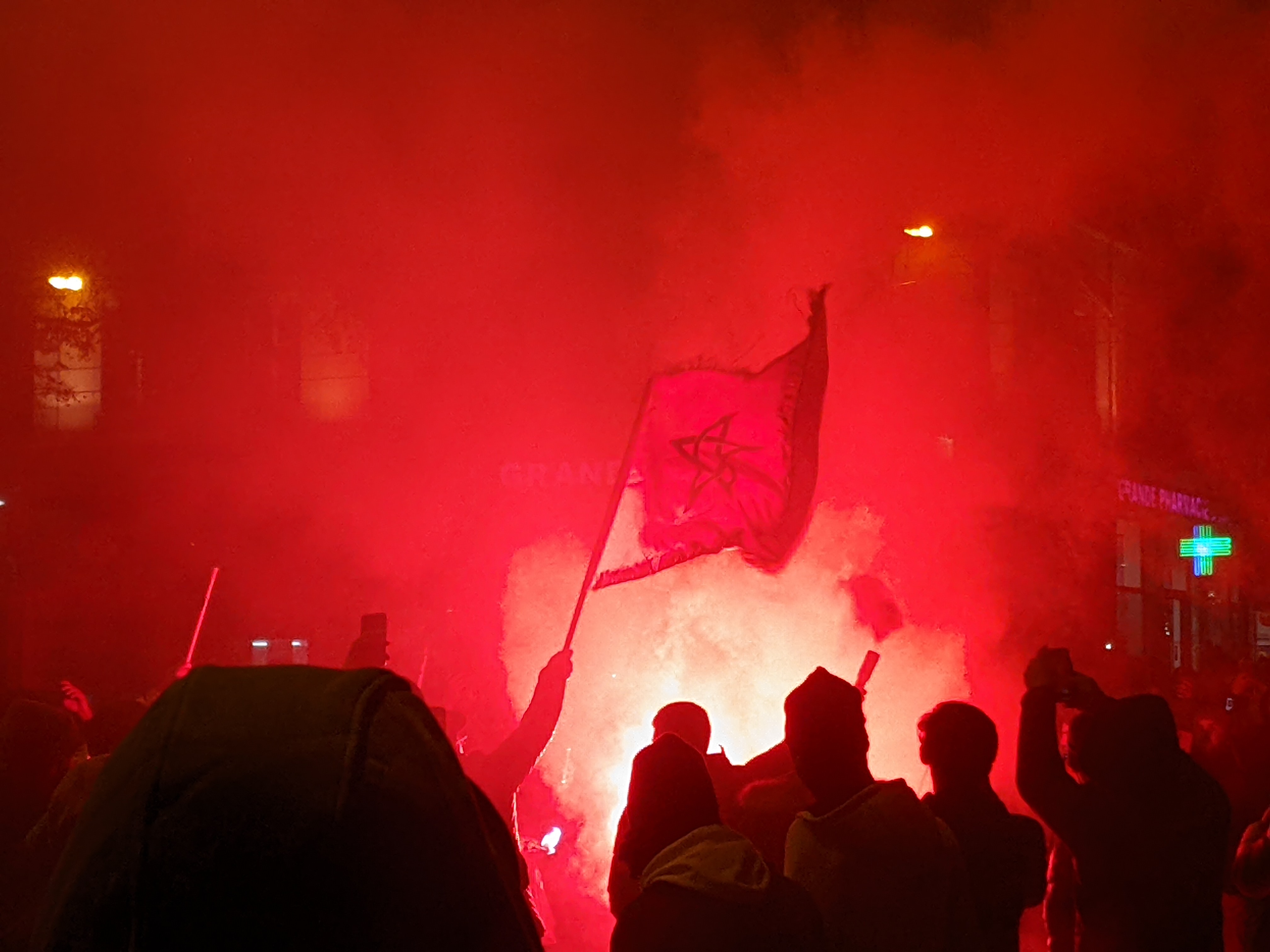
Next Stop Foxborough: The Biggest Match New England Has Ever Hosted
The destination is set. Morocco versus France, World Cup quarterfinal, Thursday, July 9, kickoff at 4:00 p.m. Eastern, at Gillette Stadium in Foxborough, Massachusetts — the venue FIFA calls Boston Stadium for the tournament. Capacity for soccer: 65,878. It is one of only four quarterfinals played across North America, and by broad agreement the most prestigious soccer match New England has ever staged.
France booked its place hours after Morocco's win, grinding past Paraguay 1-0 in Philadelphia thanks to a Kylian Mbappe penalty — his seventh goal of the tournament, a tally that has him leading the Golden Boot race and arriving in Foxborough as the most dangerous player left in the bracket.
The stakes could hardly be cleaner. The winner advances to a World Cup semifinal. For France, it is the expected next step for a squad chasing a third title in four tournaments. For Morocco, it is the chance to avenge the 2022 semifinal, reach a second semifinal in consecutive World Cups, and keep alive the possibility that an African nation lifts the trophy for the first time.
Gillette Stadium has spent the group stage and early knockouts hosting seven World Cup matches, and the region has steadily caught tournament fever — official fan fests, municipal watch parties, and crowds that surprised even organizers. But nothing on the Foxborough calendar has approached what July 9 will bring: the world's most-watched sporting event, two of its most passionate fan bases, and a fixture with genuine geopolitical texture.
And if 2022 taught the footballing world anything, it is this: whatever the official ticket allocation says, Morocco matches have a way of becoming Morocco home games. Doha was supposed to be neutral. It sounded like Casablanca. Foxborough should prepare for the same acoustics.
Tickets, Demand, and the Road to Foxborough
The ticket market for this quarterfinal was always going to be brutal, and the Morocco-France pairing has poured gasoline on it. FIFA's major ticket lotteries — the Visa presale, the early ticket draw and the post-draw random selection draw — concluded months ago. Since April 1, the last-minute sales phase has been the only official channel, operating strictly first-come, first-served through FIFA's platform with immediate confirmation.
FIFA has used variable, demand-driven pricing throughout this tournament, which means quarterfinal seats were already among the most expensive tickets of the entire World Cup before the bracket delivered a rematch of the most emotionally charged semifinal of 2022. Fans hunting official inventory are refreshing FIFA's ticketing portal for returns and late releases, which historically appear in small batches right up to match week.
The resale market tells its own story. Verified resale platforms listed quarterfinal seats at Gillette Stadium at steep premiums even before the round of 16 concluded, and prices moved again once Morocco and France both advanced. Buyers should treat anything outside FIFA's official resale platform with caution: the tournament has been accompanied by a wave of counterfeit ticket schemes in every host city.
For the Moroccan diaspora, though, price has rarely been the deciding factor — presence has. In 2022, Moroccan fans flew from Europe and Canada to Qatar on hours' notice, with Royal Air Maroc adding special flights for the semifinal. The 2026 edition is in some ways easier: no visas for the Americans and Canadians among the diaspora, a drivable distance from Montreal, and a direct flight corridor from Paris to Boston.
Those without tickets are not staying home. The pattern from Houston, Philadelphia and the group stage is that Moroccan fans travel to the host city anyway — for the fan walks, the fan fests, the cafes, and the simple need to be near it. Expect the Moroccan presence in greater Boston on July 9 to be several times larger than the number of green-and-red seats inside Gillette.
First, the geography lesson every traveling fan learns quickly: Gillette Stadium is not in Boston. It sits in Foxborough, roughly 22 miles southwest of downtown, wedged along Route 1 between Boston and Providence, Rhode Island. On a normal day it is a 35 to 45 minute drive from the city; on a World Cup quarterfinal day, it will be nothing of the sort.
For big events, the MBTA commuter rail has traditionally run special event service from Boston's South Station directly to Foxboro Station at Patriot Place, steps from the stadium — the same setup used for Patriots games and stadium concerts. Fans should check the MBTA and Gillette Stadium event pages for the World Cup service schedule and buy rail tickets in advance, because event trains sell out for far smaller occasions than this.
Driving remains the default for many, and Gillette's vast parking lots are part of its match-day culture — but parking passes for World Cup matches have been sold in advance, and Route 1 congestion before a 4:00 p.m. kickoff on a Thursday will collide with Boston-area rush hour on both ends. Fans coming from Montreal — and there will be many — face a five-to-six-hour drive down I-89 and I-93 that Moroccan-Canadian group chats have been mapping since the final whistle in Houston.
Rideshare drop-off zones, shuttle options from Providence, and park-and-ride schemes have all been part of Gillette's World Cup operations through the earlier rounds. The stadium's own event page for the quarterfinal is the single best source of truth for what is running on July 9.
The smartest play, veterans of the earlier Foxborough matches say, is to arrive absurdly early and make a day of it. Patriot Place, the retail and restaurant complex surrounding the stadium, becomes an informal fan zone hours before kickoff — and if Moroccan fans follow the script they have written all tournament, the pre-match gathering will be an event in its own right, drums and all.
Where Boston Gathers: Revere, the Common, and a Region Full of Screens
Greater Boston has a Moroccan story of its own, and its capital is Revere. The North Shore city just past East Boston is home to one of New England's largest Moroccan communities, centered on Shirley Avenue — a street of Moroccan cafes, halal markets and bakeries that has doubled as a fan zone all tournament. When Morocco played its group-stage match at Gillette Stadium, Boston 25 News reported on the community rallying around a Shirley Avenue watch party for everyone who could not get a ticket.
Expect Shirley Avenue to be the emotional center of gravity again on July 9. Community watch parties in Revere have drawn crowds throughout Morocco's run, with mint tea alongside the vuvuzelas and multiple generations packed in front of outdoor screens. For a 4:00 p.m. kickoff, the street will be loud long before the anthems.
Downtown, Boston's official World Cup Fan Fest has been the tournament's flagship gathering point — though it has already produced one perfect Moroccan moment. When the Fan Fest was forced to close due to weather during an earlier Morocco match, CBS Boston reported that Moroccan fans simply refused to go home and rallied on Boston Common instead, turning the oldest public park in America into an impromptu Marrakesh square.
The watch-party map extends far beyond downtown. Massachusetts cities and towns including Brockton, Everett, Quincy, Worcester and Cambridge have hosted official World Cup watch parties with big outdoor screens, local food vendors and community programming — a deliberate nod to the region's diversity, and several of those cities have significant North African and Arab communities of their own.
Add the sports bars of Allston and Somerville, the shisha lounges that have adopted match-day hours, and the student population that makes Boston one of America's most international cities every fall, and you have a metropolitan area with no shortage of places to lose your voice on Thursday afternoon. The only real question is whether any of them will out-sing Shirley Avenue.
The 2022 Blueprint: How the Atlas Lions' Fans Take Over a Stadium
There is a specific sound that television microphones picked up in Qatar in 2022 whenever Morocco played: a low, continuous roar that swelled into whistles whenever the opponent touched the ball, and exploded into song the moment Morocco won it back. Opposing players described it as playing inside a drum. That sound is coming to Foxborough.
The Moroccan stadium takeover is by now a documented phenomenon. In Qatar, Morocco's matches against Belgium, Spain, Portugal and France drew tens of thousands of Moroccan fans — some ticketed, many not — who made a tournament held 6,000 kilometers from Casablanca feel like a home World Cup. The 2026 edition has repeated the trick across North America, with Moroccan sections out-singing numerically larger fan bases in every round.
The repertoire is part of the spectacle. There is the national anthem, sung a cappella at a volume that has repeatedly gone viral. There are the bouncing chants borrowed from the ultra culture of Casablanca and Rabat's football terraces. There is Dima Maghrib — Always Morocco — the simplest and most portable chant of all. And there is the sonic weaponry: darbouka drums, whistles deployed with tactical precision, and the ululations that ripple through the crowd after every goal.
The visual language matters just as much. Moroccan crowds turn stands into flags — literal blocks of red punctuated by the green pentagram star, flags of every size from hand-held to housing-block. Fans bring the zellige-patterned scarves, the Amazigh flags that honor the country's Berber heritage, and jerseys spanning four decades of Atlas Lions history.
What makes it feel different from most modern fan cultures is who shows up. Morocco's traveling support is families: fathers with sons, grandmothers in the front rows, women leading chants — a demographic breadth that turned heads in Qatar and has done so again across the United States and Canada this summer. It is a national diaspora deciding, collectively, that wherever the team plays is home soil.


Tifos and Terraces: The Casablanca Art Form Behind the Curtain of Red
The choreography Moroccan fans bring to World Cup stands did not appear from nowhere. It was forged in the curvas of the Botola, Morocco's domestic league, where the ultra groups of Raja Casablanca, Wydad Casablanca and the clubs of Rabat and Tangier have spent two decades producing some of the most spectacular tifo displays anywhere in world football.
A tifo — the giant coordinated visual display unveiled by a stand at kickoff — is a logistical art form: thousands of colored panels, banners the size of apartment buildings, weeks of secret preparation. Raja's ultras in particular have built a global reputation, with their displays at the Stade Mohammed V regularly featured in international roundups of the world's best fan choreography.
That domestic culture is the engine of the national team's support. The chants that fill World Cup stadiums are Botola chants with the club names swapped out. The drum patterns, the capo-led call-and-response, the whistling walls — all of it is Casablanca derby culture, exported and unified under one flag.
At this World Cup, organized Moroccan supporter groups have coordinated sections, arranged flag distributions, and led the singing at every venue from the group stage onward. FIFA regulations make full stadium-scale tifos harder to stage than in domestic football, but Moroccan sections have improvised with mosaic displays, banner drops and the sheer chromatic force of tens of thousands of red shirts.
For the quarterfinal, the ambition is obvious: make Gillette Stadium look and sound the way Al Thumama and Education City did in 2022 — a Moroccan home fixture that happens to be taking place in Massachusetts. Sixty-five thousand seats, and a diaspora determined to claim as many as possible.

France vs Morocco: The Fixture That Means Everything Twice
No fixture left in this World Cup carries more layered meaning. France and Morocco are bound by a century of colonial history, six decades of migration, and millions of lives lived across both identities. When they met in the 2022 semifinal, it was the first World Cup match ever played between the two nations — and it stopped both countries cold.
France won that night in Al Khor, 2-0, goals from Theo Hernandez and Randal Kolo Muani ending the greatest run an African team had ever produced. But the enduring images were in the stands and on the streets: Moroccan and French fans mixed together, families split down the middle, and celebrations on both sides that spoke to how intertwined the two footballing nations have become.
For French-Moroccans — the largest Moroccan community outside the kingdom — the rematch reopens the sweetest dilemma in sport. Many grew up idolizing Zidane and Mbappe while spending summers in Agadir and Oujda. Some of Morocco's own squad were born and trained in France; the Atlas Lions have long drawn on binational players who chose the country of their parents. Every France-Morocco match is, in part, a family reunion with a scoreline.
The footballing subplot is delicious on its own. Morocco has grown since 2022: Brahim Diaz's record-breaking creativity, Ounahi's arrival as a big-game scorer, and a squad that just beat the Netherlands and dismantled a host nation without conceding. France, meanwhile, has Mbappe in Golden Boot form and the tournament's most ruthless knockout pedigree.
In Paris, Brussels and Amsterdam, the buildup will consume the week. In Casablanca, giant screens will go up in the squares. And in a quiet corner of Massachusetts, a stadium built for American football is about to host the kind of match that gets talked about for generations — with a red wave already forming on the horizon.
Five Days to Kickoff: What Happens Now
The countdown has started. Between now and Thursday afternoon, the machinery of a Moroccan World Cup mobilization will hum: flight searches from Paris, Brussels and Casablanca to Boston; carpools organizing out of Montreal, Ottawa and New York; ticket refresh marathons on FIFA's last-minute sales portal; and watch-party logistics from Shirley Avenue to Old Montreal.
The team, for its part, arrives in form and largely intact. The main injury concern from Houston is Ismael Saibari, whose first-half exit against Canada forced the substitution that ultimately produced Rahimi's goal. Morocco's staff will manage those minutes carefully with a semifinal spot four days of preparation away.
History offers the fans two anchors. The first: Morocco has already beaten European giants in consecutive World Cups — Belgium, Spain and Portugal in 2022; the Netherlands in 2026. The second: the only team to stop them in a knockout round since 2022 is the one waiting in Foxborough. Revenge narratives do not come cleaner.
Whatever happens on the pitch, the stands and the streets have already delivered their verdict on this World Cup: the Moroccan diaspora is its defining fan story, as it was in Qatar. A community stretched across four continents keeps turning stadiums into home grounds and city squares into celebrations — win, and the party runs from Foxborough to Fez.
Dima Maghrib. Always Morocco. On July 9, the phrase gets its biggest stage yet.
Frequently asked
When and where is the France vs Morocco World Cup quarterfinal?
Thursday, July 9, 2026, at 4:00 p.m. Eastern Time at Gillette Stadium in Foxborough, Massachusetts (called Boston Stadium during the tournament). It is one of only four quarterfinals of the 2026 World Cup.
How many fans will Gillette Stadium hold for the quarterfinal?
Gillette Stadium holds 65,878 fans for World Cup soccer matches. The quarterfinal is widely described as the most prestigious soccer match ever staged in New England.
How did Morocco reach the quarterfinal?
Morocco beat co-hosts Canada 3-0 in the round of 16 at NRG Stadium in Houston on July 4. Azzedine Ounahi scored twice (50th and 82nd minutes) and Soufiane Rahimi added a third in stoppage time, assisted by Brahim Diaz. Earlier, Morocco eliminated the Netherlands on penalties on June 29.
How did France reach the quarterfinal?
France beat Paraguay 1-0 in Philadelphia in the round of 16, with Kylian Mbappe converting a penalty for his seventh goal of the tournament.
Have France and Morocco met at a World Cup before?
Yes. They met in the 2022 semifinal in Qatar, the first World Cup meeting between the two nations. France won 2-0 with goals from Theo Hernandez and Randal Kolo Muani, ending Morocco's historic run as the first African team to reach a World Cup semifinal.
Is Morocco the first African team to reach back-to-back World Cup quarterfinals?
Yes. By beating Canada, Morocco became the first African nation ever to reach the quarterfinals at two consecutive World Cups, following its semifinal run in 2022.
How can I still get tickets for France vs Morocco?
FIFA's ticket lotteries have ended; the last-minute sales phase on FIFA's official ticketing platform is the remaining official channel, first-come, first-served, with occasional returns released up to match week. FIFA's official resale platform is the safest secondary option — beware of counterfeit tickets elsewhere.
How do fans get to Gillette Stadium from Boston?
Gillette Stadium is in Foxborough, about 22 miles southwest of downtown Boston. For major events the MBTA commuter rail runs special event trains from South Station to Foxboro Station at Patriot Place, and driving via Route 1 is common but slow on match days. Check the MBTA and Gillette Stadium event pages for July 9 service.
Where can fans watch the match in the Boston area without a ticket?
Boston's official World Cup Fan Fest, community watch parties in cities such as Brockton, Everett, Quincy, Worcester and Cambridge, and the Moroccan community hub on Shirley Avenue in Revere, which has hosted large watch parties throughout Morocco's run.
Why is Revere, Massachusetts, a center for Morocco fans?
Revere, on Boston's North Shore, is home to one of New England's largest Moroccan communities, centered on Shirley Avenue's Moroccan cafes, markets and bakeries. The community has organized watch parties there for Morocco's World Cup matches at Gillette Stadium.
What does 'Dima Maghrib' mean?
Dima Maghrib means 'Always Morocco' in Moroccan Arabic. It is the signature chant of Atlas Lions supporters, heard in stadiums, street celebrations and diaspora watch parties around the world.
How did Moroccan fans in Montreal react to Morocco beating Canada?
Hundreds gathered at a watch party hosted by the Moroccan Youth of Montreal at the World Cup fan zone in Old Montreal, singing, dancing and chanting after the 3-0 win — a bittersweet night for a community with deep ties to both countries, as Montreal is home to one of North America's largest Moroccan communities.
- Al Jazeera — Ounahi fires Morocco into World Cup quarterfinals with 3-0 win over Canada ↗
- Morocco World News — Moroccans celebrate Atlas Lions' qualification to World Cup quarter-finals ↗
- Houston Public Media — Canada, Morocco fans pour into Houston for the city's final World Cup match ↗
- Boston 25 News — Moroccan fans rallying at North Shore watch party for World Cup match at Boston Stadium ↗
- CBS Boston — Official World Cup watch parties scheduled in Massachusetts cities and towns ↗
- Gillette Stadium — 2026 World Cup quarterfinal event page ↗
Video via official YouTube embeds; photos via Wikimedia Commons under their stated licenses. All rights belong to the respective owners; 212 Daily claims no ownership.