Moroccan Cuisine: How the Flavors of the Maghreb Conquered the World
A Cuisine Born From Many Worlds
Moroccan cuisine, or what locals simply call l'makla, is not the invention of any single people. It is a slow accumulation of cultures layered over more than two thousand years. At its foundation sit the Amazigh (Berber) communities, the indigenous peoples of North Africa, who domesticated grains, herded sheep and goats, and developed the one-pot cooking methods that survive today in the tagine and the communal couscous bowl.
Successive waves of newcomers added their own signatures. Arab dynasties arriving from the seventh century onward brought spices from the East, the technique of layering sweet and savory, and refined court dishes. The fall of Muslim Spain pushed thousands of Andalusian Muslims and Jews into Moroccan cities such as Fez, Tetouan, and Rabat, carrying citrus, olives, almonds, and elaborate pastry-making. Later, French and Spanish colonial presence and centuries of trans-Saharan trade added still more ingredients and habits.
The result is a cuisine of remarkable depth, where a single dish can tell the story of three continents. A lamb tagine sweetened with prunes and dusted with cinnamon and sesame seeds is, in a sense, a small edible museum: the meat from Amazigh herding, the dried fruit and sweet-savory balance from Persian and Arab influence, and the slow clay-pot cooking from the mountains. Few national cuisines wear their history so openly on the plate.
The Tagine and the Art of Slow Cooking
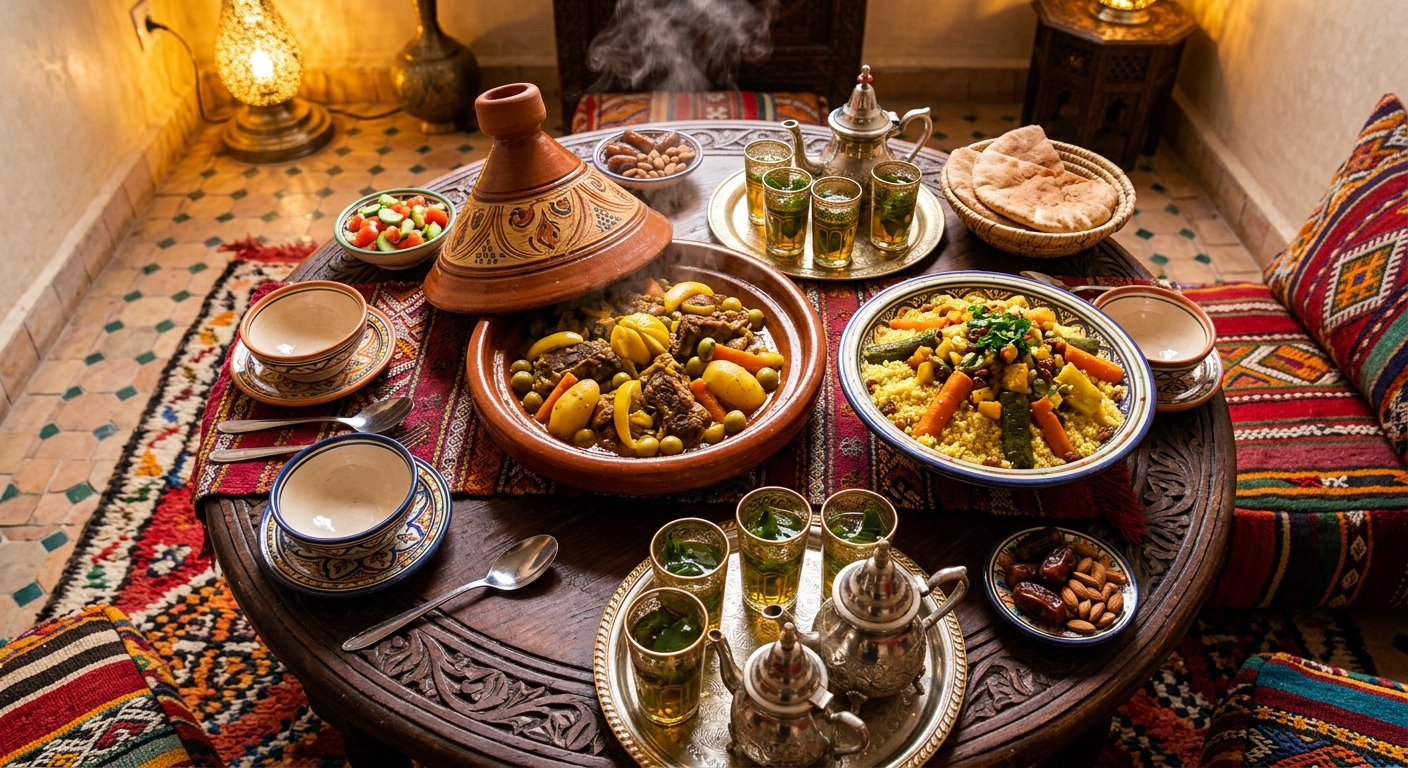
No object is more closely associated with Morocco than the tagine, the conical earthenware vessel that gives its name to the dishes cooked inside it. The design is deceptively clever. The tall cone traps rising steam, condenses it on the cool upper walls, and returns the moisture to the food below. This lets cooks braise tough cuts of meat and dense vegetables over a low charcoal brazier, or mejmar, for hours using very little water, a vital advantage in a country where fuel and water were historically precious.
A tagine is as much a method as a dish. Cooks build flavor in layers: a base of sliced onions, a glistening pour of olive oil, then meat, then vegetables arranged in a dome, and finally a careful scattering of spices, fresh herbs, and sometimes preserved lemon or olives. The lid goes on, the heat stays gentle, and the cook waits. The patience is the point. Rushing a tagine is, to many Moroccan home cooks, a small culinary sin.
Regional variations are endless. In the coastal towns, fish tagines glow with charmoula, a marinade of cilantro, garlic, cumin, and paprika. In the south, tagines lean sweeter, marrying chicken with caramelized onions and honey. In the Atlas Mountains, simple tagines of seasonal vegetables and a little smen (aged clarified butter) feed entire households. The dish bends to whatever the land and the season provide.
Couscous: The Friday Ritual
If the tagine is Morocco's most famous dish abroad, couscous is its most sacred at home. Across much of the country, Friday, the holy day, means couscous shared after midday prayers. Families gather around a single large platter, eating from a communal mound of fluffy semolina crowned with vegetables, chickpeas, and tender meat, often lamb or chicken, all moistened with a fragrant broth.
Authentic couscous is laborious. The tiny grains of semolina are rolled by hand, then steamed repeatedly in a couscoussier, the cook lifting and fluffing the grains between each steaming so they stay light and separate. This back-and-forth can take well over an hour. Many older women still judge a household by the quality of its couscous, and the skill is passed down from mother to daughter as a marker of competence and care.
Couscous also carries deep social meaning. It is the dish of generosity, served at weddings, funerals, religious holidays, and to welcome guests. To be invited to share couscous from the same plate is to be treated as family. In 2020, UNESCO inscribed couscous on its list of Intangible Cultural Heritage, recognized jointly by Morocco, Algeria, Tunisia, and Mauritania, a rare moment of culinary diplomacy across the Maghreb.
Spices, Ras el Hanout, and the Souk
Walk into any Moroccan souk and the spice stalls announce themselves long before you see them: towering pyramids of red paprika, ochre cumin, golden turmeric, and the deep crimson threads of saffron. Spice is the soul of Moroccan cooking, used not merely for heat but for fragrance, color, and the careful balancing of warm and cool, sweet and sharp.
The crown jewel of the spice cabinet is ras el hanout, an Arabic phrase meaning roughly 'head of the shop,' a blend that traditionally represented the best a merchant had to offer. There is no single recipe. A good ras el hanout can contain a dozen to thirty-plus ingredients, including cinnamon, cardamom, cloves, nutmeg, dried rose petals, and rarer additions. Each spice merchant guards his own formula, and families often have a preferred stall they have patronized for generations.
Beyond the dry spices, Moroccan kitchens rely on a quartet of preserved flavor bombs: preserved lemons cured in salt until soft and intensely tangy; smen, the funky aged butter that adds umami depth; harissa, the fiery chili paste; and fresh herbs, especially cilantro and flat-leaf parsley, used in generous fistfuls. Together they give Moroccan food its distinctive layered, never one-note character.
Street Food, Bread, and the Everyday Table
Beyond the celebrated feast dishes lies a humbler, equally beloved everyday cuisine. Bread, or khobz, is the true staple, eaten at nearly every meal and used as both food and utensil to scoop up sauces and stews. In many neighborhoods, families still carry their shaped dough to a communal wood-fired oven, the ferran, where the baker bakes each household's loaves and knows them by sight.
Morocco's street food culture is vibrant and democratic. In Marrakech's Jemaa el-Fna square, night falls and the food stalls erupt: bowls of harira, the hearty tomato-lentil-chickpea soup that breaks the fast during Ramadan; grilled merguez sausages; snails simmered in a spiced broth called babbouche; and msemen, the flaky square pancakes folded layer upon layer and served with honey or amlou, a rich almond-argan butter.
Breakfast deserves its own mention. A typical morning spread might include msemen and baghrir (the spongy 'thousand-hole' pancake), olive oil, argan oil, fresh cheese, olives, jam, and of course glasses of mint tea or strong coffee. These dishes rarely make international headlines, yet they form the warm, daily reality of Moroccan eating, the food people actually live on.
Mint Tea: More Than a Drink
No discussion of Moroccan food culture is complete without atay, the sweet green mint tea poured throughout the day. Made from Chinese gunpowder green tea, fresh spearmint, and a generous, often startling amount of sugar, it is the universal gesture of hospitality. Refusing a glass can be read as a small rejection of friendship.
The preparation is a performance. The host pours the tea from high above the glass, a foot or more, creating a frothy crown on the surface and aerating the brew. The first pour is often returned to the pot; tradition holds that the tea is served in three rounds, each tasting slightly different, captured in a well-known Maghrebi saying comparing the three glasses to life, love, and death, gentle, strong, and bittersweet.
Tea binds the social fabric. Business is negotiated over it, guests are welcomed with it, and idle afternoons dissolve into it. The ornate silver teapots, slim engraved glasses, and decorated trays are heirlooms in many homes. To drink mint tea in Morocco is to participate in a ritual of patience and generosity that long predates the tea itself.
Going Global: Morocco on the World's Plates
Over the past three decades, Moroccan cuisine has moved from exotic curiosity to global mainstay. Tagines now appear on menus from New York to Tokyo, ras el hanout sits on supermarket shelves in Europe, and argan oil has become a luxury culinary and cosmetic export. Cookbooks by writers such as Paula Wolfert introduced Western audiences to the cuisine's sophistication, while Moroccan-born chefs and the global appetite for plant-forward, spice-driven food accelerated its rise.
Tourism has been a powerful engine. Millions of visitors to Marrakech, Fez, and Essaouira return home craving the flavors they discovered, and cooking classes in riads have become a fixture of the travel experience. Meanwhile, the large Moroccan diaspora in France, Spain, the Netherlands, and Belgium has planted neighborhood restaurants, bakeries, and home kitchens that quietly spread the cuisine across Europe for generations.
Yet the global moment brings questions of authenticity. As restaurants streamline recipes for international palates, purists worry about the loss of slow, hand-rolled, charcoal-cooked tradition. The most encouraging trend is a new generation of Moroccan chefs reclaiming and modernizing their heritage on their own terms, proving that this ancient cuisine still has chapters left to write. Bssaha, as Moroccans say when sharing a meal, to your health.
| Dish | Type | Key Ingredients | Occasion |
|---|---|---|---|
| Tagine | Slow-braised stew | Meat or fish, vegetables, preserved lemon, spices | Everyday and celebrations |
| Couscous | Steamed semolina | Semolina, broth, vegetables, chickpeas, meat | Friday and special gatherings |
| Pastilla | Savory-sweet pie | Pigeon or chicken, almonds, eggs, cinnamon, sugar | Weddings and feasts |
| Harira | Soup | Tomato, lentils, chickpeas, herbs, meat | Ramadan and cold evenings |
| Mint tea (atay) | Beverage | Green tea, spearmint, sugar | All day, hospitality ritual |
Signature Moroccan dishes and their key characteristics
FAQ
What is the national dish of Morocco?
Morocco does not have a single official national dish, but couscous and tagine are widely considered its two most emblematic dishes. Couscous holds special status as the traditional Friday meal shared by families across the country.
Is Moroccan food spicy?
Moroccan cuisine is highly flavorful and aromatic but generally not very hot. It relies on warm, fragrant spices like cumin, cinnamon, and saffron rather than chili heat, though condiments such as harissa can add fire for those who want it.
What is ras el hanout?
Ras el hanout is a complex Moroccan spice blend whose name means 'head of the shop,' implying the best the merchant has to offer. It can contain a dozen to over thirty spices and varies by region, family, and individual merchant.
Why is Moroccan mint tea so important?
Mint tea, or atay, is the central symbol of Moroccan hospitality. Offering and accepting it is a gesture of friendship and respect, and the ritual of pouring it from a height and serving it in three rounds is woven into daily social life.
Has Moroccan cuisine been recognized internationally?
Yes. In 2020 UNESCO inscribed couscous on its list of Intangible Cultural Heritage, recognized jointly by Morocco, Algeria, Tunisia, and Mauritania, reflecting the dish's deep cultural significance across North Africa.
Loved this? Useful? React below — your feedback helps other readers.