Moroccan Crafts and Artisans: Inside the Living Workshops of a Nation
A Nation Built by Hand
Few countries wear their craftsmanship as visibly as Morocco. From the carved cedar ceilings of a Fez madrasa to the geometric tilework of a Marrakech fountain, from the carpet draped over a mountain doorway to the hammered brass lantern glowing in a riad courtyard, the work of human hands is everywhere. Craft in Morocco is not a quaint relic; it is a vast, living economy and a pillar of national identity.
The sector, known in Arabic as the sanaa or in French as artisanat, employs a significant share of the Moroccan workforce and contributes meaningfully to the economy. Behind each object stands a maâlem, a master craftsman, and often an apprentice learning the trade exactly as it has been taught for generations, by watching, imitating, and slowly absorbing skills that resist easy explanation in words.
Historically, these crafts were organized into guilds, the hanta, which regulated quality, training, and prices, and clustered artisans of the same trade together. This is why the medinas of old cities are still divided into specialized quarters, the dyers here, the coppersmiths there, the leatherworkers beyond. To walk a medina is to walk through a centuries-old industrial map written in sound and smell as much as in stone.
Leather and the Tanneries of Fez
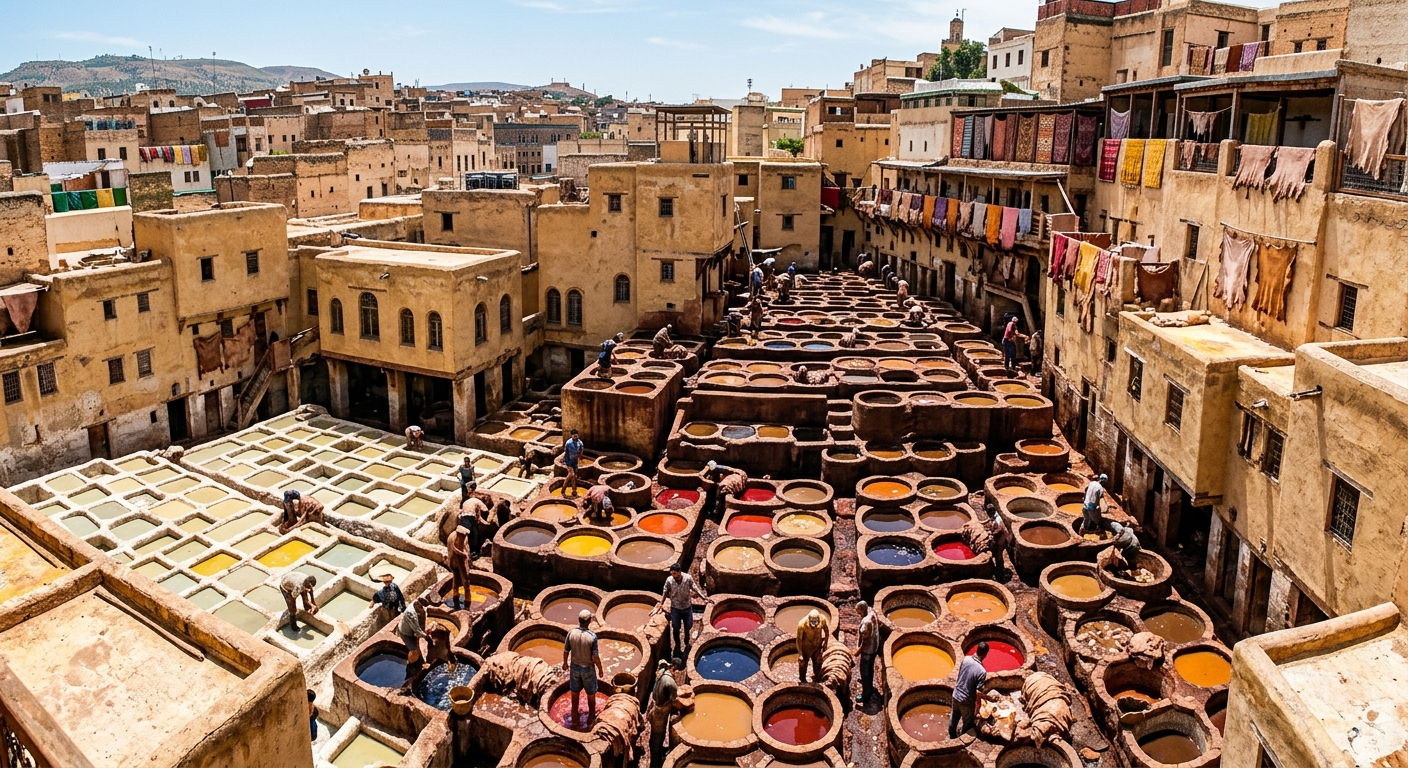
Perhaps no Moroccan craft is as famous, or as visceral, as leather tanning. The Chouara tannery in Fez, in operation for roughly a thousand years, is among the oldest in the world and one of the most photographed scenes in Morocco. From surrounding terraces, visitors look down on a honeycomb of stone vats filled with dyes and tanning solutions in brilliant colors.
The process is ancient and demanding. Raw hides are first soaked in a pungent mixture that includes pigeon droppings and lime to soften them and strip away hair and flesh, the source of the powerful smell that vendors counter by offering visitors sprigs of mint to hold under the nose. Workers then knead and treat the skins in the vats by foot and hand, before they are dyed using natural sources: saffron for yellow, poppy for red, indigo for blue, henna and mint for other shades.
The finished leather becomes babouches (the iconic pointed slippers), bags, poufs, belts, and bookbindings, much of it sold in the surrounding souks. The labor is grueling and the conditions difficult, and the trade is increasingly under pressure from machine production and changing economics. Yet the Fez tanneries endure as a breathtaking testament to the persistence of a craft performed almost exactly as it was a millennium ago.
Zellige: The Mathematics of Beauty
Zellige, the dazzling mosaic tilework that covers Moroccan walls, floors, fountains, and minarets, is among the most intellectually sophisticated of all the country's crafts. Each gleaming surface is composed of thousands of individually hand-cut glazed terracotta pieces, fitted together into intricate geometric patterns that can seem to extend infinitely without ever repeating.
The work begins with enameled tiles fired in kilns. A specialist craftsman, the maâlem, then chisels these into precise small shapes, triangles, stars, polygons, and curves, called furmah, each with its own name. Because Islamic artistic tradition often avoids figurative imagery in sacred and many decorative contexts, Moroccan artisans channeled their genius into geometry and pattern, producing designs of breathtaking complexity rooted in mathematical principles of symmetry and tessellation.
Laying zellige is done face-down: the cut pieces are arranged upside-down according to the design, then plaster is poured over the back to bind the panel together. The result is a perfectly flat mosaic of jewel-like color. The craft reaches its height in places like the Bou Inania and Ben Youssef madrasas and the tombs and palaces of Fez, Meknes, and Marrakech. Today zellige has also captured the global design world, appearing in luxury homes and hotels far beyond Morocco.
Carpets and the Weavers of the Atlas
Moroccan carpets are woven stories. In the villages of the Atlas Mountains and the plains, women have for generations knotted and woven rugs that serve as bedding, blankets, prayer mats, and floor coverings, while also encoding tribal identity, personal experience, and protective symbolism. The loom is traditionally a woman's domain, and weaving knowledge passes from mother to daughter.
Different regions produce distinct styles. The Beni Ourain rugs of the Middle Atlas, thick, cream-colored, with sparse dark geometric lines, have become icons of modern interior design. The vivid, densely patterned Azilal rugs burst with color and improvisation. Boucherouite rugs, woven from recycled fabric scraps, turn poverty into vibrant art. City workshops in Rabat and elsewhere produce more formal, symmetrical carpets influenced by urban and Anatolian traditions.
A single large carpet can take weeks or months to complete, knot by knot, often using hand-spun wool dyed with natural pigments. The patterns are rarely planned on paper; the weaver carries them in memory and improvises, which is why no two genuine rugs are identical. The global market's love of these pieces has brought income to rural women but also raised concerns about fair pay and the flood of cheap machine-made imitations sold to unwary tourists.
Metal, Wood, and Clay
Beyond leather, tile, and textile lies a whole universe of Moroccan craft. In the metalworkers' quarters, coppersmiths and brass workers hammer out trays, teapots, and the pierced lanterns whose punched patterns scatter light across riad walls. The rhythmic clang of hammers on metal is one of the defining sounds of cities like Fez and Marrakech, where the Place Seffarine in Fez has rung with the work of coppersmiths for centuries.
Woodworking is equally refined. Artisans carve fragrant cedar from the Atlas into ceilings, doors, screens, and furniture adorned with intricate arabesques. A specialty of the seaside town of Essaouira is marquetry in fragrant thuya wood, inlaid with mother-of-pearl and contrasting woods to make boxes, tables, and decorative objects. Plasterwork, gebs, carved into lacy patterns, completes the trio of architectural crafts alongside zellige and carved wood.
Pottery and ceramics round out the picture. The blue-and-white pottery of Fez and the multicolored wares of Safi, Morocco's ceramic capital on the Atlantic, are prized at home and abroad. Potters shape tagines, bowls, plates, and decorative pieces on simple wheels, then glaze and fire them, often finishing the finest pieces with hand-painted patterns or even applied zellige-style mosaic. Each region's clay, glazes, and motifs give its pottery a recognizable signature.
Tradition Under Pressure, and the Path Forward
Morocco's craft heritage faces serious modern challenges. Cheap industrial and imported goods undercut handmade work; young people increasingly seek other careers, breaking the chain of apprenticeship; and some traditional materials and methods are environmentally taxing or economically unviable. The risk that certain skills could die with the current generation of maâlems is real and pressing.
Yet there is genuine cause for optimism. The Moroccan state and various organizations have invested in the artisanat sector, promoting it through dedicated ministries, fairs, and quality labels, and recognizing its importance to tourism and exports. Designers and entrepreneurs increasingly collaborate with artisans to create contemporary products that command fair prices, opening new markets while honoring old techniques.
For travelers and buyers, the most meaningful support is informed appreciation: learning to distinguish genuine handwork from machine imitation, paying prices that respect the labor involved, and buying directly from cooperatives and workshops where possible. Behind every authentic Moroccan object is a person, a maâlem and often a lineage, whose knowledge is itself a kind of national treasure. To buy thoughtfully is to help keep that treasure alive.
| Craft | Main Center(s) | Signature Product |
|---|---|---|
| Leather tanning | Fez (Chouara), Marrakech | Babouches, bags, poufs |
| Zellige tilework | Fez, Meknes, Marrakech | Geometric mosaic panels |
| Carpets | Atlas Mountains, Rabat | Beni Ourain, Azilal rugs |
| Metalwork | Fez (Seffarine), Marrakech | Lanterns, trays, teapots |
| Thuya marquetry | Essaouira | Inlaid wooden boxes and tables |
| Pottery | Safi, Fez | Tagines, painted ceramics |
Major Moroccan crafts and their traditional centers
FAQ
Why are the Fez tanneries famous?
The Chouara tannery in Fez is roughly a thousand years old, making it one of the oldest in the world. Its honeycomb of colorful dye vats, where workers treat leather by hand using traditional natural methods, is one of Morocco's most iconic and photographed scenes.
What is zellige?
Zellige is Moroccan mosaic tilework made from thousands of individually hand-cut glazed terracotta pieces assembled into intricate geometric patterns. It decorates walls, fountains, floors, and minarets and reflects the Islamic artistic emphasis on geometry over figurative imagery.
What is a maâlem?
A maâlem is a master craftsman who has achieved expertise in a traditional trade, typically after years of apprenticeship. The title carries great respect, and maâlems are the keepers of techniques passed down through guilds and families for generations.
How can I tell a genuine Moroccan carpet from an imitation?
Genuine handmade carpets have slight irregularities, hand-knotted backs, natural wool and dyes, and no two are identical. Machine-made imitations are perfectly uniform with a printed or glued backing. Buying from cooperatives or reputable workshops helps ensure authenticity.
Where is the center of Moroccan pottery?
The Atlantic city of Safi is considered Morocco's ceramic capital, known for its colorful glazed pottery. Fez is also famous, particularly for its distinctive blue-and-white ceramics.
Loved this? Useful? React below — your feedback helps other readers.