Ouallywood: Inside Ouarzazate, the Desert City That Became Africa's Hollywood
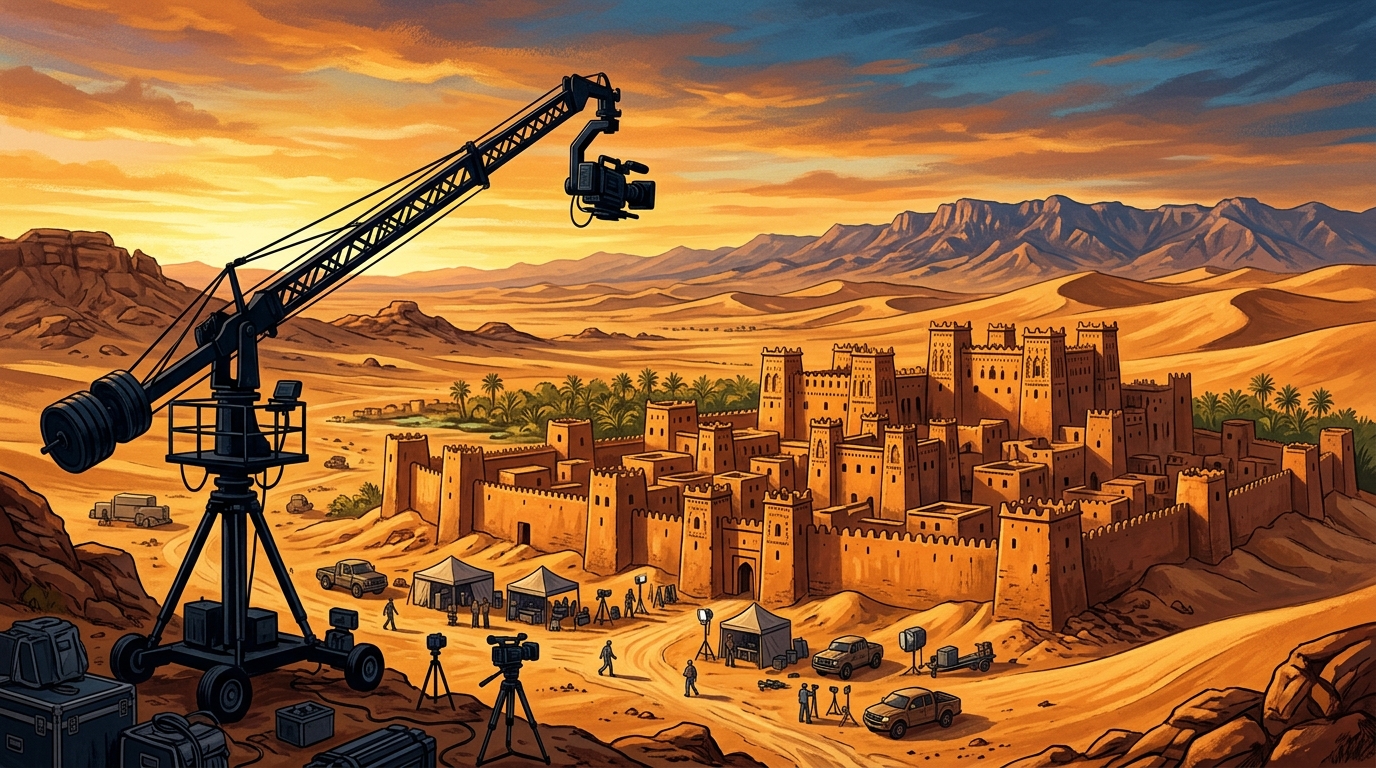
A desert built for cameras
Ouarzazate sits just south of the High Atlas, at the point where the mountains give way to pre-Saharan desert. It is a landscape that seems designed for a camera lens: hard, near-constant sunlight, red-mud kasbahs and ksour rising straight out of the rock, and the fortified village of Ait Benhaddou a short drive away, a UNESCO World Heritage site whose tiered towers have doubled for everywhere from ancient Rome to a fictional continent. Within an hour or two of the town, a production can find rolling dunes, dry riverbeds, palm oases and stark mountain passes, all without crossing a border or clearing customs on a new set of visas. That geographic compression is the whole appeal: a location scout working almost anywhere else on earth would need several countries and several flight itineraries to assemble the settings Ouarzazate offers within a single afternoon's drive, backed by a regional airport a few kilometers from the studios and a workforce that has spent generations building sets and working as extras.
That combination of scenery and light drew filmmakers here long before any studio existed. In the early 1960s, David Lean brought Lawrence of Arabia to the region, using the desert stretches around Ouarzazate, Zagora and Ait Benhaddou to stand in for Arabia itself; Moroccan soldiers were recruited as extras for the film's Tafas massacre sequence. It was one of the earliest demonstrations that this particular stretch of Morocco could pass, convincingly, for almost anywhere in the Middle East or North Africa on screen.
Word spread through the industry the way it always does: crew to crew, producer to producer. Through the 1960s and 1970s, foreign productions kept returning to Ouarzazate for location work even though the town had no permanent soundstages of its own, relying on local kasbahs, hired extras and improvised sets. That steady trickle of business is what eventually convinced a Moroccan entrepreneur that the desert town needed a studio built to stay.

Atlas Studios, CLA Studios, and the birth of Ouallywood
The turning point came in 1983, when Moroccan entrepreneur Mohamed Belghmi founded Atlas Corporation Studios about five kilometers west of Ouarzazate, on the road toward Marrakech. Built to give visiting productions permanent standing sets instead of one-off builds, Atlas Studios grew over the following decades into a sprawling backlot of more than 322,000 square feet, widely cited as one of the largest film studios in the world by land area. Its staff coined the nickname that stuck to the whole town: Ouallywood, a play on Ouarzazate and Hollywood.
Atlas Studios was not the only bet on the town's future. In 2004, a second major facility, CLA Studios, opened nearby, with its own standing sets built in Roman, Egyptian, biblical and Asian styles, including a replica of old Jerusalem. Between them, the two studios gave Ouarzazate something few filming locations anywhere in the world can offer: authentic desert and mountain scenery a few minutes' drive from ready-made ancient-world backlots, backed by local crews who had spent years working international productions.
The résumé is long. Gladiator brought Ridley Scott to the region in 2000, and he returned in 2005 for Kingdom of Heaven. Babel used the Atlas Studios lot for its Moroccan marketplace scenes in 2006. The Mummy franchise shot there, and HBO's Game of Thrones used Ouarzazate and Ait Benhaddou across multiple seasons, with the town standing in for the fictional city of Pentos and the ksar serving as the setting for the fall of Yunkai. Each new production added its sets to the backlot, so today a walk through Atlas Studios doubles as a walk through two decades of blockbuster film history: guided tours take visitors past leftover pharaonic statues, Tibetan monastery facades and Roman colonnades standing side by side in the same stretch of desert, a strange open-air museum of other people's history that now draws its own steady stream of tourists long after the film crews have packed up and left.

The CCM: the regulator behind the curtain
Every foreign shoot in Ouarzazate passes through a Moroccan institution most audiences never hear of: the Centre Cinematographique Marocain, or CCM. It was created in 1944 by a dahir, or royal decree, issued by the then-Sultan Sidi Mohammed, who would later become King Mohammed V — making it one of the oldest public film bodies in the world, founded decades before Morocco's independence in 1956, partly to build a domestic industry that could compete with the Egyptian cinema then dominating Moroccan screens.
The CCM's mandate has barely changed in substance since: it regulates, finances and promotes Moroccan cinema, oversees shooting permits and production logistics for the foreign crews who descend on Ouarzazate and elsewhere, and organizes Morocco's National Film Festival, held annually since 1982. It is, in effect, the quiet administrative machinery that makes Ouallywood function as a business rather than just a backdrop.
Domestic filmmaking has its own, separate history, usually traced to Hamid Benani's Wechma in 1970, regarded as the founding work of modern Moroccan cinema. A first generation of directors built the industry through the 1970s and 1980s; a second wave in the 1990s and 2000s pushed it toward bolder subjects and international festival attention. Nabil Ayouch became one of its best-known names, representing Morocco at the Oscars with Ali Zaoua: Prince of the Streets and, in 2021, becoming the first Moroccan director to compete for the top prize at Cannes with Casablanca Beats. Farida Benlyazid, working since the 1970s as a screenwriter, producer and director, became a defining voice for Moroccan women's stories on screen. This is the part of Morocco's film story that rarely makes the international press releases, precisely because it is not about visiting stars and rented kasbahs — it is a homegrown industry with its own funding rounds, its own award shows and its own generational arguments about what Moroccan cinema should look like, running in parallel to the foreign productions passing through Ouarzazate every year, with the CCM as the institution that keeps both halves connected to the same regulatory backbone.
Marrakech, a festival built for cultural diplomacy
Studios and regulators explain how films get made in Morocco; the Marrakech International Film Festival explains how the country sells itself as a cinema destination. Launched in September 2001, the festival was an initiative of King Mohammed VI, guided by the late French producer Daniel Toscan du Plantier, and was explicitly conceived as a bridge between cultures in the tense weeks following the September 11 attacks that same month. Its first edition paid tribute to French director Claude Lelouch and the Egyptian-born screen icon Omar Sharif.
The festival was placed on a permanent footing the following year, when King Mohammed VI established the Marrakech International Film Festival Foundation and named Prince Moulay Rachid its president. In the years since, it has become one of the most prominent film festivals in the Arab world and on the African continent, drawing international stars to the red carpet in Jemaa el-Fnaa's shadow while also giving space to Moroccan and African filmmakers rarely seen at Cannes or Venice.
Together with the CCM's own National Film Festival, Marrakech gives Morocco a rare double act: a state-run event that nurtures homegrown filmmaking, and a glamorous international showcase that keeps the country's name in front of the global industry every year, reinforcing exactly the kind of relationships that keep foreign productions booking Ouarzazate's studios.
What the cameras leave behind: an economic engine in the south
For a region far from Morocco's coastal economic centers, the film industry is a genuine livelihood. Foreign productions poured more than $100 million into Morocco in 2022 alone, and a single large shoot can move the needle on its own: reporting on Gladiator II, filmed near Ouarzazate with an estimated budget in the region of $200 million, put its likely injection into the local economy at around $30 million. Local residents are hired as extras, drivers, carpenters and set technicians, while hotels, restaurants and taxi services all see business rise whenever a big crew is in town.
The appeal for producers is straightforward economics as much as scenery: shooting in Morocco is estimated to cost roughly half what an equivalent shoot would cost in Western Europe or North America, helped by incentives that include exemption from value-added tax on production costs. The government has kept investing to defend that advantage, launching a roughly 240 million dirham film production complex in Ouarzazate intended to modernize infrastructure and give producers a one-stop service, with officials projecting it will create thousands of further direct and indirect jobs.
None of it is guaranteed to last forever. Ouarzazate has weathered quieter stretches when big-budget productions have chosen Jordan, South Africa or elsewhere instead, and local officials speak openly about the need to keep competing for business. But four decades after Atlas Studios first opened its gates, the combination that built Ouallywood in the first place — reliable desert light, standing sets ready to redress as almost any era, and an institutional backbone running from the CCM to Marrakech's red carpet — still gives Morocco a case few rival filming destinations can match.
Frequently asked
What does "Ouallywood" mean?
Ouallywood is a nickname for Ouarzazate, the southern Moroccan town that has hosted major international film productions since the 1980s. It blends the town's name with Hollywood, and was popularized by staff at Atlas Studios, the largest of the town's two film studios.
When was Atlas Studios founded and by whom?
Atlas Corporation Studios was founded in 1983 by Moroccan entrepreneur Mohamed Belghmi, about five kilometers west of Ouarzazate on the road to Marrakech. It grew into a sprawling backlot with standing sets left over from decades of international productions.
Is Atlas Studios really the largest film studio in the world?
Atlas Studios is widely cited as one of the largest film studios in the world by land area, covering more than 322,000 square feet of desert. Its scale, combined with nearby natural locations like Ait Benhaddou, is a major reason producers keep returning.
What movies and TV shows were filmed in Ouarzazate?
Productions filmed in and around Ouarzazate include Gladiator (2000), Kingdom of Heaven (2005), Babel (2006), entries in The Mummy franchise, and multiple seasons of HBO's Game of Thrones, which used the area to depict the city of Pentos and the fall of Yunkai.
Was Lawrence of Arabia filmed in Morocco?
Parts of Lawrence of Arabia (1962) were filmed in the desert around Ouarzazate, Zagora and Ait Benhaddou, with Moroccan soldiers used as extras in the Tafas massacre scene. This was more than two decades before Atlas Studios was built, showing the region's cinematic pull predated its studio infrastructure.
What is CLA Studios?
CLA Studios is Ouarzazate's second major film studio, opened in 2004. It offers standing sets built in Roman, Egyptian, biblical and Asian styles, including a replica of old Jerusalem, complementing the older Atlas Studios lot nearby.
What is the CCM and what does it do?
The Centre Cinematographique Marocain (CCM) is Morocco's national film authority, created in 1944 by a decree from the future King Mohammed V. It regulates and finances Moroccan cinema, issues shooting permits for foreign productions, and organizes Morocco's National Film Festival, held since 1982.
When was the Marrakech International Film Festival founded?
The Marrakech International Film Festival held its first edition in September 2001, an initiative of King Mohammed VI advised by French producer Daniel Toscan du Plantier. A dedicated foundation, headed by Prince Moulay Rachid, was established the following year to run it permanently.
Who are some notable Moroccan film directors?
Nabil Ayouch is one of Morocco's best-known directors, representing the country at the Oscars with Ali Zaoua: Prince of the Streets and becoming the first Moroccan filmmaker in Cannes' main competition with Casablanca Beats in 2021. Farida Benlyazid, working since the 1970s, is a pioneering screenwriter and director known for centering Moroccan women's lives on screen.
How much does Morocco's film industry contribute economically?
Foreign productions invested more than $100 million in Morocco in 2022 alone, with major shoots creating thousands of jobs for extras, technicians and local businesses around Ouarzazate. The government has also funded a new roughly 240 million dirham production complex in the region to keep attracting international crews.
- Wikipedia — Atlas Corporation Studios ↗
- Wikipedia — Moroccan Cinematographic Center (CCM) ↗
- Wikipedia — Marrakech International Film Festival ↗
- CNN — Moroccan backdrop for Game of Thrones and Gladiator ↗
- Wikipedia — Nabil Ayouch ↗
- Morocco World News — Cinema in the Desert: Behind the Film Industry's Scramble for Morocco ↗
Video via official YouTube embeds; photos via Wikimedia Commons under their stated licenses. All rights belong to the respective owners; 212 Daily claims no ownership.