Why Bread Is Sacred in Morocco: Khobz, the Ferran, and the Rhythm of Daily Life
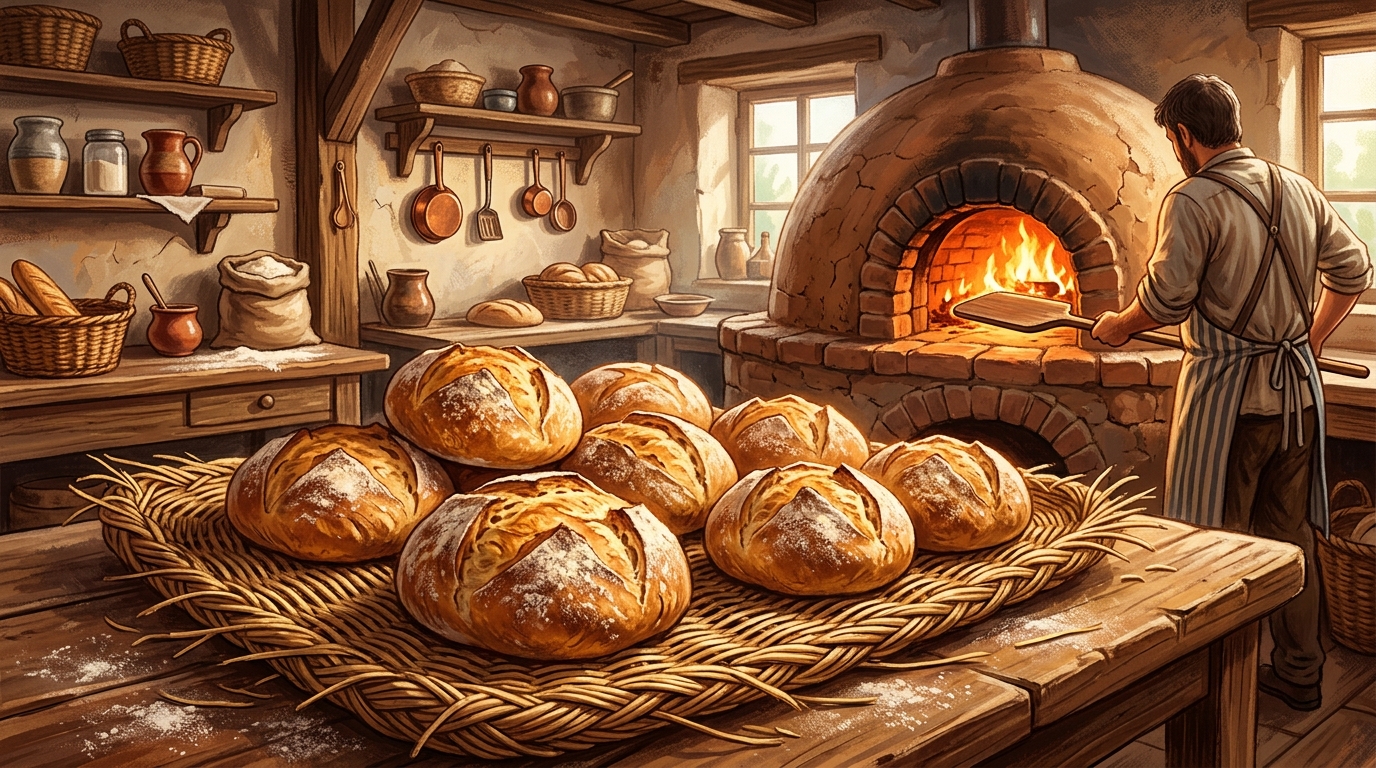
Bread as life: why khobz means more than food
In Moroccan Arabic, bread is sometimes called aïch, a word that translates literally as "life." That is not a poetic exaggeration so much as a description of how bread actually functions on a Moroccan table: it is the constant, the thing that is present at every single meal regardless of what else is being served. Tagines change with the season, couscous is reserved mostly for Fridays, but khobz — round, low, golden-crusted — is there every day, at every income level, in every region from the Rif mountains to the Sahara's edge.
That centrality is tied to an older idea of baraka, a blessing or divine grace that Moroccans have long associated with bread and with the wheat harvest itself. Bread is understood as a gift that should not be squandered, a belief that runs through Islamic teaching on gratitude for sustenance and through much older Amazigh (Berber) agrarian traditions that predate the arrival of Islam in North Africa. Both currents point in the same direction: grain is a serious matter, and turning it into bread is not a chore to be rushed but a small daily act that deserves respect.
This is why bread in Morocco carries symbolic weight far beyond its calories. Offering bread and salt to a guest is a traditional gesture of welcome and friendship. Bread anchors the family table the way a shared language does — everyone reaches for the same basket, tears from the same loaf, and in doing so takes part in something that has been repeated, largely unchanged, for centuries.

The ferran: how the neighborhood oven still feeds Morocco
For most of Morocco's urban history, having a proper oven at home was a luxury few families could afford, and even today many home kitchens are not built around large baking ovens. The solution was the ferran (also spelled farran), a wood-fired or gas-fired communal oven built into the neighborhood, typically run by a baker known locally as the farrane. Families prepare their dough at home — kneading it, letting it rise, shaping it into rounds — and then carry it, often on a wooden board called a wassela, to the ferran to be baked alongside dozens of other households' loaves.
The system works because the farrane keeps track of whose dough is whose. Each family presses its own pattern or mark into the surface of the loaf before it goes into the oven, and the baker returns the finished bread to the right household, sometimes from memory alone, a skill passed down within baking families and still relied upon today. Beyond bread, many ferrans also cook the covered dishes and tagines that families bring in to slow-cook in the retained heat.
The ferran has traditionally ranked alongside the mosque and the hammam as one of the first institutions built in a new Moroccan neighborhood, because feeding the community and washing the community were both considered non-negotiable. It has also long doubled as a social hub, particularly for women bringing bread in the morning, and in earlier decades it even served as an informal mail drop for the neighborhood. Since the 1990s, more households have installed their own ovens, and the ferran plays a smaller role in daily life than it once did — but in medinas and older neighborhoods across the country, the walk to the corner oven, dough balanced on a board, remains a living routine rather than a museum piece.

The etiquette of never wasting a crumb
Few food taboos in Morocco are as consistently observed as the rule against wasting bread. Bread is never thrown in the garbage. If a piece is left over at the end of a meal, it is set aside, given to someone who can use it, or fed to animals — mixing it in with household trash is treated as close to sinful, since the two are considered fundamentally incompatible categories. Many households keep a separate bag or container specifically for stale or leftover bread so that it never ends up alongside ordinary waste.
The physical handling of bread follows its own small code. It is not placed upside down on the table. If a piece falls to the floor, the instinctive response for many Moroccans is to pick it up, kiss it or touch it to the forehead, and set it somewhere clean — a gesture that treats an ordinary accident as a small act of disrespect toward something that deserves better. Bread is also traditionally torn by hand rather than cut with a knife, another small marker of how differently it is treated compared with other food.
For visitors, the practical takeaway is simple: if you cannot finish the bread in front of you, leave it neatly on the table rather than pushing it aside carelessly or discarding it. Moroccan hosts notice, and the gesture of respect is appreciated even when nothing is said about it directly.
Eating with bread: Morocco's original utensil
Long before forks became common on Moroccan tables, bread was already doing the job of a utensil, and in many homes it still does. A tagine is typically set in the middle of the table and eaten from communally, with each diner working from the section of the dish directly in front of them rather than reaching across. Instead of forks, diners tear off a small piece of khobz with the right hand, holding it between the thumb and first two fingers, and use it to scoop up meat, vegetables and sauce in a single practiced motion.
There is real technique to it. Using more than three fingers to eat is considered somewhat coarse, and the left hand is traditionally avoided at the table, a convention rooted in wider etiquette across the Arab and Muslim world where the left hand is reserved for other tasks. Each dip into the shared dish typically calls for a fresh piece of bread rather than reusing the same scrap, which keeps the meal both practical and clean despite the lack of individual plates or cutlery.
Restaurants and modern households in Morocco happily set out forks and knives for anyone who prefers them, and plenty of Moroccans use utensils daily without a second thought. But the option to eat a tagine the traditional way — bread in hand, sleeves rolled up, everyone working from the same dish — remains very much alive, and for many Moroccans it is still the preferred way to eat at home.
One country, many loaves: the shapes bread takes in Morocco
"Khobz" is the general word for bread, but it also names Morocco's everyday loaf: khobz beldi, a round, low, semolina-dusted flatbread baked dense and slightly chewy, with a thick golden crust built to withstand being torn and dunked. It is the default bread at almost every Moroccan meal, made at home and finished in the ferran, and its round shape and cross-hatched or dotted surface pattern is instantly recognizable across the country.
Beyond the daily loaf, Morocco has an entire family of griddle-cooked breads that rarely see an oven at all. Harcha is a semolina bread cooked on a flat griddle, crumbly and slightly gritty in texture, closer to a savory cornbread than a classic loaf. Msemen is a square, layered, pan-fried flatbread, worked and folded with oil until it turns flaky and slightly chewy, usually served at breakfast with honey or melted butter, or occasionally stuffed with savory fillings. Batbout, sometimes called khobz mkhammar, is a small, soft, pocket-like bread cooked on a griddle rather than baked, puffing up like a pita and often split open for sandwiches — small versions travel well as street food, while larger ones are torn and shared like ordinary khobz.
Then there is khobz bishmar, also known regionally as khobz b'shahma: a stuffed, pan-cooked bread traditionally filled with a savory mixture that historically centered on seasoned lamb fat (shahma), fried onions and a hard-boiled egg, sometimes enriched with shredded meat. Lighter, more modern versions swap in olive oil or vegetable fillings, but the classic version remains a heartier, more indulgent cousin of the daily loaf, closer to a meal in itself than a side. Together, these breads show that "Moroccan bread" is not one thing at all, but a whole vocabulary of dough shaped by regional habit, occasion and what a household happens to have on hand that morning.

Passed from mother to daughter: the women who keep bread alive
In most Moroccan households, bread-making is women's knowledge, taught hands-on rather than from a written recipe. Girls typically learn by watching and helping their mothers and grandmothers — how much water the flour needs on a humid day versus a dry one, how long to let the dough rest, how firm it should feel before it is ready to be shaped and sent to the oven. None of this is standardized; it is calibrated by touch and memory, and it is that calibration, more than any specific recipe, that gets passed down.
In Amazigh (Berber) villages, this tradition takes a particularly hands-on form with tafarnout, a rustic bread made from simple semolina dough and baked by pressing the shaped rounds directly against the scorching inner walls of a clay oven called a tannur or tabouna, where it cooks quickly over open flame and comes out with a charred, crisp crust and a soft interior. The technique is typically taught by community elders and kneaded through generations of hands, tying a daily food to a much older rural and Amazigh way of life that predates the country's modern cities.
Whether it happens in a Fez medina kitchen or a village oven in the Atlas foothills, the transmission is the same: bread-making is watched before it is done, corrected in the moment rather than measured out, and absorbed as much through a mother's or grandmother's hands as through her words. It is one of the quieter ways that Moroccan households keep a very old culture running, one loaf at a time.
Frequently asked
Why is bread considered sacred in Morocco?
Bread, or khobz, is tied to the idea of baraka — a blessing or grace associated with sustenance and the wheat harvest — and to Islamic teachings on gratitude for food, alongside older Amazigh agrarian traditions. Because it appears at every meal and takes real effort to make well, it is treated with a level of respect most other foods are not given.
What is a ferran in Moroccan culture?
A ferran (or farrane) is a neighborhood communal oven, traditionally wood-fired, where families bring dough prepared at home to be baked by a local baker. It developed because home ovens were historically a luxury, and it has long ranked alongside the mosque and hammam as a core neighborhood institution.
How do bakers know whose bread is whose at the ferran?
Families mark their dough with a distinctive pattern or shape before sending it to the oven, and the baker (farrane) keeps track of which loaves belong to which household, often relying on memory built up over years of serving the same families.
Is it true that Moroccans never throw away bread?
Yes, this is a widely observed practice. Leftover or stale bread is set aside, given away, or fed to animals rather than placed in the household trash, since mixing it with garbage is considered deeply disrespectful. Many homes keep a separate bag just for bread.
What happens if bread falls on the floor in Morocco?
Many Moroccans will pick it up, kiss it or touch it to the forehead as a small gesture of respect, and place it somewhere clean rather than leaving it on the ground or discarding it. The gesture reflects how bread is treated differently from other food that might fall.
Do Moroccans eat with their hands instead of utensils?
Traditionally yes, especially with shared dishes like tagine. Diners break off pieces of bread with the right hand, using the thumb and first two fingers, and use the bread to scoop up food directly from a communal dish. Utensils are also commonly available and used, especially in restaurants and modern households.
What is the difference between khobz beldi, harcha, msemen and batbout?
Khobz beldi is the everyday round semolina loaf baked in an oven. Harcha is a griddle-cooked semolina bread with a crumbly, cornbread-like texture. Msemen is a square, layered, pan-fried flatbread often served with honey. Batbout is a soft, griddle-cooked, pita-like pocket bread, commonly used for sandwiches.
What is khobz bishmar?
Khobz bishmar, also called khobz b'shahma, is a pan-cooked stuffed bread traditionally filled with seasoned lamb fat, fried onions and hard-boiled egg, sometimes with shredded meat added. Lighter versions today use olive oil or vegetable fillings instead of lamb fat.
What is tafarnout bread?
Tafarnout is a rustic Amazigh (Berber) bread made from semolina dough and baked by pressing the dough directly against the hot inner walls of a traditional clay oven called a tannur or tabouna, producing a charred, crisp crust. The technique is passed down through generations, often taught by community elders.
Who traditionally makes bread in Moroccan households?
Bread-making is generally passed down among women, with daughters and granddaughters learning by watching and helping mothers and grandmothers rather than following a written recipe, absorbing details like dough texture and timing through hands-on practice.
- Marrakech Riad — Sacred and never-wasted bread in Morocco ↗
- Slow Morocco — The Bread of Morocco ↗
- Visit Rural Morocco — Tafarnout: The Amazigh Bread ↗
- The Perfect Loaf — The Breads of Morocco ↗
- Fez Guide Advisor — The Traditional Moroccan Oven, El Ferrane ↗
Video via official YouTube embeds; photos via Wikimedia Commons under their stated licenses. All rights belong to the respective owners; 212 Daily claims no ownership.