The Mohammed VI Football Academy
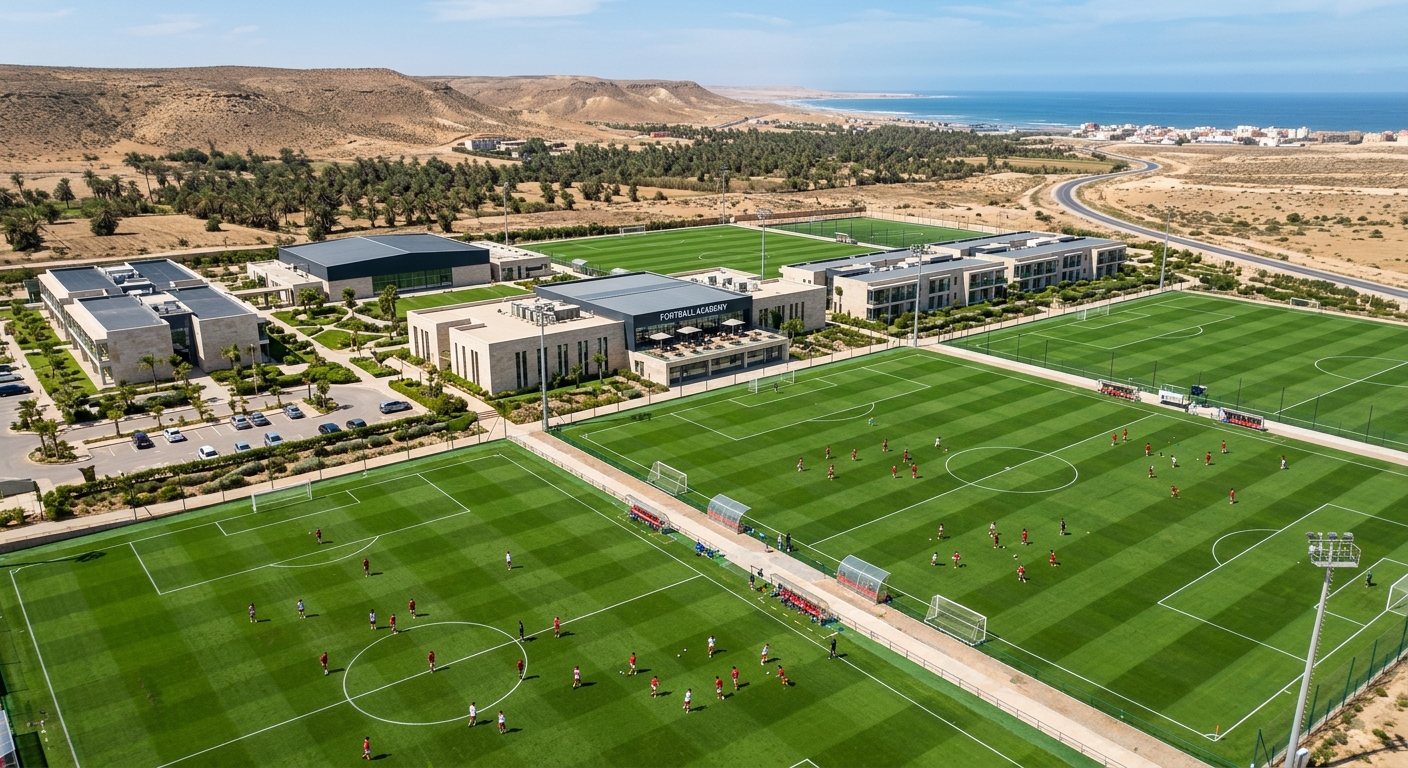
The Cradle of Moroccan Football Talent
The Mohammed VI Football Academy (Académie Mohammed VI de Football) is the jewel in the crown of Morocco's football development system. Located near Salé, in the Rabat region, this elite institution has become synonymous with the production of world-class talent and is widely credited as a cornerstone of the nation's remarkable footballing rise.
Named after King Mohammed VI, whose patronage underscores the national importance attached to the project, the academy represents a long-term, strategic investment in the future of Moroccan football. It was conceived not as a quick fix but as a generational undertaking to build a sustainable pipeline of elite players.
In the years since its founding, the academy has more than fulfilled its promise. Its graduates have populated the national team, starred at major clubs across Europe, and played pivotal roles in Morocco's historic achievements, most notably the men's run to the 2022 World Cup semi-finals. It stands as a model of what visionary football development can achieve.
What sets the institution apart is the way it has fused ambition with patience. Rather than promising overnight transformation, the academy was designed to operate on the timescale that elite player development genuinely requires, taking in young players and shepherding them through years of structured training, education, and competition. That long horizon allowed the project to compound its gains, with each successive intake benefiting from the lessons, staff expertise, and reputation accumulated by the cohorts before them.
By the time Morocco was electrifying the world in Qatar, the academy had quietly become a beating heart of the national footballing identity. Supporters who once associated Moroccan talent primarily with players raised in European systems began to recognize a homegrown pipeline capable of producing footballers of comparable quality. The academy thus functions not only as a training ground but as a powerful statement of self-belief about what Morocco can build from within its own borders.
Origins and Royal Vision
The academy was founded in 2009, established with significant royal backing and a clear mandate to transform how Morocco identified and developed young footballers. At the time, the country lacked a centralized, elite institution capable of nurturing talent to international standards from a young age.
The vision was ambitious: to create a center of excellence that rivaled the best academies in the world, providing not only top-class football training but also a complete education and personal development for its students. The goal was to produce well-rounded individuals as well as elite athletes.
This royal patronage gave the project both prestige and the resources needed to succeed. It signaled at the highest level of the state that football development was a national priority, setting the tone for the broader investment that would later transform Moroccan football across every level of the game.
Establishing the academy in 2009 was also a deliberate response to a problem that had long frustrated Moroccan football: the loss of raw talent that drifted out of the game for want of structure, or that was developed entirely abroad without any connection to the domestic system. By creating a centralized home for the country's most gifted youngsters, the federation gave Morocco a means of capturing and shaping that talent at the age when it matters most, rather than leaving it to luck or to foreign clubs.
The royal name attached to the project carried weight beyond mere prestige. It tied the academy to a vision of national modernization in which sport, education, and youth opportunity were treated as serious instruments of development. That framing helped insulate the institution from the short-term thinking that often undermines football projects, allowing it to plan across generations rather than seasons and to keep its founding philosophy intact even as Moroccan football evolved around it.
World-Class Facilities and Resources
The Mohammed VI Football Academy boasts facilities that rank among the finest in Africa and compare favorably with elite academies worldwide. Sprawling, immaculately maintained training pitches, modern accommodation, medical and sports-science support, and dedicated educational buildings combine to create an environment in which young players can flourish.
Every aspect of a young footballer's development is catered for under one roof. Strength and conditioning, nutrition, physiotherapy, and recovery are all integrated into daily life, ensuring that students are prepared for the physical demands of professional football while their bodies are still developing.
These resources reflect the seriousness of the investment behind the academy. Rather than leaving talent to develop haphazardly, Morocco created a controlled, professional environment designed to maximize the potential of every student, an approach that has paid extraordinary dividends.
The deliberate concentration of resources in one place created something rare in African football: continuity of environment. A young player arriving at the academy could expect the same high standards of pitches, coaching, medical care, and daily structure throughout his development, rather than the fragmented and uneven conditions that talented youngsters often encountered elsewhere. This consistency allowed staff to track and shape progress with a precision that would be impossible in a more scattered system.
Facilities of this quality also served a recruitment and retention purpose. They signaled to families that entrusting a child to the academy meant placing him in a serious, professional, and caring environment, and they made the institution an attractive destination for the coaching and sports-science specialists whose expertise underpins modern player development. In this way the physical investment paid dividends not only on the training pitch but in the human capital the academy was able to assemble around its students.
The Dual Mission: Football and Education
A defining feature of the Mohammed VI Football Academy is its dual commitment to football and academic education. Students do not sacrifice their schooling for sport; instead, the academy ensures they pursue a full education alongside their football training, preparing them for life regardless of whether they reach the professional ranks.
This holistic philosophy reflects a mature understanding of player development. The reality is that not every talented youngster will make it as a professional, and even those who do benefit from the discipline, intelligence, and life skills that education provides. The academy refuses to gamble young lives solely on football outcomes.
The emphasis on education also produces more rounded, intelligent footballers, players capable of understanding complex tactical instructions and conducting themselves professionally. It is a model that prioritizes the welfare of the individual while still delivering elite sporting outcomes, and it has become a key part of the academy's identity.
This commitment to schooling carried a quiet but profound message to parents across Morocco. Sending a talented son to pursue football no longer meant abandoning his future to a single, uncertain bet; it meant entering an environment where his education was protected and his prospects broadened. That reassurance widened the pool of families willing to let their children chase a footballing dream, strengthening the academy's reach into communities that might otherwise have kept their most promising youngsters away from the game.
The dual mission also shaped the character of the players the academy produced. Footballers schooled in this environment tended to arrive in professional dressing rooms with maturity, self-discipline, and an ability to absorb sophisticated tactical ideas. These qualities, as much as raw technique, help explain why academy graduates adapted so readily to demanding European clubs and to the intense pressures of international football at the highest level.
Scouting and Selection
The academy operates a rigorous scouting and selection process designed to identify the most promising young talents from across Morocco. Scouts assess players for technical ability, athleticism, temperament, and potential, casting a wide net to ensure that gifted youngsters from all backgrounds have the opportunity to be discovered.
Selection for the academy is highly competitive and represents a life-changing opportunity for those chosen. It offers a pathway from local pitches to the elite levels of the game, regardless of a young player's family circumstances, opening doors that might otherwise remain closed.
This meritocratic, nationwide approach to recruitment ensures that the academy captures the best of Morocco's young talent. By identifying and nurturing players early, the institution maximizes the time available to develop them and increases the chances of producing genuine elite performers.
The scouting network's nationwide reach was essential to the academy's mission of meritocracy. By searching far beyond the major cities and into smaller towns and rural areas, the institution sought to ensure that geography and family means did not determine whether a gifted child was ever seen. This breadth gave the academy access to a far larger and more diverse pool of potential than a narrowly urban approach would have allowed, and it embedded the principle that talent, wherever it emerged, deserved a chance.
Selection, however, was only the beginning of a long and demanding journey. Those chosen entered a rigorous, structured program in which progress was continually assessed and players were challenged to keep improving. The competitive environment, combined with the support and resources around it, was designed to convert promise into genuine elite capability, weeding out neither the most gifted nor the hardest-working but instead nurturing both toward the professional game.
The Star Graduates
The clearest measure of the academy's success is the caliber of players it has produced. Azzedine Ounahi, the midfielder whose dazzling performances at the 2022 World Cup earned worldwide acclaim and a high-profile transfer, is among its most celebrated graduates and a symbol of what the academy can achieve.
Nayef Aguerd, the commanding center-back who became a key figure for both the national team and his European club, is another standout product of the academy. His rise from the institution to the heart of Morocco's World Cup semi-final defense exemplifies the pathway the academy was built to create.
These are far from the only success stories. The academy has supplied a steady stream of players to the national team and to clubs across Europe and the domestic league. Each graduate who reaches the top reinforces the academy's reputation and inspires the next generation of hopefuls.
What unites graduates such as Ounahi and Aguerd is not simply individual brilliance but the way their journeys validate the academy's entire approach. Both progressed from the institution's structured environment into professional football and onto the grandest stage of all, the World Cup, where they performed with a composure and intelligence that reflected years of careful development. Their success offered tangible proof that elite players could be made in Morocco rather than merely discovered abroad.
The visibility of these graduates also created a powerful feedback loop. Every time a former student excelled for the national team or earned a high-profile move, the academy's standing rose, encouraging more families to embrace the pathway and more young players to aspire to it. The star graduates thus became ambassadors as much as athletes, embodying the promise of the institution and inspiring the next generation of hopefuls to believe that the same journey was open to them.
The Academy's Role in the 2022 World Cup Run
Morocco's historic run to the semi-finals of the 2022 World Cup in Qatar, the first by an African or Arab nation, was powered in significant part by academy graduates. Players developed at the Mohammed VI Football Academy were central to the squad that stunned the world by eliminating European giants.
The presence of these homegrown talents alongside players developed in the European diaspora created a balanced, cohesive squad. The academy graduates brought technical quality and a deep connection to the national project, embodying the success of Morocco's long-term planning.
The World Cup run was the ultimate validation of the academy's founding vision. What had begun as an ambitious project in 2009 had, little more than a decade later, helped propel Morocco to the brink of a World Cup final. It was a triumph of patience, investment, and belief.
The contribution of academy products to that campaign went beyond the individual contributions of any one player. It demonstrated that homegrown talent could not only reach the World Cup but thrive against the very best, holding its own alongside teammates forged in the elite leagues of Europe. The seamless integration of these two groups, domestic graduates and diaspora stars, into a single cohesive unit was one of the quiet triumphs underpinning Morocco's historic run.
For the academy itself, Qatar represented a vindication that few football projects ever receive so emphatically. An institution conceived little more than a decade earlier had helped supply players to a team that reached a World Cup semi-final, an achievement no African or Arab nation had managed before. That validation transformed the academy from a promising experiment into an established pillar of the national footballing structure, its value placed beyond doubt.
A Model for African Football
The Mohammed VI Football Academy has become a reference point for football development across Africa and beyond. Its combination of elite facilities, holistic education, rigorous scouting, and long-term vision offers a blueprint that other nations have studied and sought to emulate.
The academy demonstrates that African football need not rely solely on raw talent or the export of unpolished players to Europe. With proper investment and structure, nations can develop world-class players at home, retaining greater control over the process and reaping the rewards directly.
This model has implications far beyond Morocco. As more African federations recognize the value of structured, well-funded development, the Mohammed VI Academy stands as proof that the continent can produce elite talent through deliberate institution-building rather than chance.
The significance of this model lies in the way it reframes the relationship between African football and the wider game. For decades the prevailing pattern saw the continent's raw talent exported young and developed elsewhere, with the benefits accruing largely to foreign clubs. The academy offered an alternative in which the development, the identity, and the long-term reward remained rooted at home, allowing a nation to shape its own players to its own footballing philosophy.
Crucially, the Moroccan example showed that this alternative was not merely aspirational but achievable, provided the commitment and resources were genuine. The combination of state-level backing, sustained funding, and a clear long-term plan turned an ambitious idea into a functioning, results-producing institution. For other African federations weighing how to invest scarce resources, that proof of concept is perhaps the academy's most valuable export.
Expanding the Development Network
While the Mohammed VI Football Academy is the flagship, it sits within a broader and expanding development network in Morocco. Regional academies, club youth systems, and grassroots programs all contribute to a comprehensive pipeline designed to identify and nurture talent at every level.
This layered structure ensures that the elite academy is fed by a wide base of well-organized development below it, while also providing pathways for players who may not enter the flagship institution. The result is a deeper, more resilient talent pool for the national teams.
The federation's continued investment in this network reflects an understanding that sustained success requires breadth as well as elite focus. By strengthening development across the country, Morocco is building the foundations for long-term competitiveness rather than relying on a single institution alone.
This broader network also serves an important function in catching talent that the flagship academy alone could never reach. Not every gifted youngster will pass through the doors of the Mohammed VI institution, and a single elite center, however excellent, can only accommodate a limited number of players. By cultivating regional academies and club systems alongside it, Morocco ensures that promising players who develop later, or who emerge far from the flagship, still have credible pathways toward the professional game.
The layered approach reflects a mature philosophy of national development, one that values both depth and breadth. A strong base of widespread, well-organized youth football feeds the elite tier above it, while the prestige and standards of the flagship academy raise expectations throughout the system. Together they create a virtuous cycle in which talent is identified earlier, nurtured better, and given more routes to the top than ever before in Moroccan football.
The Lasting Legacy
The legacy of the Mohammed VI Football Academy is already profound and continues to grow. It has produced internationals, fueled historic achievements, and reshaped perceptions of what is possible for football development in Morocco and Africa. Its graduates carry its influence to the highest levels of the world game.
Perhaps its greatest legacy is the example it sets: that long-term vision, royal and institutional commitment, world-class facilities, and a holistic approach to player welfare can transform a nation's footballing fortunes. The academy is a physical embodiment of Morocco's ambition.
As Morocco prepares for an era of hosting major tournaments and competing at the highest levels, the academy will remain central to its plans. The institution that began in 2009 has become the engine of a footballing golden age, and its influence on Moroccan and African football is set to endure for generations.
The academy's influence is also measured in the expectations it has reset for an entire football culture. Where Moroccan success was once viewed as occasional and fortunate, the steady production of internationals from a dedicated institution has helped establish a sense that sustained excellence is both possible and deserved. That shift in mindset, from hoping for talent to systematically producing it, may prove to be among the most durable parts of the academy's legacy.
Looking ahead, the institution is positioned to remain central to Morocco's footballing ambitions for decades. As the country prepares to host and compete in the sport's biggest events, the academy will continue to supply the players, embody the philosophy, and carry the prestige that underpin those ambitions. Born of a long-term vision in 2009, it has become a self-sustaining engine of talent whose influence on Moroccan and African football looks set to endure for generations to come.
| Aspect | Detail |
|---|---|
| Founded | 2009 |
| Location | Near Salé, Rabat region |
| Patron | King Mohammed VI |
| Mission | Elite football plus full education |
| Notable graduate | Azzedine Ounahi (2022 World Cup star) |
| Notable graduate | Nayef Aguerd (national team defender) |
Mohammed VI Football Academy key facts
FAQ
When was the Mohammed VI Football Academy founded?
The academy was founded in 2009 near Salé in the Rabat region, established with royal backing to develop elite Moroccan football talent and named after King Mohammed VI.
Which famous players came from the Mohammed VI Football Academy?
Notable graduates include midfielder Azzedine Ounahi and defender Nayef Aguerd, both of whom were key figures in Morocco's historic run to the 2022 World Cup semi-finals.
What makes the academy different from other youth setups?
The academy combines elite, world-class football training with a full academic education and holistic player welfare, ensuring students are developed as well-rounded individuals as well as athletes.
How did the academy contribute to Morocco's 2022 World Cup success?
Academy graduates were central to the squad that reached the World Cup semi-finals, providing technical quality and homegrown talent that complemented the diaspora-developed players.
Is the academy a model for other African nations?
Yes. Its blend of elite facilities, education, rigorous scouting, and long-term vision has become a blueprint that other African federations study as proof that elite talent can be developed at home.
Loved this? Useful? React below — your feedback helps other readers.