The Ultimate Marrakech Guide for 2026: Souks, Riads, Palaces and the Perfect Itinerary
First Impressions of the Red City
Marrakech assaults the senses in the most wonderful way. Founded in 1070 by the Almoravids, the city earned its nickname, the Red City, from the rose-hued clay used in its ancient ramparts, palaces and houses, a color that glows almost incandescent at sunset. For nearly a millennium it has been a crossroads of Berber, Arab, African and European cultures, and that layered history is etched into every alley and archway.
The city divides neatly into two worlds. Inside the medieval medina, encircled by 19 kilometers of ochre walls, life unfolds much as it has for centuries: donkey carts, hidden riads, the call to prayer echoing over rooftops. Beyond the walls lies Gueliz, the modern Ville Nouvelle laid out by the French, with wide boulevards, chic cafes, contemporary art galleries and international restaurants.
Most visitors come for the medina, and rightly so. But understanding this dual personality is the key to a great trip. The historic core delivers the romance and the chaos; the new city offers respite, sophistication and a window into how modern Moroccans actually live. The best Marrakech itineraries weave between the two.
Jemaa el-Fnaa: The Beating Heart
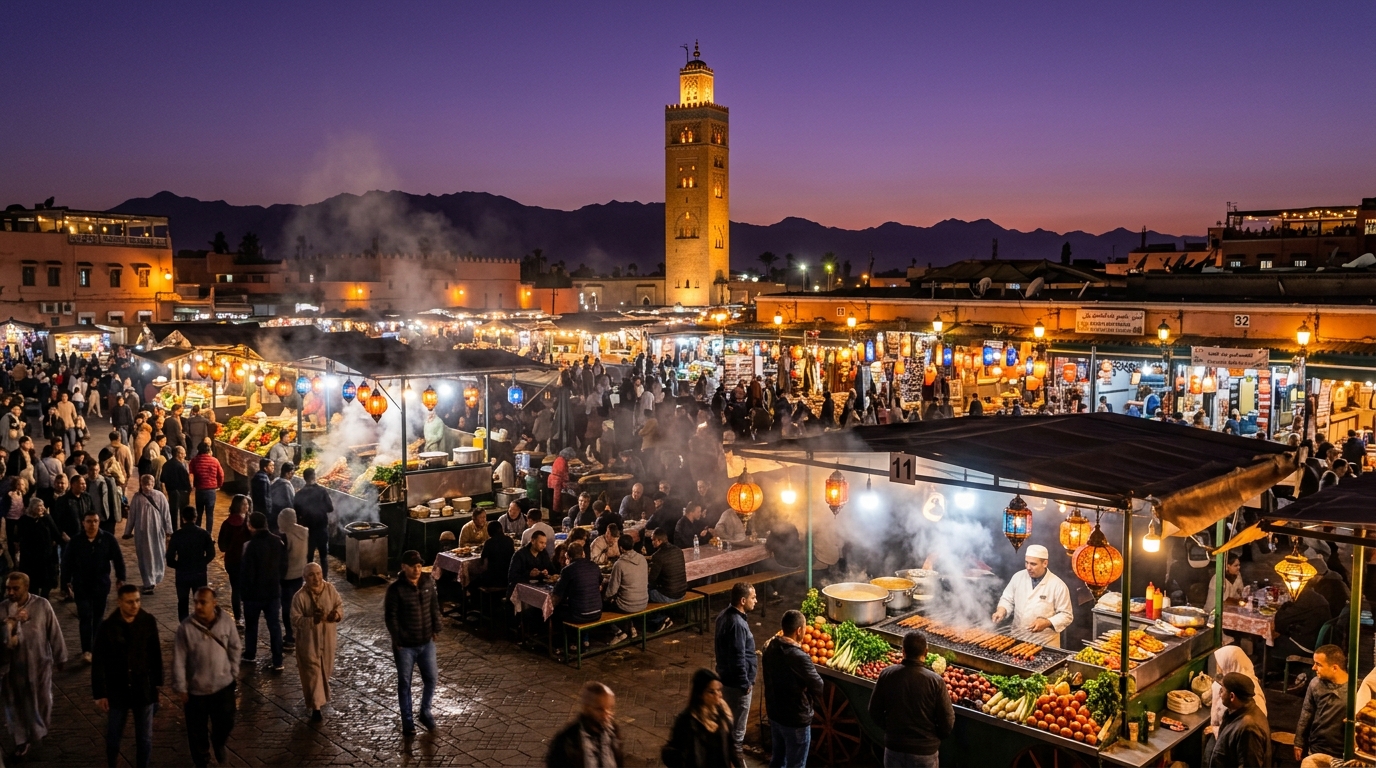
No square on Earth is quite like Jemaa el-Fnaa. By day it simmers gently with orange-juice vendors, henna artists and snake charmers; by night it explodes into one of the world's greatest open-air spectacles. As the sun drops, dozens of food stalls materialize in clouds of fragrant smoke, storytellers gather crowds in Arabic and Berber, musicians drum into the darkness, and the whole space becomes a living theater. UNESCO recognized this performance tradition as a Masterpiece of the Oral and Intangible Heritage of Humanity.
The square is the natural orientation point for any visit. Radiating north and east from it sprawl the souks, the legendary covered markets where artisans sell leather babouches, hand-knotted carpets, brass lanterns, spices, ceramics and silver jewelry. The souks are organized loosely by trade, and getting lost in them is part of the experience, though a good sense of which landmark to aim for helps you find your way back.
A word on the square's photogenic performers: the snake charmers, monkey handlers and costumed water sellers will expect payment for photos, and aggressively so. Agree on a tip beforehand or simply enjoy the scene from one of the rooftop cafes that ring the plaza, where a mint tea buys you the best seat in the house and a panoramic view of the controlled chaos below.
Palaces, Tombs and Madrasas
Marrakech rewards those who slow down to admire its architecture. The Bahia Palace, a 19th-century masterpiece, sprawls across nearly two acres of courtyards, fountains and rooms ornamented with carved cedar, stucco and zellige tilework so intricate it borders on the obsessive. It was built to be the greatest palace of its time, and even half-empty it dazzles.
Nearby, the Saadian Tombs lay hidden behind a palace wall for centuries until their rediscovery in 1917. The mausoleum of the Saadian dynasty, with its chamber of twelve columns in Italian Carrara marble, is among the finest examples of Moroccan funerary art. The Ben Youssef Madrasa, once the largest Islamic college in North Africa, reopened after meticulous restoration and offers perhaps the city's most photogenic interior, a serene courtyard of carved wood and tile.
The Koutoubia Mosque anchors the skyline with its 77-meter minaret, a 12th-century landmark and the architectural sibling of Seville's Giralda. Non-Muslims cannot enter, but the surrounding gardens make a peaceful place to admire it. Together these monuments tell the story of successive dynasties that each left their mark on the city in stone, marble and tile.
Gardens and Modern Marvels
For all its dense, sensory intensity, Marrakech also offers oases of calm. The Majorelle Garden, created by French painter Jacques Majorelle and later saved and restored by Yves Saint Laurent, is a botanical jewel of cobalt-blue buildings, towering cacti, bamboo groves and trickling pools. Adjacent stands the striking Musee Yves Saint Laurent, a tribute to the designer who found endless inspiration in the city.
Other green retreats reward the curious. The Menara Gardens, with their reflecting pool and Atlas backdrop, and the historic Agdal Gardens offer space to breathe. Le Jardin Secret, tucked within the medina itself, restores a centuries-old riad garden complete with traditional water systems. These spaces are not afterthoughts; in Moroccan culture the garden is a vision of paradise, and Marrakech takes that idea seriously.
The city's creative energy extends to its hammams and spas, ranging from humble neighborhood bathhouses to lavish modern wellness temples. A traditional hammam, with its steam, black soap and vigorous scrub, is a genuine cultural ritual and an essential Marrakech experience. After days of pounding the souks, surrendering to a hammam is the perfect reset.
Where to Stay and What to Eat
The quintessential Marrakech lodging is the riad, a traditional house built around an interior courtyard, often with a plunge pool, fountain and rooftop terrace. Hidden behind plain medina doors, riads open into tranquil, jewel-box worlds that block out the street noise and immerse you in Moroccan design. Staying in one, rather than a generic hotel, is the single best decision most visitors make. For more space, pools and resort amenities, the Palmeraie and Hivernage districts offer larger hotels.
Marrakech is a feast. Start with the classics: slow-cooked tagines of lamb with prunes or chicken with preserved lemon and olives, fragrant couscous traditionally served on Fridays, and harira, the hearty tomato-lentil soup. Street food at Jemaa el-Fnaa ranges from grilled meats to snail broth and freshly fried sfenj doughnuts. For something refined, the medina hides spectacular rooftop restaurants serving modern Moroccan cuisine.
Do not miss the ritual of mint tea, the so-called Berber whisky, poured from height into small glasses and offered everywhere as a gesture of hospitality. Pair your days with stops at a traditional cafe to people-watch over a coffee or a fresh-pressed orange juice from the square. Eating well in Marrakech requires no insider knowledge; it requires only an appetite and a willingness to wander.
Day Trips and the Perfect Itinerary
Marrakech is the ideal launchpad for exploring southern Morocco. The Atlas Mountains rise just an hour away, where the Ourika Valley, the village of Imlil and the trailheads for Mount Toubkal, North Africa's highest peak, offer waterfalls, Berber villages and crisp mountain air. The cinematic kasbah of Ait Benhaddou, a UNESCO World Heritage site and frequent film location, lies beyond the Tizi n'Tichka pass and makes a memorable long day trip or an overnight stop en route to the desert.
The Sahara beckons too. While the famous Erg Chebbi dunes near Merzouga require a multi-day trip, the closer Agafay desert, a stony moonscape just 40 minutes from the city, offers camel rides, luxury camps and Atlas sunsets within easy reach. The coastal town of Essaouira, with its windswept ramparts and fresh seafood, is another popular escape, about three hours west.
For first-timers with three to four days, a winning rhythm looks like this: spend your first full day in the medina, exploring Jemaa el-Fnaa, the souks and a palace or two; dedicate day two to the Majorelle Garden, the new city and a relaxing hammam; use day three for an Atlas Mountains or Ait Benhaddou excursion; and save day four for a leisurely return to favorite spots, last-minute shopping and a final sunset over the rooftops. Slow down, get pleasantly lost, and let the Red City work its centuries-old magic.
| Attraction | What to expect | Suggested time |
|---|---|---|
| Jemaa el-Fnaa & souks | Square, food stalls, markets | Half to full day |
| Bahia Palace | Ornate 19th-century palace | 1–1.5 hours |
| Majorelle Garden & YSL Museum | Botanical garden, art | 2–3 hours |
| Ben Youssef Madrasa | Restored Islamic college | 1 hour |
| Atlas Mountains day trip | Valleys, villages, waterfalls | Full day |
| Ait Benhaddou | Famous fortified kasbah | Long day trip |
Marrakech top sights at a glance
FAQ
How many days do I need in Marrakech?
Three to four days is ideal. That allows time for the medina and souks, the major palaces and gardens, a hammam, and at least one day trip to the Atlas Mountains, Ait Benhaddou or the Agafay desert.
Should I stay in a riad or a hotel?
For an authentic experience, choose a riad, a traditional courtyard house in the medina that offers tranquility and beautiful design. For larger pools and resort amenities, hotels in the Palmeraie or Hivernage districts are a good alternative.
Is it safe to walk around the Marrakech medina?
Yes, the medina is generally safe, though it can feel chaotic. Watch for scooters in narrow lanes, be firm but polite with pushy vendors and unofficial guides, and keep an eye on belongings in crowded areas like Jemaa el-Fnaa.
What food should I try in Marrakech?
Sample lamb or chicken tagine, Friday couscous, harira soup, grilled street food at Jemaa el-Fnaa, and fresh-pressed orange juice. Always accept a glass of sweet mint tea, the traditional symbol of Moroccan hospitality.
What is the best day trip from Marrakech?
The Atlas Mountains, including the Ourika Valley and Imlil, are the most accessible and rewarding day trip. The UNESCO-listed kasbah of Ait Benhaddou and the nearby Agafay desert are also excellent options.
Loved this? Useful? React below — your feedback helps other readers.