Malhun: Inside the Sung Poetry That Became the Soul of Moroccan Music
What Malhun is — and who created it
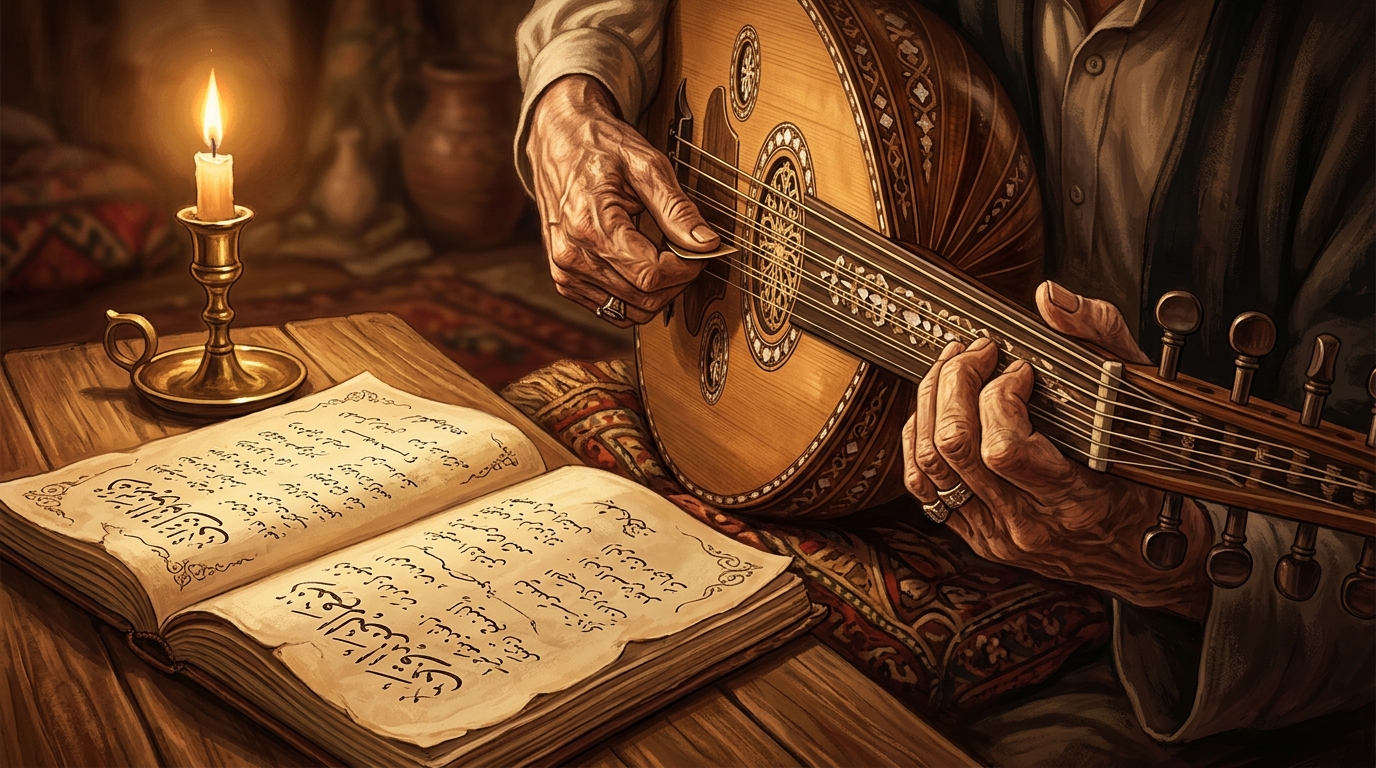
Malhun (also spelled Melhoun, Al-Malhun or Malhoun) is a genre of sung, strophic poetry composed in colloquial Moroccan Arabic (Darija) rather than classical fus'ha, performed with a small orchestra of oud or lute, violin, rebab and hand drums. UNESCO describes it plainly as 'a popular poetic and musical art' whose verses have historically been sung in dialectal Arabic — and in some communities, in Hebrew as well, reflecting Morocco's mixed Muslim and Jewish urban culture.
What sets Malhun apart from other classical Arabic poetic traditions is its origin story: it did not come from royal courts or religious academies, but from craftsmen's guilds. Historically it belonged to an almost entirely masculine, working-class milieu — tailors, cobblers, coppersmiths and other artisans in the old medinas who wrote and performed poems as a shared pastime and a mark of collective identity. A poet-craftsman composing a fine qasida (ode) could earn as much standing among his peers as a master of his actual trade.
That guild culture is why Malhun took root so deeply in Morocco's historic artisan capitals: Fez, Meknes, Marrakesh, Rabat and Salé. Each city developed its own recognizable school and repertoire, and rivalries between cities' poets became part of the art form's folklore — Meknes and Fez in particular are still cited as the genre's two great historical centers.
Unlike a solo folk singer performing alone, a Malhun piece is a collective event by design: a lead voice carries the verses while a small chorus and ensemble answer at set points in the structure, turning each qasida into something closer to a call-and-response ceremony than a simple song. That communal performance style, inherited directly from the guild gatherings where the art was born, is part of why Malhun still functions today as a marker of shared identity in the cities that produced it.
From the Tafilalet oases to the imperial cities
Malhun's documented roots reach back further than most people assume. The earliest known composition in the style, a piece called the Mal'aba by the poet Al-Kafif az-Zarhuni, dates to the Marinid dynasty era in the 14th century. Most historical accounts place Malhun's real emergence as a distinct genre in the 15th century, developing first in the Tafilalet oases of southeastern Morocco before migrating north into the empire's great cities.
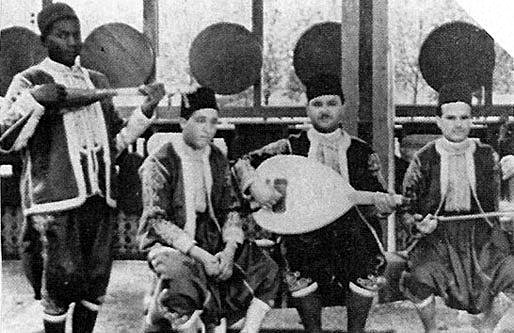
By the 16th century, Malhun had spread into urban centers across Morocco and the wider Maghreb, carried along trade and pilgrimage routes and adapted by local guilds wherever it landed. The 18th and 19th centuries are generally considered its golden age: this is when Fez, Meknes and Marrakesh produced the run of poets whose qasidas are still performed today, and when the genre's musical accompaniment — built around the oud, rebab, violin and taarija hand drum — settled into the form recognized now.
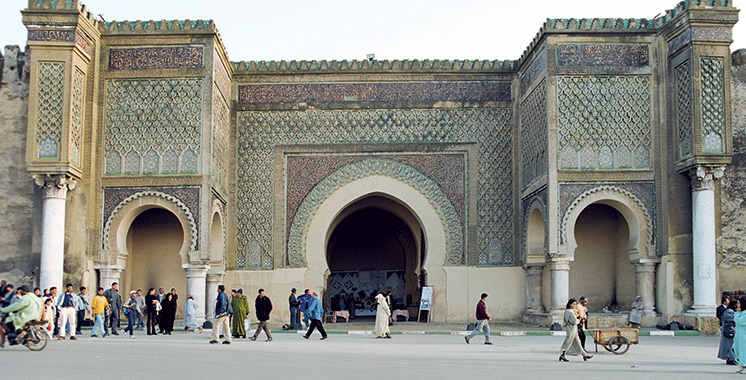
Meknes in particular became inseparable from the art. The imperial city built under Sultan Moulay Ismail, with its monumental gates like Bab Mansour, was home to entire lineages of Malhun poets and to Sufi zawiyas (lodges) that doubled as centers where the poetry was composed, taught and performed.
The architecture of a qasida: how a Malhun poem is built
A Malhun poem is called a qasida, and it follows a strophic structure related to the older Andalusi muwashshah form rather than the monorhyme qasida of classical Arabic literature. A full piece is typically organized around solo verses (aqsam), punctuated by a harba — a refrain, whose name literally means 'launch,' that the whole ensemble answers together — and often closes with a dridka, an accelerated rhythmic passage that signals the piece is winding toward its end.
Rhyme schemes range from simple, repeating patterns to genuinely intricate schemes that some scholars compare to free verse. What never changes is the language: Malhun is composed in Darija, everyday spoken Moroccan Arabic, not the classical fus'ha used in formal religious or literary Arabic. That choice was itself a quiet act of artistic democratization — it meant a craftsman with no formal religious education could still compose sophisticated, publicly admired poetry in the language he actually spoke.
Subject matter ranges widely: romantic longing and the beauty of a beloved, the pleasures of food, wine (real or symbolic) and company, nature and the changing seasons, imagined journeys, moral instruction, social commentary on the injustices and characters of the day, and — running through much of the repertoire — Sufi religious devotion, in which the 'beloved' of a love poem doubles as a symbol for divine longing.
This dual reading is one of the reasons Malhun rewards close listening: the same qasida can be enjoyed on the surface as a love song or a piece of everyday wit, while a listener attuned to Sufi symbolism hears an entirely different, more devotional poem underneath. That layering, built into the language itself, is part of what elevated Malhun from simple guild entertainment into a genre serious enough for scholars, Sufi orders and, eventually, UNESCO to take note of.
Sufi mystics and master poets
Malhun's history is inseparable from a handful of towering names. Abd al-Rahman al-Majdoub (died 1568), a Sufi mystic born near Al Jadida and buried in Meknes, is remembered above all for short, punchy quatrains blending ecstatic spirituality with sharp social satire — lines so quotable that many became everyday Moroccan proverbs, still quoted by people who have never heard the word Malhun.
A different kind of master was Sidi Kaddour El Alami (circa 1742-1850) of Meknes, who founded a Sufi zawiya that became one of the genre's great training grounds and composed enduring qasidas such as 'El Farradjia' (also known as 'Ya Krim') and 'El Meknassia.' He is remembered today as one of the greatest neo-classical voices in the entire North African popular-poetry tradition, a saint-poet whose verses are still performed by Malhun and Chaabi singers in Morocco and Algeria alike.
A generation or two later came Driss Ben Ali al-Malki (died 1901), nicknamed 'lhench' ('the snake') for his technique of coiling verses to hide their opening lines from casual listeners — part of the genre's tradition of riddling wordplay. His qasidas, including 'Chemaa' ('the candle') and pieces built around women's names such as 'Ghita' and 'Leghzal Fatma,' remain core repertoire pieces for Malhun singers today.
The living bridge to Chaabi and modern Moroccan music
Malhun did not stay locked in guild houses; it became the direct lyrical ancestor of Chaabi, Morocco's modern popular music. When Chaabi crystallized in urban centers like Casablanca and Rabat from the 1940s onward, café orchestras and wedding bands fused the refined, Andalusi-inflected modal sense and strophic poetry of Malhun with rural aita vocal traditions, Amazigh festive rhythms and Gnawa grooves — building the sound that still fills Moroccan weddings and celebrations.
Two figures illustrate that bridge well. Houcine Slaoui (1921-1951), born in Salé, is remembered as a pivotal early influence on modern Chaabi, best known for the song 'Lmarikan,' inspired by seeing American troops land in Morocco in 1942. And Zohra Al Fassia, celebrated as one of the pioneering queens of 20th-century Moroccan music, built her reputation performing Malhun and the related chgouri and gharnati repertoires at celebrations across Casablanca before becoming one of the country's most beloved singers.
The 20th century's most revered pure-Malhun voice was Haj Houcine Toulali (1924-1998) of Meknes, who composed hundreds of qasidas, led his own Malhun orchestra, and is still considered the genre's benchmark performer decades after his death. His recordings of pieces like 'Leghzal Fatma' remain the versions by which younger performers are measured, and Malhun associations across Morocco continue to teach, perform and safeguard the repertoire he helped preserve.

UNESCO recognition: Malhun joins humanity's intangible heritage
On December 6, 2023, during the 18th session of UNESCO's Intergovernmental Committee for the Safeguarding of the Intangible Cultural Heritage (held that year in Botswana), Malhun was formally inscribed on the Representative List of the Intangible Cultural Heritage of Humanity, under the title 'Malhun, a popular poetic and musical art.' The listing recognized both the poetic tradition itself and the network of guild-linked practitioners, associations and master-to-apprentice teaching that keeps it alive.
UNESCO's own description highlights the breadth of Malhun's subject matter — love, the joys of life, human beauty, nature, religious devotion, pleasure, gastronomy, imagined journeys, and commentary on political and social events — as evidence of a living, adaptable art form rather than a frozen museum piece. The inscription joined a growing list of Moroccan cultural elements UNESCO has recognized, alongside traditions like Gnawa music and the art of the Moroccan caftan.
For a genre once confined to the closed, mostly male world of artisan guilds, that global recognition marks a full-circle moment: a poetry written by craftsmen for their own community has become an officially safeguarded part of the story humanity tells about itself.
Frequently asked
What is Malhun (Melhoun)?
Malhun, also spelled Melhoun or Al-Malhun, is a Moroccan tradition of sung poetry composed in colloquial Moroccan Arabic (Darija) rather than classical Arabic, historically performed by craftsmen's guilds and accompanied by instruments like the oud, rebab, violin and hand drums.
Where did Malhun originate?
Malhun developed in the Tafilalet oases of southeastern Morocco, with its earliest known composition, the Mal'aba by Al-Kafif az-Zarhuni, dating to the 14th-century Marinid era. The genre spread as a distinct art form mainly from the 15th century onward into Morocco's imperial cities.
Which cities are most associated with Malhun?
Fez, Meknes, Marrakesh, Rabat and Salé are the historic strongholds of Malhun, each developing its own school and repertoire. Meknes, home to poets like Sidi Kaddour El Alami and Haj Houcine Toulali, and Fez are generally considered the two great historical centers of the art.
Why is Malhun linked to artisan guilds?
Malhun emerged from the working-class milieu of craftsmen's guilds — tailors, cobblers, jewelers and other tradesmen who composed and performed poetry together as a shared pastime. Skill in Malhun could earn a craftsman as much respect among peers as mastery of his actual trade.
What is the structure of a Malhun qasida?
A Malhun poem (qasida) is strophic, related to the older Andalusi muwashshah form. It is typically built from solo verses called aqsam, a call-and-response refrain called the harba, and often closes with an accelerated rhythmic passage called the dridka.
Who are the most important historical Malhun poets?
Key figures include Abd al-Rahman al-Majdoub (died 1568), remembered for mystical, proverb-like quatrains; Sidi Kaddour El Alami (circa 1742-1850) of Meknes, composer of 'El Farradjia' and 'El Meknassia'; and Driss Ben Ali al-Malki (died 1901), nicknamed 'lhench,' known for pieces like 'Chemaa' and 'Leghzal Fatma.'
How is Malhun connected to Sufism?
Many Malhun poets were Sufi mystics or affiliated with Sufi zawiyas (lodges), and much of the repertoire uses the language of romantic longing as a symbol for devotion to the divine. Al-Majdoub and Sidi Kaddour El Alami, who founded his own zawiya in Meknes, both embody this Sufi thread in the tradition.
How did Malhun influence modern Moroccan Chaabi music?
Chaabi, Morocco's modern popular music, crystallized in cities like Casablanca and Rabat from the 1940s by fusing Malhun's sung poetry and Andalusi-influenced melodies with rural aita traditions, Amazigh rhythms and Gnawa grooves. Malhun's poetic structure and vocabulary remain audible in Chaabi lyrics today.
Is Malhun recognized by UNESCO?
Yes. On December 6, 2023, Malhun was inscribed on UNESCO's Representative List of the Intangible Cultural Heritage of Humanity under the title 'Malhun, a popular poetic and musical art,' during the 18th session of the Intergovernmental Committee held in Botswana.
Is Malhun still performed today?
Yes. Malhun associations across Morocco continue to teach and perform the classical repertoire of poets like Haj Houcine Toulali, and the tradition remains part of weddings, cultural festivals and heritage events, alongside its ongoing influence on Chaabi and other contemporary Moroccan music.
- UNESCO Intangible Cultural Heritage — Malhun, a popular poetic and musical art ↗
- Wikipedia — Malhun ↗
- Morocco World News — UNESCO Adds Morocco's Malhoun Music to Intangible Cultural Heritage List ↗
- Wikipedia — Kaddour El Alamy ↗
- Wikipedia — Abd al-Rahman al-Majdoub ↗
- Wikipedia — List of Intangible Cultural Heritage elements in Morocco ↗
Video via official YouTube embeds; photos via Wikimedia Commons under their stated licenses. All rights belong to the respective owners; 212 Daily claims no ownership.