Majorelle Garden: How a French Painter's Marrakech Refuge Became Yves Saint Laurent's Final Resting Place
A convalescing painter finds his life's work
Jacques Majorelle was born in 1886 in Nancy, France, the son of Louis Majorelle, a celebrated Art Nouveau cabinet-maker. Jacques trained as a painter rather than following his father into furniture, and around 1917, while still a young artist, he traveled to Morocco specifically to recover from a serious medical condition. What began as a convalescence turned into a permanent relocation: Majorelle settled in Marrakech after further travels around North Africa and the Mediterranean, drawn to the region's light and color as an Orientalist painter working in a well-established European artistic tradition of the period.
In 1923, four years after marrying Andrée Longueville, Majorelle purchased a four-acre plot on the edge of Marrakech and began what would become his true life's work: a botanical garden, expanded gradually over almost forty years to roughly ten additional acres, filled with plants gathered from his travels across multiple continents. In 1931 he commissioned French architect Paul Sinoir to design a Cubist studio-villa on the property, giving the garden its architectural centerpiece alongside its ever-expanding planting.
The garden was not, at first, conceived as a public attraction. It was Majorelle's personal studio, retreat and living canvas, developed in parallel with his painting career, and it only opened to the public in 1947, more than two decades after he first bought the land — a project pursued, for most of its life, purely for its creator's own satisfaction rather than for any commercial or civic purpose.
Majorelle's plant collecting reflected his own travels as much as Morocco's own flora: he sourced specimens from five continents over the decades, assembling a collection that had reached around 135 distinct species by the time of his death — an eclectic, well-traveled botanical library assembled by one obsessive collector rather than a formally planned civic botanical garden, which is part of what gives the site its distinctly personal, idiosyncratic character even today.

The invention of Majorelle Blue
The garden's defining feature arrived relatively late in its development. In 1937, Majorelle formulated a specific, extremely saturated ultramarine-cobalt blue, inspired directly by colors he had observed in Marrakech's tiled architecture and in the traditional blue burnouses worn by some Berber communities — a color drawn from the country he had adopted rather than imported from France. He used the new shade to repaint his studio-villa and key architectural elements throughout the garden, and the effect was striking enough that the color became inseparable from the site itself.
Majorelle went on to formally patent the shade, which is now known internationally as bleu Majorelle, or Majorelle Blue — a rare case of an individual artist's custom paint color outliving both his career and, eventually, his ownership of the very property that made it famous, to become a recognized reference color used well beyond Morocco in design, fashion and branding contexts that have nothing directly to do with the garden itself.
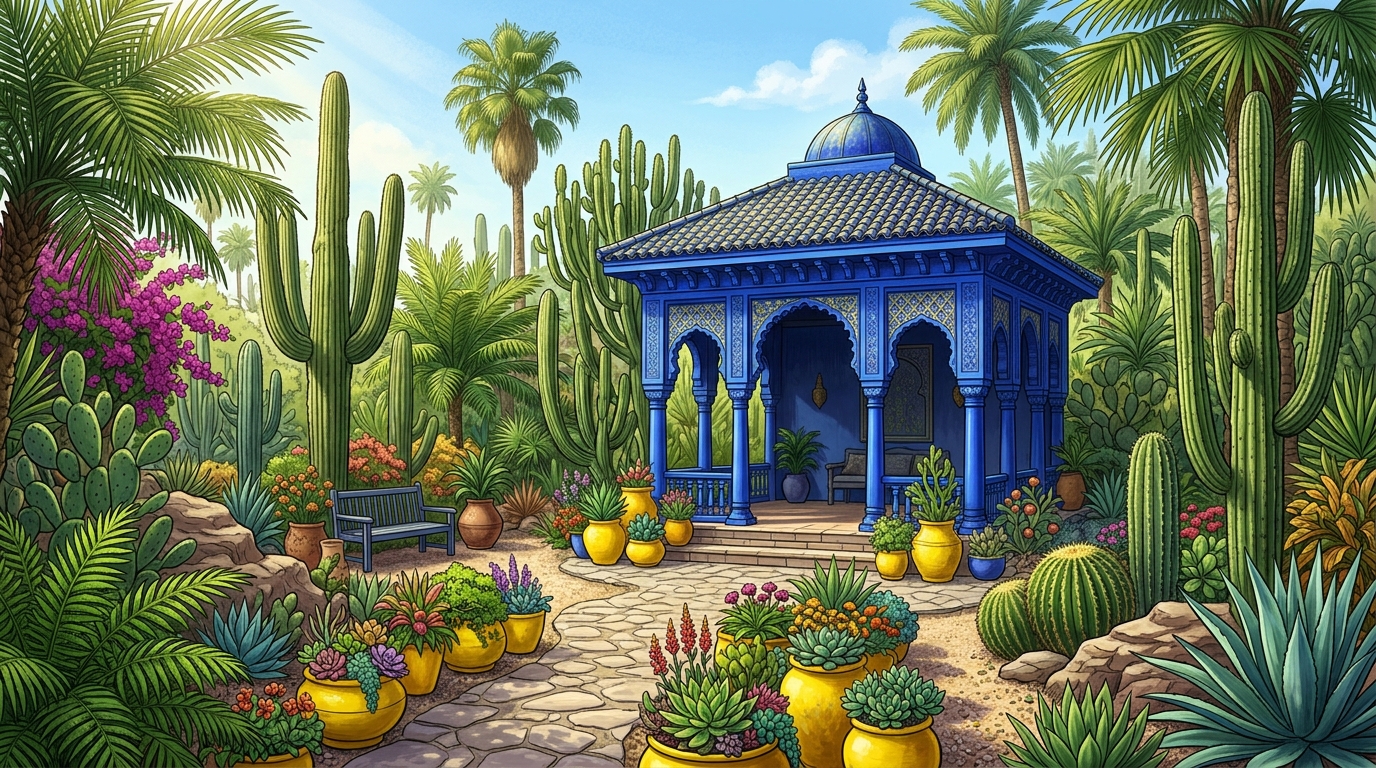
The blue is deployed with real restraint against the garden's greenery: bold architectural surfaces, plant pots, pergolas and fountain elements carry the color, set off deliberately against dense planting, so that the cobalt reads as punctuation within the garden rather than as its dominant visual note. That contrast — vivid, saturated architecture against carefully massed botanical greenery, much of it Majorelle's own imported cacti and exotic species — is the specific visual signature that made the garden internationally recognizable well before Yves Saint Laurent ever set foot in it.
Visitors moving through the garden today pass through a sequence of distinct botanical environments rather than one uniform landscape: a cactus garden bringing together succulent species from the Americas and Africa side by side, shaded bamboo groves, water features lined with water lilies, and rows of towering palms, all threaded together by pathways that repeatedly frame views of the blue villa from different angles. That deliberate variety, moving a visitor through contrasting moods and plant textures within a comparatively small overall footprint, is itself considered part of Majorelle's original design intelligence, refined rather than reinvented by the garden's later stewards.

Decline, divorce and near-destruction
Majorelle's personal life fractured before his garden did. Following his divorce in the 1950s, he was forced to sell off portions of the property, and after a serious car accident, he was repatriated to Paris, where he died in 1962 — a quiet, difficult end for a man who had spent nearly four decades building one of Morocco's most distinctive private gardens. Without its creator's daily attention, the property fell into disrepair, and by the late 20th century it faced a genuinely existential threat: reporting on the garden's history describes real estate development pressure that, left unchecked, could have seen the site broken up and built over entirely.
That is the state in which Yves Saint Laurent and his life and business partner Pierre Bergé encountered the garden in the 1980s. The couturier and his partner purchased the neglected property specifically to save it from that development threat, then invested in restoring both the planting and Majorelle's original blue architecture to something close to its former state, turning a private rescue project into what would eventually become one of Marrakech's signature cultural landmarks.
Saint Laurent's connection to Morocco predated the garden purchase by roughly two decades: he had first visited Marrakech in the 1960s and, alongside Bergé, kept a home in the city for years before the Majorelle rescue, drawing on the city's colors and craft traditions as a recurring influence in his fashion collections. Buying the garden was, in that sense, less an isolated act of philanthropy than the culmination of a much longer personal relationship between the designer and the city that had already been shaping his creative work for two decades.
Saint Laurent's attachment to the garden was not a passing design interest; by his own and others' accounts, it became a genuine personal refuge, a place he returned to repeatedly for inspiration and calm across the following decades of his career at the height of French fashion.
Restoration under Saint Laurent and Bergé went well beyond simple upkeep of what Majorelle had left behind. The two men actively expanded the botanical collection they inherited, growing it from Majorelle's roughly 135 species to more than 300 plant species drawn from five continents by the time the garden reached its current form, alongside repainting and structurally repairing Sinoir's Cubist villa and the garden's other blue architectural features back to something close to their original 1930s appearance.
From private refuge to public foundation
In 2001, Saint Laurent and Bergé formalized the garden's future by creating the Fondation Jardin Majorelle, a nonprofit structure intended to guarantee the site's preservation and public access beyond either founder's lifetime; the foundation was formally recognized as a public utility a decade later, in 2011 — the same year the garden's former studio building reopened as the Musée Pierre Bergé des Arts Berbères, under the high patronage of King Mohammed VI, displaying more than 600 objects collected by Saint Laurent and Bergé from across Morocco's Berber-speaking regions, from the Rif Mountains to the Sahara.
Yves Saint Laurent died in 2008. In accordance with his wishes, his ashes were scattered in the Majorelle Garden, cementing, in the most literal way possible, the bond between a Paris-based designer and a Marrakech garden originally built by a French painter he never met. A memorial to Saint Laurent, including a Roman-style column relocated from a demolished part of his personal estate, now sits within the grounds.
The site's cultural footprint expanded again in October 2017 with the opening of the Musée Yves Saint Laurent Marrakech, a dedicated museum adjacent to the garden showcasing the designer's fashion work and his enduring relationship with Morocco. Pierre Bergé, who had remained director of the Fondation Jardin Majorelle in the years after Saint Laurent's death, did not get to see the project mature for long: he died on September 8, 2017, from complications of myopathy, just weeks before the new museum's opening, meaning neither of the garden's two modern saviors lived to see its current, most fully realized form.
Between the garden itself, the Berber Museum and the YSL Museum, the roughly two-and-a-half-acre core of Majorelle's original planted grounds now anchors a wider cultural complex that draws over 700,000 visitors annually and supports a resident population of more than fifteen species of North African birds within its cactus gardens and shaded walkways — an improbable second act for a plot of land one convalescing painter bought almost entirely for himself in 1923.

Frequently asked
Who created Majorelle Garden?
French Orientalist painter Jacques Majorelle (1886-1962), who purchased the land in Marrakech in 1923 and developed the garden over nearly forty years as his personal studio and life's work.
What is Majorelle Blue?
A specific, highly saturated cobalt-ultramarine paint color that Jacques Majorelle formulated in 1937, inspired by tiled architecture and traditional Berber burnouses he observed in Morocco. He patented the shade, now known internationally as bleu Majorelle, and it remains one of the very few individually named paint colors created and popularized by a single working artist.
When did Majorelle Garden open to the public?
In 1947, more than two decades after Jacques Majorelle first purchased the land in 1923.
Why did the garden fall into disrepair?
After Jacques Majorelle's divorce in the 1950s forced him to sell parts of the property, and following his death in 1962 after a car accident, the garden lost its caretaker and declined, eventually facing real estate development pressure.
How is Yves Saint Laurent connected to Majorelle Garden?
Yves Saint Laurent and his partner Pierre Bergé purchased the neglected garden in the 1980s specifically to save it from development, restored it, and later formalized its protection by founding the Fondation Jardin Majorelle in 2001.
Is Yves Saint Laurent buried at Majorelle Garden?
Not buried in the traditional sense, but following his death in 2008, his ashes were scattered in the garden in accordance with his wishes, and a memorial now stands on the grounds.
What is the Berber Museum at Majorelle Garden?
The Musée Pierre Bergé des Arts Berbères, housed in Jacques Majorelle's former studio, opened in 2011 and displays more than 600 objects collected by Saint Laurent and Bergé from Berber-speaking regions across Morocco, from the Rif Mountains to the Sahara.
When did the Yves Saint Laurent Museum open in Marrakech?
The Musée Yves Saint Laurent Marrakech opened adjacent to the garden in October 2017, dedicated to the designer's fashion work and his relationship with Morocco.
How many visitors does Majorelle Garden receive?
The garden and its associated museums draw over 700,000 visitors annually, making it one of the most visited sites in Morocco, alongside the neighboring Berber Museum and Yves Saint Laurent Museum that share its grounds.
How large is Majorelle Garden?
The core garden covers roughly two and a half acres, though Jacques Majorelle expanded his original four-acre purchase by approximately ten additional acres over his nearly forty years developing the property.
- Wikipedia — Majorelle Garden ↗
- Jardin Majorelle — The Musée Pierre Bergé des Arts Berbères ↗
- Garden Collage — The History of Jardin Majorelle, The Marrakech Garden That Transfixed Yves Saint-Laurent ↗
- History Hit — Jardin Majorelle: History and Facts ↗
- Musée YSL Marrakech — Le Jardin Majorelle ↗
- Journey Beyond Travel — Majorelle Garden and Pierre Bergé Berber Art Museum in Marrakesh ↗
Video via official YouTube embeds; photos via Wikimedia Commons under their stated licenses. All rights belong to the respective owners; 212 Daily claims no ownership.