The Khamsa: What the Hand of Fatima Really Means in Morocco
What the khamsa is and what it protects against
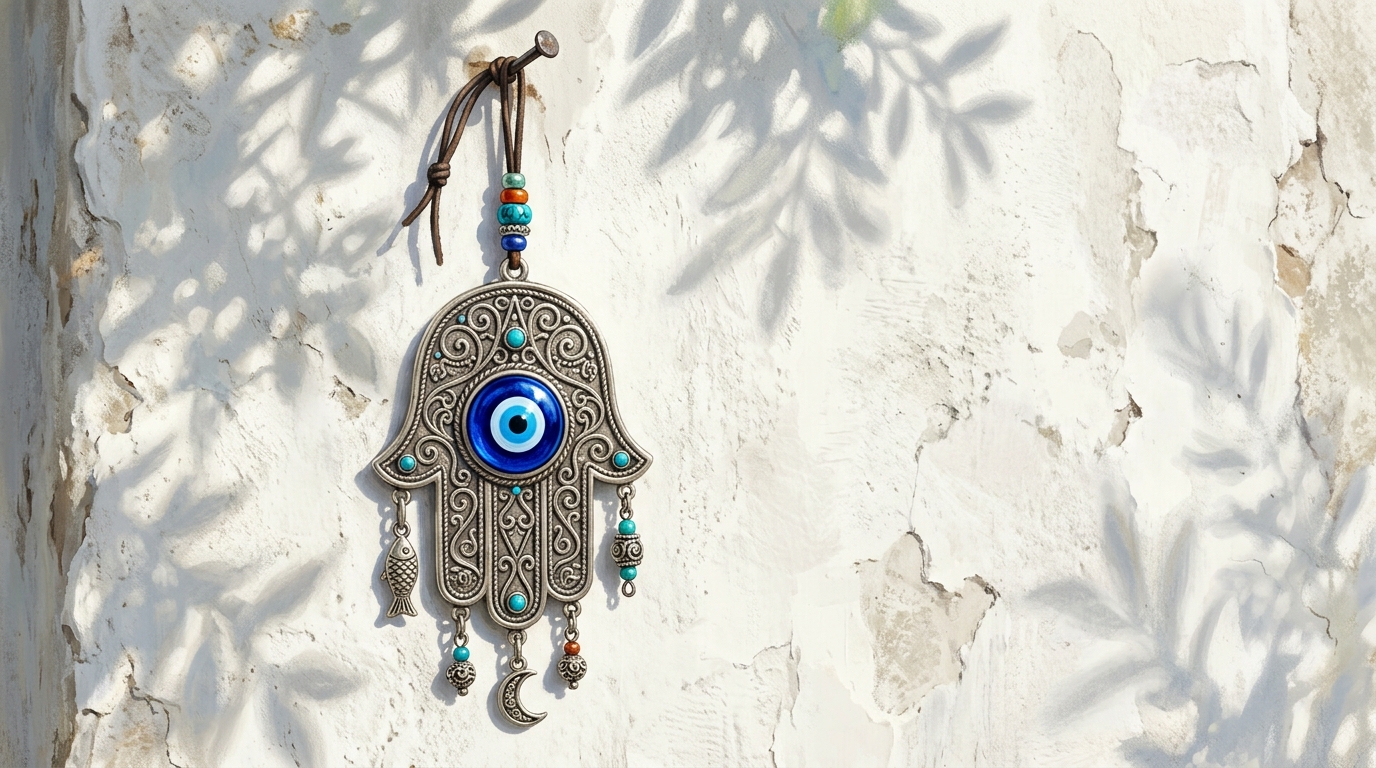
The khamsa (also spelled khmissa in Morocco) is a stylized image of an open right hand, palm outward, fingers together or slightly spread, often with a stylized eye placed in the middle of the palm. Its core, near-universal purpose is protection against the evil eye — the belief, found across the Mediterranean, Middle East, and North Africa, that an envious or malicious stare can bring illness, bad luck, or misfortune to its target, even unintentionally.
The number five is central to the symbol's meaning, not incidental to it. Khamsa is simply the Arabic word for "five," referring to the five fingers of the hand, and a common Arabic protective phrase, khamsa fi ainek ("five [fingers] in your eye"), makes the connection between the number and the eye explicit — an assertive gesture aimed at deflecting a harmful gaze rather than passively warding it off.
In Morocco, the eye set into the palm of many khamsa designs makes this logic visible: the symbol does not just block the evil eye in the abstract, it stares back at it. That combination — an assertive, watching hand — is why the khamsa shows up specifically at thresholds and vulnerable points: house doors, shop entrances, cribs, and jewelry worn close to the body, including on newborns and pregnant women.
A much older symbol than any one religion
The open-hand amulet predates Islam, Judaism, and Christianity in the region by a wide margin. Open-hand protective motifs appear in the ancient Near East, with connections proposed to the "Hand of Ishtar" in ancient Mesopotamia and Babylon, and to the Egyptian Mano Pantea, in which two extended fingers represented the goddess Isis and the god Osiris and the thumb represented their child Horus. Archaeological evidence, including an engraved hand from an Iron Age tomb at Khirbet el-Qom in ancient Judah, shows the motif already functioning as a protective symbol in a funerary context well over two thousand years ago.
Its documented use as a wearable amulet became especially prominent in medieval al-Andalus, the Muslim-ruled territories of the Iberian Peninsula. According to historical accounts, Amazigh (Berber) communities brought the khamsa into al-Andalus, and centuries later, when Muslim and Jewish populations were expelled from Spain, they carried the symbol back with them into North Africa, reinforcing its presence across Morocco, Algeria, and Tunisia. Clear documentation of the hamsa as an amulet exists from at least the thirteenth century onward.
That layered history is why the khamsa cannot be claimed as belonging to a single faith. It has been worn and displayed by Muslim, Jewish, and even Christian communities across the region for centuries, with each tradition attaching its own explanation to the same basic shape.
One symbol, several religious explanations
In Jewish tradition, the hand carries deep resonance: some of the earliest known appearances of hand amulets are found in Israelite tombs dating back roughly to 800 BCE, and in Kabbalistic interpretation the five-fingered hand shape doubles as a visual reference to the Hebrew letter Shin, the first letter of Shaddai, one of the names for God. Biblical language about God's protective "strong hand" leading the Israelites out of Egypt reinforces the association. The symbol was historically most prevalent among Sephardic and Middle Eastern Jewish communities, including Morocco's, though its use had largely faded among Ashkenazi Jewish communities by the mid-twentieth century.
In Islamic practice, the specific label "Hand of Fatima" — referring to Fatima, daughter of the Prophet Muhammad — is a comparatively modern framing. Historical accounts trace the popularization of that name to French colonial North Africa, where European writers and administrators applied it to a symbol that Amazigh and Arab communities had already been using under other names, including khamsa itself. In Shia Islamic interpretation specifically, the five fingers are sometimes read as representing the Panjtan, or Five People of the Cloak: Muhammad, Ali, Fatima, Hasan, and Husayn. Notably, some Salafi religious authorities reject the khamsa as an amulet, issuing rulings that it is impermissible to hang or wear it for protective purposes, since attributing protective power to an object rather than to God is considered theologically problematic in that interpretation.
Levantine Christian communities adopted their own version too, referring to it as the Hand of Mary (Kef Miryam in Arabic), and pendants combining the hand shape with explicitly Christian religious inscriptions have been documented historically — further evidence of how thoroughly the symbol crossed confessional lines rather than staying confined to one tradition.
The specifically Amazigh and Moroccan version
In Amazigh (Berber) languages, the word for the decorative hand motif, afus, simply means "hand," underlining how deeply the symbol is embedded in Amazigh material culture rather than being a borrowed decorative import. Morocco's Amazigh communities have long produced khamsa jewelry and hamsa-decorated objects as part of a broader visual tradition that also includes geometric textile weaving, pottery, and tattoo-like body art motifs.
Jewish silversmiths working in cities such as Fez, Marrakech, Meknes, and the Sous Valley historically produced much of Morocco's most elaborate khamsa jewelry, blending Sephardic, Amazigh, and Arab design elements into pieces that were often larger and more architecturally elaborate than khamsa jewelry made further east, frequently incorporating coral and enamel work alongside silver. This cross-community craftsmanship is itself a physical record of how closely Morocco's Jewish and Muslim communities lived and worked together for centuries before most of Morocco's Jewish population emigrated in the mid-twentieth century.
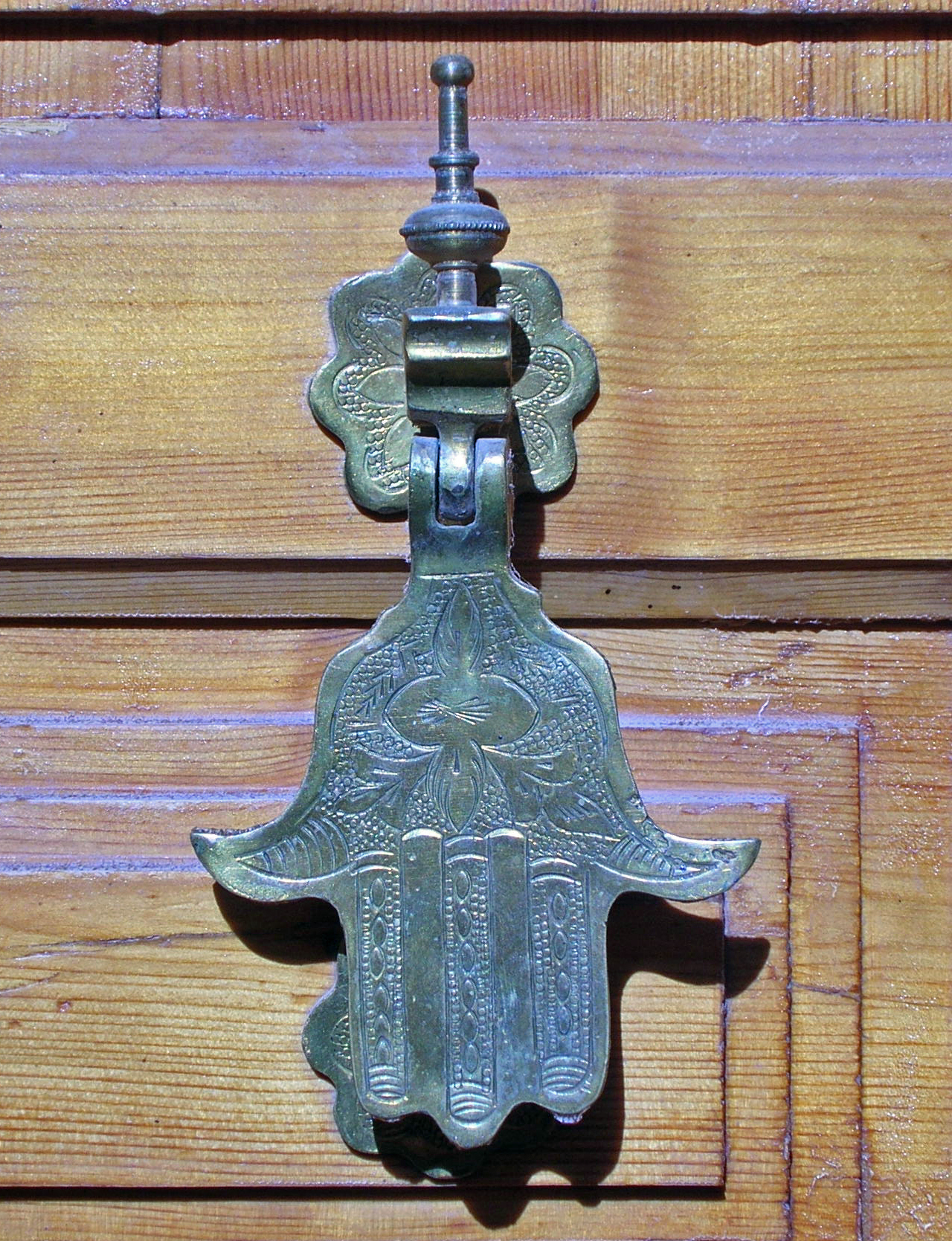
Today, khamsa jewelry remains widely worn by Moroccan women, both as a fashion object and, for many, as a genuine expression of the older protective belief, and hand-shaped door knockers like those found in southern towns such as N'Kob remain a recognizable feature of traditional Moroccan architecture.
Visually, longtime collectors and jewelers often distinguish Moroccan and wider Maghrebi khamsa pieces from those made further east by their heavier use of silver over gold, bolder and chunkier geometric framing around the hand, and a heavier reliance on enamel and coral inlay rather than fine filigree — differences that trace directly back to the specific materials and techniques available to Amazigh and Jewish silversmithing communities in the Atlas and the Sous Valley rather than to any doctrinal difference in meaning.

Where and how the khamsa is used today
Beyond jewelry and door knockers, the khamsa appears throughout Moroccan visual life: painted or tiled above shop entrances, printed on textiles, embroidered on clothing, and depicted in home decor. Its placement is rarely accidental — it tends to appear at points of transition and vulnerability: doorways where the outside world meets the home, the necklines and wrists of clothing, and objects associated with children and childbirth.
The symbol has also traveled well beyond its original protective function. Across North Africa and the wider diaspora, the khamsa has become a popular secular "good luck" charm sold on keychains, postcards, and in tourist shops, stripped of any specific religious framing for buyers who simply find the design appealing or meaningful as a general good-luck token. It has also become something close to a national emblem in parts of the region — the khamsa is one of the recognized national symbols of Algeria, for instance, appearing in official iconography — reflecting how far the symbol has traveled from a purely private, household amulet toward broader cultural and even political identity.
Whether worn as sincere protection, inherited family custom, fashion, or a nod to Amazigh and North African identity, the khamsa's staying power comes from exactly this flexibility: a single, simple hand shape that different communities in Morocco have filled with their own meaning for well over a thousand years, without ever fully agreeing on — or needing to agree on — a single explanation. That flexibility is also why the symbol travels so easily: a Moroccan visitor abroad, a jeweler in a diaspora community, or a designer reworking traditional motifs for a modern collection can all reach for the khamsa without having to first settle which of its many historical meanings they intend.

Frequently asked
What does khamsa mean?
Khamsa is the Arabic word for "five," referring to the five fingers of the open-hand symbol. In Morocco it is also called khmissa, and internationally it is often known as the Hand of Fatima or hamsa.
What is the khamsa supposed to protect against?
The khamsa's core purpose is protection against the evil eye — the widespread belief across the Mediterranean, Middle East, and North Africa that an envious or malicious look can cause harm, illness, or misfortune, even unintentionally.
Is the khamsa a religious or a secular symbol?
Both, depending on who is using it. It has deep roots in pre-Islamic and pre-Jewish Near Eastern amulet traditions, and today carries specific meanings in Jewish, Islamic, and Christian practice in the region, while also functioning as a purely secular good-luck charm sold widely as jewelry and souvenirs.
Why is it called the Hand of Fatima?
The name refers to Fatima, daughter of the Prophet Muhammad, but this specific label is a relatively modern one, popularized by European writers during the French colonial period in North Africa for a symbol that Amazigh and other communities had already used for centuries under other names, including khamsa.
Did Jewish communities in Morocco also use the khamsa?
Yes, extensively. Jewish silversmiths in cities such as Fez, Marrakech, Meknes, and the Sous Valley were historically among Morocco's leading khamsa jewelry makers, blending Sephardic, Amazigh, and Arab design elements, and the symbol has deep roots in Jewish tradition, including a Kabbalistic association with the Hebrew letter Shin.
What is the Amazigh (Berber) connection to the khamsa?
In Amazigh languages the word afus means "hand," and Amazigh communities are historically credited with carrying the khamsa into medieval al-Andalus, from where it returned to North Africa with expelled Muslim and Jewish populations. Amazigh jewelry and craft traditions remain a major source of Moroccan khamsa design today.
Where is the khamsa typically placed or worn in Morocco?
Common placements include door knockers and entrances, shop fronts, jewelry (especially necklaces and bracelets), children's clothing, and objects connected to childbirth — generally points seen as vulnerable to the evil eye, particularly thresholds between inside and outside.
Do all Muslims accept the khamsa as a valid religious symbol?
No. While many Muslim communities in North Africa use it as a folk protective symbol, some Salafi religious authorities have issued rulings against wearing or hanging the khamsa as an amulet, viewing the attribution of protective power to an object as theologically problematic.
How old is the open-hand protective symbol?
Very old. Open-hand amulets appear in the ancient Near East, with proposed links to the Mesopotamian "Hand of Ishtar" and the Egyptian Mano Pantea, and archaeological finds such as an engraved hand from an Iron Age tomb in ancient Judah show the motif functioning as protection well over two thousand years ago, long before it took its modern khamsa form.
Is the khamsa specific to Morocco?
No, it is used across much of North Africa, the Middle East, and parts of the Mediterranean, but Morocco has one of the richest and most distinctive khamsa traditions, shaped by its blend of Amazigh, Jewish, and Arab craftsmanship, and the symbol also appears as a national emblem in neighboring Algeria.
- Wikipedia — Hamsa ↗
- Bedouin Silver — Khamsa in Jewellery: History, Symbolism, and the Hand of Fatima ↗
- Touring in Morocco — The Hand of Fatma or Khamsa in Morocco ↗
- Best Morocco Travel — Hand of Fatima & Hamsa: Symbolism in Morocco ↗
- MoroCraft — Hand of Fatima: Five Powerful Meanings You Need to Know ↗
- Sky Jems — Hamsa: The Jewelled Hand Against the Evil Eye ↗
Video via official YouTube embeds; photos via Wikimedia Commons under their stated licenses. All rights belong to the respective owners; 212 Daily claims no ownership.