Jesse Marsch's Canada vs Morocco: The Tactical Plan to Beat the Atlas Lions in Houston

The Fixture: Canada vs Morocco, Round of 16, Houston
On Saturday, July 4, 2026, Canada meet Morocco in the Round of 16 of the FIFA World Cup at NRG Stadium in Houston, with kickoff scheduled for 1:00pm Eastern Time. For a co-host nation that had never before won a match at a men's World Cup, this is uncharted territory: a place in the last sixteen, a marquee venue, and a genuinely winnable tie against an opponent that has just survived one of the tournament's most dramatic nights. For Morocco, fresh off a penalty-shootout elimination of the Netherlands, it is another test against a team that will not sit back and admire them.
The framing of this preview matters. As of July 1, the match has not been played. There is no score to report, no hero to crown, and nothing here should be read as a forecast of the result. What follows is a tactical study of how Jesse Marsch is likely to set Canada up to win, drawn from the identity he has built over a coaching career steeped in the Red Bull school of football, and a look at where Mohamed Ouahbi's Morocco - organized, technical and ruthless in transition - can make that plan backfire.
The stylistic contrast is what makes the fixture so compelling. Canada want to hunt the ball, compress the pitch and attack in straight lines. Morocco want to defend with structure, invite pressure and then punish it with Achraf Hakimi's runs and the passing of Brahim Diaz and Bilal El Khannouss. A game of pressing against counter-pressing, of vertical Canadian ambition against Moroccan control, is exactly the kind of chess match that decides knockout football. Readers who followed our tactical breakdown of how Morocco beat the Netherlands will recognize the questions Canada now have to answer.
There is also a human dimension that colors the occasion. Houston is home to a large North African diaspora and a growing Canadian soccer following, and a July 4 kickoff on American soil during a tournament co-hosted by Canada, Mexico and the United States guarantees a charged atmosphere. Both fan bases travel and both sing. The noise inside NRG Stadium will be part of the tactical picture, because pressing teams feed off crowd energy and deep-lying teams have to keep their heads when the volume rises.

Who Is Jesse Marsch? From Princeton to the Red Bull Empire
To understand how Canada will play, you have to understand the coach. Jesse Marsch is an American, born in Racine, Wisconsin, in 1973, and a Princeton graduate whose playing career unfolded in Major League Soccer with D.C. United, the Chicago Fire and Chivas USA. He was a combative, intelligent midfielder rather than a star, the kind of player who tends to become a coach. His first significant coaching education came on the international stage as an assistant to Bob Bradley with the United States men's national team, including at the 2010 World Cup, which planted the roots of the pressing, front-foot identity he would later make his signature.
There is a Canadian footnote to his origin story that has aged beautifully: Marsch was the first-ever head coach of the Montreal Impact when the club entered MLS in 2012. He then took over the New York Red Bulls, where his high-energy, high-pressing teams won the Supporters' Shield and where he fully immersed himself in the Red Bull method. That performance earned him a move into the European side of the Red Bull network, first as an assistant at RB Leipzig, then as head coach of Red Bull Salzburg.
Salzburg was where his reputation crystallized. His teams there won domestic doubles, developed a conveyor belt of elite young talent and pressed opponents into submission with a relentless, coordinated intensity that made them one of the most watchable sides in Europe. That success bought him a return to RB Leipzig as head coach in 2021, a spell that ended prematurely in December of that year, and then a move to the Premier League with Leeds United in 2022, where he fought to keep a struggling side up before being dismissed in early 2023.
Those setbacks matter because they shaped the coach Canada hired. Marsch arrived at the Canadian job in 2024 with scar tissue from the unforgiving worlds of the Bundesliga and the Premier League, but also with a clarified philosophy. He is not a coach who reinvents himself for every opponent. He believes in an identity - aggression, verticality, collective running - and he sells it to players with a conviction that borders on evangelism. His post-match speeches at this World Cup, which he has cheerfully refused to soften even when critics call them performative, are an extension of that same relentless belief system.
For a deeper look at the man on the opposite bench, our profile of Mohamed Ouahbi - the youth-development specialist who took over Morocco only months before the tournament - is the natural companion to this piece. The two coaches could hardly be more different in temperament, and that contrast will play out on the touchlines in Houston.
The Canada Rebuild: What Marsch Inherited and What He Changed
Marsch did not build Canada's golden generation - that credit belongs to the qualification cycle that ended a 36-year World Cup drought - but he inherited it at a delicate moment and gave it a clearer competitive edge. When he took charge in 2024, Canada had talent and belief but had struggled to translate both into results on the biggest stages. His first major tournament in charge, the 2024 Copa America, produced a run to the semi-finals and a fourth-place finish, an eye-catching result that announced Canada as a side that could live with elite South American opposition.
The rebuild was as much psychological as tactical. Marsch pushed a message of fearlessness and identity, insisting that Canada should impose themselves rather than survive. He built the team around a spine of Bayern Munich's Alphonso Davies, the goalscoring of Jonathan David, the midfield steel of Stephen Eustaquio and the athleticism of defenders like Moise Bombito and Alistair Johnston. Around that core he demanded the kind of coordinated pressing and quick vertical play that had defined his club sides.
Crucially, Marsch has managed personnel and fitness with an eye on the long game of a tournament. The most significant example is Davies himself, who arrived at the World Cup managing a hamstring problem and was reintroduced carefully - held back, then unleashed as a substitute in the Round of 32 win over South Africa, a cameo that visibly lifted the team. That kind of squad management, resisting the temptation to rush a talisman, is exactly the sort of decision that separates coaches who last deep into tournaments from those who burn out their best players early.
The results at this World Cup tell the story of a team that has learned to win ugly as well as pretty. A commanding win over Qatar showcased the free-flowing, high-scoring version of Marsch's Canada, while a narrow, gritty knockout victory over South Africa showed a side capable of grinding out a result under pressure. Against Morocco, they will likely need both faces of their identity within the same ninety minutes.

The Red Bull DNA: Gegenpressing as a First Principle
At the heart of everything Marsch does is the counter-press, or gegenpressing: the idea that the best time to win the ball is in the seconds immediately after you lose it, when the opponent is unbalanced and not yet set. In the Red Bull model, the moment of transition is not a threat to be survived but an opportunity to be attacked. Canada are drilled to swarm the ball-carrier in packs, cut off the nearest passing lanes and force turnovers high up the pitch where they can be converted into fast, direct attacks on goal.
This is a physically and mentally demanding way to play. It requires every outfield player to understand pressing triggers - the cues, such as a heavy touch, a pass into a corner, or a slow ball played backward, that tell the team it is time to jump. It requires the front players to press in coordinated lines so that the man on the ball has no easy escape, and it requires the midfield and defense to step up aggressively behind the press to compress the space and win the second ball. When it clicks, it looks like the opponent is being suffocated.
The other half of the Red Bull identity is verticality. Marsch's teams do not press to then patiently pass the ball around; they press to win it and go, looking for the fastest route to goal. The instruction is to play forward whenever forward is on, to attack the space behind a disorganized defense before it can recover its shape. This is why his sides so often score within seconds of winning possession, and why Canada, with the raw pace of Davies and the movement of David, are so dangerous in the chaotic moments that a high press manufactures.
Against Morocco, this philosophy will be tested by an opponent that is comfortable being pressed. Ouahbi's side did not panic under Dutch pressure, and they have technicians - Brahim Diaz, El Khannouss, the pivot players - who can play through a press with one or two clean touches. The central tactical question of the match is whether Canada's pressing can be coordinated and disciplined enough to trap Morocco, or whether Morocco's quality on the ball will let them break the press and expose the spaces Canada leave behind when they commit bodies forward.
Canada's Likely Shape: A Pressing 4-3-3
Marsch's default structure is a 4-3-3 that morphs into a 4-2-2-2 or a narrow 4-4-2 in the press, and Canada are likely to line up in a version of that against Morocco. The back four provides the platform, a midfield three gives the pressing structure its engine, and a front three led by Jonathan David sets the first line of pressure. The shape is designed to give the team clear reference points for whom to press and which passing lanes to cut, while keeping enough numbers central to protect against being played through.
The midfield three is the key to the whole system. Typically it features a controlling anchor - Stephen Eustaquio is the natural candidate, a metronome who screens the defense and starts attacks - flanked by two more mobile, box-to-box runners such as Ismael Kone and Jonathan Osorio, whose job is to press forward, support the front line and arrive late in the box. Getting the balance right here is delicate: press too aggressively with all three and Morocco's technicians will find the space vacated in front of the back four; sit too passively and Canada surrender the initiative that is their whole reason for being.
Out wide, Canada's front three are hybrid threats. On one flank, the pace and directness of players like Tajon Buchanan or a rotating cast of wingers gives width and a running threat in behind. On the other, the great tactical question is where to deploy Alphonso Davies - as an orthodox left-back bombing forward, or higher up as a left winger or wing-back where his acceleration can be pointed straight at the Moroccan goal rather than being spent tracking Hakimi. That single decision may shape the entire contest, and it is examined in detail below.
Defensively, expect Canada to be brave with their line. Marsch teams push up to compress the field, betting that their pressing will prevent clean balls in behind and that their defenders - athletic types like Bombito and Johnston - can win footraces if the line is breached. Against a team with Hakimi's engine and Morocco's counterattacking speed, that high line is both Canada's greatest weapon and their most obvious vulnerability.
Alphonso Davies as the Outlet
No single player defines Canada's ceiling like Alphonso Davies. The Bayern Munich star is one of the fastest players in world football and one of the very few who can turn a defensive action into a goalscoring threat within the span of a single run. For a team built on transitions, he is the perfect outlet: win the ball, find Davies in space, and let his acceleration do the rest. His reintroduction as a substitute in the knockout win over South Africa was a turning point precisely because his presence stretches the game and forces opponents to think about the space behind their own defense.
The tactical dilemma for Marsch is how to maximize Davies without exposing Canada. Deployed as a left-back, Davies offers overlapping runs and recovery pace, but he would spend much of the game in a direct duel with Achraf Hakimi, arguably the best attacking full-back on the planet. That is a heavyweight matchup that could tilt either way and could pin Davies deeper than Canada would like. Deployed higher, as a left winger or left-sided forward in transition, Davies becomes a pure attacking weapon aimed at Morocco's goal, but Canada then need cover behind him for the space Hakimi will attack.
The likely compromise is a fluid role in which Davies starts from the left of the defensive line but is licensed to explode forward the instant Canada win the ball, with a midfielder or the left-sided forward tucking in to cover. This is classic Red Bull thinking: use your best athlete as the tip of the counterattacking spear while building the structure around him to survive the moments he is upfield. If Canada get this balance right, every Moroccan turnover becomes a potential fast break down the left.
For Morocco, the counter-plan is equally clear: do not give Davies a running start. That means keeping possession securely so Canada cannot counter, defending the transition moment aggressively so any turnover is contested immediately, and using Hakimi's own attacking to pin Davies back and make him defend. The Davies-Hakimi flank is the single most glamorous duel of the tie, a contest between two of the fastest, most dynamic full-backs in the world, and it will be worth the price of admission on its own.
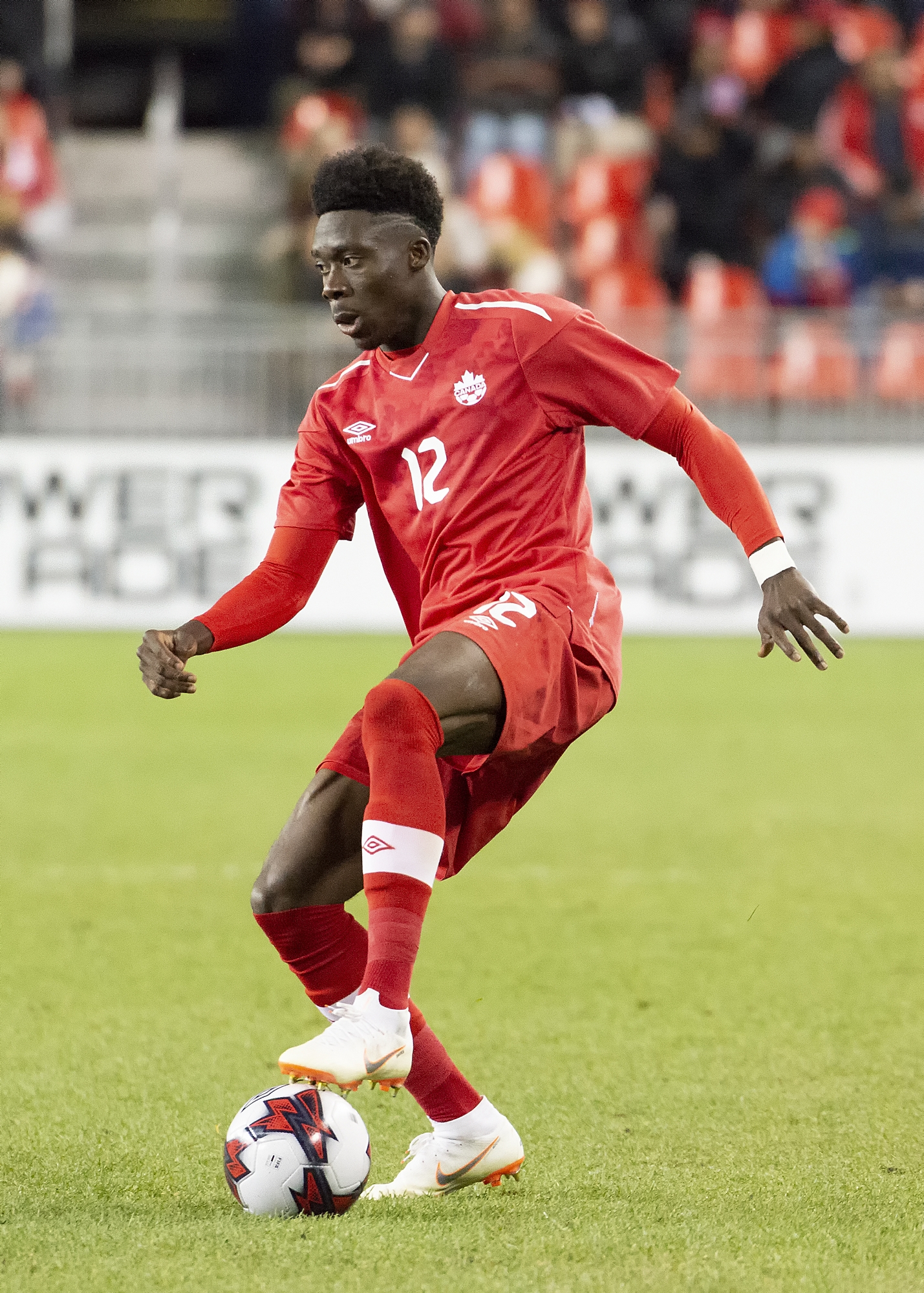

Jonathan David's Runs and the Striker's Job in a Marsch System
If Davies is the outlet, Jonathan David is the finisher, and his role in a Marsch system is more demanding than a casual glance at his goal tally suggests. Canada's all-time leading scorer is a supremely intelligent mover, and in a pressing team the center-forward is the conductor of the defensive effort as much as the spearhead of the attack. David sets the first pressing trigger, curving his runs to shepherd Moroccan center-backs and goalkeeper Yassine Bounou toward the touchline while cutting off the pass back into midfield.
In possession, David's value is in the timing and direction of his runs. Against a deep, organized Moroccan block there will be little space to run into, so he must be clever - dropping to link play and drag a center-back out of position, then spinning in behind the instant a teammate wins the ball high. In transition, when Morocco are caught upfield, David's diagonal runs across the last defender are exactly the movement that turns a Canadian counter into a clear chance. His finishing is elite, and Canada's whole plan is geared to manufacture the two or three moments per game where that finishing decides things.
The challenge is that Morocco's central defense is physical, disciplined and used to marshalling a low block. David will not be gifted space; he will have to create it through movement and combination play, often with a midfielder breaking beyond him. This is where the runners from Canada's midfield three become vital - a late arrival from Kone or Osorio, or an underlapping burst, can create the numerical overload that pulls a Moroccan defender away from David and opens the crucial half-yard.
There is also a game-state dimension. If the match becomes stretched in the second half, as knockout games so often do when legs tire in the Houston heat, David's movement in the spaces that open up becomes even more lethal. Marsch's substitutions - fresh legs to renew the press and stretch a tiring Moroccan back line - are designed precisely to create those late openings for his most clinical player.
The High Press vs Morocco's Build-Up
The decisive battle of the match may be fought in the first phase of Morocco's build-up: goalkeeper, center-backs and pivot trying to play out under the weight of Canada's press. Marsch will want his front three and midfield runners to jump aggressively the moment Morocco try to build, cutting the pitch in half and forcing Bounou into long, hopeful clearances that Canada's defenders can gather. Every win here is doubly valuable: it stops a Moroccan attack and starts a Canadian one in a dangerous area.
Morocco, however, are unusually well equipped to beat a press. Bounou is comfortable with the ball at his feet, the center-backs are composed, and the presence of a genuine deep-lying passer allows Morocco to draw the press in and then break it with a single line-splitting pass. Players like Brahim Diaz and El Khannouss are precisely the profiles who thrive against a high press, because they receive between the lines, turn in tight spaces and release runners before the press can recover. If Morocco can consistently play through the first wave, Canada's aggression becomes a liability rather than a weapon.
This is the tension at the core of the tie. Canada's press is high-risk, high-reward: dominate the trigger moments and they can strangle Morocco and score cheap goals; get baited and bypassed and they leave a stretched, vulnerable defense exposed to Morocco's best counterattacking players. The team that wins the majority of these build-up duels will likely win the match, and it is why the coaching staffs will have spent the days before Houston obsessing over pressing angles and passing patterns.
Expect Marsch to be selective rather than reckless. The smartest version of his press does not chase for ninety minutes; it picks its moments, springing the trap when the cue is right and dropping into a compact mid-block when it is not. Reading when to jump and when to hold is the difference between a press that suffocates Morocco and one that Morocco slice open, and it is a collective decision that eleven players must make in unison, over and over, for the length of the game.

Vertical Transitions: Canada's Fastest Route to Goal
When Canada win the ball, the clock starts. Marsch's teams are coached to attack the transition moment before the opponent can re-set, and against a Morocco side that likes to commit Hakimi and its midfielders forward, those windows will exist. The blueprint is simple in concept and brutal in execution: win it, play forward immediately, and get Davies and David running at a defense that is facing its own goal.
The first pass out of the press is everything. Canada will look to release a runner in behind or find a forward's feet between the lines with a single vertical ball, bypassing the temptation to slow down and build. The midfield runners then flood forward to support, turning a two-versus-two into a four-versus-four in seconds. This is where Canada can score the kind of goals that do not require them to break down Morocco's set block at all - goals born of chaos rather than construction.
Morocco's defense against this is what tacticians call rest defense - the positioning of players while in possession so that the team is balanced for the moment it loses the ball. Ouahbi will insist that Morocco never over-commit, keeping a pivot and both center-backs anchored even when Hakimi bombs forward, so that a Canadian turnover runs into an organized first line rather than open grass. If Morocco's rest defense is disciplined, Canada's transitions fizzle out against numbers; if it is loose, Canada will find the running lanes their whole game is built to exploit.
The Houston heat adds a layer here. Pressing and counter-pressing are enormously taxing, and the team that can sustain its transition threat deepest into the game gains a decisive edge as the match opens up. Marsch's bench, and his willingness to throw on fresh, fast legs to keep the vertical threat alive, could be as important as anything in his starting eleven.
Where Ouahbi's Morocco Can Hurt Canada
For all Canada's ambition, Morocco arrive as arguably the more complete side, and they have obvious ways to hurt Marsch's team. The first and most dangerous is Achraf Hakimi. If Canada push Davies high and leave space behind him, Hakimi is the ideal player to attack it, combining with the right winger to create two-versus-one overloads down Canada's left. Every yard Canada commit forward on that flank is a yard Hakimi can exploit going the other way.
The second is Morocco's quality between the lines. Brahim Diaz and Bilal El Khannouss are the kind of press-resistant creators who turn a broken press into a killer attack. Give them a half-second in the pocket between Canada's midfield and defense and they will slide a runner through or drive at a retreating back line. Against a team that deliberately vacates central space to press, that is a recurring danger, and it is exactly the profile of player who punishes high defensive lines.
The third is the emerging threat of players like Eliesse Ben Seghir and the movement of striker Ismael Saibari, who scored the decisive penalty against the Netherlands and offers exactly the kind of intelligent running that stretches a high line. If Canada defend aggressively up the pitch, Morocco have the runners to get in behind and the passers to find them. A single ball over the top into that space can undo twenty minutes of Canadian pressing dominance.
Finally, there is Morocco's temperament. This is a side that just absorbed relentless Dutch pressure, equalized in the 90+1 minute through Issa Diop and held its nerve in a shootout won by Bounou's save. They do not panic when pressed, they do not lose their shape when chasing a game, and they have a goalkeeper who wins knockout ties. Canada's aggression will be met by a team that has proven it can stay calm in exactly the kind of chaos Marsch wants to create.
The Hakimi-Davies Duel and the Battle of the Flanks
The marquee individual battle is Achraf Hakimi against Alphonso Davies, two of the fastest and most attack-minded full-backs on earth, most likely stationed on the same side of the pitch. It is a duel with a fascinating strategic wrinkle: whoever is forced to defend the other is a player whose true value lies in attack. If Hakimi pins Davies back, Canada lose their best outlet. If Davies pins Hakimi back, Morocco lose one of their best attacking weapons. Both coaches will try to make the other's star do the defending.
Marsch's likely answer is to make the duel happen in Morocco's half. If Canada can keep the ball high and press Morocco deep, then Hakimi is the one defending near his own corner flag and Davies is the one running at goal. That is Canada's ideal version of the flank battle. Ouahbi's answer is the mirror image: control possession, let Hakimi advance, and make Davies spend his energy chasing back rather than sprinting forward. The flank that wins this psychological and physical tug-of-war will likely swing the match.
The opposite flank matters too, and it may be quieter but no less important. Morocco's left side, where Noussair Mazraoui and a wide forward operate, will be tested by Canada's right-sided runners, while Canada's right-back and winger must guard against Morocco switching play to isolate their most dangerous man one-versus-one. Smart teams attack the side away from the marquee duel, and both coaches will look to overload whichever flank the other has weakened by loading up elsewhere.
Wing play, in other words, is where this game is likeliest to be decided, because it is where both teams are strongest and where both are most willing to take risks. Full-backs bombing forward, wingers isolating defenders, switches of play to exploit a shifted block - the touchlines in Houston will be the busiest real estate on the pitch.
The Midfield Battle: Structure vs Runners
Between the two penalty areas, the game will be shaped by a contrast of midfield philosophies. Canada's three is built for energy and pressing, with an anchor screening the defense and two runners shuttling forward to hunt the ball and support attacks. Morocco's midfield is built for control and progression, with a pivot to break up play and technicians who receive between the lines and dictate tempo. The team that controls the center controls the terms of the match.
For Canada, the danger is being outplayed through the middle. If Morocco's passers get on the ball facing forward, they can carve open the spaces that Canada's aggressive midfield leaves behind. The Canadian runners must therefore press with discipline, jumping only on the right cues and recovering their shape quickly when the press is beaten, or they will find themselves chasing shadows while Brahim Diaz and El Khannouss pick them apart. Stephen Eustaquio's positioning as the deepest midfielder - screening the passes into Morocco's creators - is quietly one of the most important jobs on the pitch.
For Morocco, the danger is being overrun physically. Canada's midfielders are athletic and relentless, and if Morocco try to play too many short passes under pressure without an outlet, they risk being swarmed and turned over in dangerous areas. Ouahbi's men will need the composure to know when to play through the press and when to go long to reset, using Bounou and the center-backs as pressure valves rather than forcing the issue.
This is a classic tactical trade-off: Canada's midfield is designed to win the ball, Morocco's to keep and progress it. Whichever identity imposes itself in the opening twenty minutes will set the tone. If Canada's runners dominate the second balls and turnovers, the game becomes the frantic, vertical contest they want. If Morocco's technicians settle on the ball and start to control tempo, the game slows into the kind of patient, structured match that suits the Atlas Lions.

Set Pieces: An Underrated Path to Goal
In tight knockout games between well-matched sides, set pieces are frequently the difference, and both teams have reasons to fancy themselves. Marsch's coaching background places heavy emphasis on the details of dead-ball situations, and Canada carry aerial threats and a deliberate, rehearsed approach to attacking corners and free-kicks. In a match where open-play chances may be scarce against a disciplined Moroccan block, a well-worked set piece could be Canada's cleanest route to goal.
Morocco, for their part, are a serious set-piece side both ways. Their equalizer against the Netherlands came from Issa Diop rising in the 90+1 minute, a reminder that this team has the aerial power and the delivery to score from dead balls at the most important moments. Defensively, Morocco's tall, physical center-backs make them difficult to break down in the air, which only raises the stakes on the quality of Canada's delivery and the cleverness of their routines.
The margins here are fine and the preparation is meticulous. Blocking runs, near-post flicks, second-phase set-ups, short-corner combinations to change the angle of delivery - these are the small details that coaching staffs pore over in the days before a match like this. In a game that could well be decided by a single goal, whichever side executes its set-piece routines more sharply may earn the decisive moment.
There is a defensive discipline component too. Conceding needless fouls in dangerous areas, or switching off at the second phase of a corner, is exactly how tight matches slip away. Both Marsch and Ouahbi will have drilled their teams on the unglamorous work of defending set pieces, because at this level a lapse of concentration on a dead ball can undo everything the tactics achieved in open play.
Marsch's In-Game Management and the Bench
One of Marsch's underrated strengths is his willingness to intervene during a match rather than trust a plan to survive contact with reality. His teams make aggressive, proactive substitutions, and he is not shy about changing shape mid-game to chase a result. Against Morocco, where the flow could swing sharply between Canadian pressing spells and Moroccan control, that in-game flexibility could be decisive. Expect him to read the pressing battle in real time and adjust his triggers, his line height and his personnel accordingly.
The bench is a weapon in a pressing system because pressing is exhausting. Fresh legs late in a game can renew an intensity that a tiring opponent can no longer match, and Marsch has shown a pattern of using substitutes to sustain or ramp up the press in the final half hour. In the Houston heat, that squad depth could tell: a Moroccan back line that has defended heroically for seventy minutes is exactly the kind of target a wave of fresh Canadian runners is designed to break.
There is also the Davies factor as a managed asset. Marsch's careful handling of his talisman's fitness gives him a tactical option many coaches lack: the ability to introduce a game-breaking talent into a stretched, tiring match, precisely when the space for Davies's pace is at its greatest. Whether Davies starts or is held back, his availability from the bench is a threat that forces Morocco to keep defending the transition long after they might otherwise have settled.
Finally, there is Marsch's emotional management. His touchline energy and his much-discussed speeches are not just theater; they are a deliberate tool to keep a young team playing on the front foot when the pressure of a knockout tie might otherwise make it shrink. A team that believes it belongs plays with the courage a high press requires. Whether that belief holds up against a Moroccan side that has already survived a shootout will be one of the quieter but more important subplots of the afternoon.

Canada's Vulnerabilities Morocco Can Exploit
Every plan carries a cost, and Canada's aggressive identity comes with clear vulnerabilities that Morocco are well built to exploit. The most obvious is the space behind a high defensive line. When Canada push up to compress the pitch, they invite the ball over the top, and Morocco have both the passers to deliver it and the runners - Saibari, Ben Seghir, a bursting Hakimi - to attack it. One perfectly weighted pass can turn Canada's pressing dominance into a one-on-one against the goalkeeper.
The second vulnerability is the transition moment against the transition team. Canada want to counter Morocco, but Morocco are themselves lethal on the counter, and if a Canadian attack breaks down with players committed forward, the Atlas Lions have the pace and precision to punish it. This is a game where over-committing in search of a goal could be fatal, and where the discipline to know when not to press may matter as much as the press itself.
Third is the risk of frustration. If Morocco settle into a compact block and control the tempo, Canada could find themselves passing in front of a well-organized defense without creating clear chances, the same problem the Netherlands faced. A pressing team starved of turnovers can become ragged, over-pressing out of impatience and leaving gaps. Morocco will be perfectly content to make Canada chase the ball, absorb the pressure and wait for the one transition that decides the game.
Fourth, and not to be underestimated, is Morocco's big-game composure. Canada are talented and rising, but Morocco carry the deeper tournament pedigree and a squad that has learned to win knockout football under extreme pressure. In the decisive moments - a late set piece, a possible shootout, a game-state that demands cool heads - that experience is an intangible edge that no tactical plan fully neutralizes.
The Keys to the Match: What to Watch in Houston
Boil the tactics down and a handful of questions will decide the tie. First: can Canada's press consistently trap Morocco's build-up, or will Bounou, the center-backs and the technicians play through it? Every match Marsch's side has controlled has started with winning that first-phase battle, and every one they have lost has featured an opponent comfortable in possession. The opening twenty minutes of pressing will tell us which version of the game we are getting.
Second: who wins the Hakimi-Davies flank? The team that turns that duel into an attacking asset rather than a defensive chore gains an enormous edge. Watch whether Davies is bombing forward at goal or pinned back tracking Hakimi, because that single dynamic will reveal who is dictating terms. Third: can Morocco's rest defense survive Canada's vertical transitions, or will one loose turnover be punished by David and the runners flooding forward?
Fourth: the benches and the heat. This is a July afternoon game in Houston, and the physical demands of pressing football in that climate are enormous. Whichever coach manages his substitutions and his players' legs more shrewdly - keeping the intensity high or the block disciplined as bodies tire - could own the final half hour, which is so often when knockout ties are decided. Fifth: set pieces and composure, the tie-breakers when open play cancels out.
None of this is a prediction. Morocco arrive as the side with the deeper pedigree and a squad brimming with confidence after eliminating the Netherlands; Canada arrive as a fearless, well-coached team with a genuine game-plan and match-winners of their own, on home-continent soil with the whole country watching. For everything you need on the wider fixture, our full Morocco vs Canada Round of 16 preview sets the scene, and our tactical breakdown of how Morocco beat the Netherlands explains the system Marsch's team must now solve. Kickoff is Saturday, July 4, 1:00pm ET, NRG Stadium, Houston.
Frequently asked
When and where do Canada play Morocco at the 2026 World Cup?
Canada face Morocco in the Round of 16 on Saturday, July 4, 2026, at NRG Stadium in Houston, with kickoff scheduled for 1:00pm Eastern Time. It is a single-elimination knockout tie, so the match will be decided on the day, going to extra time and penalties if level after 90 minutes.
Who is Jesse Marsch?
Jesse Marsch is the American head coach of Canada's men's national team. A Princeton graduate and former MLS midfielder, he was the first head coach of the Montreal Impact in MLS, then coached the New York Red Bulls, Red Bull Salzburg, RB Leipzig and Leeds United before taking the Canada job in 2024. He is known for a high-pressing, vertical style rooted in the Red Bull school of football.
What formation will Canada play against Morocco?
Marsch typically sets Canada up in a 4-3-3 that morphs into a compact pressing block. It uses a defensive anchor such as Stephen Eustaquio, two mobile midfield runners, and a front three led by Jonathan David, with Alphonso Davies a key weapon on the left either from full-back or higher up the pitch.
How will Canada try to beat Morocco tactically?
Through a high press to win the ball early, aggressive counter-pressing to trap Morocco in their own build-up, and fast vertical transitions aimed at getting Alphonso Davies and Jonathan David running at a stretched defense. Canada want to make the game chaotic and physical rather than let Morocco control possession.
Where can Morocco hurt Canada?
Morocco can exploit the space behind Canada's high defensive line with balls over the top for runners like Ismael Saibari and Eliesse Ben Seghir, use Achraf Hakimi to attack down Alphonso Davies's flank, and beat Canada's press with press-resistant creators Brahim Diaz and Bilal El Khannouss playing between the lines. They are also lethal on the counterattack themselves.
What is the Alphonso Davies vs Achraf Hakimi matchup about?
It is a duel between two of the fastest, most attack-minded full-backs in the world, likely stationed on the same flank. Whichever coach forces the other's star to spend the game defending gains an edge, because both Davies and Hakimi are most dangerous going forward. It may be the single most important individual battle of the tie.
Did Alphonso Davies play at the 2026 World Cup?
Yes. Davies was managing a hamstring problem earlier in the tournament and was reintroduced carefully, coming off the bench in Canada's Round of 32 win over South Africa, a cameo that lifted the team. His fitness and how Marsch uses him is a major storyline heading into the Morocco game.
Has this Canada vs Morocco match been played yet?
No. As of July 1, 2026, the match has not been played - it is scheduled for July 4. This article is a tactical preview and analysis of how each team is likely to approach the game, not a report of a result. No score, goals or outcome should be assumed.
Who are Morocco's key players in this tie?
Goalkeeper Yassine Bounou, who saved the decisive penalty against the Netherlands, right-back Achraf Hakimi, creators Brahim Diaz and Bilal El Khannouss, forward Ismael Saibari, who scored the winning shootout penalty, and the emerging Eliesse Ben Seghir. They are coached by Mohamed Ouahbi, who took charge months before the tournament.
- Canada Soccer - official site ↗
- CBC Sports - Jesse Marsch on Canada's World Cup expectations (exclusive interview) ↗
- TSN - Jesse Marsch post-match press conference ↗
- CBC Sports - What to expect from Canada's Round of 16 match against Morocco ↗
- CBC Sports - FIFA World Cup ↗
- ESPN - FIFA World Cup 2026 ↗
- Wikipedia - Jesse Marsch ↗
- Wikimedia Commons - Jesse Marsch (Canada v Qatar) by Bryan Berlin (CC BY-SA 4.0) ↗
- Wikimedia Commons - Alphonso Davies by Chris McPhee (CC BY 2.0) ↗
Video via official YouTube embeds; photos via Wikimedia Commons under their stated licenses. All rights belong to the respective owners; 212 Daily claims no ownership.