The Jabador: Inside the History of Morocco's Elite Men's Two-Piece
From everyday layers to a named garment
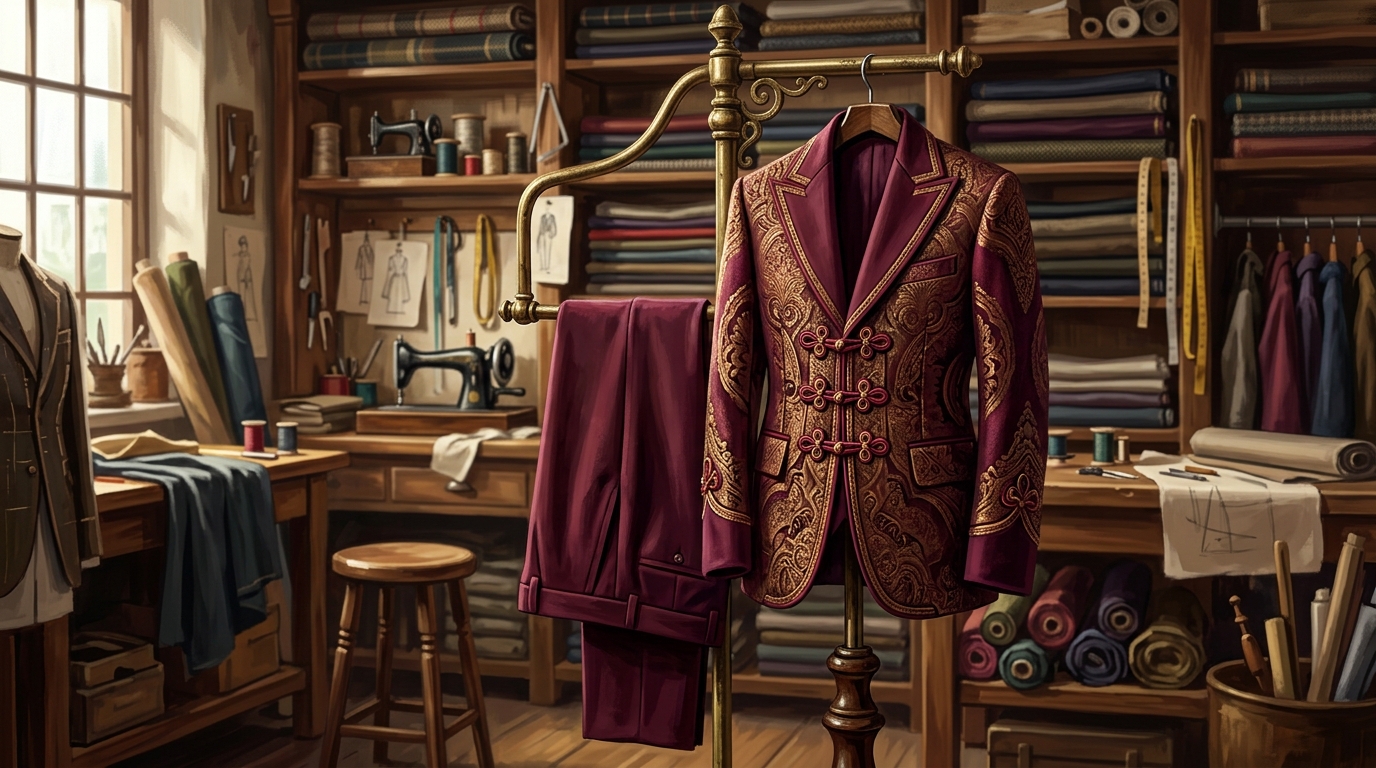
The jabador did not arrive fully formed. Its earliest ancestors are two separate, much older pieces: the serwal, a pair of loose trousers, and the bad'ia, a sleeveless vest, both worn in Morocco since the early era of Islamization. For centuries these were simply components of ordinary dress rather than a single, named ensemble. The modern jabador emerged only when tailors began pairing a fitted jacket with a matching bad'ia and serwal, unifying what had been separate layers into one coordinated outfit.
That unification is generally traced to a blend of outside influences layered onto existing Moroccan tailoring: Ottoman court dress, Persian textile traditions and the Andalusian styles carried into Morocco by refugees and craftsmen from Al-Andalus. Rather than replacing Moroccan clothing, these influences were absorbed into it, producing a garment that looked distinctly Moroccan even though its component ideas arrived from several directions over several centuries.
Construction still reflects that layered history. A classic jabador pairs serwal qandrisi trousers — loose through the hip, tapering toward the ankle, cut short enough to allow the ritual ablution (wudhu) required before Islamic prayer — with a short, fitted tunic and the bad'ia vest underneath. The embroidery techniques used to finish the piece carry their own names: sfifa (the decorative edge trim), aqad (the hand-braided button closures), dfira and mlifa (fine wool cording), the same vocabulary of ornamentation used on the kaftan and djellaba, underscoring that all of Morocco's formal garments share one tailoring lineage.
Fabric choice has always signaled formality within the jabador itself. Everyday and semi-formal versions were traditionally cut from wool or cotton, while the most ceremonial jabadors — the ones worn by grooms or dignitaries — were made from fine wool blends, velvet or brocade, with metallic thread embroidery concentrated on the vest and trouser cuffs. That gradient, from plain wool to embellished velvet, let a single garment category cover everything from a merchant's daily business dress to a noble's court appearance, simply by changing the fabric and the density of the stitching.

The 16th-century elite: Leo Africanus and the notables of Fez
The strongest historical anchor for the jabador's early identity comes from the 16th century. The Spanish Arabist Luciano Rubio Calzón identified the garment described by Hassan al-Wazzan — known in Europe as Leo Africanus — in his celebrated Description of Africa, written around 1525, as an early form of what became the jabador. Leo Africanus's account references the dress of the nobles of Fez, and at that time the garment was reserved almost exclusively for the country's wealthiest urban classes: merchants, dignitaries and ambassadors, not ordinary townspeople.
A separate 16th-century source, the chronicler Al-Fishtali, documented a related ceremonial tradition: a wax procession held in Marrakech for Eid al-Nabawi (the Prophet's birthday), carried out by ceremonial bearers known as amaria. That tradition, perpetuated over the centuries by ceremonial hostesses called neggafates, is still performed today in the city of Sale, a rare case of a specific 16th-century courtly ritual surviving into the present with its original garment vocabulary intact.
It is worth pausing on how unusual this documentation is. Most traditional garments worldwide are reconstructed from surviving textiles, paintings or much later oral history, with no contemporary written account of who wore them or why. The jabador is comparatively well anchored: two independent 16th-century chroniclers, writing about two different cities, both describe a version of the same elite garment within a few decades of each other, giving historians a rare fixed point from which to trace everything that came before and after.
By the 19th century the jabador's exclusivity had loosened. European travel literature of the period documents the garment as recognizable, everyday urban attire in cities like Tangier — evidence that what had been a marker of nobility two and a half centuries earlier had, by then, filtered down into the wardrobes of ordinary city merchants and artisans, even as its finest embroidered versions remained a marker of wealth and status.
This trajectory — a garment beginning as an elite marker and gradually becoming accessible to a wider urban population — mirrors what happened with the kaftan over roughly the same centuries, and it is a useful reminder that Morocco's most iconic traditional clothing did not spring into existence as folk costume for the masses. Almost all of it started at court or among the wealthiest merchant families, and only reached the general population generations later, after the exclusivity of the original garment had already faded.
From noble dress to groom's uniform
The jabador's modern identity — as the default outfit for a Moroccan groom — is largely a 20th-century development. Designers shortened the tunic to the waist, transformed the once-plain serwal into an embroidered trouser in its own right, and refined the bad'ia vest, turning a functional layered outfit into a coordinated, photograph-ready ensemble. That same period also saw women begin adopting jabador-inspired tailoring for their own formalwear, and the garment's reputation spread beyond Morocco's borders into wider North African and diaspora fashion.
For the most formal version of the outfit, the jabador is layered underneath a selham (also called a burnous): a floor-length, hooded cape, traditionally woven from fine wool or silk. The selham is not exclusive to grooms — it is the same garment the King of Morocco wears over formal dress at state ceremonies — which is part of why a groom in a full jabador-and-selham combination reads, instantly, as dressed for the most important day of his life.
Specialist ateliers in Fez, Rabat and Casablanca, and increasingly diaspora-facing labels based in France, now produce jabadors as a distinct product category alongside kaftans and djellabas, marketed specifically for wedding season. This commercial formalization — dedicated size charts, made-to-order embroidery, matching sets for the groom and his close male relatives — is itself a 20th- and 21st-century phenomenon, turning what was once bespoke court tailoring into a recognizable, purchasable category of menswear sold across North Africa and to Moroccan communities in Europe and North America.
Today the jabador functions as Morocco's rough equivalent of a tuxedo: the default choice for grooms, for men attending weddings as guests, and for formal religious and civic occasions. Grooms participating in the traditional amariya procession — in which the couple is carried into the wedding hall on ceremonial platforms — are still typically dressed in a jabador with a selham over it, a direct, visible line back to the Eid al-Nabawi processions documented by Al-Fishtali five hundred years ago.
How the jabador differs from the djellaba and the gandoura
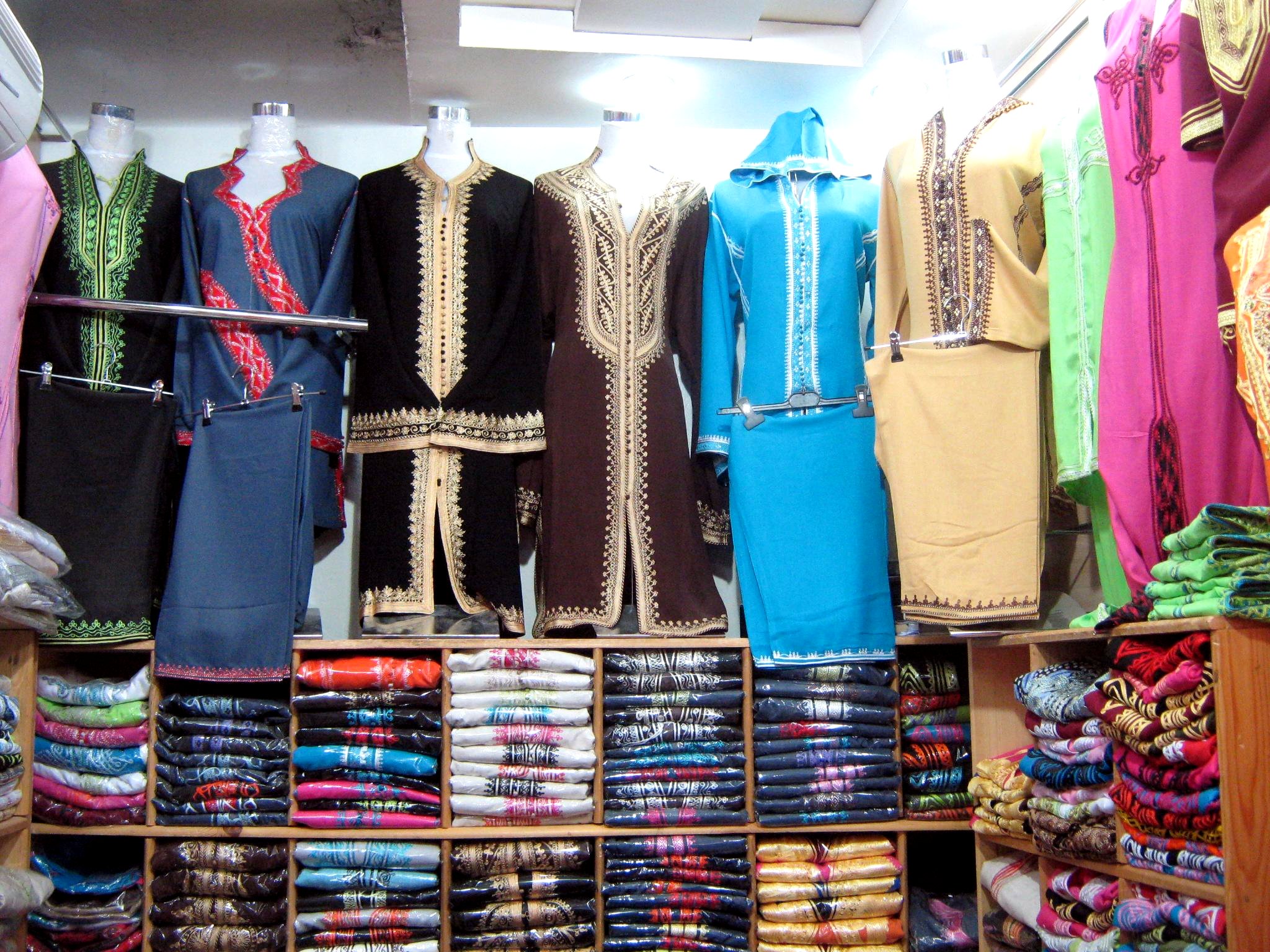
Morocco's menswear wardrobe has several related but distinct pieces, and the jabador sits at the formal end of that spectrum. The djellaba, with its hood and loose, unfitted cut, is everyday clothing. The gandoura is simpler still: typically a plain, sleeveless, hoodless tunic, often white, worn for both everyday comfort and lighter ceremonial occasions. The jabador, by contrast, is fitted, tailored in two matched pieces, and reserved for genuinely formal settings.
Traditional Moroccan menswear as a whole follows a pattern art historians describe as 'sobriety outside, richness inside': the outer garment (djellaba or jabador tunic) is often relatively restrained, while hidden inner layers and trim carry the more elaborate embroidery. That principle still shapes how a jabador is worn: the vest and trouser embroidery is where the craftsmanship concentrates, even when the outer tunic itself looks comparatively simple from a distance.
The result is a small, legible dress code that any Moroccan can read at a glance: gandoura for a relaxed family gathering, djellaba for the street and the mosque, jabador for a wedding or a formal reception, and jabador-plus-selham for the most ceremonial occasions of all, up to and including royal appearances. Five centuries after Leo Africanus described the notables of Fez in their fine tunics, the same basic logic of layered formality still governs what a Moroccan man puts on for the most important days of his life.
That legibility is precisely why the jabador has outlasted so many other historical Moroccan garments as everyday-adjacent fashion faded and Western suits became common office wear. A suit communicates nothing distinctly Moroccan; a jabador communicates formality and Moroccan identity simultaneously, which is exactly the combination a wedding, a religious holiday or a state ceremony calls for. It is a garment that survived not by resisting change, but by being flexible enough to keep absorbing it, the same way it absorbed Ottoman, Persian and Andalusian influence five hundred years ago.
Frequently asked
What is a jabador?
The jabador is a traditional Moroccan men's two-piece outfit consisting of a fitted, short tunic worn over matching trousers (serwal), often with a sleeveless vest (bad'ia) underneath and finished with sfifa trim and hand-braided aqad buttons. It is Morocco's formal menswear, roughly equivalent to a Western tuxedo or dinner suit.
How old is the jabador?
Its component pieces (serwal trousers and the bad'ia vest) date back to the early era of Islamization in Morocco, but the jabador as a named, unified garment is generally traced to at least the 16th century, when it is linked to the elite dress described by Leo Africanus (Hassan al-Wazzan) in his Description of Africa, circa 1525.
Who originally wore the jabador?
In the 16th century the jabador (or its embryonic form) was reserved for Morocco's wealthiest urban classes — merchants, dignitaries and ambassadors, particularly the notables of Fez. By the 19th century it had become common urban attire in cities like Tangier.
What is the difference between a jabador and a djellaba?
The djellaba is a loose, hooded, everyday robe worn by both men and women. The jabador is a fitted, hoodless, two-piece formal outfit — tunic plus matching trousers — reserved for weddings and formal occasions, not daily wear.
What is a selham and how does it relate to the jabador?
The selham (or burnous) is a floor-length hooded cape made of fine wool or silk, worn over a jabador for the most formal occasions, including weddings and state ceremonies. It is the same style of garment the King of Morocco wears at official events.
What is the bad'ia in a jabador outfit?
The bad'ia is the sleeveless vest worn as part of the jabador ensemble, underneath the fitted tunic. It is one of the outfit's oldest components, predating the unified jabador by centuries.
Why do Moroccan grooms wear a jabador?
The jabador became Morocco's standard formal menswear over the 20th century, and today it is the default groom's outfit, often paired with a selham cape for the ceremonial amariya procession in which the couple is carried into the wedding hall.
What embroidery techniques are used on a jabador?
Traditional jabadors use sfifa (decorative edge trim), aqad (hand-braided silk-cord buttons), and fine cording techniques called dfira and mlifa — the same embroidery vocabulary used on Moroccan kaftans and formal djellabas.
Is the jabador only worn by men?
Historically yes, but over the 20th century women also began adopting jabador-inspired cuts and tailoring for their own formalwear, though the classic jabador remains primarily a men's garment.
How is a jabador different from a gandoura?
The gandoura is a simpler, often plain and usually white, sleeveless, hoodless tunic worn for everyday comfort or light ceremonial use. The jabador is a fitted, tailored, embroidered two-piece set reserved specifically for formal occasions like weddings.
- Jabador.com — History of the Jabador in Morocco ↗
- The Moorish Times — The History and Origins of the Jabador ↗
- Awraaf — Moroccan Cultural Attire Explained: The Jabador Origins and History ↗
- Made in Atlas — Moroccan Attire for Men: 5 Traditional Garments Styling Guide ↗
- Muda Paris — Origins and Evolution of the Men's Jabador ↗
Video via official YouTube embeds; photos via Wikimedia Commons under their stated licenses. All rights belong to the respective owners; 212 Daily claims no ownership.