The Imilchil Marriage Festival: Legend, Reality and Amazigh Tradition
The legend of Isli and Tislit
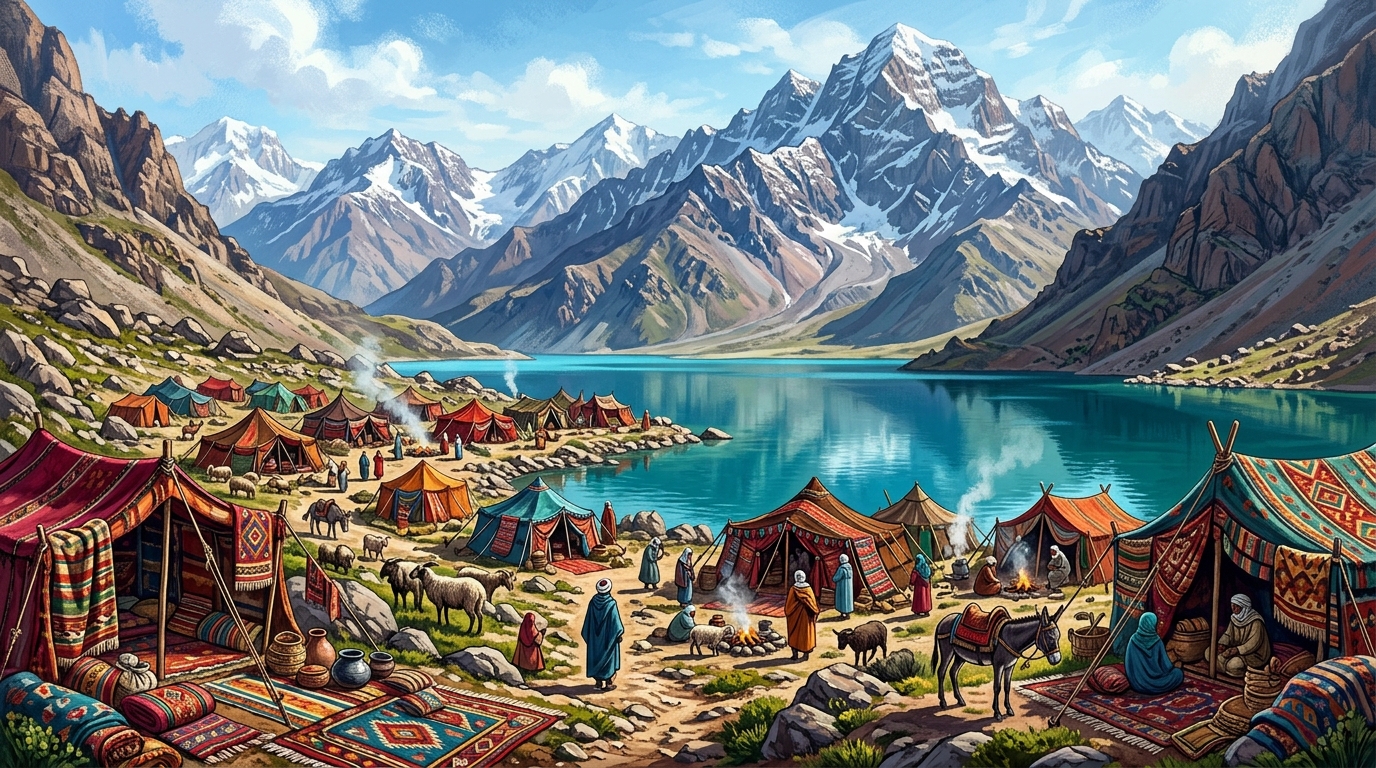
The story told locally, and repeated in nearly every account of the festival, is Morocco's own version of a star-crossed romance. According to the most commonly told version, a young man and woman from rival clans of the Ait Haddidou tribe fell in love, but their families' feud forbade the match. Grief-stricken and unable to be together, the two are said to have wept until their tears formed two separate lakes in the mountains — Isli, meaning roughly "the fiancé" or "groom," and Tislit, "the fiancée" or "bride" — with a ridge of mountain standing permanently between them, even in death.
In the legend's telling, the two tribes were so moved by the tragedy that they agreed to set aside one day a year on which young men and women from different clans could meet freely and choose partners for marriage, so that no other couple would suffer the same fate. That founding story is the reason the event is known internationally as a "marriage festival," and it is genuinely part of the oral tradition of the region — but, as with many origin legends attached to real institutions, it explains the meaning locals attach to the day more than it documents the actual historical origin of the gathering.
The lakes themselves are real and are still a minor pilgrimage and tourism site in their own right, a short drive from Imilchil, a small High Atlas town of roughly a couple thousand people that gives the wider festival its popular name.

What the festival actually is: a moussem before it is a love story
Strip away the romance, and the Imilchil gathering is, first and foremost, a moussem — an annual religious festival centered on a local saint's shrine, the same format found across rural Morocco. Organizers hold it at the site associated with a local wali whose name appears in different transliterations across sources — rendered variously as Sidi Ahmed ou Mghayat, Sidi Hmad Oulmghenni or Sidi Mohamed el Maghani — with a shrine in the Assif Melloul valley roughly 20 kilometers from Imilchil itself.
According to Bassou Oujabbor, a historian from Imilchil interviewed by Al Jazeera, the moussem is primarily a religious event honoring this local saint, who is believed to bless both political agreements between tribes and the business transactions made in the large seasonal market set up for the occasion. That framing matters, because it means the pilgrimage and market — not the marriage-brokering — are the historically documented core of the event, with the romantic legend layered on top as the story that gives the day its popular meaning.
The market side is substantial in its own right: shepherds from the scattered Ait Haddidou communities bring livestock to sell, while settled and semi-nomadic families sell wool, carpets, jewelry, leather goods and other crafts, using the gathering to stock up on supplies before the harsh Atlas winter cuts off many of the surrounding villages.
Myth versus reality: does anyone actually get married there?
This is where the popular version of the festival and the more careful reporting genuinely diverge, and it is worth being precise about what is and is not documented. The widely repeated tourist narrative — that dozens of Berber women dressed in ceremonial shawls come to the festival specifically to scan the crowd and choose a husband on the spot, with weddings performed then and there — is, by multiple more grounded accounts, an exaggeration of what actually happens.
According to Oujabbor's account, no wedding ceremonies take place during the event itself; some framings go further, describing the popular "marriage market" story as a misconception and suggesting the festival's marriage-related business is largely administrative rather than romantic, including opportunities for couples in this geographically isolated region to formalize paperwork. Other reporting takes a middle position: young unmarried men and women from different, otherwise hard-to-reach villages do use the gathering to meet, flirt and get acquainted — a real social function in a region where, as one account puts it, someone "can't simply go and look for" a partner given how scattered and conservative daily village life is — and families do use the occasion to negotiate a potential match and its dowry. But the couples that hit it off become engaged rather than married on the spot, with the actual wedding ceremony held later, in the couple's own village, at a date and place the family chooses.
Adding to the administrative layer, several accounts describe local officials or judges attending the moussem to register marriage contracts on the day, sometimes for dozens of couples — a real and documented practice, though it functions as a legal formality for unions already arranged by families rather than proof that the festival is a spontaneous singles' market in the way it is often marketed to tourists. Readers should treat the more cinematic claims — a fixed number of brides scanning strangers to pick a husband within the day — as popular embellishment of a real but more mundane underlying custom: an annual meeting point for engagement, family negotiation and paperwork, wrapped around a religious pilgrimage and a livestock market.
The Ait Haddidou: a High Atlas tribe shaped by distance
The festival belongs to the Ait Haddidou, an Amazigh (Berber) tribe of Morocco's High Atlas, historically shepherds who moved with their flocks between mountain pastures before settling into more fixed villages around Imilchil. The area is genuinely remote even by rural Moroccan standards: a wide scattering of small settlements across high valleys, cut off for parts of the year by snow, with limited routine contact between one village and the next.
That isolation is central to why an annual gathering like this carries so much practical weight locally, independent of the legend. When a young person's own village offers few realistic marriage prospects, and travel between villages is difficult for much of the year, a single fixed, well-known annual meeting point — combining a religious pilgrimage, a major regional market and a socially sanctioned occasion for young people from different clans to meet under family supervision — solves a real logistical problem for a dispersed mountain population.
The Ait Haddidou are widely described as among the more traditionally dressed and distinct Amazigh groups in Morocco, and the festival remains, alongside its tourism profile, a genuine occasion for the tribe's own internal social life: family reunions, trade, and the renewal of ties between communities that otherwise rarely cross paths outside the moussem.
Timing, scale and the modern tourist spotlight
The festival is held annually in September, typically over about three days; the 2024 edition, for example, ran September 19 to 21. Depending on the year and source, some describe a longer surrounding window of market and festival activity in late August and September, but the core moussem days cluster in mid-to-late September, tied to the end of the summer grazing season in the high pastures.
It draws a genuinely large crowd for such a remote location — accounts describe thousands of visitors from the surrounding region converging under tents with livestock, textiles and produce, alongside a growing number of domestic and foreign tourists drawn specifically by the festival's international reputation. That reputation is very much a double-edged sword locally: tourism brings revenue to a genuinely poor, isolated region, but it also means a market and pilgrimage originally organized entirely around Ait Haddidou social needs now has to accommodate a large audience mainly interested in photographing the legend rather than the livestock trading.
Local and national reporting has flagged this tension directly, noting concern that the rituals and atmosphere can be affected by the sheer number of outside visitors and cameras — a common pressure point for any living tradition that becomes a tourism symbol for a wider destination.

A living Amazigh tradition, not just a postcard story
Whatever the precise mix of myth and documented practice, the Imilchil gathering endures as one of the most recognizable living expressions of Amazigh culture in Morocco: Berber dress, music, dance, poetry and craft on display alongside pilgrimage rites at a Sufi-linked shrine and a working seasonal market that still genuinely matters to the region's herding economy.
For visiting outsiders, the honest framing is probably the most respectful one: this is not a real-time dating show staged for cameras, but a centuries-old moussem in which faith, trade, family alliance and courtship have always been bundled together — and where the romantic legend of Isli and Tislit gives an old social institution a story that both locals and visitors can hold onto, even if the on-the-ground reality is quieter and more procedural than the postcard version suggests.
That combination — a genuine, still-functioning tribal institution wrapped in a legend that has taken on a life of its own internationally — is itself a good example of how much of Morocco's festival calendar works: real religious and economic gatherings, and the folklore that grows up around them, existing side by side rather than one simply being false and the other true.
Frequently asked
What is the Imilchil Marriage Festival?
It is an annual moussem (religious and social festival) held near Imilchil, a High Atlas town belonging to the Amazigh Ait Haddidou tribe, combining a pilgrimage to a local saint's shrine, a large seasonal market, and traditional occasions for engagement and family negotiation, all associated with the legend of the lovers Isli and Tislit.
What is the legend of Isli and Tislit?
According to local oral tradition, two young people from rival Ait Haddidou clans fell in love but were forbidden to marry by their feuding families. Grief over their separation is said to have formed two lakes, Isli ("groom") and Tislit ("bride"), and the tribes are said to have agreed afterward to set aside an annual day for young people from different clans to meet.
Do actual weddings take place at the Imilchil festival?
According to a local historian cited by Al Jazeera, no wedding ceremonies are performed at the festival itself. Couples who meet or have already been arranged may become engaged there, but the wedding ceremony itself is typically held later, in the couple's own village.
Is the 'marriage market' story exaggerated?
Largely, yes. The popular image of unmarried women scanning the crowd to pick a husband on the spot is a romanticized version of a more procedural reality: family-supervised meetings, engagement, dowry negotiation, and in some cases on-site registration of marriage paperwork for unions already arranged, rather than spontaneous matchmaking.
Who is the saint honored at the festival?
Sources render the name differently — Sidi Ahmed ou Mghayat, Sidi Hmad Oulmghenni and Sidi Mohamed el Maghani all appear in different accounts — but all refer to the same local wali whose shrine in the Assif Melloul valley, near Imilchil, is the festival's religious focus.
Who are the Ait Haddidou?
The Ait Haddidou are an Amazigh (Berber) tribe of Morocco's High Atlas, historically transhumant shepherds who settled around Imilchil. Their villages are widely scattered across high valleys, which is part of why an annual central gathering has long mattered for meeting, trade and marriage arrangements.
When is the Imilchil Marriage Festival held?
It takes place annually in September, generally over about three days tied to the end of the summer grazing season; the 2024 edition ran from September 19 to 21.
What role does the market play at the festival?
The moussem includes a large seasonal souk where shepherds sell livestock and families sell wool, carpets, jewelry and handicrafts, functioning as one of the region's main opportunities each year to trade and stock up before winter isolates many mountain villages.
Has tourism changed the festival?
Yes. The festival's international fame as a 'marriage festival' now draws significant numbers of domestic and foreign visitors and photographers, bringing revenue to a remote region but also raising concerns, reported locally and nationally, that the rituals can be affected by the pressure of outside attention.
Where is Imilchil located?
Imilchil is a small town in Morocco's High Atlas Mountains, in the central-eastern part of the range, home to a population of roughly a couple thousand people and the namesake of the wider festival and the nearby Isli and Tislit lakes.
- Wikipedia — Imilchil ↗
- Wikipedia — Tislit lake ↗
- Al Jazeera — In Pictures: Imilchil marriage festival ↗
- Morocco World News — Imilchil Wedding Festival: An Ancient Commemoration of Love and Tragedy ↗
- Morocco World News — Love to Fill the Air at Imilchil's Marriage Festival This September ↗
Video via official YouTube embeds; photos via Wikimedia Commons under their stated licenses. All rights belong to the respective owners; 212 Daily claims no ownership.