Hassan II Mosque: The Facts Behind Casablanca's Record-Breaking Landmark on the Sea
A king's idea, built on the water
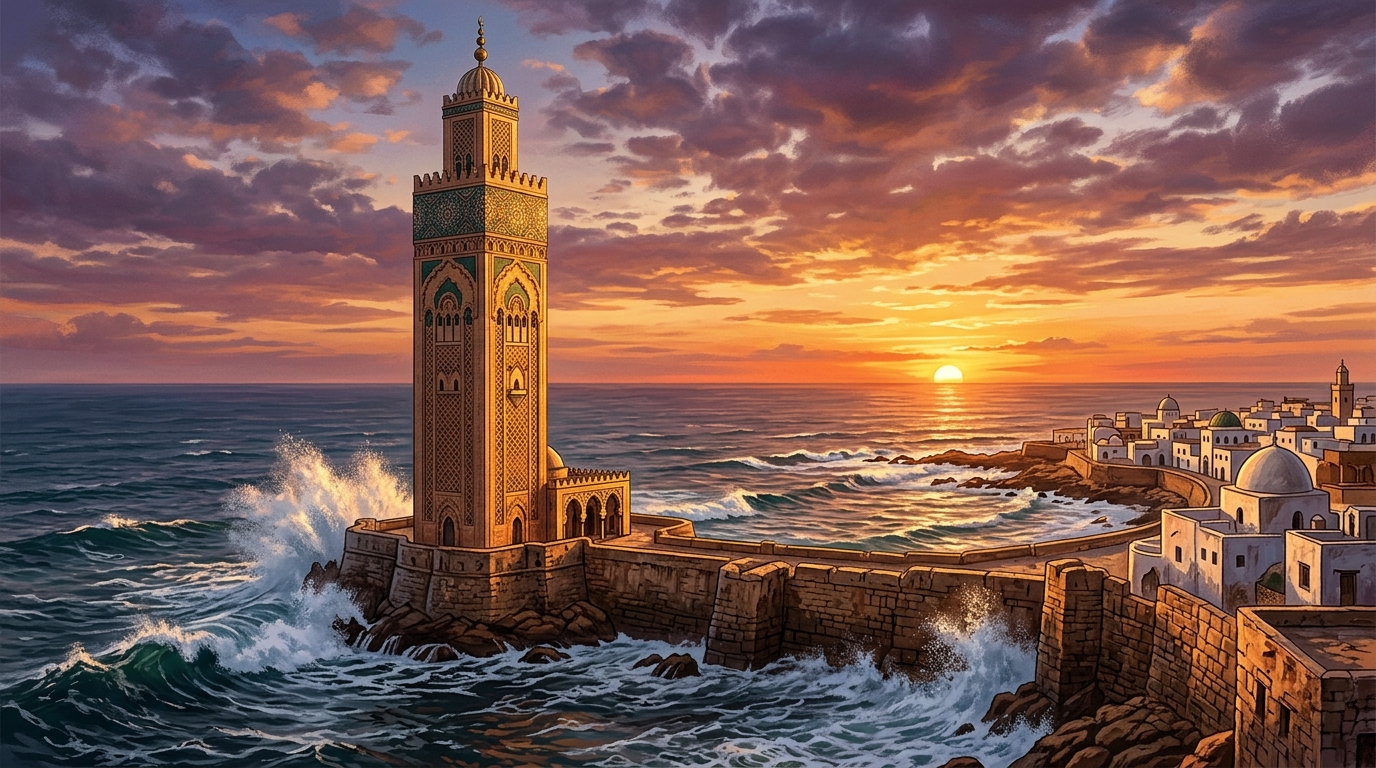
The mosque's origin traces to King Hassan II's first official visit to Casablanca after his accession to the throne in 1961. Public accounts of the project describe the king deciding, during that visit, to build a great mosque positioned on the water, directly inspired by a Quranic verse describing God's throne as resting upon water. That single idea — a mosque where worshippers could pray with the ocean beneath and beside them — became the defining architectural premise of the entire project decades before construction actually began.
The formal commissioning is generally dated to 1980, and groundbreaking followed in July 1986, with King Hassan II personally laying the foundation stone. The project was originally targeted for completion in 1989, timed to coincide with the king's 60th birthday, but the scale and complexity of the build pushed the actual finish date later. Construction was completed on August 30, 1993, after roughly seven years of continuous work — a genuinely fast timeline for a structure of its size and craftsmanship density, achieved through round-the-clock work in the final construction phases.
The mosque was designed by French architect Michel Pinseau, working under King Hassan II's direct guidance, with the French construction group Bouygues serving as lead builder. The design places the structure on a nine-hectare promontory between Casablanca's harbor and the El Hank Lighthouse, with a significant portion of the building's foundation extending out over the Atlantic — worshippers inside genuinely do pray beside and, in the design's spirit if not through a literal glass floor, above the sea.

The numbers: minaret, capacity, roof
The mosque's minaret stands 210 meters (about 690 feet) tall, roughly 60 stories, and was, on completion, the world's second-tallest minaret — a record that made it an instant landmark on the Casablanca skyline, visible from well outside the city. At its summit sits a laser that projects a beam toward Mecca, reportedly visible up to 30 kilometers away on a clear night, turning the building into a literal, functioning compass for the faithful even after dark.
Capacity is equally outsized: the complex can accommodate up to 105,000 worshippers at once, split between roughly 25,000 inside the covered prayer hall and around 80,000 more on the mosque's outdoor grounds, making it one of the largest mosques in the world by capacity and the second-largest in Africa. The main structure measures roughly 200 meters long by 100 meters wide, with a ceiling and roof engineered specifically for one of the building's signature features.
Those numbers were not accidental. Contemporary accounts of the project consistently frame it as intended to be among the largest and most technically advanced mosques built anywhere in the modern era, a deliberate statement piece for both King Hassan II's reign and Morocco's broader national identity, rather than simply a large building that happened to serve a religious function.
That feature is a genuinely retractable roof over the main prayer hall, roughly 60 meters high and weighing an estimated 1,100 tons, engineered to open fully in around five minutes. When open, worshippers pray directly beneath the sky, a mechanical feat that remains unusual among religious buildings of any era or scale and that reinforces the same open-to-the-elements design philosophy behind the mosque's oceanfront setting.

Built by Morocco, for Morocco, funded by Morocco
Unlike many national megaprojects funded through state debt or foreign loans, the Hassan II Mosque's construction cost — estimated variously between roughly 400 million and 700 million dollars, or around 500 to 585 million euros depending on the source and year of estimate — was financed primarily through public subscription, with contributions solicited directly from Moroccan citizens across the country and around the world. Reports on the fundraising describe a minimum contribution set as low as five Moroccan dirhams, a deliberately accessible amount meant to let citizens of any income level participate, alongside larger donations and additional financing arranged through international construction loans.
The result was a mosque genuinely built on the collective contribution of millions of ordinary Moroccans, commonly cited at around 12 million individual donors, rather than a project experienced by the public purely as a top-down royal decree. That funding structure gave the mosque a distinct civic character from the outset: not simply a monument commissioned by a king, but one the broader Moroccan public had a direct, literal financial stake in seeing completed.
Labor followed the same nationally sourced logic. All principal building materials — wood, plaster, copper, marble, mosaic tile and dyes — were sourced from within Morocco, drawing on cedar from the Middle Atlas, marble from Agadir and granite from Tafraoute, with the notable exceptions of white granite columns and fifty glass chandeliers imported from Murano, Italy. Roughly 10,000 artists and craftsmen contributed to the project overall, including several thousand specifically qualified maalems working across carpentry, plasterwork and zellige tile-cutting, drawn from across the kingdom specifically to demonstrate the full range of Moroccan traditional craft on a single, unprecedented scale.
The scale of specialized labor is worth dwelling on: reporting on the workforce breaks down figures such as 854 qualified master carpenters out of 1,530 assigned to the project, roughly 80 qualified plasterwork maalems out of 1,600 workers in that trade, and about 100 qualified zellige specialists out of 170 assigned to mosaic work. Those ratios show a project that deliberately mixed apprentices and general laborers alongside a comparatively small core of genuinely master-level craftsmen, using the mosque itself as a kind of national training ground across almost every traditional Moroccan building trade at once.

Salt water, restoration and the sea it was built to embrace
Building a structure of this scale directly against the Atlantic came with a genuine engineering cost. By the early 2000s, salt water exposure had caused measurable deterioration to parts of the mosque's foundation and structure, and restoration work began around 2005 specifically to address the damage, at an estimated cost of around 50 million euros. That restoration effort was designed to extend the building's structural lifespan by an additional century, addressing the same oceanfront positioning that gives the mosque its defining visual and symbolic identity.
That tension — the sea as the mosque's entire architectural reason for being, and also its primary structural threat — is a fitting footnote to a building whose founding idea was a specific verse about a divine throne resting on water. Decades after King Hassan II first stood in Casablanca and decided to build there, the mosque remains both a functioning place of worship, hosting non-Muslim visitors on guided tours (unusually, among Moroccan mosques, which are typically closed to non-Muslims), and an ongoing engineering project, permanently negotiating with the exact ocean it was designed to sit beside.
Beyond the prayer hall: a full religious and cultural complex
The mosque itself is only the most visible part of a larger nine-hectare complex that Hassan II and his architects planned around it. The site also houses a madrasa (Islamic school), hammams (traditional bathhouses) for ritual ablution, a library, and museum spaces documenting the mosque's own construction — meaning the complex was designed from the outset to function as a full religious and educational campus rather than a single freestanding monument built purely for visual impact.
Interior decoration draws on the same national craft vocabulary found across Morocco's historic mosques and palaces: hand-cut zellige mosaic tilework, carved and painted cedar ceilings, sculpted stucco and plasterwork, and Quranic calligraphy worked directly into wall and ceiling surfaces throughout the prayer hall and surrounding galleries. Placing that density of traditional, hand-executed ornamentation inside a building using cutting-edge 20th-century engineering (the retractable roof, the laser-guided minaret, deep marine foundations) makes the mosque something of a deliberate architectural argument: that Morocco's oldest craft traditions and its most modern construction techniques were never in conflict, and could be combined at a genuinely monumental scale.
That combination is also why the mosque remains, decades after completion, one of the most frequently cited modern reference points for Moroccan national identity and craftsmanship in a single structure, alongside older sites like the Fez madrasas or the Alhambra-adjacent architecture of the Marinid and Saadian periods discussed elsewhere in Morocco's architectural history — except built in seven years rather than assembled gradually across centuries.
Frequently asked
Who built the Hassan II Mosque and when?
It was commissioned by King Hassan II, designed by French architect Michel Pinseau, and built by the French construction group Bouygues. Groundbreaking took place in July 1986, and construction was completed on August 30, 1993, roughly seven years later.
How tall is the Hassan II Mosque's minaret?
The minaret stands 210 meters (about 690 feet) tall, roughly 60 stories, making it the world's second-tallest minaret on completion.
How many people can the Hassan II Mosque hold?
Up to 105,000 worshippers: approximately 25,000 inside the covered prayer hall and around 80,000 more on the mosque's outdoor grounds.
Why is the Hassan II Mosque built over the water?
King Hassan II wanted the mosque positioned on the water, directly inspired by a Quranic verse describing God's throne as resting upon water, and chose a promontory site on the Atlantic in Casablanca to realize that idea.
How much did the Hassan II Mosque cost to build?
Estimates vary by source, ranging from roughly 400 to 700 million dollars (around 500 to 585 million euros), financed primarily through public subscription from Moroccan citizens rather than solely by the state treasury.
Who paid for the Hassan II Mosque?
It was funded largely through public subscription, with an estimated 12 million Moroccan donors contributing, including a minimum contribution set as low as 5 Moroccan dirhams to allow participation across all income levels.
Does the Hassan II Mosque really have a retractable roof?
Yes. The roof over the main prayer hall is retractable, roughly 60 meters high and weighing about 1,100 tons, and can open fully in around five minutes, allowing worshippers to pray under the open sky.
What materials were used to build the Hassan II Mosque?
Nearly all principal materials were sourced within Morocco, including cedar from the Middle Atlas, marble from Agadir and granite from Tafraoute, with white granite columns and fifty glass chandeliers imported from Murano, Italy, as notable exceptions.
How many craftsmen worked on the Hassan II Mosque?
Roughly 10,000 artists and craftsmen contributed to the project overall, including several thousand qualified maalems specializing in carpentry, plasterwork and zellige tile-cutting, recruited from across Morocco to work alongside a larger body of apprentices and general laborers.
Can non-Muslims visit the Hassan II Mosque?
Yes, unusually for a working mosque in Morocco. The Hassan II Mosque offers guided tours to non-Muslim visitors outside prayer times, unlike most Moroccan mosques, which are generally closed to non-Muslims entirely.
- Wikipedia — Hassan II Mosque ↗
- Fondation de la Mosquée Hassan II — History ↗
- Atalayar — Hassan II Mosque: the architectural jewel open to the sea and the sky ↗
- Sacred Destinations — Hassan II Mosque, Casablanca, Morocco ↗
- Tours Casablanca — About the Hassan II Mosque: Photos, Interior & History ↗
Video via official YouTube embeds; photos via Wikimedia Commons under their stated licenses. All rights belong to the respective owners; 212 Daily claims no ownership.