Harira: The Soup That Defines Ramadan in Morocco
What exactly is harira?
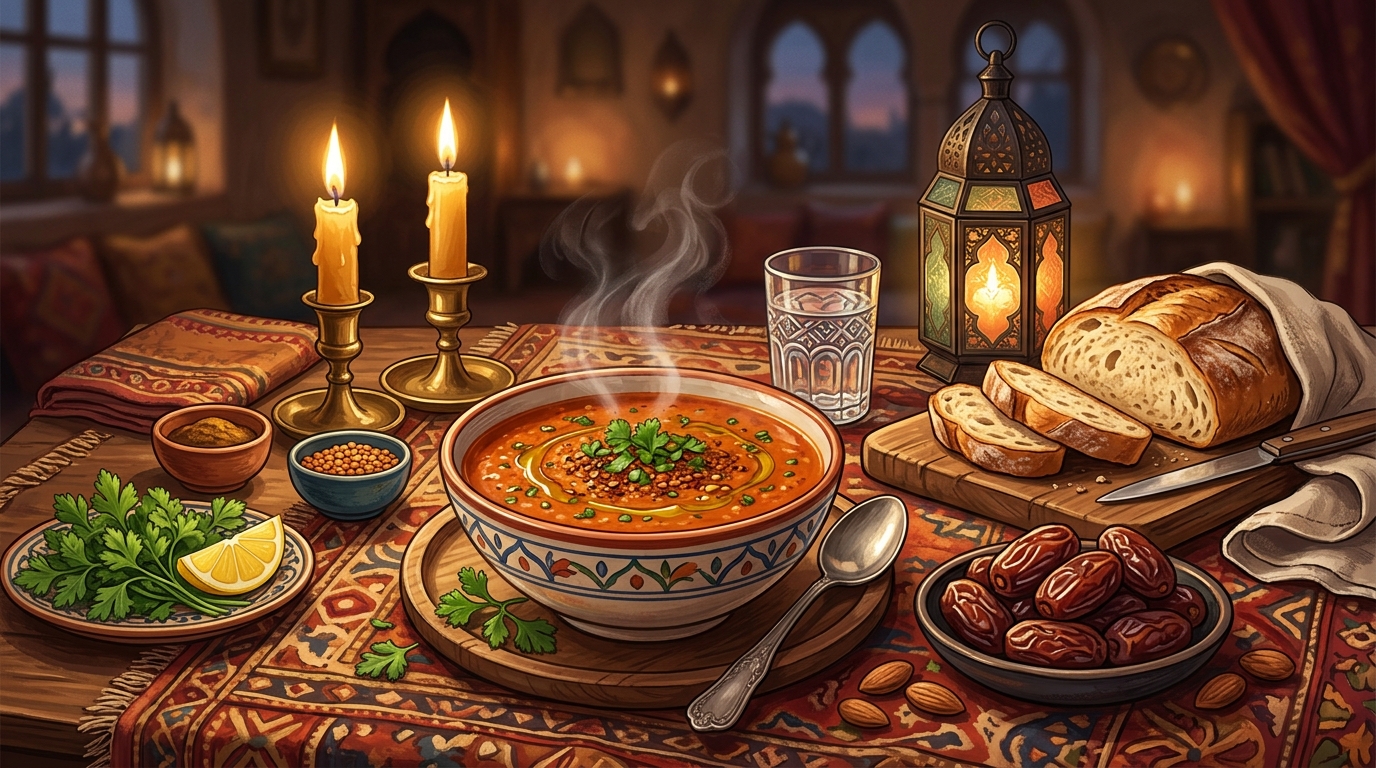
Harira is a thick, tomato-based soup built around two humble pulses, lentils and chickpeas, simmered with small pieces of lamb or beef, onions, celery and a generous handful of fresh herbs. Cilantro and parsley are stirred in throughout the cooking, giving the soup its bright, herbaceous backbone, while warming spices such as ginger, black pepper, turmeric and cinnamon give it depth without turning it fiery. Rice or broken vermicelli noodles are common additions, bulking the soup into something closer to a meal than a starter.
What separates harira from a simple lentil soup is its body. Moroccan cooks thicken it with tadouira, a slurry of flour whisked into water (sometimes with a little tomato paste) that is stirred into the pot near the end of cooking, giving the broth its characteristic velvety, almost custardy texture. Some households use a beaten egg instead of, or alongside, the flour slurry to finish the thickening. Either way, the goal is the same: a soup substantial enough to sit in the stomach, not a thin consommé.
The final, quietly essential touch in many kitchens is a spoonful of smen, a salted, aged, clarified butter with a sharp, almost cheese-like tang, stirred in just before serving. Smen carries the ras el hanout, ginger and turmeric through the fat in a way plain oil cannot, rounding out the soup's flavor and giving it the deep, savory finish that Moroccans immediately recognize as harira rather than any other regional lentil soup.

The centerpiece of iftar
During Ramadan, harira is the food Moroccans build their entire day around. Fasting from dawn to sunset, most households follow a set order at the moment the fast breaks: a few sips of water and a date first, echoing the Prophet Muhammad's own practice of breaking a fast this way, and then, almost immediately, a bowl of harira. The soup is deliberately gentle on a stomach that has had nothing since before sunrise, the lentils supplying slow-release energy, the tomato broth restoring fluids, and the spices warming the body without shocking it.
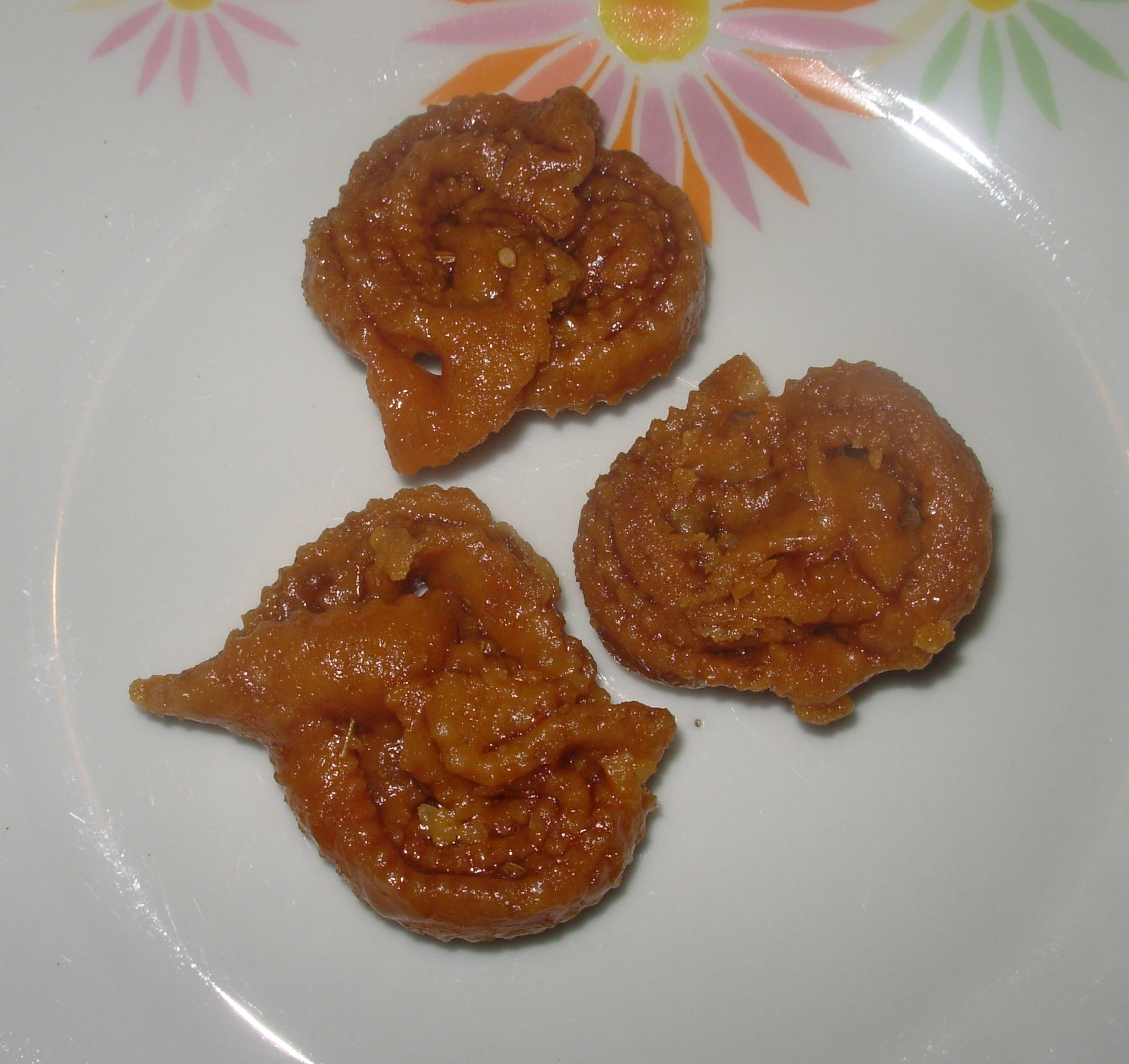
Harira rarely arrives alone. It is typically flanked by chebakia, a sesame-and-honey pastry shaped into a flower or knot, deep-fried and then soaked in honey syrup and orange-blossom water, and by hard-boiled eggs, often dipped in a mix of cumin and salt. Dates, fresh bread, and sometimes a glass of milk or buttermilk round out the spread. The contrast is part of the point: a savory, substantial soup followed by something intensely sweet and rich, after a day when the body has had neither.
The stretch of time before iftar is when the whole country seems to be doing the same thing at once, chopping herbs, stirring pots, watching the clock. Because the exact fast-breaking time shifts by only a minute or two from house to house within a city, the smell of harira on the stove becomes a kind of citywide clock, rising from kitchen windows in the final half hour before the call to prayer that signals the fast is over.
Debated origins: Berber, Arab, Andalusian, or all three
Exactly where and when harira originated is genuinely unsettled, and food historians disagree rather than converge on one story. The American food historian Gil Marks argued the soup as Moroccans know it today took shape within Morocco itself, its name likely derived from an Arabic and Persian root associated with silk, a nod to its smooth, thickened texture. Other accounts point to older roots, noting that a seven-ingredient soup called harira is described in early Islamic-era texts discussing pre-Hegira Arab diets, suggesting the basic concept long predates Morocco's modern borders.
A third strand of the story emphasizes Andalusian influence. After the 1492 fall of Granada, waves of Muslim and Jewish families fleeing the Iberian Peninsula settled in Moroccan cities such as Fez and Rabat, bringing culinary techniques, including layered spicing and careful broth clarification, that Moroccan cooks are thought to have folded into their own soup-making traditions. Combine that with the older, indigenous Amazigh (Berber) practice of hearty grain-and-legume stews eaten across rural Morocco long before Arab or Andalusian arrivals, and harira looks less like a dish with one clean origin story and more like a genuine culinary layering of Amazigh, Arab and Andalusian cooking over many centuries.
That ambiguity is not really a problem for Moroccans; if anything, it fits. Harira is claimed proudly as Moroccan today regardless of which historical thread gets the most credit, and most families are far more interested in whose grandmother's version is the best than in resolving a centuries-old academic debate.
Harira and chorba: cousins, not twins
Travel a little further east across the Maghreb and you will hear about chorba, a name often used loosely for Maghrebi soups in general but which, in Morocco and neighboring Algeria, usually refers to something distinctly lighter than harira. Where harira is thick, opaque and built around lentils and chickpeas bound with a flour tadouira, chorba tends to be a thinner, more broth-like soup, often carrying small pasta shapes such as vermicelli rather than pulses as its main body.
The herb profile differs too. Harira leans on cilantro and parsley stirred through a tomato-and-legume base, while chorba is more commonly seasoned with mint, giving it a cleaner, brighter aroma that suits its lighter texture. In practice, many Moroccan families consider chorba the everyday, quick-to-make soup and harira the special, more labor-intensive dish reserved for occasions, chiefly Ramadan, though both appear on tables throughout the year outside the fasting month.
The line between the two is not rigid. Some households add lentils to their chorba or thin down their harira depending on the season and who is eating, and regional names shift the picture further still, but the general rule holds across most of Morocco: if it is thick, tomato-red and finished with a flour slurry, it is harira; if it is light, clear and full of tiny noodles, it is more likely called chorba.
One soup, many regional faces
Ask a dozen Moroccan families for their harira recipe and you will get a dozen slightly different answers, and regional identity plays a real role in those differences. Versions associated with Fez are often described as the richest and most elaborate, built with a wider spice mix and, in some households, an extra spoonful of smen for depth, reflecting the city's long-standing reputation as a center of refined Moroccan cooking. Marrakech-style harira, by contrast, is sometimes made slightly sweeter, occasionally with a few raisins or a touch of honey worked into the broth, and is traditionally served alongside griddle breads like msemen or baghrir for dipping.
Further east, near the Algerian border around Oujda and Oran, a related style sometimes labeled harira oranaise reflects the culinary overlap between Morocco and western Algeria in that borderland region. Coastal and southern households have their own inflections too, adjusting the ratio of chickpeas to lentils, the amount of meat, or the thickness of the tadouira to family taste. Vegetarian harira, made without meat but keeping the full vegetable, legume and herb base, is also common, particularly for guests or family members who do not eat meat, and loses very little of the dish's essential character in the process.
Harira additionally holds a place in Morocco's Jewish culinary heritage. Moroccan Jewish communities have long prepared their own version of the soup to break the fast of Yom Kippur, following a similar logic to Ramadan iftar: a gentle, restorative dish designed to ease a body that has fasted all day back into eating. That the same soup anchors two entirely different religious fasting traditions, observed by different communities within the same country, says something about how deeply harira is woven into Moroccan life generally, not only into Ramadan specifically.
A dish made by hand, and shared by everyone
Harira is rarely a solo cooking project. During Ramadan especially, it tends to be made in large batches, often by the women of a household working together, chopping herbs, peeling tomatoes and stirring the pot through the late afternoon as the fast winds down. Recipes are passed down orally from mother to daughter far more often than they are written, which is part of why so many small variations survive from family to family, even within the same neighborhood.
Practically, many households now prepare the base broth well ahead, sometimes freezing large batches without the tadouira or rice, since those ingredients do not hold up well after thawing, and adding the vermicelli, thickening slurry and final herbs only when the soup is reheated for that evening's iftar. This lets a household get through most of Ramadan's thirty evenings without cooking the entire dish from scratch every single day, while still serving something that tastes freshly finished each time.
Sharing is built into the dish itself. It is common for neighbors to send bowls of their own harira to one another during Ramadan, for mosques and community groups to prepare large batches for those who cannot afford to cook, and for restaurants and street stalls across Moroccan cities to sell harira by the bowl or the liter in the hour before sunset, with lines forming as the fast-breaking hour approaches. Though harira is eaten year-round in Morocco, as an everyday soup, a market-stall snack, a cold-weather comfort food, it is during Ramadan that it stops being just a soup and becomes something closer to a shared, citywide appointment.
Frequently asked
What is harira soup made of?
Harira is a tomato-based soup built on lentils and chickpeas, usually simmered with small pieces of lamb or beef, onions, celery, fresh cilantro and parsley, and warming spices like ginger, turmeric, black pepper and cinnamon. It is thickened near the end of cooking with tadouira, a flour-and-water slurry, and often finished with a spoonful of smen, Morocco's aged, salted butter.
Why is harira eaten during Ramadan in Morocco?
Harira is the traditional dish Moroccans use to break the daily Ramadan fast at sunset, usually right after a date and a few sips of water. Its blend of legumes, tomato broth and mild spices is designed to be gentle and restorative for a stomach that has gone without food since before dawn, supplying energy and fluids without overwhelming it.
What is tadouira in harira?
Tadouira is a thickening mixture, typically flour whisked with water and sometimes a little tomato paste, stirred into harira toward the end of cooking. It gives the soup its characteristic thick, smooth body. Some cooks use a beaten egg in place of, or alongside, the flour slurry to achieve a similar effect.
Is harira the same soup as chorba?
No. Harira and chorba are related but distinct: harira is thick, tomato-red and built around lentils and chickpeas bound with a flour tadouira, while chorba is generally a lighter, more broth-like soup, often containing small pasta such as vermicelli instead of pulses, and seasoned more with mint than with harira's cilantro-and-parsley profile.
Where did harira originate?
Its exact origin is debated among food historians. Some trace it as a Moroccan creation whose name relates to an Arabic and Persian word for silk, referencing its smooth texture. Others point to older Arab-era descriptions of a similar soup, to indigenous Amazigh (Berber) cooking traditions, or to culinary techniques brought by Andalusian refugees who settled in cities like Fez after 1492. Most historians now see it as a genuine blend of these influences rather than a single point of origin.
What is smen and why is it added to harira?
Smen is a salted, clarified, aged butter with a sharp, tangy flavor, a staple of Moroccan cooking. A spoonful stirred into harira just before serving helps carry the soup's spice blend through the fat and adds a deep, savory finish that many Moroccans consider essential to an authentic bowl.
What else is served with harira at iftar?
Harira is typically part of a wider iftar spread that includes dates, water, and often chebakia, a sesame-and-honey pastry fried and soaked in syrup, along with hard-boiled eggs (sometimes dipped in cumin and salt), fresh bread, and occasionally a glass of milk or buttermilk.
Is harira only eaten during Ramadan?
No. Harira is eaten year-round in Morocco, as an everyday soup, a market and street-stall snack, and a cold-weather comfort food. But it is during Ramadan that it becomes the country's defining fast-breaking dish, prepared in nearly every household at the same time each evening.
Is there a vegetarian version of harira?
Yes. Harira is commonly made without meat while keeping its full vegetable, legume, herb and spice base, and vegetarian versions retain most of the soup's essential character. It is a common option for guests or family members who do not eat meat.
Does harira have a role in Moroccan Jewish tradition too?
Yes. Moroccan Jewish communities traditionally prepare their own version of harira to break the fast of Yom Kippur, following a similar logic to Ramadan iftar: a gentle, restorative soup to ease the body back into eating after a full day of fasting.
- Wikipedia — Harira ↗
- National Geographic — To Break the Ramadan Fast in Morocco, Start With Soup ↗
- Yabiladi — Is Harira Truly Moroccan? ↗
- Taste of Maroc — Harira Recipe: Moroccan Tomato Soup with Chickpeas and Lentils ↗
- NPR — Smen Is Morocco's Funky Fermented Butter That Lasts For Years ↗
- Morocco World News — A Very Moroccan Ramadan: Harira, Dates and Chebakia Galore ↗
Video via official YouTube embeds; photos via Wikimedia Commons under their stated licenses. All rights belong to the respective owners; 212 Daily claims no ownership.