Gnawa Music: The Spiritual Soul of Morocco's Sacred Sound
Origins in the Slave Routes of the Sahara
Gnawa music carries within it one of the most poignant histories in Morocco. Its name and traditions trace back to the populations brought across the Sahara, many of them enslaved, from West African regions including present-day Mali, Senegal, Ghana, and northern Nigeria, from at least the sixteenth century onward. The word 'Gnawa' itself is widely thought to derive from references to the Guinea region and its peoples.
Torn from their homelands, these communities preserved fragments of their spiritual and musical worlds and wove them together with the Islamic faith of their new home. What emerged was something genuinely new: a syncretic tradition that honored sub-Saharan ancestral spirits while invoking Allah, the Prophet, and Sufi saints. Music became the vessel that carried memory, identity, and the longing for a lost homeland across generations.
Over time, Gnawa brotherhoods established themselves in cities such as Marrakech, Essaouira, and Casablanca. They formed confraternities led by master musicians and spiritual guides, building a tradition that was at once religious order, healing practice, and artistic lineage. The history of pain at its root is precisely why Gnawa music can feel so raw and transcendent, it is the sound of survival turned into devotion.
The Maâlem and the Instruments of Trance
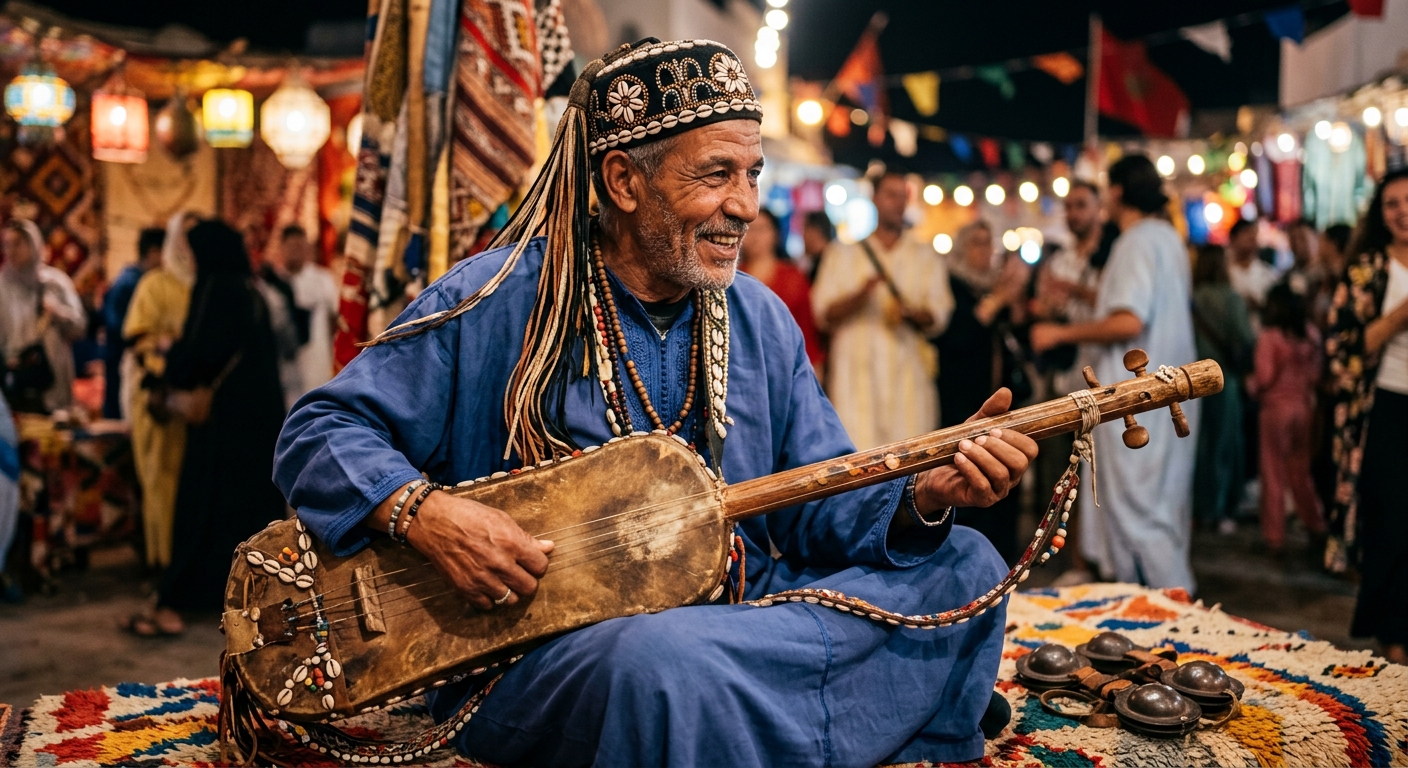
At the center of every Gnawa ensemble stands the maâlem, the master musician. The title is earned through years of apprenticeship and signifies not just technical mastery but spiritual authority, for the maâlem is expected to guide participants safely through the intense states a ceremony can induce. He plays and sings the lead, calling and the chorus responding in a hypnotic, looping dialogue.
The maâlem's instrument is the guembri (also called sintir or hajhouj), a three-stringed bass lute with a body carved from a single block of wood and a face covered in camel skin. Its deep, percussive, buzzing tone anchors the entire music, functioning as both bass line and rhythmic pulse. A metal ring of jingles attached to the neck adds a shimmering rattle as the strings are plucked and slapped.
Around the maâlem, a group of musicians plays the qraqeb, large iron castanets that clash in relentless, galloping rhythms. The metallic clatter, said by some to evoke the chains of slavery transformed into instruments of liberation, drives the music's trance-inducing momentum. Drums called tbel may join, and the players sing, clap, and dance, building waves of sound that can carry on through an entire night.
The Lila: An All-Night Ceremony of Healing
The heart of authentic Gnawa practice is the lila, meaning 'night' in Arabic, an all-night ritual ceremony of music, possession, and healing. Far more than a concert, the lila is a sacred event hosted in a home or zawiya (lodge), often organized to cure illness, resolve spiritual afflictions, or fulfill a vow. It can last from dusk until dawn.
A lila unfolds in a precise order, guided by the maâlem and a female ritual leader known as the moqaddema, who tends to participants. The music progresses through a sequence of suites, each associated with a particular spirit, or mluk, and with a specific color, incense, and quality. As each spirit's music plays, those who are 'ridden' by that spirit may fall into trance, dancing with eyes closed in states of jedba, the ecstatic possession that is believed to bring healing.
Colors are central to the symbolism. White is linked to purity and the saints, black to powerful and dangerous spirits, blue to the sky and water spirits, red to forces of strength, and so on. The moqaddema drapes dancers in the appropriate colored cloth as their spirit arrives. To outsiders the lila can look intense, even alarming, but within the tradition it is a structured, protective, and profoundly therapeutic system, a form of musical medicine refined over centuries.
Faith, Spirits, and a Living Syncretism
Gnawa belief sits at a fascinating intersection of orthodox Islam and older African spiritual cosmology. Ceremonies open with invocations to Allah and the Prophet Muhammad and praise for Sufi saints, firmly locating the practice within Moroccan Islamic culture. Yet the suites that follow address a pantheon of spirits, the mluk, whose origins lie in sub-Saharan traditions of spirit veneration.
This blend has at times made Gnawa a subject of debate among more conservative religious voices, who view the trance and spirit work with suspicion. Practitioners, however, understand their work as compatible with their faith, a means of healing and devotion sanctioned by long tradition and by the protective figures of Islam. The tension between official orthodoxy and lived popular religion is itself an old and recurring feature of Moroccan spiritual life.
What makes Gnawa so culturally significant is precisely this living syncretism. It is one of the clearest surviving expressions of Morocco's deep connection to sub-Saharan Africa, a reminder that the country is not only Arab and Amazigh and Mediterranean but also profoundly African. In the Gnawa lila, histories that might otherwise have been erased continue to breathe, sung in a mix of Arabic and remembered African words.
From the Margins to the World Stage
For much of the twentieth century, Gnawa music lived on the social margins, associated with poor and Black communities and the world of popular healing rather than respectable concert halls. Its journey into the global spotlight is a remarkable story of cultural revaluation. Beginning in the 1960s and 1970s, the hypnotic sound caught the ears of foreign musicians and travelers.
Jazz and rock legends were drawn to it. Jimi Hendrix famously visited Essaouira; the jazz pianist Randy Weston lived in Morocco and championed Gnawa for decades; saxophonist Pheroan akLaff, Ornette Coleman, Pat Metheny, and many others recorded with Gnawa masters. The natural affinity between the guembri's rolling bass and the swing of jazz, both with roots in the African diaspora, made the encounters feel like a reunion across the Atlantic.
The turning point came in 1998 with the founding of the Gnaoua World Music Festival in the coastal town of Essaouira. Drawing hundreds of thousands of visitors each summer, it transformed Gnawa into a source of national pride and international fascination, pairing maâlems with global stars on open-air stages by the sea. The festival helped shift Gnawa from a stigmatized practice to a celebrated cultural treasure.
Recognition, Fusion, and the Question of Tradition
In December 2019, UNESCO inscribed Gnawa on its Representative List of the Intangible Cultural Heritage of Humanity, a formal acknowledgment of its value and a spur to preservation efforts. The recognition crowned decades of work by maâlems, scholars, and festival organizers and gave the tradition new institutional support and visibility.
Today Gnawa thrives in two parallel worlds. In homes and zawiyas, the sacred lila continues much as it has for generations, conducted by maâlems who carry the spiritual lineage. On stages and recordings, a more secular, fusion-oriented Gnawa flourishes, blending with jazz, funk, electronic, hip-hop, and rock, performed for audiences who may know nothing of the spirits the music once summoned.
This dual life raises gentle questions. Some elders worry that the festival circuit and global fusion dilute the sacred core, turning ritual into spectacle. Others argue that adaptation has always been Gnawa's strength, that a music born from cultural collision is naturally suited to keep absorbing new sounds. What remains constant is the guembri's heartbeat and the iron clatter of the qraqeb, carrying a centuries-old story of suffering, faith, and the power of music to heal.
| Element | Description | Role |
|---|---|---|
| Guembri (sintir) | Three-stringed camel-skin bass lute | Lead instrument and rhythmic anchor |
| Qraqeb | Large iron castanets | Driving percussion and trance rhythm |
| Maâlem | Master musician and spiritual guide | Leads music and ceremony |
| Moqaddema | Female ritual leader | Tends participants and manages trance |
| Lila | All-night ritual ceremony | Healing through music and possession |
| Mluk | Pantheon of spirits | Each invoked by a colored suite |
Key elements of Gnawa music and ceremony
FAQ
What are the origins of Gnawa music?
Gnawa music originates with sub-Saharan West African peoples brought to Morocco, many as enslaved people, from at least the sixteenth century. They blended their ancestral spiritual and musical traditions with Moroccan Islam to create the unique Gnawa heritage.
What is a lila?
A lila is an all-night Gnawa ceremony of music, dance, and spiritual healing. Led by a maâlem and a female ritual leader called the moqaddema, it progresses through musical suites dedicated to different spirits and can induce healing trance states in participants.
What instruments are used in Gnawa music?
The two signature instruments are the guembri, a three-stringed bass lute with a camel-skin face played by the maâlem, and the qraqeb, large iron castanets that provide relentless trance-inducing rhythm. Drums and clapping also feature.
Is Gnawa music religious?
Gnawa is deeply spiritual, blending Islamic devotion to Allah, the Prophet, and Sufi saints with the veneration of ancestral spirits called mluk. It functions as both a form of worship and a system of musical healing.
Why is the Essaouira festival important to Gnawa music?
The Gnaoua World Music Festival, founded in Essaouira in 1998, helped transform Gnawa from a marginalized practice into a celebrated cultural treasure. It draws huge crowds, pairs Gnawa masters with international artists, and boosted the tradition's global recognition.
Loved this? Useful? React below — your feedback helps other readers.