Gnaoua vs Chaabi vs Andalusian Music: Morocco's Three Musical Worlds Explained
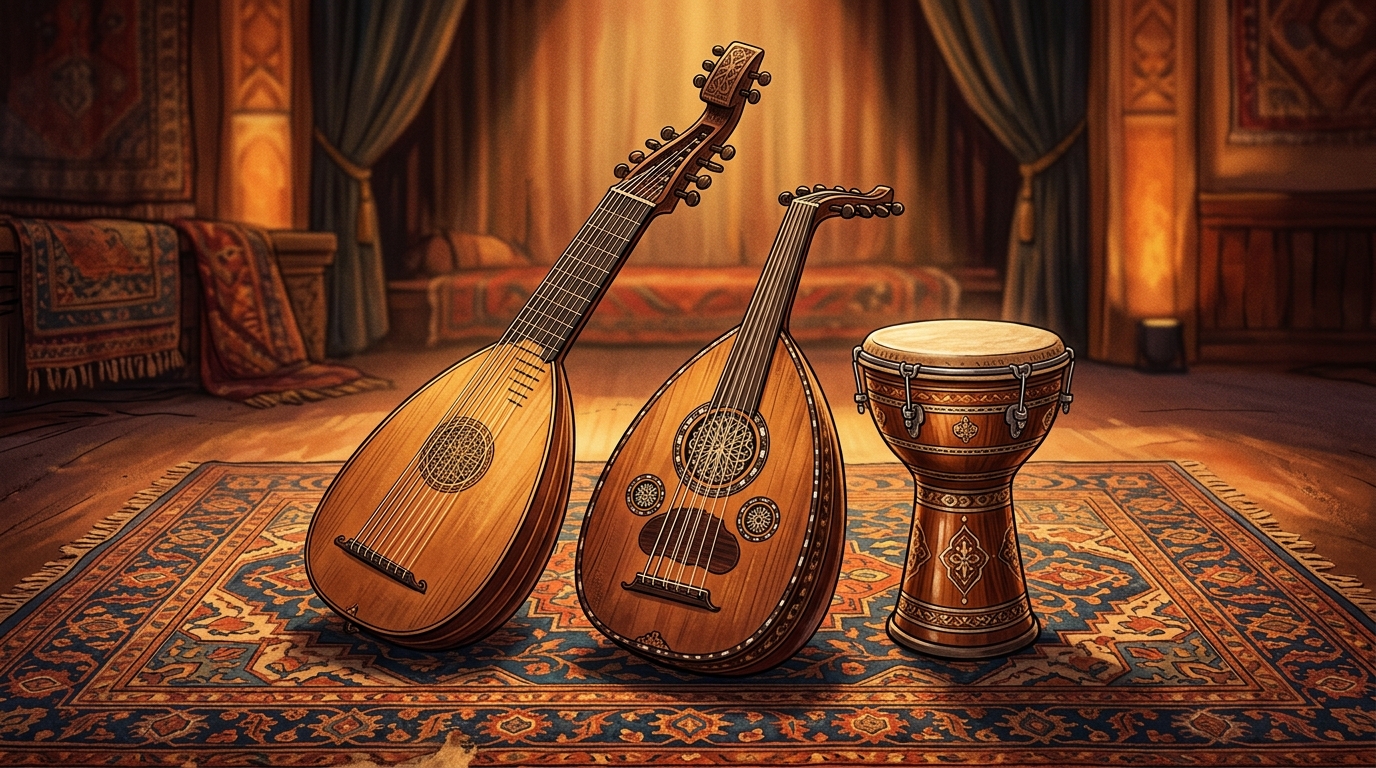
Three musics, one country
Morocco's musical map is unusually layered because of who has passed through, settled, or been brought to the country over the centuries: Amazigh (Berber) communities native to the land, Arab dynasties arriving from the east, Muslims and Jews expelled from Spain after 1492, and enslaved sub-Saharan Africans marched north across the Sahara from as early as the 11th century, in flows that intensified during the 15th and 16th centuries. Each left a distinct musical fingerprint, and three of those fingerprints — Gnaoua, Chaabi and Andalusian Al-Ala — remain the country's most instantly recognizable.
They are not interchangeable, and Moroccans generally do not treat them as competing options for the same occasion. Andalusian music is chamber and courtly, historically patronized by urban elites in cities such as Fez and Tetouan. Chaabi is street and wedding music, blunt and immediate, built for a packed room of dancing guests. Gnaoua music is ceremonial and spiritual at its root, tied to an all-night healing ritual, even though it has also become globally famous as a festival and world-music genre. Understanding what each one is actually for is the fastest way to understand what makes it sound the way it does.
It also helps to think about who traditionally performed each style. Andalusian orchestras were, and largely still are, associations of trained musicians who apprentice for years under a maâlem or master player before joining an ensemble. Chaabi bands are working musicians hired for a night, expected to read a room and keep the energy high for hours on end. Gnaoua troupes occupy a different category still: many maâlems inherit their role within families or brotherhoods, treating the guembri less as an instrument to be studied than as an object with its own spiritual weight, blessed and passed down rather than simply bought and played.
Gnaoua: trance music with sub-Saharan roots
Gnaoua (also spelled Gnawa) traces its origins to West and sub-Saharan African peoples brought to Morocco through the trans-Saharan slave trade, with communities tracing ancestry to regions covering modern Mali, Senegal, Guinea and further south. Their descendants preserved and transformed a set of spiritual practices into a distinct Moroccan tradition, one now recognized internationally: UNESCO inscribed Gnaoua on its Representative List of the Intangible Cultural Heritage of Humanity in December 2019.
The sound is built around two instruments. The guembri (also called sintir or hajhouj) is a three-string bass lute with a wooden body covered in camel or goat skin, plucked to produce a deep, buzzing, hypnotic pulse. Over it, qraqeb — heavy iron castanets held one pair per hand — snap out fast, driving cross-rhythms. The lead musician, the maâlem (master), sings call-and-response verses while playing the guembri; a moqadma (a female ritual guide, sometimes called a shuwafa or clairvoyant) manages incense, colors and offerings.
The full ceremonial context is the lila, also called derdeba: an all-night ritual invoking a set of spirits (mluk), each associated with a specific color, incense and rhythm, intended to guide participants into trance (jedba) for healing. Outside that ritual context, Gnaoua has become a major public genre too, anchored by the Gnaoua World Music Festival in the Atlantic port city of Essaouira, held annually since 1998 and now drawing several hundred thousand visitors, where troupes led by maâlems such as Hamid El Kasri and the late Mahmoud Guinia (1951-2015) have shared stages with jazz, blues and rock musicians.

Chaabi: the people's music of streets and weddings
Chaabi means, literally, "of the people," and that is exactly its role: it is Morocco's mainstream popular folk music, the genre that dominates weddings, street festivals, cafés and family celebrations across the country. It crystallized in urban centers like Casablanca and Rabat from the 1930s through the 1940s, when café orchestras and wedding bands began fusing several existing traditions — Andalusian modal melody, sung poetry known as malhun, rural aita vocal styles from the plains, and Amazigh festive rhythms — into something danceable and immediate.
A typical Chaabi lineup centers on a lead singer backed by bendir frame drums, derbouka goblet drums, violin and often an oud, with call-and-response choruses that invite the whole room to sing along. It is built to work in a crowd: verses are direct, rhythms are propulsive, and a good Chaabi band can keep a wedding hall dancing for hours.
In the late 1960s, a Casablanca group called Nass El Ghiwane transformed Chaabi from party music into something that could also carry social and political weight. Founded in 1969, drawing on Gnaoua trance rhythms and the Sufi poetry of Abderrahman El Majdoub, and introducing instruments like the banjo into the mix, Nass El Ghiwane became — in filmmaker Martin Scorsese's words — "the Rolling Stones of Africa," and inspired a wave of similarly styled groups including Jil Jilala and Lemchaheb. That lineage shows how elastic Chaabi is: equally at home as pure wedding entertainment or as a vehicle for protest song.

Andalusian classical music (Al-Ala): the inheritance of Muslim Spain
The most formal of the three traditions has the deepest historical roots. Andalusian classical music developed in Muslim Iberia (al-Andalus) between the 8th and 15th centuries, with the 9th-century court musician Ziryab — active under Emir Abd al-Rahman II in Córdoba — often credited as a founding figure. When the Reconquista pushed Muslims and Sephardi Jews out of Córdoba, Seville, Valencia and Granada, they carried this music south across the Strait of Gibraltar, where it took new root in Moroccan cities, above all Fez and Tetouan.
In Morocco the secular instrumental repertoire is called al-Āla ("the instrument"), while a related devotional a cappella style is called al-samâ wa-l-madîh. Both are organized around the nuba (nawba), a suite form structured in a fixed sequence of rhythmic movements. Where the tradition is said to have once included two dozen nubas, one for each hour of the day, Morocco has preserved eleven complete suites, drawing on some twenty-six distinct musical modes across them. Ensembles typically combine oud, rebab (a bowed spike fiddle), violin, qanun (zither), darbouka and tar, with voice soloists carrying the melodic lines.
Fez's Andalusian orchestra tradition was defined for much of the 20th century by Haj Abdelkrim Raïs (1912-1996), a rebab virtuoso who took over the city's Arabo-Andalusian orchestra in 1946 and led it for roughly five decades, later naming it al-Brihi in tribute to his own teacher. Tetouan maintains a parallel orchestral lineage. Together, the two cities are still considered the twin capitals of Moroccan Andalusian music, though ensembles also perform in Rabat, Meknes, Chefchaouen and Tangier.

Where the three meet: modern Moroccan fusion
None of these traditions stayed sealed off from the others, and today's Moroccan popular music is largely a story of remixing all three. Chaabi itself was born partly from Andalusian melodic material fused with rural and Gnaoua elements, so the crossover is baked into its DNA. Nass El Ghiwane's trance-inflected Chaabi already leaned on Gnaoua rhythm decades ago, and that habit has only deepened since.
Marrakech hip-hop group Fnaire, formed in 2001, built its signature sound by layering rap over Gnaoua grooves, Chaabi vocal styles and local Marrakchi folk percussion such as dakka — a fusion that helped carry them to national prominence, including the royal Ouissam Alaouite honor in 2013. Rock and reggae band Hoba Hoba Spirit, formed in Casablanca in 1998, mixes gnaoua bass patterns and rock guitar in the opposite direction. Meanwhile Andalusian ornamentation continues to surface in mainstream Moroccan pop vocals and in orchestral collaborations abroad, such as the Montreal-based Orchestre Andalou, which has performed Moroccan Andalusian repertoire internationally since the late 1990s.
The result is a musical culture where a single festival lineup — Mawazine in Rabat, for instance, or the Essaouira Gnaoua festival itself — can move from a strict, centuries-old nuba to a wedding-ready Chaabi set to a Gnaoua-rap fusion act within the same weekend, without any of it feeling like a contradiction. That layering, rather than any one genre alone, is what people usually mean when they talk about the sound of Morocco.
For a newcomer, the easiest entry point is usually Chaabi, because it is everywhere and immediately danceable. Gnaoua rewards patience: a full lila unfolds over many hours and builds trance gradually rather than delivering an instant hook. Andalusian Al-Ala asks the most of a listener unfamiliar with its modal system, but it is also the tradition most directly linked, through Ziryab and the courts of al-Andalus, to more than a thousand years of continuous history — a lineage few musical traditions anywhere can claim.
Frequently asked
What is the main difference between Gnaoua, Chaabi and Andalusian music?
Gnaoua is spiritual trance music with sub-Saharan African roots, centered on the guembri lute and qraqeb castanets and tied to overnight healing ceremonies called lila. Chaabi is Morocco's mainstream popular folk music, played at weddings and street celebrations. Andalusian music (Al-Ala) is a formal classical tradition inherited from Muslim Spain, performed by seated orchestras of oud, rebab and violin.
Which of the three is the oldest?
Andalusian classical music has the deepest documented roots, developing in Muslim Iberia between the 8th and 15th centuries before being carried to Morocco after the Reconquista. Gnaoua's core practices trace to sub-Saharan communities brought to Morocco mainly from the 15th and 16th centuries onward. Chaabi is the youngest of the three as a distinct genre, crystallizing in its modern urban form in the 1930s-40s.
What instruments define Gnaoua music?
The guembri (also called sintir or hajhouj), a three-string bass lute covered in animal skin, and the qraqeb, heavy iron castanets played in pairs, are the two defining instruments. Ceremonies also use large tbel drums.
What is a lila or derdeba?
A lila, also called derdeba, is an all-night Gnaoua ceremony led by a maâlem (master musician) and a moqadma (ritual guide), invoking a set of spirits through specific colors, incense and rhythms to guide participants into a healing trance state known as jedba.
What is Al-Ala in Moroccan music?
Al-Ala is the Moroccan term for the secular instrumental form of Andalusian classical music, organized into suites called nuba. Morocco has preserved eleven complete nubas out of a tradition said to have once numbered two dozen.
Who was Haj Abdelkrim Raïs?
Haj Abdelkrim Raïs (1912-1996) was a leading rebab player who led the Andalusian orchestra of Fez from 1946 for roughly five decades, later naming the ensemble al-Brihi in honor of his own teacher. He is considered one of the towering figures of 20th-century Moroccan Andalusian music.
Why is Chaabi played at Moroccan weddings?
Chaabi developed specifically as danceable, crowd-engaging music for public and communal occasions, with call-and-response choruses, driving percussion and lyrics built for group participation, making it the default soundtrack for Moroccan wedding celebrations.
How did Nass El Ghiwane change Chaabi music?
Formed in Casablanca in 1969, Nass El Ghiwane infused Chaabi with Gnaoua trance rhythms, Sufi poetry and new instruments like the banjo, turning popular music into a vehicle for social commentary. Filmmaker Martin Scorsese later called them "the Rolling Stones of Africa," and they directly inspired groups like Jil Jilala.
Is Gnaoua music recognized internationally?
Yes. UNESCO inscribed Gnaoua on its Representative List of the Intangible Cultural Heritage of Humanity in December 2019. It is also celebrated annually at the Gnaoua World Music Festival in Essaouira, held since 1998.
How do modern Moroccan artists blend all three traditions?
Groups like Fnaire (Gnaoua, Chaabi and Marrakchi dakka rhythms fused with rap) and Hoba Hoba Spirit (Gnaoua bass lines fused with rock and reggae) show how contemporary Moroccan pop routinely layers elements from all three traditions rather than treating them as separate lanes.
- Wikipedia — Gnawa music ↗
- Wikipedia — Chaabi (Morocco) ↗
- Wikipedia — Andalusi classical music ↗
- UNESCO — Gnawa, Intangible Cultural Heritage of Humanity ↗
- Wikipedia — Nass El Ghiwane ↗
- Wikipedia — Abdelkrim Rais ↗
Video via official YouTube embeds; photos via Wikimedia Commons under their stated licenses. All rights belong to the respective owners; 212 Daily claims no ownership.